Avoid £75 Per Hour Detention: Live Unload Times UK Warehouses Must Meet

Live unloads are usually expected to finish within a typical free time window of one to two hours from the driver checking in. Finish within that free time and the delivery costs exactly what you quoted; overrun it and you’re into detention, billed hourly by the carrier. The single action that protects your margin is confirming the agreed free time in writing and pre-booking a dock slot before the truck leaves the port.
TL;DR:
- Confirming the free time in writing and pre-booking a dock slot can prevent detention charges and protect profit margins.
- UK carriers charge around 75 pounds per hour for detention after free time, with rates varying depending on carrier and cargo type.
- Slower unloads often result from paperwork delays, insufficient equipment, security checks, or dock congestion, not the unloading itself.
- Accurate timestamping of key events and real-time communication tools are crucial for reducing disputes and streamlining live unloads.
- Delays at the dock impact driver hours and regulatory compliance, increasing liability risks for warehouses if not properly managed.
Table of Contents
- What is a live unload and what counts as normal live unload times?
- Waiting time charges: how detention works and typical UK rates
- Should you choose live unload or drop-and-hook?
- How should warehouses prepare to hit target live-unload times?
- Which metrics and controls actually reduce waiting and disputes?
- How Jhaulage applies these standards across UK container haulage
- How do live unload times affect driver hours and Working Time Regulations?
- How much do live unload times vary by industry?
- What technology actually streamlines communication during a live unload?
- What should drivers actually do during a live unload?
- What are the legal risks around live unload delays?
- Practical closing perspective for UK logistics managers
- Sources
What is a live unload and what counts as normal live unload times?
A live unload happens when the driver waits with the trailer or container while your team empties it, rather than dropping the unit and collecting it later. The clock starts the moment the vehicle checks in at the gate, and it runs until the last pallet or item comes off.
UK haulage practice generally follows two free-time bands: around one hour for LTL (less than truckload) consignments and around two hours for FTL/drayage and container deliveries, according to FreightAmigo’s industry guidance. A well-run yard can strip a palletised 40ft container inside that window without much drama, a target Armstrong’s operational guidance treats as realistic when resources are booked in advance. Loose, mixed, or non-standard cargo is a different story entirely. Hand-stacked goods, oversized items, or floor-loaded units routinely take several hours, sometimes stretching into a full shift.
What actually eats the clock is rarely the unloading itself. The usual culprits are:
- Missing or incorrect paperwork that holds up gate clearance
- Too few forklifts or pallet jacks for the volume arriving
- Security or customs checks triggered on arrival
- Peak-hour congestion at the dock, especially mid-morning and late afternoon
Timestamp everything. Gate-in time, dock assignment time, and unload-complete time should all sit in your TMS or a driver-signed log, because that record is what settles any dispute over free time later.
Waiting time charges: how detention works and typical UK rates
Detention starts the moment your free time expires, and carriers typically prorate the charge by the hour rather than rounding to a half-day rate. This is where a slow unload stops being an operational headache and starts becoming a line item you have to explain to finance.
A useful UK benchmark: Hapag-Lloyd’s published carrier haulage waiting-time notice sets the rate at £75 per hour or part thereof once the initial loading or unloading allowance runs out. Rates vary by carrier and lane, but that figure gives you a realistic order of magnitude for budgeting. Broader industry reporting from FreightAmigo suggests detention and lumper fees both sit within wide ranges depending on the site and cargo type, so always confirm current rates with your carrier rather than assuming last year’s notice still applies.
Beyond straight detention, watch for:
- Lumper fees, charged when a third-party crew is brought in to unload
- Administrative surcharges applied when disputes drag on past an agreed resolution window
If you want to contest a charge, you need evidence, not opinion. Keep appointment confirmations, gate-in and gate-out scans, and driver-signed logs on every delivery. FreightAmigo’s guidance on unload efficiency points to gate timestamps and driver logs as the single most persuasive evidence when a detention invoice is challenged.
Should you choose live unload or drop-and-hook?
Neither method wins in every situation. The right call depends on how quickly the receiving site can turn the cargo around and how much yard capacity you’re working with.
- Choose live unload when the cargo is palletised, quick to handle, time-sensitive, or needs a documented chain of custody for high-value or high-security goods. Live unload also suits sites without spare yard space to store a dropped trailer.
- Choose drop-and-hook when the cargo is loose, awkward, or slow to unload, or when driver productivity matters more than a slightly higher demurrage risk on the trailer itself. Drop-and-hook removes the driver’s wait time entirely, which matters on tight rosters.
- Weigh the trade-offs before booking. Live unload carries detention risk if the dock is slow; drop-and-hook carries equipment dwell costs if the trailer sits longer than expected. Contract clauses should state clearly who arranges lumpers and who pays for delays at each stage, since ambiguity here is what causes most billing disputes.
- Record the decision in the booking. Whichever method you pick, put it in the carrier instructions and the TMS record, not just a phone call. A verbal agreement is worthless when an invoice lands three weeks later.
How should warehouses prepare to hit target live-unload times?
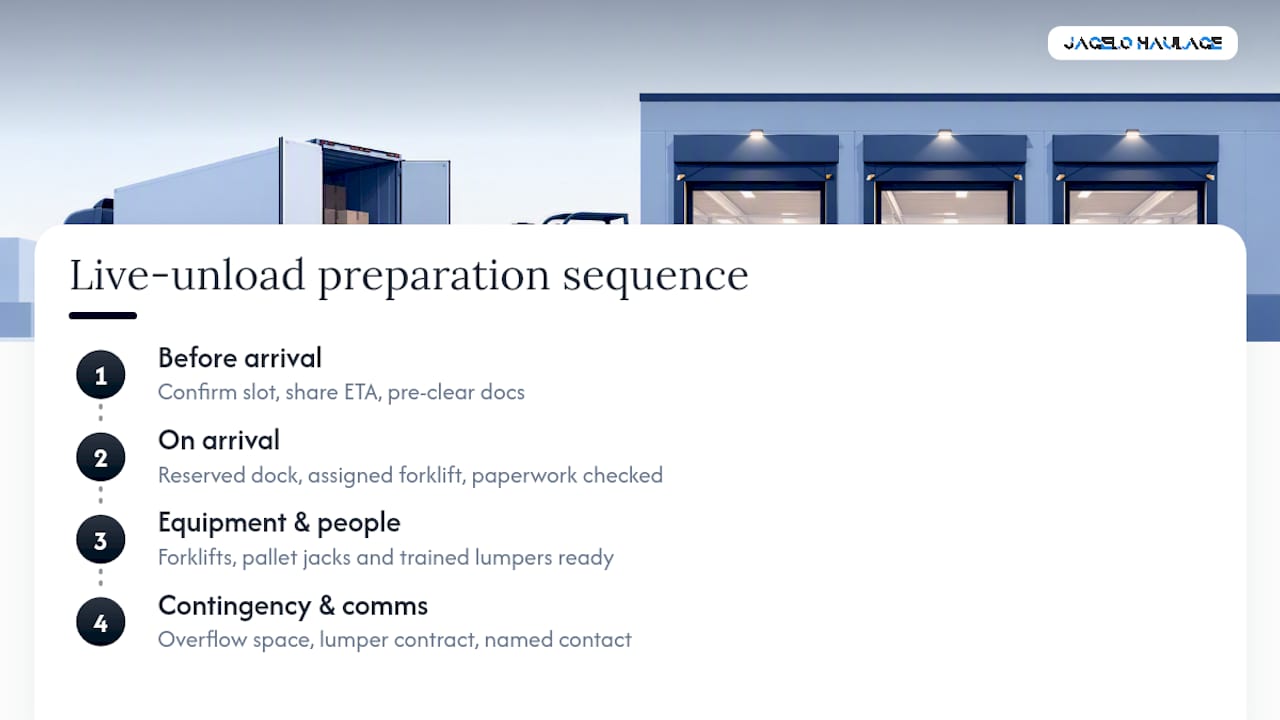
Hitting a 1–2 hour window isn’t luck. It’s the result of a sequence that starts well before the truck arrives.
Before arrival: confirm the delivery slot in your TMS, share a realistic ETA with the driver or carrier, and pre-clear any documentation or site access permissions the driver will need at the gate. Our own guide to booking a container delivery slot covers the practical steps for locking in a dock window that both sides can actually keep.
On arrival: the dock should already be reserved, a forklift operator assigned, and paperwork checked before the driver clocks in. A quick health and safety brief at this stage prevents delays later, not during the unload itself.
Equipment and people: forklifts, pallet jacks, and trained lumpers need to be available on demand, particularly during peak shipping weeks when several deliveries land close together.
Contingency planning matters too. Keep overflow space earmarked for unexpected volume, have a lumper contract you can activate at short notice, and agree a communication protocol for when something goes wrong mid-unload.
Pro Tip: Assign one named contact as the single point of communication with the driver during the unload. Splitting that role across several staff is one of the most common reasons free time quietly slips away.
Which metrics and controls actually reduce waiting and disputes?
You can’t manage what you don’t measure, and detention disputes are much easier to win when you’ve been tracking performance all along.
- Track the right KPIs: average unload time, the percentage of unloads completed within free time, detention incidents per 1,000 deliveries, and driver turnaround time. These four numbers tell you where the problem sits, whether it’s a specific site, a specific shift, or a specific cargo type.
- Capture evidence as standard practice, not as an afterthought when a dispute arises. Gate-in and gate-out scans, driver mobile logs, and time-stamped photos should sit in your TMS audit trail automatically.
- Build process controls around appointment windows. Staggered arrivals prevent the pile-up that turns a 90-minute unload into a three-hour wait, and real-time driver ETA sharing lets your dock team adjust staffing before the truck shows up.
- Set a billing review workflow. Reconcile detention invoices routinely rather than in batches, name a single owner for disputes, and agree an escalation timescale so charges don’t sit unresolved for months.
Our guide on haulage lead times goes deeper into how lead-time planning feeds directly into these numbers.
How Jhaulage applies these standards across UK container haulage
We run these principles operationally, not just as advice on a page. Jhaulage’s fleet of 40-plus tracked trucks and trailers gives real-time GPS visibility across the ports we cover, including Felixstowe, Tilbury, Southampton, and Liverpool, so receiving sites get accurate ETAs instead of guesswork.
That visibility is what actually reduces live-unload risk. Dedicated port slots mean fewer surprise arrivals stacking up at your dock, and on-call crews mean a delayed vessel doesn’t cascade into a missed appointment window three steps down the chain. Our coverage of container haulage across major UK ports and preparing containers for port delivery expands on how port-specific handling and lead times interact with your own dock schedule.
If you’re planning time-critical or oversized container movements and want scheduling built around your dock’s actual capacity, get in touch with Jhaulage about bespoke port-to-door arrangements.
How do live unload times affect driver hours and Working Time Regulations?
A slow live unload doesn’t just cost you in detention fees. It eats directly into the driver’s legal working day, and that has knock-on effects for your whole schedule.
UK Working Time Regulations for mobile workers cap drivers at 60 hours in a single week, with average hours not exceeding 48 across a reference period, typically 17 weeks. Driving time is generally limited to 9 hours a day, extendable to 10 twice weekly, and a driver must take a 45 minute break after 4.5 hours behind the wheel. Waiting time at a dock counts as working time even when the driver isn’t driving, and that matters because a 3 hour live unload instead of the expected 1.5 can push a driver close to their daily limit before they’ve even left the site.
The practical consequence for warehouses is straightforward: every hour a driver waits at your dock is an hour taken out of their remaining legal driving time for that day. A delayed unload on the first drop of a multi-stop route can force a carrier to swap drivers, reroute the remaining deliveries, or delay them to the next day entirely. That’s a cost that rarely appears on the detention invoice but shows up in missed delivery windows further down your supply chain.
Building slack into schedules for known slow sites, and flagging likely delays to the carrier before the driver sets off, protects both the driver’s hours and your delivery commitments.
How much do live unload times vary by industry?
Free time and typical durations shift considerably depending on what’s inside the container, and treating every delivery the same way is where a lot of scheduling goes wrong.
Retail and FMCG deliveries on standard pallets tend to move fastest, often clearing within the standard 1–2 hour window because the goods are uniform and dock teams handle the same SKUs daily. Food and beverage deliveries can take longer even when palletised, since temperature checks and quality inspections add time before the forklift even starts moving.
Construction materials, machinery parts, and other oversized or irregular cargo routinely blow past the standard free time. These loads often need specialist handling equipment that isn’t always on standby, and floor-loaded or non-palletised freight can turn a 2 hour allowance into a half-day job. Hazardous goods deliveries add another layer, since safety checks and documentation verification happen before unloading can even begin, regardless of how quickly the physical cargo could otherwise move.
Retail distribution centres handling high volumes typically negotiate tighter free-time terms precisely because their cargo unloads fast and predictably. Sites that regularly receive awkward or mixed cargo are usually better served negotiating longer free time upfront rather than absorbing detention charges on every delivery. Knowing which category your regular freight falls into should shape what you negotiate into the contract, not what you discover after the first invoice.
What technology actually streamlines communication during a live unload?
The biggest source of wasted time during a live unload usually isn’t the physical work. It’s the gap between what’s happening at the dock and what the driver, the carrier, and the warehouse office each think is happening.
A transport management system with live appointment slots and automated ETA sharing closes much of that gap before the truck even arrives, letting dock staff plan forklift and lumper availability around a real arrival window rather than a rough estimate. Real-time GPS tracking, already standard across a fleet like Jhaulage’s, gives the receiving site visibility of exactly where the container is and how much notice they have to prepare the dock.
During the unload itself, a single-point digital communication channel between the driver and the dock supervisor prevents the confusion that happens when three different staff members are giving a driver three different instructions. Digital proof-of-delivery tools that timestamp gate-in, dock assignment, and unload completion automatically remove the need for manual logs, and that timestamped record is exactly what you need if a detention charge is ever disputed.
Workflow automation tools built specifically for haulage, such as Logivo’s appointment and workflow platform, can integrate appointment booking with driver communication so the whole sequence, from booking to gate-in to unload sign-off, sits in one system rather than scattered across phone calls and spreadsheets. For sites juggling multiple carriers and dock slots daily, that consolidation is often what turns an unpredictable yard into a genuinely reliable one.
What should drivers actually do during a live unload?
A driver’s behaviour during a live unload directly affects how quickly the free-time clock gets satisfied, and a few simple habits make a measurable difference.
On arrival, the driver should check in immediately at the gate or with the designated dock contact rather than waiting to be approached, since that check-in time is usually what starts the free-time clock officially. Keeping all delivery paperwork, including the delivery note, seal numbers, and any customs documentation, ready and accessible avoids the common delay of a driver searching the cab while a forklift operator waits idle.
During the unload, the driver should stay with the vehicle or within immediate reach, since many sites require a driver signature or presence check at various stages of the process. Noting down the actual unload start and finish times, ideally with a photo of the dock clock or a timestamped note, gives the driver their own independent record if a dispute over detention charges arises later.
If the unload is running long, the driver should flag it to their transport office as soon as it becomes clear the free-time window will be missed, rather than waiting until the vehicle finally leaves. Early notice gives the carrier time to start the detention conversation with the customer while the delay is still fresh and documented, rather than reconstructing events days later from memory.
What are the legal risks around live unload delays?
Live unload delays create liability questions that go beyond the detention invoice itself, and it’s worth understanding where the exposure actually sits.
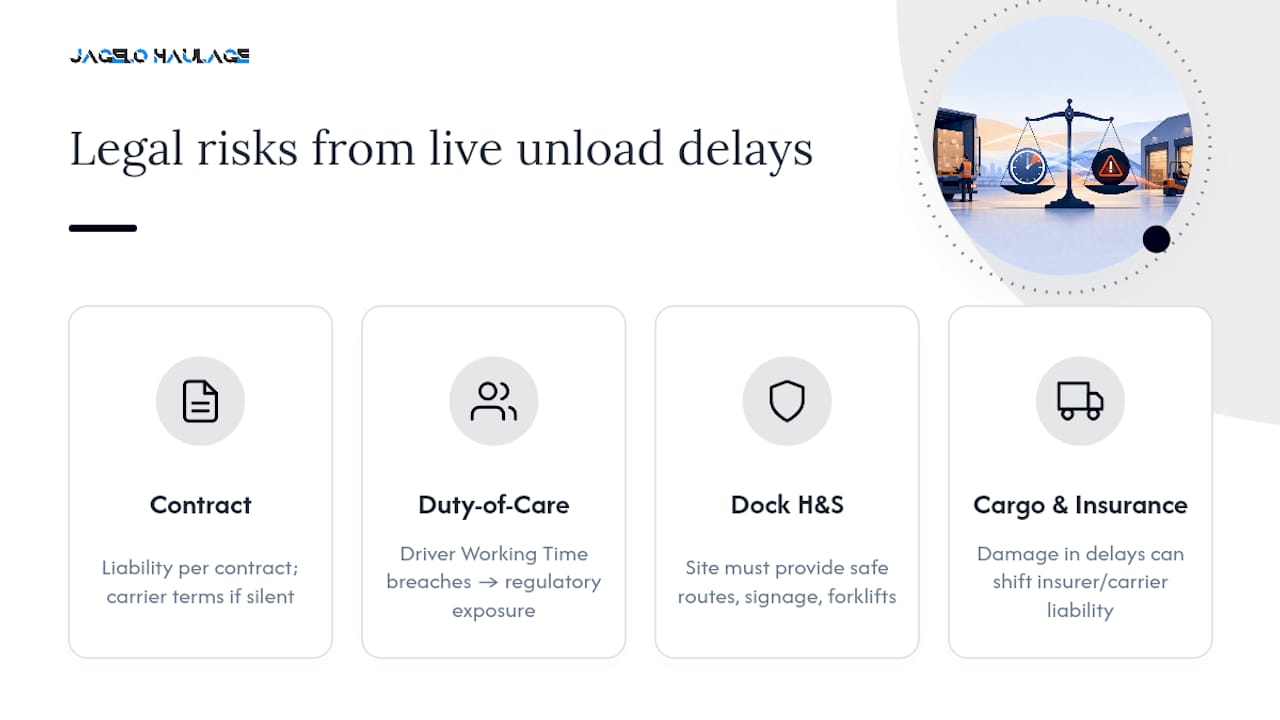
Contractually, the party responsible for detention charges depends entirely on what the service agreement says. If free time and hourly rates aren’t explicitly written into the contract, disputes over who pays tend to drag on, and the carrier’s standard terms usually apply by default, which may not favour the receiving site. This is precisely why clear contract clauses defining free time, hourly rates, and who arranges lumpers matter more than most operators realise until the first serious dispute lands.
There’s also a duty-of-care dimension. If a warehouse’s slow processes cause a driver to exceed safe working hours or push them into a compliance breach under the Working Time Regulations, that exposes both the carrier and, potentially, the receiving business to regulatory scrutiny. Health and safety obligations at the dock itself carry separate liability too. Sites must ensure safe working conditions for visiting drivers, covering everything from safe pedestrian routes to appropriate signage around forklift operations.
Insurance and cargo liability can also shift depending on how a delay unfolds. If cargo is damaged during an extended unload because of rushed handling under time pressure, or because it sat exposed to weather during a prolonged wait, liability can become contested between the carrier, the site, and the insurer. Written appointment confirmations, gate timestamps, and driver logs aren’t just useful for detention disputes. They’re the record that determines who was responsible when something goes wrong.
Practical closing perspective for UK logistics managers
Most detention disputes I’ve seen argued out aren’t really about the hourly rate. They’re about the absence of a clean, timestamped record that either side can point to with confidence. That’s the gap worth closing first, before you worry about renegotiating rates or investing in new kit.
Three things matter more than anything else here. Keep to slot discipline and capture evidence on every delivery, not just the ones that go wrong, because you never know in advance which one will end in a dispute. Make free time and charge rates explicit in every service agreement rather than assuming everyone shares the same understanding of “reasonable”. And invest in an appointment system with a handful of visible KPIs, because delays that nobody measures are delays that nobody ever actually fixes.
— Vytautas
Sources
- Gov
- United Kingdom - Carriers Haulage Waiting Time (Hapag-Lloyd)
- Live Unload explained — FreightAmigo
- Everything you need to know about live unloading — Armstrong