Haulage lead time explained for UK logistics professionals

Haulage lead time is defined as the total elapsed duration from the moment a transport request is initiated to the point of final delivery, encompassing every stage between those two events. This is the industry’s standard metric for end-to-end logistics planning, and it extends well beyond what most professionals think of as transit time. Total lead time can vary from as few as 5 days to more than 25 days, depending on process complexity, port dwell, and multimodal transfers. For UK logistics professionals managing container shipping schedules through ports such as Felixstowe, Tilbury, Southampton, and Liverpool, understanding what is haulage lead time is the foundation of accurate supply chain planning.
What components make up haulage lead time in logistics?
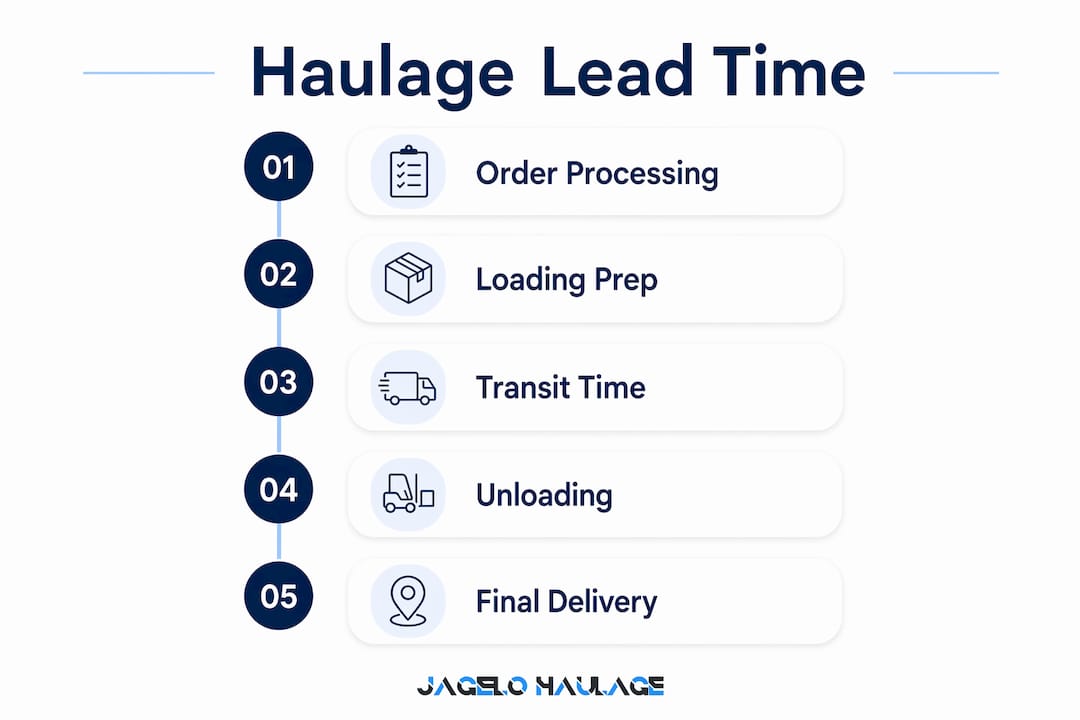
Haulage lead time is the sum of every distinct operational phase between order placement and confirmed delivery. The lead time formula breaks this down as: order processing time, plus procurement or preparation time, plus transit time, plus receiving and unloading time. Neglecting the “order to ship” phase alone introduces significant inventory errors, particularly in container logistics where pre-departure processes are lengthy.
The four core components work as follows:
- Order processing and documentation. This covers the time required to raise a transport order, confirm container availability, complete customs declarations, and obtain port release. At busy UK ports, this phase alone can span 24 to 72 hours.
- Loading and yard operations. Container de-hire, yard positioning, and Vehicle Booking System (VBS) slot allocation all contribute here. Delays at this stage frequently cascade into missed departure windows.
- Transit time. This is the actual driving or movement time between origin and destination. For domestic ground transport, transit typically spans 2 to 5 days. Port-to-inland import containers can face 14 to 30 or more days post-vessel discharge when dwell time is included.
- Unloading and receiving. Confirmation of delivery, container return, and goods-in processing at the consignee’s facility close the lead time clock.
Understanding UK port logistics best practices helps logistics teams identify which of these phases is consuming the most time in their specific operation.
Pro Tip: Map your last ten shipments against each of these four components separately. You will almost certainly find that one phase, usually documentation or yard operations, accounts for a disproportionate share of total elapsed time.

How does haulage lead time differ from transit time?
Transit time measures only the period during which a vehicle or vessel is physically in motion. Haulage lead time is the broader metric, capturing every phase including the non-driving activities that bookend and interrupt that movement. Non-transit activities such as document processing, terminal waits, and yard dwell can account for a significant share of total door-to-door time, often underestimated in planning.
The practical difference matters enormously for scheduling accuracy. A logistics planner who quotes transit time to a customer is giving an incomplete figure. The customer receives goods based on total lead time, not transit time alone.
| Metric | What it measures | Typical UK range | Planning use |
|---|---|---|---|
| Transit time | Vehicle or vessel in motion only | 1–5 days (domestic ground) | Carrier scheduling |
| Haulage lead time | All phases, order to delivery | 5–25+ days (container imports) | Inventory and delivery commitments |
| Port dwell time | Container sitting at terminal | Variable, often 2–7 days | Demurrage risk management |
Treating transit time as a proxy for total lead time produces systematic under-stocking and missed delivery commitments. The distinction is not academic. It directly affects safety stock calculations, customer service levels, and demurrage exposure.
What factors influence haulage lead time?
Lead time in logistics is not fixed. Lead time variability and consistency are the critical metrics that drive cost and service outcomes, not the average figure alone. Several categories of factors drive that variability.
Administrative and documentation delays are the most commonly underestimated source of extended lead times. Incomplete customs entries, late container release notices, and missing proof-of-delivery documents each add hours or days to the total elapsed time.
Port dwell and modal transfers add unpredictable time at the boundary between sea freight and road haulage. Container congestion at Felixstowe or Southampton can hold a box in the terminal for several days beyond the vessel’s arrival date.
Carrier versus merchant haulage responsibility shapes who controls the lead time clock. Carrier haulage places scheduling control with the shipping line, which means the consignee has limited visibility and reduced ability to intervene when delays occur. Merchant haulage assigns that control and risk directly to the consignee, who appoints their own road haulier and manages port collection independently. Merchant haulage generally gives logistics professionals greater control over total lead time, at the cost of greater operational responsibility.
Lead time variability compounds these factors. Calculating both the mean and standard deviation of cumulative lead times across a shipment history gives a statistically sound basis for setting safety stock levels. A consistent 12-day lead time is far easier to plan around than an average of 12 days with a standard deviation of 5 days.
Key factors to monitor and manage:
- Container release and customs clearance speed
- VBS slot availability at the port of discharge
- Road network conditions and driver availability
- Accuracy and completeness of shipping documentation
- Whether carrier or merchant haulage terms apply to each shipment
Pro Tip: Request lead time data broken down by phase from your haulage provider, not just total elapsed time. Granular data reveals where the bottlenecks actually sit, which is rarely where you expect.
How can UK logistics professionals optimise haulage lead time?
Reducing administrative delays such as paperwork processing and container de-hire produces greater lead time reductions than increasing truck speed. This is the central insight that separates high-performing UK logistics operations from average ones. Speed on the road is already close to its physical and regulatory ceiling. Process efficiency is not.
Practical optimisation methods for UK container operations include:
- Pre-clearing customs documentation before vessel arrival to eliminate port-side delays. HMRC’s Customs Declaration Service allows advance submission, which cuts release time materially.
- Booking VBS slots in advance at ports such as Felixstowe and Southampton to avoid queuing delays that can add a full working day to collection time.
- Integrating real-time GPS tracking with your transport management system. GPS tracking and integrated software collapse the gap between planned and actual lead times by giving planners live visibility to act on delays before they compound.
- Building realistic lead time buffers based on historical standard deviation, not optimistic averages. A buffer sized to the 90th percentile of your actual lead time distribution protects service levels without excessive stock holding.
- Collaborating directly with port authorities and haulage providers on scheduling. Early communication about vessel arrival windows and collection priorities reduces reactive scrambling.
Effective route planning and optimisation also contributes to tighter lead time control, particularly for multi-drop container deliveries across the UK’s motorway network.
The role of haulage in supply chain efficiency extends beyond moving boxes. A well-managed haulage operation functions as a data source, feeding lead time actuals back into inventory planning systems and improving forecast accuracy over time.
Key takeaways
Haulage lead time is the complete elapsed time from transport request to final delivery, and managing its variability, not just its average, is the defining discipline of effective UK container logistics.
| Point | Details |
|---|---|
| Lead time vs transit time | Haulage lead time includes all non-driving phases; transit time measures movement only. |
| Formula for accuracy | Total lead time equals order processing, plus preparation, plus transit, plus unloading time. |
| Variability is the real risk | Calculate mean and standard deviation of lead times to set accurate safety stock levels. |
| Process beats speed | Reducing documentation and yard delays cuts more time than increasing vehicle speed. |
| Technology closes the gap | Real-time GPS tracking and integrated systems reduce the difference between planned and actual lead times. |
Why lead time precision is the competitive edge most UK operators overlook
The logistics industry spends considerable energy debating transit times, fleet capacity, and fuel costs. In my experience working with container haulage operations across UK ports, the single most undervalued metric is lead time variability. Operators who know their average lead time feel informed. Operators who know their standard deviation are actually in control.
The shift from carrier haulage to merchant haulage terms is one of the most consequential decisions a logistics manager can make, yet it is often treated as a procurement detail rather than a planning decision. Taking on merchant haulage responsibility means accepting accountability for every phase of the lead time clock. That accountability, managed well, becomes a genuine advantage. You control the VBS booking, the haulier selection, and the documentation timeline. You are no longer waiting for a shipping line’s subcontracted driver to appear.
The other pitfall I see repeatedly is treating lead time as a fixed input to planning rather than a distribution. A single bad week at Felixstowe can push a 10-day average to 18 days. If your safety stock was sized for 10 days, you are already in trouble before the delay is even confirmed. Build your buffers on the 85th or 90th percentile of your actual lead time history, and you will absorb most disruptions without touching your service level commitments.
Technology has made this analysis accessible. Integrated transport management systems and GPS tracking give you the raw data. The discipline is in using it consistently rather than reverting to rule-of-thumb estimates when things get busy.
— Vytautas
Jhaulage: container haulage expertise built for UK lead time demands
Jhaulage operates a fleet of over 40 GPS-tracked trucks and trailers across the UK’s major container ports, including Felixstowe, Tilbury, Southampton, and Liverpool. Every movement is monitored in real time, giving you the visibility needed to manage lead times with confidence rather than guesswork. Jhaulage provides 24/7 support, advance port slot coordination, and full container load services designed to reduce the administrative and operational delays that extend total lead time. For logistics professionals who need a container haulage partner that treats lead time precision as a core deliverable, Jhaulage is the specialist to contact.
FAQ
What is haulage lead time in simple terms?
Haulage lead time is the total time from raising a transport request to confirmed delivery, covering order processing, loading, transit, and unloading. It is always longer than transit time alone.
How do you calculate haulage lead time?
Add order processing time, preparation and loading time, transit time, and unloading or receiving time together. The sum of all four phases gives the total haulage lead time for a shipment.
What is a typical haulage lead time for UK container imports?
Domestic ground transport typically takes 2 to 5 days, while port-to-inland import containers can take 14 to 30 or more days post-vessel discharge when port dwell and administrative processing are included.
Why does haulage lead time vary so much between shipments?
Lead time variability stems from documentation delays, port congestion, VBS slot availability, and whether carrier or merchant haulage terms apply. Managing variability requires tracking both the average and standard deviation of lead times across shipments.
What is the fastest way to reduce haulage lead time?
Reducing administrative delays, particularly customs pre-clearance and container de-hire processing, produces the largest time savings. Increasing vehicle speed has minimal impact compared to eliminating process bottlenecks.
Recommended
- Haulage for Shipping Lines: A Comprehensive Guide to UK Port Logistics | Jagelo Haulage
- Jagelo Haulage Blog | Container Haulage News & Insights
- Road Haulage for Containers: A Professional Guide to UK Port Logistics | Jagelo Haulage
- A Comprehensive Guide to Merchant Haulage: How to Organise Efficient UK Container Transport | Jagelo Haulage