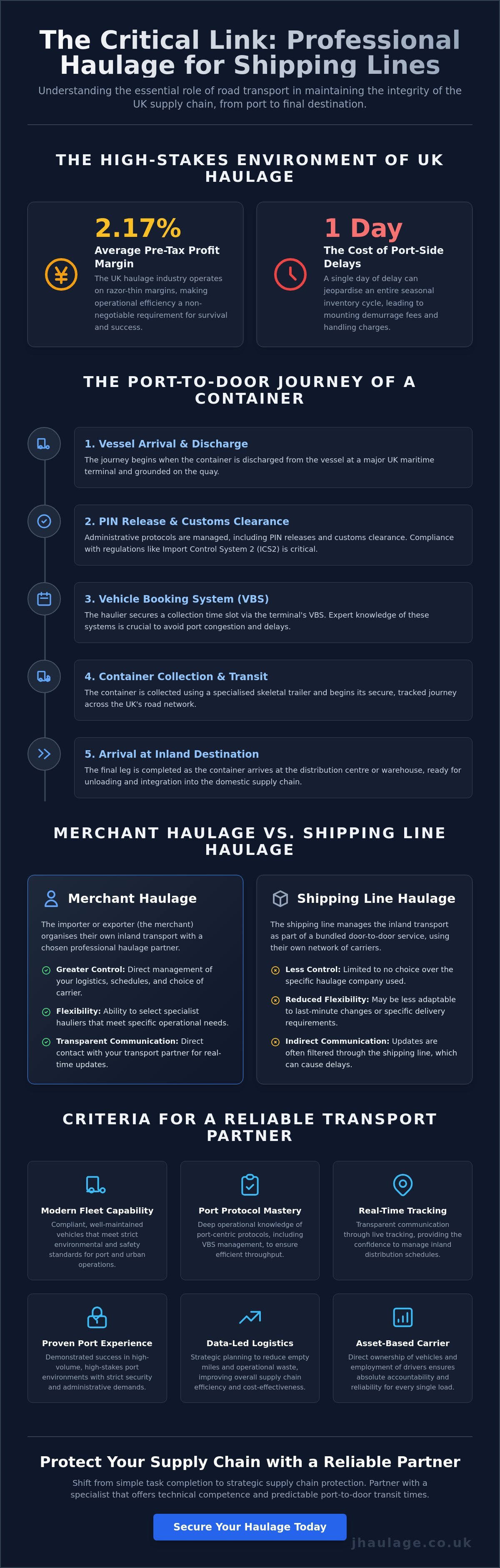
A single day of port-side delay can compromise an entire seasonal inventory cycle. With the average pre-tax profit margin in the haulage industry sitting at just 2.17 per cent, there's no room for operational friction or inconsistent fleet availability. You know that securing reliable haulage for shipping lines is the only way to protect your cargo from mounting demurrage fees and terminal handling charges. It's a high-stakes environment where technical competence and strict adherence to port-centric protocols are the minimum requirements for success.
This guide explains how professional haulage for shipping lines maintains the integrity of the UK supply chain. You'll learn how to identify a national transport partner that offers transparent communication and predictable port-to-door transit times. We'll also examine the impact of current regulatory shifts, including the Import Control System 2 (ICS2) and updated terminal fees, to ensure your logistics strategy remains robust and cost-effective.
Key Takeaways
- Understand how road transport serves as the critical final link in maritime logistics to maintain global trade continuity.
- Differentiate between merchant and professional haulage for shipping lines to determine which model best suits your operational control requirements.
- Learn to manage the administrative lifecycle of a container, including PIN releases and customs clearance protocols, to avoid port-side delays.
- Identify the essential criteria for a reliable transport partner, focusing on fleet capability and proven experience in high-volume port environments.
- Discover how data-led logistics strategies reduce empty miles and operational waste to improve overall supply chain efficiency.
Defining Haulage for Shipping Lines and Its Role in Global Trade
When Defining Haulage for Shipping Lines, we must view it as the operational bridge between maritime trade and inland commerce. It is the critical final leg of the intermodal journey. Without efficient road transport, the UK's massive container throughput would remain static at the terminal. This sector moves millions of tonnes of goods annually, supporting nearly every aspect of the national economy. Professional haulage for shipping lines ensures that the efficiency gained at sea isn't lost during the transition to the road network.
The relationship between shipping lines, freight forwarders, and road transport providers is built on functional reliability. Each party depends on the other to maintain the flow of goods across the supply chain. Asset-based carriers offer a level of security that digital broker platforms can't replicate. By owning the vehicles and employing the drivers directly, a carrier maintains absolute accountability for every load. A partnership with a specialist such as Jagelo Haulage provides the technical competence required to manage these high-stakes operations. It shifts the focus from simple task completion to strategic supply chain protection.
The Vital Link in the Intermodal Chain
Road transport bridges the gap between deep-sea vessels and inland distribution centres. Success in this segment requires precise synchronisation with vessel discharge schedules. If a truck isn't available when a container is grounded, the entire supply chain experiences friction. Maintaining this integrity requires professional container handling and the use of specialised skeletal trailers. It's about ensuring the cargo moves from the quay to the warehouse door without unnecessary interruption.
Why Professional Standards Matter at the Port
Major UK maritime hubs operate under strict security and administrative protocols that demand disciplined compliance. Carriers must navigate these complexities daily to ensure efficient throughput. Most terminals utilise a Vehicle Booking System (VBS) to regulate traffic and manage port congestion. A haulier without deep operational knowledge of these systems will struggle to secure the necessary time slots. Specialised knowledge of port-centric protocols is non-negotiable for carriers who wish to provide a protected outcome for their clients. Professional haulage for shipping lines demands a mastery of these fundamentals to prevent operational waste and secure the national supply chain.
How Port-to-Door Logistics Operates Across the United Kingdom
Understanding How Port-to-Door Logistics Operates requires a focus on operational synchronisation. Once a container arrives at a UK terminal, the focus shifts to minimising "dwell time." Efficient haulage for shipping lines bridges the gap between the vessel's arrival and the customer's warehouse. This process involves managing an administrative burden that includes PIN releases and customs clearance protocols. Any shipment docking at an EU port or transiting through the UK must now comply with Import Control System 2 (ICS2) requirements, making data accuracy more critical than ever.
Reliability also depends on the physical equipment used. Modern fleets must meet strict environmental and safety standards to operate within UK ports and urban centres. For example, a 44-tonne vehicle now incurs a combined VED and HGV Levy of £1177 as of April 2025. Carriers who invest in compliant, well-maintained vehicles provide more than just transport; they offer a protected outcome that safeguards the client's reputation. Real-time tracking has moved from a premium feature to a functional necessity. It provides the transparency needed to manage inland distribution schedules with confidence.
The Step-by-Step Journey of a Shipping Container
The lifecycle begins with vessel arrival and container discharge at a maritime terminal. Once the container is grounded and cleared by customs, the carrier initiates the booking process via the Vehicle Booking System (VBS). This system regulates traffic to prevent terminal congestion. The haulier then collects the unit and begins secure transit across the national road network. Each stage requires disciplined coordination to ensure the container reaches its inland destination within the agreed window.
Managing Logistics to Avoid Port Demurrage
Delays in container collection lead to port demurrage fees, which can quickly erode profit margins. With revised Terminal Handling Charges (THC) for 2026 reaching up to £310 for refrigerated units, proactive scheduling is a financial imperative. Professional carriers use advanced planning to ensure units are moved before storage charges accrue. For urgent cargo, same-day delivery options provide a strategic advantage in maintaining lean inventory levels. If you require a partner that understands these time-sensitive pressures, you can request a bespoke logistical assessment to secure your throughput.
Merchant Haulage vs Shipping Line Haulage: Understanding the Key Differences
The distinction between carrier-controlled and merchant-controlled transport is a fundamental decision for any logistics manager. Providing professional haulage for shipping lines requires an understanding of both booking models. Shipping Line Haulage involves the carrier arranging the inland transport as part of a single freight rate. This model offers a streamlined administrative process but can limit the cargo owner's control over specific delivery windows. Conversely, Merchant Haulage allows the cargo owner or their freight forwarder to take full control of the road transport leg. By choosing this route, businesses can select a dedicated partner like Jagelo Haulage to ensure their specific operational standards are met.
Official UK road freight statistics indicate that road transport remains the dominant mode for moving goods from maritime hubs to inland destinations. In this high-volume environment, the reliability of haulage for shipping lines becomes a significant competitive factor. Whilst shipping lines handle the maritime leg with expertise, their inland transport solutions may lack the granular flexibility required for complex warehouse schedules. Jagelo Haulage supports both models with equal operational discipline, providing the same high standards of safety and punctuality whether the booking is made by a carrier or a merchant.
When to Opt for Shipping Line Haulage
This model is often preferred for its simplicity. Booking a "one-stop-shop" solution reduces the number of invoices and administrative touchpoints. It's particularly suitable for high-volume, standardised cargo movements where specific delivery windows are less critical. However, logistics managers should be aware that carrier-controlled transport may face prioritisation issues during peak maritime seasons. This can lead to increased dwell times at the port if the shipping line's preferred carriers are over-capacity.
The Strategic Advantages of Merchant Haulage
Merchant haulage offers direct control over the supply chain. You choose the carrier, dictate the schedule, and maintain a direct line of communication with the transport office. This transparency is vital for managing tight production schedules or limited warehouse space. Building a relationship with a dedicated transport partner ensures that your specific protocols are followed every time. For those considering this shift, reading about Outsourced Container Haulage: Dispelling Myths for UK Logistics Managers can provide further clarity on the benefits of taking control of your inland logistics.
Essential Requirements for a Reliable Container Haulage Partner
Selecting a partner for haulage for shipping lines requires a rigorous evaluation of their operational fundamentals. In a sector where profit margins are notoriously lean, a single failure in the communication chain can have significant financial consequences. Reliability is built on a foundation of technical competence and a disciplined approach to fleet management. A carrier must provide comprehensive insurance coverage, typically adhering to the Road Haulage Association (RHA) standard liability of £1,300 per tonne; they should also maintain the capacity to handle high-value cargo with additional protection. This level of professional security ensures that your cargo remains protected throughout the inland leg of its journey.
Proven experience in managing large-scale port logistics is another critical requirement. The ability to navigate the administrative complexities of major UK terminals is what prevents unnecessary delays and demurrage. A reliable carrier understands that their role isn't just to move a box; it's to act as a strategic extension of your own supply chain. This requires a commitment to punctuality and a deep understanding of the high stakes involved in maritime logistics. By prioritising performance over self-promotion, a seasoned professional provides the stability needed to manage consistent throughput year-round.
The Importance of an Asset-Based Fleet
Investing in an asset-based fleet is a strategic decision that separates professional carriers from digital brokers. When a company owns its vehicles, it maintains absolute control over maintenance schedules and driver training. This ownership allows for a prompt response to emergency requirements that subcontracted models simply cannot guarantee. By managing these resources in-house, Jagelo Haulage ensures that every vehicle meeting a container at the port quay is fit for purpose and operated by a seasoned professional. It eliminates the uncertainty associated with third-party sub-contracting and ensures that the equipment used is compliant with the latest safety standards.
Safety and Compliance in the Haulage Industry
Adherence to industry-standard safety accreditations, such as FORS, is a non-negotiable requirement for modern port logistics. These standards ensure that drivers are trained to navigate the complex environments of maritime hubs safely and efficiently. Securing cargo is a technical task that varies depending on container size and weight distribution. A disciplined carrier uses specialised skeletal trailers and high-tensile lashing equipment to maintain the safety of the load throughout the journey. For those operating through specific hubs, our guide on Reliable Container Haulage from Felixstowe: A Guide to Port Logistics offers deeper insight into terminal-specific safety protocols.
Responsive customer support and strong communication channels are the final pieces of the reliability puzzle. You need a partner who provides clear, declarative updates on transit status without being prompted. This transparency allows logistics managers to organise their warehouse staff and equipment with precision. If your current provider lacks this level of functional reliability, you can obtain a professional haulage quotation to secure a more stable partnership for your haulage for shipping lines.
Optimising Supply Chain Efficiency with Professional Haulage Solutions
Efficiency in haulage for shipping lines is achieved through the systematic removal of operational waste. It's a strategic outcome rather than a mere physical task. A disciplined carrier prioritises route optimisation to minimise "empty miles," which is a critical factor when fuel costs represent approximately one-third of total HGV running costs in the United Kingdom. Reducing these unnecessary journeys doesn't just lower expenses; it strengthens the entire supply chain by ensuring that assets are always positioned where they add the most value.
Data and reporting play a central role in this refinement process. By analysing transit times and terminal turnaround data, logistics managers can identify bottlenecks before they impact the bottom line. This level of transparency allows you to position your business as a preferred partner for global shipping lines. These entities value carriers that follow protocols strictly and provide predictable results, as this reliability reduces their own administrative burden. A stable, professionally managed transport partnership offers long-term value that far exceeds the temporary gains of a lower freight rate.
Reducing Costs Through Operational Discipline
Efficient scheduling is the most effective tool for managing the rising costs of road transport. By synchronising collections with vessel discharge, a professional haulier reduces the time vehicles spend idling at port gates. This discipline directly lowers fuel consumption and the associated carbon footprint. For a deeper analysis of the financial factors involved, see our guide on Understanding Container Transport Costs: A Comprehensive UK Buying Guide for 2026. You must also consider the hidden costs of "cheap" haulage. Choosing a provider based solely on price often leads to secondary expenses such as port storage fines, missed delivery windows, and damaged professional reputations.
Future-Proofing Your Logistics Strategy
The UK logistics sector is facing a period of rapid regulatory and environmental change. Adapting to new port regulations and clean air zone requirements is essential for maintaining uninterrupted service. Working with a partner that invests in modern fleet technology ensures that your supply chain remains compliant with evolving standards. This proactive approach to fleet management protects you from the sudden operational shifts that can disrupt less organised carriers. As HGV operating costs (excluding fuel) rose by 5.91 per cent in 2025, the value of a partner who manages these pressures through disciplined investment becomes clear.
Jagelo Haulage remains the preferred choice for national container transport because we prioritise the fundamentals of the industry. We understand that our performance at the port quay directly impacts your success at the warehouse door. Our commitment to functional reliability and technical expertise provides the security your business needs to navigate the complexities of haulage for shipping lines. By focusing on performance and results, we help you build a supply chain that is both resilient and cost-effective.
Securing Your National Port Logistics Strategy
A resilient supply chain depends on the seamless integration of maritime arrivals and road transport. As operational costs and terminal fees continue to fluctuate, the value of a disciplined carrier becomes even more apparent. Professional haulage for shipping lines ensures that your cargo moves through the port environment without unnecessary friction or administrative delay. By choosing a partner that prioritises functional reliability, you protect your business from the hidden costs of logistical inefficiency.
Jagelo Haulage offers over 15 years of industry experience and a modern fleet of 40+ trucks and trailers. We're specialists in national port-to-door logistics who understand the precise requirements of the UK's major maritime hubs. Our asset-based approach provides the security and accountability needed to maintain consistent throughput regardless of seasonal demand. Request a Professional Container Haulage Quote from Jagelo Haulage to establish a transport partnership rooted in technical competence and operational stability. We're ready to secure your inland delivery schedule.
Frequently Asked Questions
What is the difference between merchant haulage and shipping line haulage?
Merchant haulage gives the cargo owner or freight forwarder direct control over carrier selection and delivery windows. Shipping line haulage is a carrier-arranged service where the inland transport is included in the ocean freight rate. Choosing merchant haulage often allows for more granular communication and greater flexibility during peak maritime seasons.
How much notice is typically required to book container haulage from a UK port?
Booking lead times generally range between three and five working days under normal operational conditions. During peak seasons or periods of high port congestion, additional notice is required to secure specific Vehicle Booking System (VBS) slots. Early notification allows for better synchronisation with terminal discharge schedules and ensures fleet availability.
Can you provide same-day delivery for containers arriving at major ports?
Same-day container deliveries are possible when terminal discharge and customs clearance align with available collection windows. This is a specialised outcome for time-critical cargo. Our operational team assesses each request based on real-time port data to ensure the delivery window is achievable and the cargo remains secure throughout transit.
What insurance coverage is standard for shipping container transport?
Standard insurance for shipping container transport typically follows the Road Haulage Association (RHA) conditions of carriage. This provides a liability of £1,300 per tonne for the goods in transit. For cargo exceeding this value, it's recommended to arrange additional cover to maintain full financial protection throughout the inland leg of the journey.
How do you manage port delays and the Vehicle Booking System (VBS)?
We manage port delays through disciplined use of terminal-specific booking systems and real-time monitoring. Our team tracks vessel grounding times to secure the most efficient collection slots available. This proactive approach to haulage for shipping lines reduces the risk of port-side bottlenecks and helps to avoid unnecessary storage charges.
Do you operate a modern fleet that meets current environmental standards?
Our fleet consists of modern, Euro VI compliant vehicles that meet the strictest environmental standards in the United Kingdom. This ensures unrestricted access to Clean Air Zones and Low Emission Zones across major industrial hubs. Regular investment in fleet technology means our operations remain compliant with current national regulations and safety protocols.
What information do I need to provide for an accurate haulage quote?
Providing an accurate quote for haulage for shipping lines requires several key data points. You'll need to provide the container size, approximate weight, and the container number if available. We also require the specific port of arrival, the final destination postcode, and any site-specific instructions to ensure a precise logistical assessment.
Is your haulage service available for both 20ft and 40ft containers?
Our service is fully equipped to handle both 20ft and 40ft containers using specialised skeletal trailers. These vehicles are designed to transport all standard ISO units, including high cubes and refrigerated containers. This versatility allows us to support a diverse range of maritime logistics requirements across the national road network.