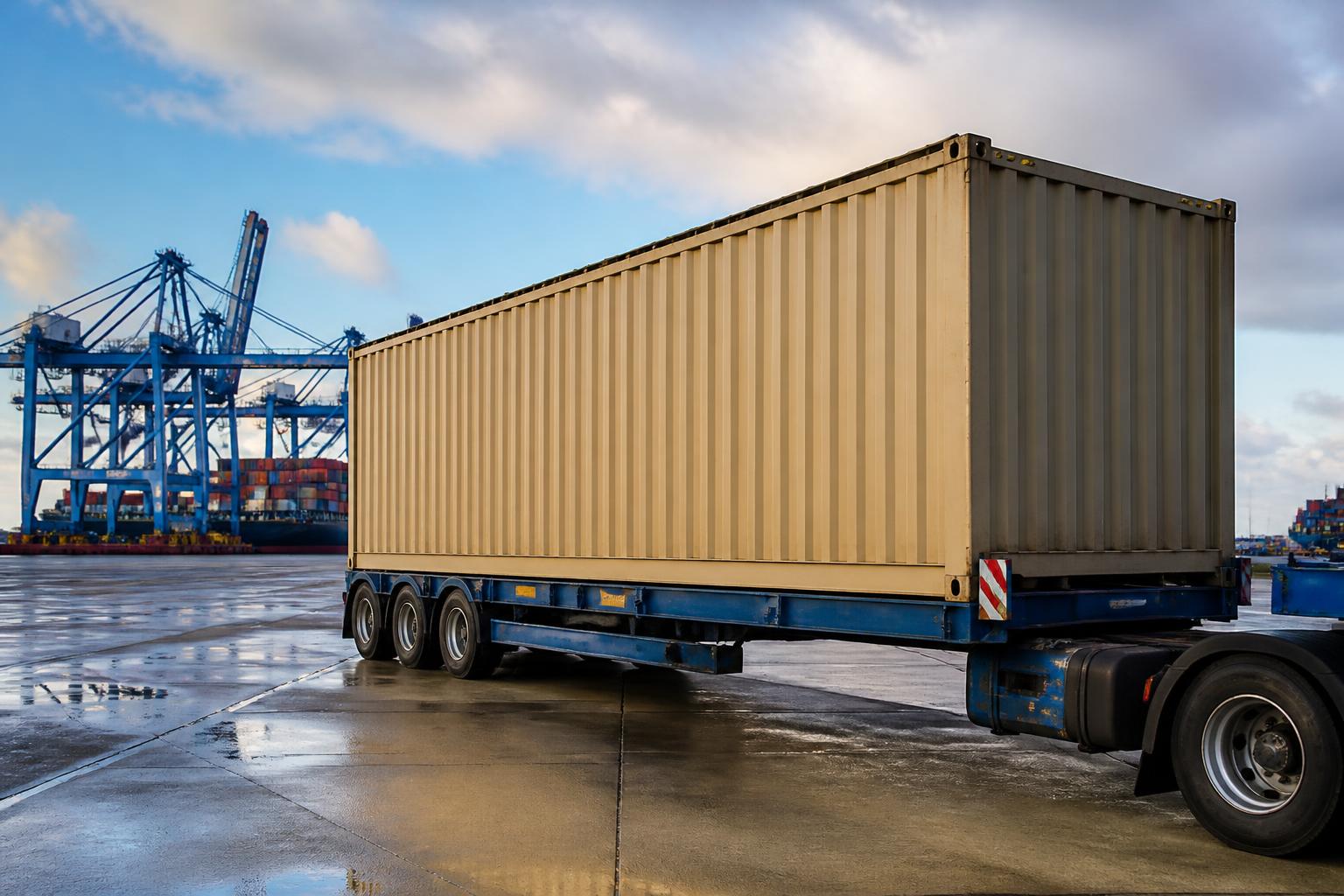
If you need to know who can move oversized containers from a UK port, the short answer is this: not every container haulier can, and not every container move that looks routine will run as standard port haulage once the actual dimensions and gross weight are checked. An oversized collection needs the right tractor and trailer combination, a haulier that understands merchant haulage at the relevant port, and proper route and booking checks before anyone takes a slot.
At Jagelo Haulage Limited, we collect containers from Felixstowe, London Gateway, Tilbury, Purfleet, Southampton and Liverpool and deliver throughout Great Britain. For oversized boxes, we first establish whether the unit can move as a normal container road move at all, or whether it needs different equipment, a different route plan, or a different handling method from the port onward. That decision is what prevents refusals at the terminal gate, failed collections, and unnecessary storage, detention or demurrage.
What counts as an oversized container move?
In UK port haulage, oversized does not only mean a container that is visibly wider or taller than normal. It can also mean a container whose weight, length, centre of gravity, or handling requirements fall outside the assumptions of a standard skeletal trailer move.
Most routine merchant haulage collections involve standard ISO containers, typically a 20ft ISO Container, 40ft ISO Container or 45ft ISO Container, moving on a normal skeletal trailer within usual road limits and terminal handling rules. If the box is within normal external dimensions, within legal road weight limits once mounted on the trailer and unit, and can be handled by the port as a routine lift, it is usually not treated as oversized.
A move starts to become oversized, or at least non-standard, when one or more of the following applies:
- the container itself is over standard external dimensions
- the load inside causes over-height, over-width or over-length issues
- the gross weight is too high for a standard road move on usual equipment
- the weight distribution is unusual
- the box needs specialist handling, escorting, timing restrictions or route planning
- the port booking cannot be made as an ordinary import collection
This can arise with certain special equipment, out of gauge units, heavily laden 20ft containers, and some cases involving a Refrigerated Container where the issue is not size alone but handling, power, timing or weight. A box can also be non-standard because the discharge terminal has specific restrictions on how it must be collected.
In practice, many enquiries about who can move oversized containers from port UK come down to one of two questions. First, is the unit legally roadable as loaded? Second, can it be collected through the normal port process, or does it need a separate operating plan?
That is why we ask for the container number, size and type, verified gross weight or shipping line gross weight data, commodity, collection port, delivery postcode and any declared over-dimensions before we confirm the move. Without that, nobody is doing more than guessing.
Who can actually collect oversized containers from port?
The right answer is a haulier that can legally operate the move, has suitable equipment available, understands the terminal process at that port, and is prepared to check the route before the collection is booked.
For UK container work, that means an operator with a valid goods vehicle operator licence, port booking capability, and drivers used to terminal procedures. In our case, we run our own vehicles and trailers on operator licence OF2023521, and where extra volume is carried by vetted partners, those moves run on the partner haulier's own operator licence.
For oversized or non-standard port collections, the haulier also needs to check:
- whether a standard skeletal trailer is suitable
- whether a slider, extendable or other specialist trailer is needed
- whether axle weights will remain legal
- whether the delivery point can accept the vehicle and trailer combination
- whether the route has bridge, width, turning or timing constraints
- whether the port will release the unit through its normal booking route
That is the difference between a general road haulier and a container operator used to merchant haulage from major UK ports. A haulier may be perfectly competent in general haulage and still be the wrong choice for a port collection if they do not work inside the terminal systems and release processes every day.
The practical checks matter more than broad claims about capability. Before we accept an oversized collection, we want to know whether the line release is in place, whether customs are clear, whether the terminal shows the unit available, and whether the dimensions and weight support the equipment plan. If any of that is uncertain, we say so early.
For some moves, the issue is not only whether the box can be collected, but whether it should be collected immediately. If a container is at risk of a wasted trip because release status is not settled, or if route restrictions mean a same day delivery cannot realistically be achieved, it is better to identify that before the slot is booked. We cover that approach in more detail in how to reduce risk on port-to-site container moves.
What needs checking before the port slot is booked?
Before any oversized or potentially oversized collection is booked, six checks should be treated as basic.
First, release. The shipping line or carrier release must be in place and usable at the terminal. If the line has not released the unit, or if there is a mismatch between release status and terminal availability, the booking may fail or the driver may be turned away. On merchant haulage jobs, we normally need the release reference and the expected free time position before proceeding.
Second, customs. The container must be customs cleared or otherwise in a collectable status for the intended movement. A box under hold, inspection or documentary query is not ready just because the vessel has discharged. This sounds obvious, but a surprising number of failed collections start with an assumption that discharge equals release.
Third, dimensions. We need the exact equipment type and any declared over-dimensions. "40ft" is not enough if the actual unit is special equipment or if the cargo projects. Even where the booking system accepts the job, the road movement may still be impossible on standard equipment.
Fourth, gross weight. This is one of the main causes of trouble on 20ft imports. A heavily loaded 20ft ISO Container can be within the shipping line's limits and still be problematic for legal road movement, depending on the actual gross weight, axle distribution, trailer type and destination route. VGM is relevant to the maritime leg, but for road planning we need the actual road movement implications, not just the fact that a VGM exists.
Fifth, route suitability. We check whether the journey can be run on a lawful, practical route from the port to the delivery point. That includes known restrictions, likely bridge issues, site access, and whether the consignee can unload the vehicle safely. A route that works for a standard 40ft ISO Container may not work for a heavier or non-standard unit.
Sixth, whether the move is truly standard container haulage. Some jobs are described as FCL collections but turn out to need specialist planning because of weight, dimensions or delivery constraints. Others are part of an LCL supply chain but still move as a full import container from quay to premises. The labels FCL and LCL help commercially, but they do not decide whether the road leg is standard. Nor do CBM figures. What matters is the physical unit and the actual movement.
Where the load is temperature controlled, timing can be just as important as dimensions. A Refrigerated Container may not be oversized, but if plug arrangements, monitoring, or depot handling are involved, the collection still needs tighter planning than an ordinary dry box. If that is your issue rather than out of gauge dimensions, our guide to moving a reefer from Felixstowe without avoidable port cost is the more relevant starting point.
How oversized collections differ by UK port
The collection process is not identical across UK ports. The broad issues are similar, but terminal systems, booking rules, release visibility and operating practices vary enough that the port matters.
At Felixstowe, slot management and terminal process are familiar territory for container operators, but that does not remove the need to check release, customs and weight before booking. Timing against free time is often critical, especially where a non-standard unit could need replanning if the first collection attempt fails.
At London Gateway, the booking flow and operational rhythm differ from Felixstowe, and the delivery plan needs to reflect that. The same applies to Tilbury and Purfleet, where local access, traffic timing and terminal arrangements can affect whether a collection can realistically be turned around as planned.
At Southampton, box status, line release and the specifics of the cargo can combine to make a straightforward-looking collection less straightforward in practice. This is particularly true where the box is not simply oversized, but also hazardous or otherwise restricted.
At Liverpool, inland routing and delivery timing often need more attention, especially for longer final mile runs into constrained consignee sites.
The booking systems themselves also differ. Some terminals use CARGOES VBS, while others use their own Container Booking System or CBS process. A booking slot is not just an administrative step. It is the point where release status, terminal availability and the transport plan have to line up. If they do not, the slot can be wasted and the job can slide into avoidable cost.
That is one reason we do not treat all ports as interchangeable. We collect regularly from Felixstowe, London Gateway, Tilbury, Purfleet, Southampton and Liverpool, and we plan against the actual port process rather than assuming a booking pattern from one terminal will apply at another. If your move is specifically landing at London Gateway, our notes on getting a container from London Gateway to warehouse without avoidable port cost explain the operational issues in more detail.
How to choose a haulier without risking delays or refusals
If you are comparing hauliers for an oversized or non-standard port collection, ask operational questions first.
Ask what equipment they will use. If the answer is vague, or if they have not asked for dimensions and gross weight, that is a warning sign. A haulier cannot confirm an oversized move properly without understanding the unit.
Ask whether they regularly handle merchant haulage from the specific port. Port work is not just driving from A to B. It involves line release, customs status, slot booking, terminal process and free time management. A haulier that mostly works on carrier haulage or general domestic loads may not be set up for the same level of control.
Ask whether the move will stay on their own fleet or be subcontracted. Subcontracting is not a problem in itself, but it should be controlled. We run 40 vehicles and 40 trailers of our own, and when we use vetted partner hauliers for additional volume, they work on their own operator licences and under the same agreed standards, including the same freight liability limit on subcontracted loads.
Ask what freight liability cover applies. Standard RHA limits are often lower than importers assume. Our freight liability is £6,500 per tonne under RHA 2024 conditions, which is five times the usual RHA standard of £1,300, and up to £10,000 per tonne is available by arrangement for high value freight. If you are moving a valuable load, that question should be settled before the box is booked out.
Ask how they handle escalation when a container is at risk. A useful haulier is one that tells you early if the box is likely to miss free time, if release is not usable, if the weight makes a standard move impossible, or if the delivery site is not suitable for the planned trailer. Silence is what creates surprise storage and demurrage.
Ask whether they understand commodity-specific requirements. For example, waste movements and animal by-product related cargoes need the correct registrations. We are an upper tier waste carrier and dealer, CBDU471791, and we are registered with APHA to carry Category 3 animal by-products, animal feed in shipping containers, quay to premises, U1433815/TRANS. If your cargo type has extra compliance requirements, the haulier should be able to state clearly whether they can carry it.
Finally, ask how they define success on the job. For us, it is not just whether the container eventually moves. It is whether the release, booking, collection and delivery are planned in a way that avoids refusals, wasted runs and preventable port cost.
Jagelo Haulage Limited was founded in 2019, and the team running the operation has worked in container haulage since 2015. Since 2019, we have moved more than 75,000 containers, around 13,000 a year. That volume matters because oversized and non-standard collections benefit from routine port experience. Problems are usually not dramatic. They are ordinary operational issues that were either checked in time or were not.
So, who can move oversized containers from a UK port? The haulier that can prove the move works before the slot is booked. That means checking release, customs, dimensions, gross weight, route, equipment and site access, then booking the terminal collection on that basis. If you need us to assess a container from Felixstowe, London Gateway, Tilbury, Purfleet, Southampton or Liverpool, we will tell you plainly whether it can run as standard haulage or needs a different plan.
Can any container haulier move an oversized container?
No. Some oversized moves still fit standard container haulage, but others need different trailers, route checks or separate planning. The haulier needs the dimensions, gross weight and port details before confirming.
Is an overweight container the same as an oversized one?
Not always. A container can be within normal dimensions but too heavy for a standard road move. Equally, it can be within weight but have out-of-gauge cargo that changes how it must be handled.
What information should I send for a quote?
Send the port, container size, gross weight, collection and delivery postcodes, shipping line, release status, customs status and any over-height, over-width or out-of-gauge details.
Can oversized containers be collected from Felixstowe?
Potentially, yes, but it depends on the unit details and whether the move can be planned within the port process. At Felixstowe, collections are booked on the Container Booking System (CBS).
Do oversized containers always need a specialist abnormal load service?
No. Some can still move as container haulage if the unit, weight and route allow it. Others fall outside normal limits and need separate assessment before a haulier can accept the job.