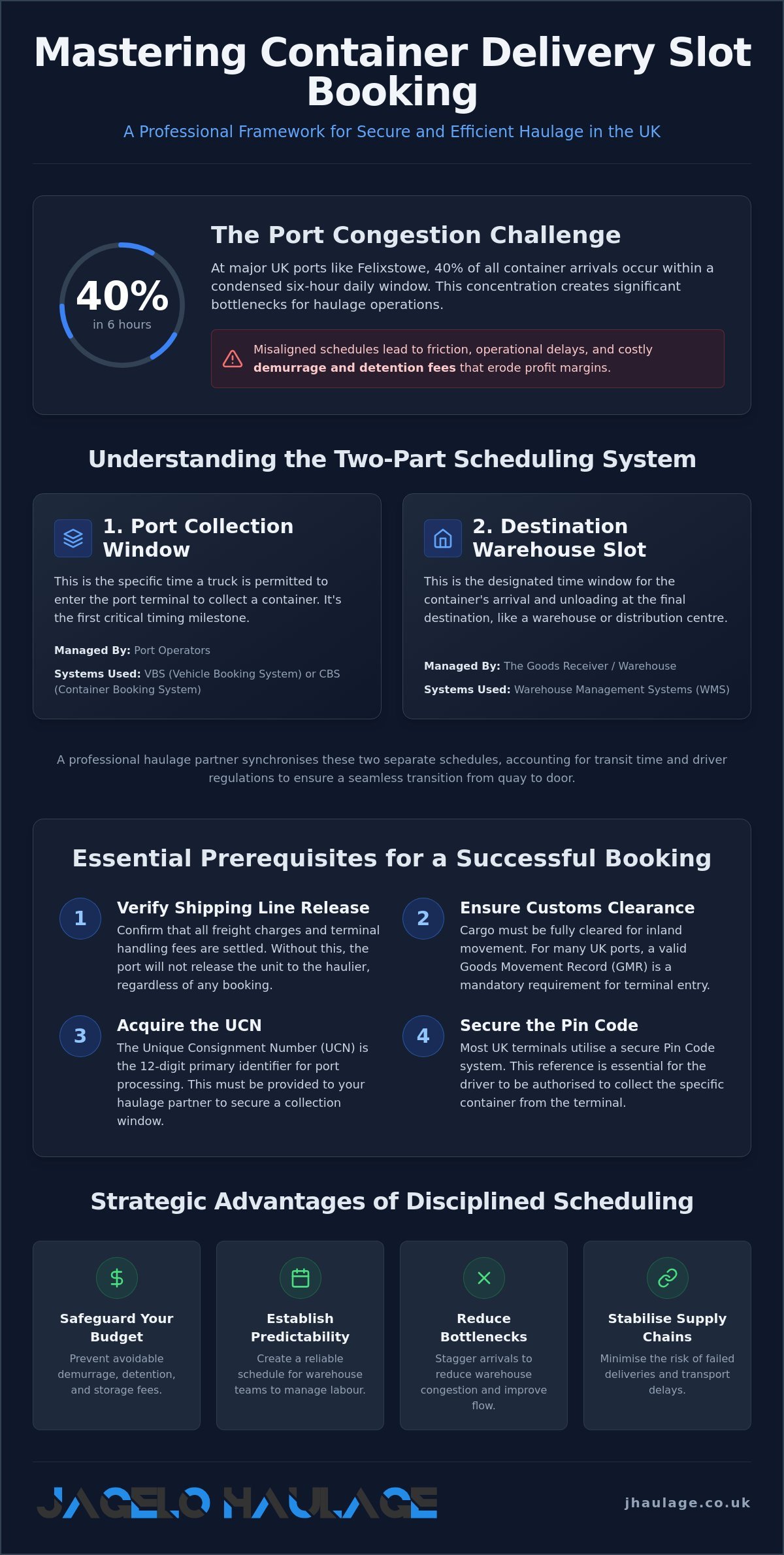
40% of all arrivals at the Port of Felixstowe terminals occur within a daily six-hour period, creating a bottleneck that can compromise even the most robust supply chains. You are likely familiar with the logistical friction caused by misaligned schedules and the resulting demurrage costs that erode your margins. Managing the delicate balance between port release and warehouse capacity requires more than just luck; it requires disciplined coordination and clear visibility across the haulage chain. Every minute of waiting time at the port adds unnecessary expense to your bottom line.
By mastering the process of booking a container delivery slot, you can eliminate avoidable storage fees and establish a predictable schedule for your warehouse teams. This article provides a professional framework for navigating the complexities of UK port logistics. We will examine the technical requirements of modern booking systems and provide a structured approach to ensuring your haulage operations remain secure, efficient, and entirely predictable from the quay to the final destination.
Key Takeaways
- Understand the critical distinction between port collection windows and destination warehouse slots to ensure a seamless transition from quay to door.
- Learn the essential prerequisites for booking a container delivery slot, including the verification of shipping line release status and the acquisition of a Unique Consignment Number.
- Navigate the complexities of modern Warehouse Management Systems to maintain predictable schedules and high operational efficiency at your discharge site.
- Identify the hidden triggers of demurrage and detention fees to implement preventative measures that safeguard your logistical budget.
- Discover how partnering with a disciplined haulage provider with extensive port expertise can stabilise your supply chain and reduce the risk of failed deliveries.
The Fundamentals of Container Delivery Scheduling in the UK
In the disciplined world of logistics, a container delivery slot is a designated time window for cargo arrival at a specific destination. It acts as the final synchronisation point between the maritime journey and the terrestrial supply chain. Whilst the concept seems simple, the execution requires a high level of coordination between port operators, haulage providers, and warehouse managers. Successful scheduling ensures that the transition from the quay to the inland site remains fluid and cost-effective.
A clear distinction exists between port collection windows and destination warehouse slots. Port collection windows, often managed through systems like the Vehicle Booking System (VBS) or the newer Container Booking System (CBS) at Felixstowe, dictate when a truck may enter the terminal to retrieve a container. In contrast, destination slots are governed by the receiver's site capacity. Professional container haulage providers must bridge these two distinct environments. They ensure the vehicle departs the port with sufficient time to meet the warehouse's specific unloading window, accounting for transit variables and driver rest requirements.
Precise scheduling is critical for maintaining supply chain velocity in 2026. As ports implement stricter Late Notification Periods and digital customs frameworks become more rigid, the margin for error has narrowed. A missed window at either end of the journey can trigger a cascade of delays. By prioritising the process of booking a container delivery slot with accuracy, businesses protect their operations from the friction of modern logistics.
Delivery Slots vs Vessel Slot Charters
Terminology in the shipping industry can often lead to confusion for those outside the operational core. Maritime "slot charters" refer to the physical space a shipping line leases on a vessel to transport containers across oceans. This is a matter of cubic capacity and weight. Ground-based delivery slots are entirely different; they represent a temporal window for road transport. Understanding The Fundamentals of Containerization reveals that whilst the container remains the constant unit, the "slot" it occupies shifts from a physical location on a ship to a scheduled moment on a warehouse calendar. Logistics managers must focus on this inland delivery window to ensure the final leg of the journey is as secure as the maritime passage.
The Impact of Scheduling on Operational Efficiency
Effective scheduling reduces warehouse congestion by staggering arrival times throughout the working day. When multiple containers arrive simultaneously without a structured plan, the result is a bottleneck that compromises site safety and operational flow. A delivery slot serves as a strategic operational anchor for warehouse management. It allows site supervisors to organise labour and equipment for unloading at the precise moment of arrival. This disciplined approach ensures that goods move quickly into inventory, whilst haulage assets are released promptly to maintain the momentum of the wider transport network.
Essential Prerequisites for Booking a Delivery Slot
Before initiating the process of booking a container delivery slot, you must ensure all administrative prerequisites are met. A premature booking often leads to gate rejections or wasted haulage assets. First, confirm the container release status with the shipping line. This verification confirms that all freight charges and terminal handling fees are settled. Without this, the port will not release the unit to the haulier, regardless of the transport schedule. You should also verify that the cargo has passed all necessary inspections, as customs holds will override any transport arrangements.
Customs clearance is equally vital. In the current regulatory environment, ensuring your cargo is cleared for inland movement is non-negotiable. Many locations are amongst the UK Ports Requiring GVMS (Goods Vehicle Movement Service), where a valid GMR (Goods Movement Record) is a mandatory requirement for entry. Additionally, you must secure the Unique Consignment Number (UCN). This 12-digit reference is the primary identifier for port processing. It must be provided to your haulage partner before they can secure a collection window.
Documentation and Reference Details
Accuracy in documentation prevents costly operational failures. Most UK terminals now utilise a Pin Code system for container collections. This secure reference acts as a digital key; if the code provided by the merchant doesn't match the port's records, the driver is refused entry. If you are moving dangerous goods, ensure all hazardous declarations are completed and submitted beforehand. Failure to declare such items accurately leads to severe penalties and significant delays at the port gate. Providing precise destination site requirements, such as vehicle height restrictions or specific gate entry protocols, is also essential for a successful arrival.
Synchronising Port VBS and Warehouse Windows
The primary challenge in UK logistics is the dual-synchronisation of the Vehicle Booking System (VBS) and the destination delivery slot. Major maritime hubs like Felixstowe and Southampton operate strict VBS protocols to manage traffic flow and reduce congestion. You must secure a VBS window that allows the driver to exit the port with enough time to reach the warehouse during its specific unloading period. Jagelo Haulage manages these dual-booking requirements by leveraging their expertise in major UK maritime hubs to align port collections with inland arrival times.
Managing these variables requires a disciplined approach to data. To ensure your cargo moves without friction, you should provide your transport partner with a complete data set at least 24 to 48 hours before the vessel arrives. If you require assistance in navigating these complex scheduling requirements, you can request a professional haulage quote to secure your supply chain velocity.
Navigating Destination Site and Warehouse Booking Systems
The final leg of the journey requires the same level of precision as the initial port collection. In 2026, the widespread adoption of automated Warehouse Management Systems (WMS) has fundamentally changed how national distribution centres operate. These systems now automatically cancel arrivals that fall outside their designated window, meaning booking a container delivery slot is no longer just a suggestion; it's a strict contractual requirement. National distribution centres (NDCs) follow rigid protocols that prioritise high-volume throughput. If a haulier misses a slot, the system might not allow a re-entry for another 24 hours, causing significant disruption to your inventory flow.
Maintaining slot integrity depends on consistent on-time performance. Warehouse teams are scheduled based on these arrivals to maximise labour efficiency and dock availability. When a container arrives early or late, it disrupts the sequence of the entire facility. This is why professional haulage partners focus on the exact synchronisation of port exit times with destination windows. To ensure the cargo moves through the terminal without friction, hauliers must understand How to Use the Goods Vehicle Movement Service. Any administrative delay at the port gate will inevitably lead to a missed warehouse slot later in the day.
Warehouse Access and Vehicle Restrictions
Logistics managers must communicate site-specific restrictions to their transport provider well in advance. Many industrial zones have strict weight limits or height clearances that prevent standard skeletal trailers from entering. Some sites also require specific equipment, such as side-loaders for ground-level delivery or low-profile trailers for older loading bays. Checking these variables is a fundamental part of booking a container delivery slot. Restricted industrial zones may also have timed access windows to reduce local traffic congestion, requiring drivers to arrive within very narrow margins to avoid local authority penalties.
Communication Protocols for Successful Arrival
Successful delivery relies on clear communication between the haulier and the site contact. Providing the driver with a direct phone number for the gatehouse or warehouse supervisor prevents unnecessary delays at the point of entry. Real-time tracking is now a standard requirement, allowing warehouse teams to monitor the vehicle's progress and adjust their labour allocation based on the latest ETA. If an unforeseen delay occurs on the motorway, the haulier must follow established procedures to reschedule the slot immediately. Jagelo Haulage prioritises this level of visibility, ensuring that both the client and the destination site are kept informed of the vehicle's status throughout the journey.
Preventing Costly Delays and Operational Failures
Logistical failures in the UK container market often stem from a lack of synchronisation between port release and destination availability. When the process of booking a container delivery slot is handled without sufficient lead time or data accuracy, the financial penalties accumulate rapidly. These costs are not merely operational inconveniences; they are significant overheads that can erode the profitability of an entire shipment. Discipline in scheduling remains the only effective defence against these avoidable charges.
Demurrage and detention represent the two primary hidden costs of poor scheduling. Demurrage is the fee charged by the terminal for containers staying on the quay beyond the agreed free period. Detention occurs when the container is kept outside the port for too long, often due to warehouse unloading delays. Both charges are billed per day and increase in severity over time. Managing these requires a strategic approach to booking a container delivery slot that prioritises containers based on their specific storage expiry dates.
Managing Port Storage and Demurrage
The free time window at major UK ports is typically limited to between three and five days after vessel discharge. Every hour counts. Logistics managers must monitor the Last Free Day (LFD) for every unit in their inventory. If a container is approaching its expiry, it must be prioritised for collection even if other units arrived earlier. This methodical approach ensures that port storage fees are kept to an absolute minimum. For a detailed breakdown of how these variables influence your total spend, see our guide on Understanding Container Transport Costs.
Mitigating the Risk of Failed Deliveries
A failed to arrive status at a national distribution centre often triggers an immediate financial penalty from the warehouse operator. To mitigate this risk, haulage partners must verify site access requirements before the truck departs the port. This includes checking for temporary roadworks or weight restrictions that could delay the vehicle. Driver hours and tachograph regulations must also be factored into every delivery plan. A driver who reaches their legal driving limit just miles from the destination will result in a missed slot. When a site cannot accept cargo, the delivery is classified as frustrated. This requires the haulier to move the container to a secure storage yard, which adds further handling and storage fees to the operation.
Maintaining a resilient supply chain requires a partner who understands these risks and implements proactive measures to avoid them. To secure your cargo and eliminate avoidable fees, you should request a haulage quote from our professional transport team.
Strategic Advantages of a Professionally Managed Haulage Partner
Achieving a seamless transition from port to door requires a haulage partner that operates with a high degree of technical competence. When booking a container delivery slot, the reliability of the transport provider is the determining factor in whether the schedule holds or fails. A professionally managed partner provides the necessary infrastructure and expertise to navigate the high stakes of the UK supply chain. This stability is vital in a market where port congestion and strict warehouse windows leave no room for error.
A modern fleet of over 40 trucks provides the operational capacity required for consistent scheduling. This scale allows a haulier to absorb minor disruptions without compromising your delivery window. Expertise in major UK maritime hubs ensures that drivers understand the specific gate protocols and terminal layouts of ports like Felixstowe, Liverpool, and London Gateway. This local knowledge reduces the risk of failed collections and ensures the container leaves the port as soon as it is released for inland movement.
Merchant haulage offers a strategic advantage by providing greater control over the delivery timeline. Unlike shipping line haulage, where the carrier dictates the transport schedule, merchant haulage allows you to choose a partner that prioritises your specific operational needs. This control is essential for synchronising arrivals with warehouse labour shifts and avoiding the storage fees discussed in previous sections. Responsive customer support further enhances this control; operational managers receive direct updates, allowing for rapid adjustments to the schedule if site conditions change.
Disciplined Logistics Management with Jagelo Haulage
Jagelo Haulage maintains a commitment to secure, professionally managed transport operations. We leverage 15 years of industry experience to navigate the complexities of digital booking systems and customs requirements. Our nationwide reach supports consistent delivery outcomes for clients across diverse industrial sectors. By positioning ourselves as a strategic partner, we ensure that the task of booking a container delivery slot remains a predictable part of your logistical framework. We follow protocols strictly to protect the integrity of your supply chain and ensure every arrival is punctual.
Securing Your Supply Chain for the Future
As the industry moves towards the regulatory changes of late 2026, the value of a disciplined partner becomes even more apparent. We provide specialised logistics for shipping containers that helps businesses prepare for the evolving demands of the UK transport network. This proactive approach ensures that your supply chain remains resilient against cost volatility and regulatory shifts. To maintain your operational velocity and ensure reliable arrival times, you can Contact Jagelo Haulage to organise your next container delivery and secure a dependable transport solution.
Optimising Your UK Container Logistics for Long-Term Stability
Successful logistics management relies on the precise synchronisation of multiple variables. You've seen how accurate documentation and a clear understanding of port systems prevent the accumulation of costly demurrage fees. By prioritising the process of booking a container delivery slot with sufficient lead time, you ensure that your warehouse operations remain fluid and your supply chain stays protected. Discipline in these fundamentals is the only way to eliminate operational friction and maintain predictable arrival times.
Jagelo Haulage provides the disciplined infrastructure required to maintain this level of performance. We utilise 15 years of specialised logistics experience and a modern fleet of over 40 trucks to manage direct operations from all major UK ports. This scale and expertise allow us to provide the reliability your cargo demands, regardless of the complexity of the route. We position ourselves as a strategic partner to ensure your goods move from the quay to the door without avoidable delays.
Request a professional container haulage quote from Jagelo Haulage to secure your delivery schedule. Maintaining a methodical approach to your transport operations will safeguard your margins and provide the long-term stability your business needs to thrive.
Frequently Asked Questions
How far in advance should I book a container delivery slot?
You should aim to secure your transport at least 48 to 72 hours before the vessel is scheduled to arrive at the port. This lead time allows your haulage partner to align the port collection window with your destination's specific availability. Booking a container delivery slot early reduces the risk of encountering fully booked windows at high-volume terminals, especially during peak periods.
What information is required to book a delivery from a UK port?
To process a booking, you must provide the container number, the 12-digit Unique Consignment Number (UCN), and the terminal release pin. You also need to specify the cargo weight and provide any necessary hazardous goods declarations. Accurate destination details, including the site contact and any vehicle restrictions, are essential for the haulier to complete the journey without rejection at the gate.
What happens if the driver misses the booked delivery window?
If a driver misses a booked window, the warehouse management system may automatically cancel the arrival. This often results in a "failed to arrive" penalty fee from the destination site and requires a complete reschedule of the delivery. In some cases, the container may need to be returned to a secure yard or "shunted" to a local depot, which incurs additional handling and storage costs.
Can I change a delivery slot once it has been confirmed?
Changes to a confirmed slot are possible but depend on the specific rules of the destination site and the current port terminal capacity. Most automated warehouse systems require at least 12 to 24 hours' notice for a reschedule to avoid late-cancellation penalties. Frequent changes disrupt the haulage chain and may affect the availability of your assigned transport assets for that day.
How does the Vehicle Booking System (VBS) affect my delivery time?
The Vehicle Booking System (VBS) dictates the exact time a truck can enter the port to collect a container. If VBS slots are limited due to terminal congestion, the haulier may be forced to collect the unit later than originally planned. This delay directly impacts the feasibility of your destination delivery window, making the synchronisation between the port and the warehouse critical for success.
What is the difference between demurrage and detention charges?
Demurrage refers to the storage fees charged by the port for containers that remain on the quay beyond the allocated free time. Detention is the charge for the extended use of the shipping line's equipment outside the port area. Both fees are billed daily and can increase significantly if the delivery cycle is not completed within the shipping line's specified "free period."
Are there specific vehicle requirements for delivering containers to warehouses?
Many warehouses have specific requirements, such as height clearances for loading bays or weight limits for the site's access roads. You must specify if the site requires a side-loader for ground-level unloading or if a standard skeletal trailer is sufficient. Providing these details during the process of booking a container delivery slot prevents equipment mismatches and ensures the driver can safely access the discharge point.
How can I track the progress of my container delivery in real-time?
Professional hauliers use GPS telematics to monitor the progress of their fleet and provide accurate ETAs to the destination warehouse. This data allows operational managers to detect potential delays on the road network before they result in a missed slot. Direct communication channels between the transport office and the site gatehouse help to manage minor transit variations and maintain the integrity of the delivery schedule.