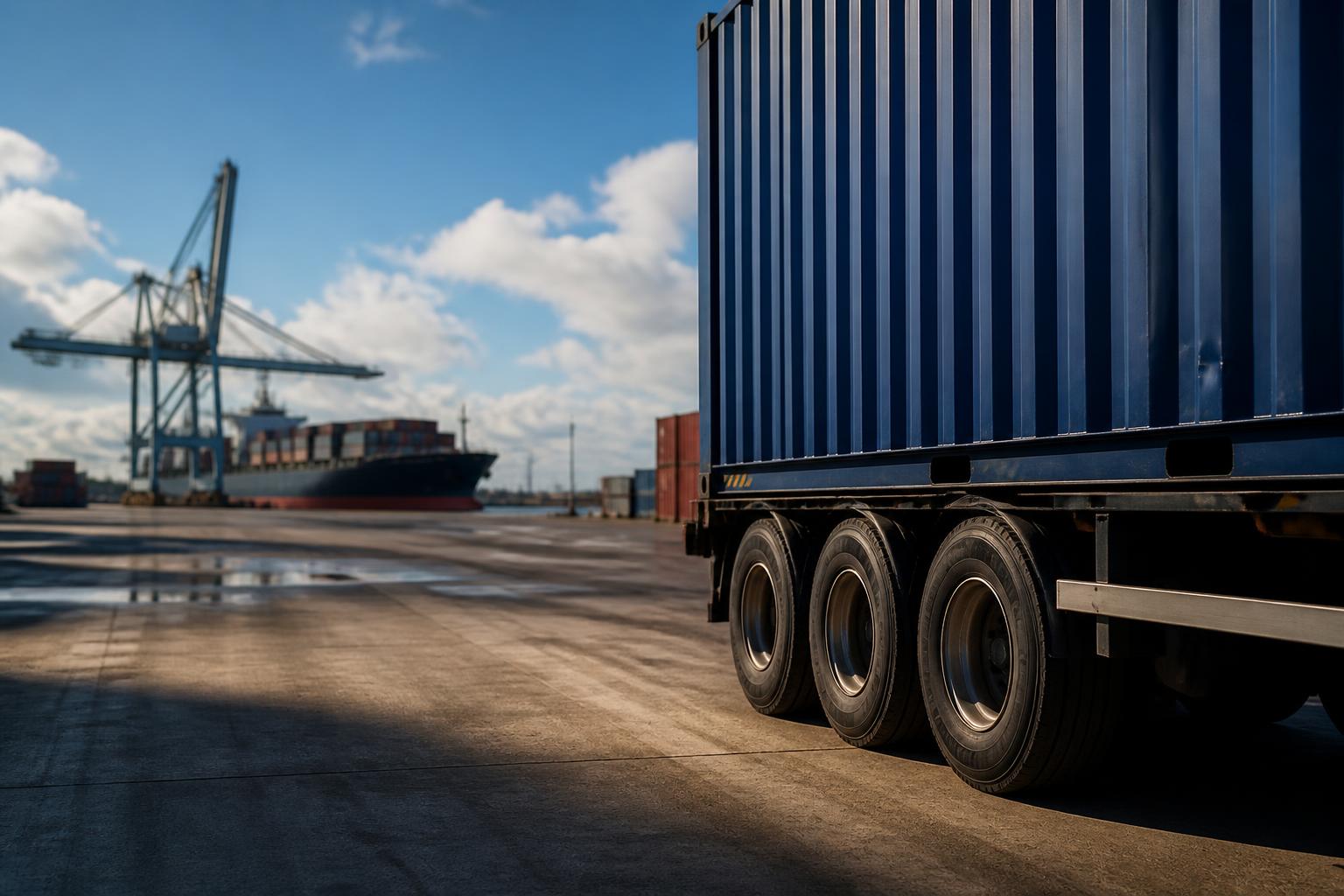
Port storage and delay are usually avoidable if the inland move is treated as part of the import plan, not as something arranged after the vessel arrives. In practice, that means getting the container release in place, checking customs status, watching free time from the shipping line, and booking the terminal slot early enough to collect before demurrage starts. Once storage is running, options narrow quickly.
That is why we handle container haulage as an operational job rather than a simple road booking. From our base near Felixstowe, we collect from Felixstowe, London Gateway, Tilbury, Purfleet, Southampton and Liverpool, and we plan around terminal systems, line terms and site constraints before the box is due out. For importers, forwarders and customs agents, that early control is what keeps a routine collection from turning into avoidable cost.
What shipping container haulage covers in practice
For UK importers and forwarders, shipping container haulage starts where the sea leg ends. The vessel discharges the unit into the port or terminal system, and the inland road move begins only when the container is available for collection and the required release and customs position allow it to leave.
That sounds straightforward, but in practice there are two separate operations. The ocean carrier is responsible for the maritime leg into the UK port. The haulier is responsible for the road movement from the terminal to the delivery point in Great Britain, or in some cases to a warehouse, devanning point, cold store, inspection facility, railhead or another approved site. Those responsibilities meet at the terminal gate, but they are not the same job.
For FCL traffic, the container itself is the unit being moved inland. We collect the full box from the port and deliver it as booked. For LCL traffic, the position can be different. An LCL shipment is usually grouped with other cargo in one container and unpacked at a deconsolidation point, so the importer may not need a full container road move at all. Sometimes a forwarder still books a container movement to an unpack facility, but often the final consignee receives palletised freight rather than the container itself.
That distinction matters because a lot of delay starts with confusion over whether the road leg is collecting an FCL import container or whether the goods are part of an LCL movement controlled elsewhere. If the shipment is LCL, the terminal collection process, release documents and delivery planning may sit with the deconsolidator or forwarder, not with the consignee expecting a full box.
In UK practice, container haulage also covers more than just turning up with a tractor unit. The haulier normally checks whether the box is released, whether the terminal needs a booking reference, whether the line’s free time is still running, whether the gross weight is suitable for the planned vehicle and route, and whether the delivery point can actually receive the container. If a container needs a specific trailer type, timed delivery, quay to premises movement for regulated goods, or additional coordination with the customs agent, that belongs in the haulage planning stage as well.
What has to be in place before a container can be collected
Before we can collect a container, several operational checks have to line up. Missing any one of them can mean a failed trip, a lost slot, or storage starting while everyone assumes the move is covered.
First is the release. The shipping line, or the line’s agent, must have issued release for the container. Depending on the line and terminal, this may be electronic release passed into the terminal system, a release reference, or a status update visible through the relevant portal. Without release, the container is not collectable even if the vessel has discharged and the box is physically in the stack.
Second is customs status. In the UK, a container may be blocked by customs formalities, documentary checks, inspection instructions or other holds that prevent outturn. A road booking does not remove a customs hold. We need to know whether the goods are cleared, whether there is an outstanding instruction from HMRC or another authority, and whether any intervention has been raised. For some cargoes there may also be APHA requirements, which is separate from general customs clearance. Where a load involves regulated products, the paperwork and movement basis need confirming before collection.
Third is terminal availability. A container can be discharged but still not be in a status that allows collection. It may be awaiting grounding, transfer, system update or release confirmation. Terminals differ in how quickly statuses update, and that affects when a slot can sensibly be booked.
Fourth is free time. Shipping lines set the period before demurrage starts, and the clock does not wait for internal handovers between importer, forwarder, warehouse and haulier. We need the last free day confirmed, not assumed. If there is any doubt over whether weekends, bank holidays or discharge day count under the line’s tariff, that needs checking at once. The UK position depends on the line’s terms and terminal process, not a single general rule.
Fifth is the booking reference needed to secure collection. At some ports that means a terminal vehicle booking under a named system. At others it may involve a line release code, import reference, PIN or separate collection authority. If the booking data is wrong, the driver arrives but the move still fails.
Finally, we need to know whether the box is FCL or linked to an LCL process, because that determines what is being collected, who controls release, and where the unit should go next. It also affects unloading arrangements and timing. A full container to a consignee site is one plan. A container to a deconsolidation point with cargo measured in CBM is another.
How port booking and free time affect the road move
Port collection is planned around two clocks. One is the terminal booking system. The other is the shipping line’s free time. If either is ignored, storage costs and delivery delay follow very quickly.
At Felixstowe, collections are planned through CARGOES VBS. At London Gateway, the relevant process is the Container Booking System, often shortened to CBS. Other ports have their own booking methods and operating patterns. The point is the same in each case, a container is not simply collected when the driver is nearby. A slot has to be available, booked correctly, and timed around driver hours, distance, site opening times and the delivery plan.
That matters because free time can expire before a workable slot appears if the booking is left too late. A line may give only a limited number of free days after discharge. If release is late, customs is unresolved, or the consignee asks for delivery after the free period, demurrage can start while the box is still in the port stack. Once that happens, the cost issue is no longer theoretical.
Good shipping container haulage avoids that by identifying risk before charges begin. If the release has not landed, if the terminal is congested, if the consignee cannot unload within the available window, or if the requested delivery date sits beyond free time, we need to say that early. That gives the importer or forwarder time to make a decision, pull the box sooner, redirect it, arrange temporary handling, or accept the charge knowingly. Leaving that conversation until after storage has started does not help anyone.
The same applies to detention after delivery, although that is a separate charge from port demurrage. If the container is delivered but cannot be turned round and returned within the line’s allowed period, detention may follow. We have covered that in more detail in our article on how detention charges build up on UK container moves.
Choosing the right equipment for the container and delivery point
The road move has to match both the container and the receiving site. That starts with the basic box type.
A 20ft ISO Container is compact, but often heavy. Dense cargo in a 20ft unit can create axle and gross weight issues long before volume is the problem. The delivery point may have enough room for the trailer but not enough hard standing for a heavily loaded unit to be positioned safely.
A 40ft ISO Container usually presents fewer weight concentration issues, but it needs more space to access, turn and unload. A 45ft ISO Container adds further length and can rule out tighter yards, older industrial estates and some retail or urban delivery points. Access restrictions that seem minor on paper can become real problems once a full length skeletal trailer is on site.
A Refrigerated Container brings another layer. The cargo may be temperature controlled, the unit may require power at the receiving end, and unloading delays can be more sensitive than with dry freight. If you are moving chilled or frozen cargo, the road booking should reflect whether the consignee is plugging in the unit, stripping it immediately, or cross-docking. We have set out the practical points separately in our guide to temperature control in a Refrigerated Container.
Site planning is as important as container type. We need to know whether the delivery point unloads from the trailer, whether it has handling equipment, whether the box must be left for tipping or live unload only, and whether there are booking times, vehicle restrictions or security rules. If the consignee assumes the driver will wait all day, but the job has been planned as a standard live tip, the problem appears after the container is already out of port.
Weight also affects route and equipment decisions. Some cargoes fit physically but still need special planning because of gross weight or load distribution. That is one reason we ask for clear cargo details up front rather than relying on a container number alone.
When merchant haulage is the better fit
For many UK importers and forwarders, merchant haulage is the better fit because it gives direct control over the inland move. The importer, freight forwarder or customs agent appoints the haulier, rather than leaving the road leg under the ocean carrier’s arrangement.
That matters in day to day operations. With merchant haulage, you can choose the collection day based on free time, warehouse readiness and customs status. You can nominate the delivery point, coordinate directly on access and unloading, and get updates from the road operator actually collecting the box. If a container is at risk of missing free time, the person planning the haulage can act on that immediately.
Carrier haulage can suit some movements, but it generally gives the importer less visibility and less control over the inland leg. The carrier decides how the move is arranged within its own network and terms. If your priority is to manage timing closely, align the road move with your own warehouse plan, or use a haulier that already knows your sites and traffic, merchant haulage is often the cleaner option.
That is why most of our work is booked directly by importers and freight forwarders. They want the road move handled by a haulier who is looking at the terminal booking, release position and delivery constraints from the start. We have also explained the division between forwarding and road haulage in our article on freight forwarding or haulage for UK container moves.
What to check when appointing a container haulier
If you are appointing a container haulier in Great Britain, start with actual operating coverage. Ask which ports they collect from regularly, not which ports they could in theory cover. We collect from Felixstowe, London Gateway, Tilbury, Purfleet, Southampton and Liverpool, and deliver across Great Britain. Regular port work matters because each terminal has its own booking rhythm, cut-offs and gate procedures.
Check the operator licence. A legitimate haulier should be able to give you its licence details. Our own licence is OF2023521. If a business cannot provide that basic information, that is a warning sign.
Check the level of freight liability, and ask what conditions apply. Standard limits are often lower than customers assume. Our freight liability cover is £6,500 per tonne under RHA 2024 conditions, with the same limit applying on subcontracted loads, and up to £10,000 per tonne available by arrangement for higher value cargo. If your goods are sensitive or high value, do not leave that question until after a claim issue arises.
Ask how subcontracting is handled. Most container operators use partner capacity at peak periods, but the important point is whether those partners are vetted, properly licensed, and managed to the same standard. Extra volume should not mean a drop in visibility or liability position.
Ask who books the terminal slot and who monitors free time. A haulier that simply waits for instructions after discharge is less useful than one that checks release, watches the last free day and flags risk early. That early warning is often the difference between a routine import and added port cost. The same principle applies on specialist traffic, including bulk and regulated movements, where planning errors become expensive quickly. We have covered that in our article on choosing a bulk container transporter without added port cost.
Finally, ask practical questions. Can they handle all common ISO containers? Can they advise on site access before the delivery fails? Do they understand customs and release blockers well enough to spot when a collection is not genuinely ready? Can they move regulated loads where approvals matter? In our case, we operate 40 vehicles and 40 trailers of our own, we are an upper tier waste carrier and dealer under CBDU471791, and we are registered with APHA to carry Category 3 animal by-products, animal feed in shipping containers, quay to premises, U1433815/TRANS.
The point is not to collect credentials for a file. It is to appoint a haulier that will protect the road move before avoidable storage and delay begin. At Jagelo Haulage Limited, that is the job we do every day.
What is shipping container haulage?
It is the road movement of a shipping container between a port and an inland delivery or collection point in Great Britain. In practice, it includes booking the terminal slot, checking release and planning around free time.
What is merchant haulage?
merchant haulage is when the importer, freight forwarder or customs agent books the road move directly with the haulier, rather than leaving inland transport under the shipping line's control.
What causes delay on container collections?
Common causes are missing release, customs holds, no terminal booking, expired free time, overweight containers, site access issues and incomplete delivery instructions. Most can be reduced by checking the file before the collection is booked.
How are Felixstowe collections booked?
At Felixstowe, collections are booked on the Container Booking System or CBS. This replaced the Vehicle Booking System, CARGOES VBS, in January 2025.
What information should I send a haulier?
Send the container number, port, delivery postcode, size and type, gross weight, release status, customs status, free time, commodity, any site restrictions and the target delivery date.
What insurance level should I check?
Check the haulier's freight liability terms and limits, including whether the same limit applies to subcontracted loads. If the cargo is high value, confirm whether a higher limit can be arranged before the move.