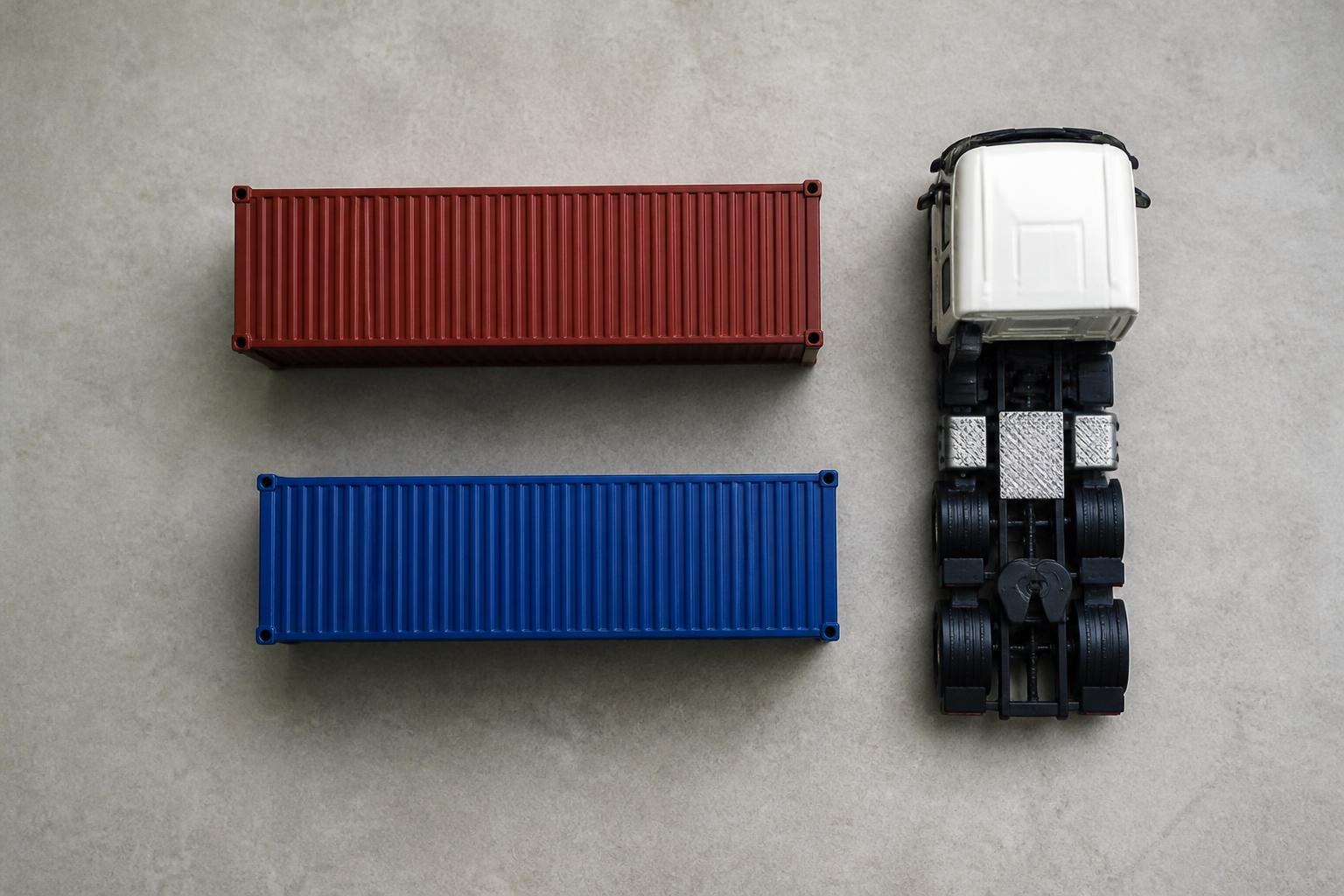
If you are choosing a Suffolk haulier for UK port container work, compare operational control before you compare the rate. A low headline price does not help if the haulier cannot secure the port slot, spot a customs hold early, or tell you in time that free time is running out. For importers and forwarders booking merchant haulage, the real question is who is actually managing the move from release to delivery, and who is only reacting when the container is already urgent.
At Jagelo Haulage Limited, we run container collections from Felixstowe, London Gateway, Tilbury, Purfleet, Southampton and Liverpool into Great Britain every week. We are based in Woolpit, Suffolk, about 35 miles from Felixstowe, and that location matters most when your traffic is East Coast led and you want a haulier that can plan collections tightly around release, customs status and port booking windows.
What importers and forwarders should compare first
The first comparison point is not the quote. It is who controls the job from start to finish.
For a typical FCL import, the key stages are straightforward on paper. The shipping line release must be in place. Customs status must allow collection. The port booking must be secured. The container must be collected within free time. Delivery must be planned around site restrictions, unloading capability and return timing. Problems usually arise where these stages sit with different parties and nobody is clearly responsible for joining them up.
When you assess a Suffolk haulier serving UK ports, ask who checks release status, who reviews customs position, who books the slot, who monitors free time, and who flags risk before demurrage or storage starts. If the answer is vague, or if every exception is pushed back to the customer without warning, you are taking on more risk than the rate suggests.
You should also compare the quality of the information flow. A useful operator gives practical updates, not generic status lines. You need to know whether the box is actually collectable, whether the booking has been secured, whether the quay is running normally, and whether delivery still fits the free time available. If a container is held, rolled, not released, or missing a valid booking, that should be identified early enough for you to act.
This is especially important where one booking desk is handling mixed traffic across multiple ports. Felixstowe, London Gateway, Tilbury, Purfleet, Southampton and Liverpool do not all work the same way. A haulier that treats every port as interchangeable will eventually miss something that costs you time.
Price still matters, of course. But it should be compared after you have looked at control, coverage, communication, liability and fleet access. We set out more on that in our guide to what actually drives haulage pricing from the ports.
Port coverage and booking systems
Port coverage is not just a list of names on a website. It means understanding how the booking systems and operating patterns differ by location.
At Felixstowe, the Container Booking System, usually shortened to CBS, is central to planning. If your haulier is collecting there regularly, they need to understand how the Container Booking System works in practice, not just in theory. Slot availability, release timing, customs status and vehicle planning all affect whether a box can be moved when expected. If a haulier blames CBS for every delay, that often means they are booking late or planning reactively.
We work Felixstowe daily, and for many Suffolk importers this is the most practical gateway. Proximity helps, but the bigger advantage is familiarity with local collection patterns and the discipline of booking against actual release and free time, not assumptions.
London Gateway has its own booking environment through CARGOES VBS. The key issue there is not only whether a slot can be obtained, but how quickly the job can be turned once release is confirmed. Late afternoon release can still be workable in some cases, but only if the haulier has vehicle availability, booking access and a realistic delivery plan. We have covered that in more detail in our explanation of same day London Gateway collection risk.
Tilbury and Purfleet need the same discipline, but with their own traffic patterns and booking pressures. Tilbury in particular can look simple until a missed or poorly timed booking pushes the move outside free time. If your cargo regularly routes there, it is worth checking how your haulier handles booking lead time, cut-off awareness and rebooking when plans change. We have written separately about how Tilbury slot booking changes collection risk.
Southampton and Liverpool are different again because they are usually chosen for network reasons rather than Suffolk proximity. A Suffolk operator can still be the right fit, but only if they genuinely plan those ports as part of normal operations rather than treating them as occasional one-offs. Ask how often they collect there, whether they use their own fleet for those routes, and how they manage onward delivery timing into Great Britain.
For importers moving mixed flows, the practical test is simple. Can the haulier collect from Felixstowe one day, London Gateway the next, and then cover Tilbury, Purfleet, Southampton or Liverpool without needing a different process each time? If not, your internal team ends up doing the coordination that the haulier should be doing.
Fleet control, overflow capacity and subcontracting
One of the biggest differences between hauliers is the balance between own fleet work and subcontracted work.
There is nothing inherently wrong with subcontracting. In container haulage, overflow support is often necessary, especially around seasonal peaks, vessel bunching, late release clusters or sudden delivery changes. The issue is whether subcontracting is controlled, visible and backed by proper standards.
We run 40 vehicles and 40 trailers of our own on operator licence OF2023521. That matters because own fleet control usually gives a clearer line between planning and execution. The planner knows what vehicles are available, what trailers are suitable, where the driver is finishing, and whether the job can realistically be done within the booking and delivery window. It also makes communication simpler when a job changes mid-flow.
Where overflow is needed, we use vetted partner hauliers operating on their own operator licences. That is a sensible model when demand exceeds planned capacity, but buyers should ask direct questions. Are partner hauliers used occasionally, or does most of the work leave the booking desk immediately? Are they known operators or spot market cover? Does the same freight liability apply? Who gives the status update if there is a delay? Who checks that the subcontractor can actually handle the container type and delivery point?
Those questions matter more for specialist traffic. A standard 20ft ISO Container or 40ft ISO Container to a straightforward industrial estate is one thing. A 45ft ISO Container with a tighter delivery profile, a Refrigerated Container, or a site with time-specific access is another. The more conditions attached to the move, the more important direct fleet control becomes.
You should also ask what equipment the haulier runs itself. With ISO containers, trailer availability is often taken for granted until it is not. If a haulier relies heavily on whichever subcontractor is free that day, the answer to a late change may be "we are trying to find someone" rather than "we have reassigned the job".
A Suffolk base can be useful here because it often supports stronger East Coast fleet positioning, especially for Felixstowe collections. But geography only helps if the operator has enough of its own vehicles to turn that advantage into actual collection capacity.
Free time, customs holds and early warning
Most avoidable port cost starts with late visibility, not with the final missed collection.
A good operator checks whether the container is released, whether customs status allows movement, and how much free time is actually left before the box becomes expensive. That sounds basic, but many jobs only become urgent because nobody joined those facts together early enough.
For imports into Great Britain, the practical sequence usually runs like this. The line release must be available. Customs must permit removal from the port or terminal. The booking must fit the available collection window. Delivery must be realistic within the same plan. If any one of those elements is uncertain, the job should be marked at risk before the last day of free time.
That is where early warning matters. We would rather tell a customer on day one that a container is likely to miss free time than wait until the final afternoon and say there are no slots left. Importers and forwarders can often still fix the problem if they know early enough. They may be able to resolve a release issue, clear a customs query, adjust delivery timing, or authorise a different plan. Once the box is already in demurrage or storage, the options narrow quickly.
Customs holds need the same approach. In UK traffic, a hold can sit outside the haulier's control, but not outside our attention. If a box is not collectable because customs status is not cleared, that should be tracked as an active exception. The same applies where APHA-related checks are relevant. A haulier does not replace the declarant or the border process, but we should be alert to what is stopping movement and whether the delivery plan still works once the hold is lifted.
This is also where LCL-related assumptions can cause confusion. A haulier collecting full containers from the port is usually dealing with FCL movements, even if the consignee's commercial shipment is only part of the contents by CBM. If the box is not actually available for merchant haulage because of deconsolidation arrangements or warehouse handling, that needs to be clear from the outset.
The best test is whether your haulier consistently says what will happen next. Not just "awaiting release", but whether the remaining free time still supports the intended collection and delivery plan.
Freight liability and specialist compliance checks
Freight liability is often reviewed too late, after a claim issue has already arisen.
Many buyers assume all UK container hauliers carry the same cover because they all mention RHA conditions. They do not. The standard RHA limit is often lower than customers expect. If you are moving higher value freight, you should check the actual amount per tonne, whether it applies equally to subcontracted work, and whether a higher limit can be arranged in advance.
Our freight liability cover is £6,500 per tonne under RHA 2024 conditions, which is five times the standard RHA limit of £1,300. The same limit applies to subcontracted loads, and up to £10,000 per tonne is available by arrangement for higher value cargo. That is the sort of detail you should ask for directly from any haulier you are comparing, because "insured" on its own tells you very little.
Compliance checks also matter where the cargo or the move has a specific regulatory angle. If the container movement involves waste, ask for the waste carrier registration, not a general assurance. We are an upper tier waste carrier and dealer, registration CBDU471791.
If the traffic involves Category 3 animal by-products or animal feed in containers, check APHA-related registration carefully. We are registered with APHA to carry Category 3 animal by-products, animal feed in shipping containers, quay to premises, reference U1433815/TRANS.
These are UK-specific checks and should be treated as such. Great Britain requirements in this area are not simply a matter of applying a general EU assumption. If your import programme includes controlled goods, feed materials, by-products or regulated waste streams, the registration should match the actual work being booked.
The same principle applies to specialist equipment or cargo profiles. If you need a Refrigerated Container moved inland, or you are dealing with out of gauge or hazardous cargo, ask for evidence that the operator handles that traffic as part of normal business, not just on an exceptional basis. The paperwork and planning standard should rise with the risk.
When a Suffolk base is the right fit for your traffic
A Suffolk-based operator is usually the right fit when your traffic is East Coast led, especially where Felixstowe is the main port and you want a haulier that can manage merchant haulage directly rather than simply taking an instruction and seeing what happens.
That fit is strongest where your team wants one operator to book the slot, monitor release and customs status, collect from the port, and deliver into Great Britain with early warning if anything starts to slip. For many importers, that means regular FCL work from Felixstowe, plus supplementary flows from London Gateway, Tilbury or Purfleet.
It can also work well if you have national delivery points but want booking control close to the East Coast port environment. We are based near Felixstowe, but our work is not limited to Suffolk deliveries. We collect from Felixstowe, London Gateway, Tilbury, Purfleet, Southampton and Liverpool and deliver across Great Britain. Since 2019 we have moved more than 75,000 containers, around 13,000 a year, so the model is established rather than occasional.
Where you should ask more detailed planning questions is when the traffic is heavily weighted to ports further from Suffolk, when delivery windows are highly specialised, or when the cargo needs a particular compliance framework. In those cases, the right conversation is not "are you in Suffolk" but "how exactly will you plan this route, with this port, this release pattern, this free time, and this delivery condition".
That is also true for businesses comparing a local East Anglia operator with a larger network haulier. The better choice is the one that can show real control over the jobs you actually move. If your main concern is avoidable port cost around Suffolk collections, our comparison of who handles Suffolk port work without unnecessary port charges may help frame the questions.
In practice, a good container haulage company in Suffolk for UK ports should give you three things. Clear port coverage. Direct control over vehicles and bookings. Early warning before exceptions become charges. If your current provider cannot do those consistently, the cheapest quote is rarely the cheapest outcome.
What should I compare besides the haulage rate?
Check port coverage, who books the slot, how free time is monitored, whether the haulier runs its own fleet, how overflow is covered, and the freight liability limit.
Why does a Suffolk location matter for port container work?
For traffic through Felixstowe in particular, a Suffolk base can support planning and responsiveness. It is still worth checking coverage for London Gateway, Tilbury, Purfleet, Southampton and Liverpool.
How should Felixstowe collections be booked now?
At Felixstowe, collections are booked on the Container Booking System. If a haulier still talks about VBS as the live system, ask how they are managing CBS bookings in practice.
Is subcontracting a problem in container haulage?
Not by itself. The key point is whether overflow goes to vetted partner hauliers on their own operator licences and whether the same freight liability applies to subcontracted loads.
What level of freight liability should I ask for?
Ask for the stated limit under the haulier’s terms and whether it also applies to subcontracted moves. If the cargo is high value, ask whether a higher limit is available by arrangement.