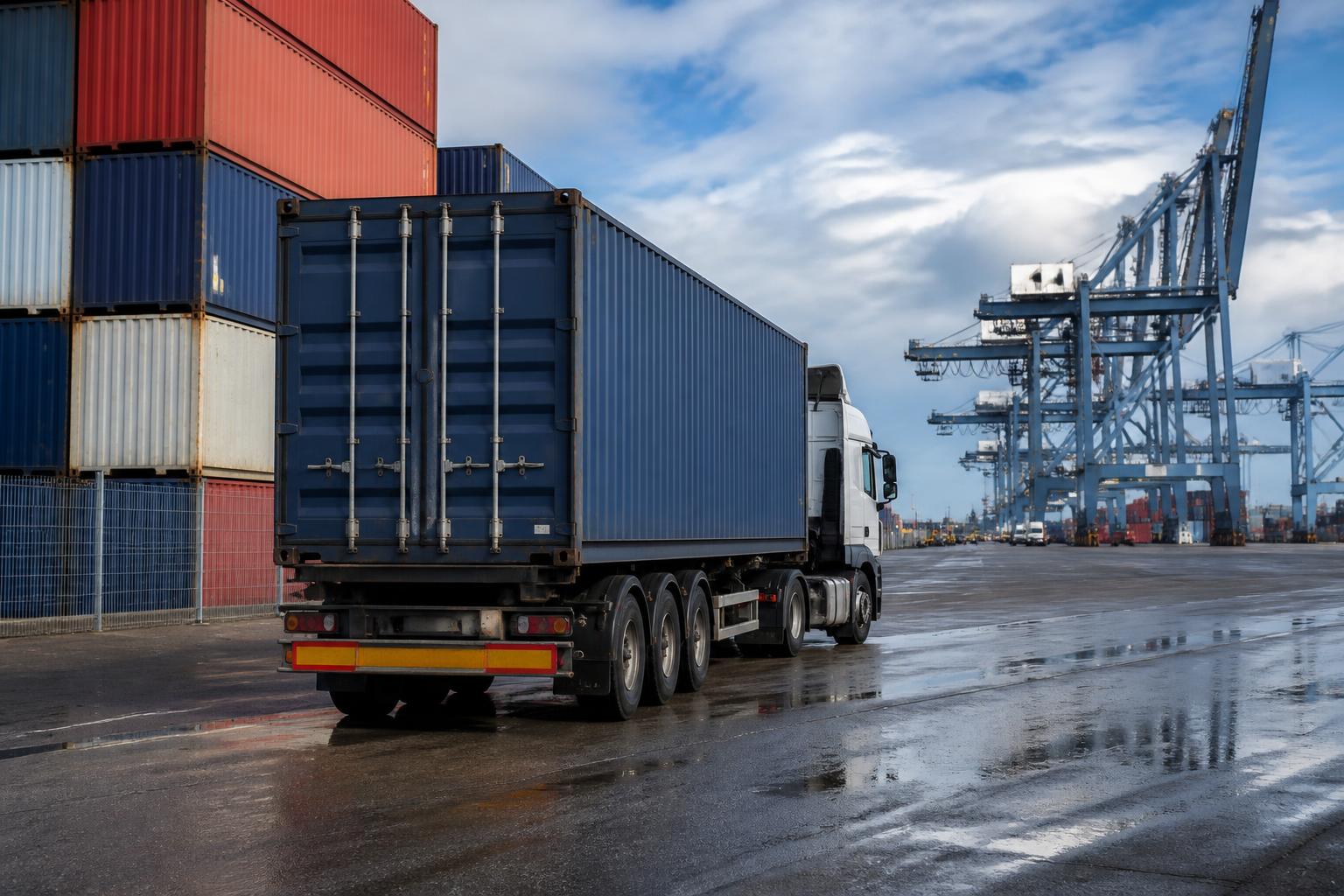
If you are asking who handles Suffolk port collections without avoidable port cost, the short answer is that you need a container haulier that does more than put a lorry under a box. The job is to check the release, watch customs status, book the port slot, plan around free time, send the right vehicle and trailer, and tell you early if a hold, VBS problem or delivery restriction puts the collection at risk.
For most Suffolk importers, that usually means a haulier with regular access to Felixstowe and practical experience of merchant haulage into Great Britain. We handle that work every day from Felixstowe, London Gateway, Tilbury, Purfleet, Southampton and Liverpool, with our own fleet on operator licence OF2023521 and partner capacity for overflow. The point is not simply to collect the container. It is to collect it in time, with the right information, and without creating storage, demurrage or wasted road time that could have been avoided.
What Suffolk importers usually mean by port collections
When an importer asks who does port collections for containers in Suffolk, they are usually buying a full merchant haulage service from quay to delivery point, not just a truck movement.
In practice, that job normally includes:
- checking that the container has a valid shipping line release
- checking whether customs is cleared, under review, or held
- confirming whether the box is available for collection
- booking the collection through the relevant port system
- planning the move within shipping line free time
- assigning suitable equipment for the container type and weight
- collecting from port and delivering to the consignee or nominated premises in Great Britain
- reporting issues early if the container cannot move as planned
For FCL imports, that is the standard expectation. For LCL work, there may be a different inland leg after deconsolidation, so the port collection question is often about the movement into the unpack point rather than direct final delivery.
At Suffolk level, the term usually points to Felixstowe traffic, but many importers based in Suffolk also route containers via London Gateway, Tilbury or Southampton depending on vessel rotation, line service or inland delivery point. A useful haulier is one that can work across those port pairs without forcing you to change operator every time the routing changes.
The operational detail matters. A 20ft ISO Container with a heavy cargo needs different planning from a light 40ft ISO Container or 45ft ISO Container. A Refrigerated Container may need a different delivery arrangement and tighter timing. Some cargoes need waste carrier registration. Some food and feed related movements need the right registration status. If those checks are left too late, the rate on the quote stops mattering because the avoidable cost appears somewhere else.
In Great Britain, port collection also sits alongside UK customs processes rather than EU free circulation rules. That means release and customs status must be checked against UK import formalities, and where there is a hold, the haulier needs to know before the slot is booked and the vehicle is dispatched.
Which types of haulier are available in Suffolk
Suffolk importers generally have four choices.
The first is the local container haulier. This is often the best fit where most work is through Felixstowe and the requirement is regular merchant haulage into Great Britain. A local operator usually understands port routines, local traffic patterns, booking cut offs, and the realities of same day planning when a line release or customs status changes late. That local knowledge matters most when the box is close to free time expiry or when the booking windows are tight.
The second is the national container operator. National firms can be a good fit for very large import programmes, especially if you need broad depot coverage or integrated warehousing. The trade off is that Suffolk traffic can become one lane among many. If your issue is a specific Felixstowe collection that needs quick intervention, you want to know who is actually watching the release, the slot and the delivery restriction, not just who owns the account.
The third is forwarder-managed haulage. Many freight forwarders buy haulage as part of a wider import service and manage the collection on your behalf. That can work well if the forwarder has a strong operations team and uses reliable port hauliers. It can work less well if the road leg is treated as an interchangeable subcontract and no one takes ownership of the timing risk. Importers using forwarder-managed haulage should still ask who the actual collecting haulier is, what port access they hold, and how exceptions are handled.
The fourth is the general haulier that takes occasional container work. Sometimes this is enough for straightforward jobs, but it is usually where problems begin. Container haulage from the ports is not standard pallet network work. It depends on release controls, VBS systems, booking references, quay availability, free time, line rules, and container-specific equipment. A firm that only occasionally handles ISO containers may offer a low rate and still cost more overall if a failed collection, wrong trailer, missed slot or late warning creates storage or demurrage.
That is why the question is not only who does port collections for containers in Suffolk, but who does them routinely enough to control the risk around them.
How to compare hauliers beyond the rate
Rate matters, but it is not the first filter. We would compare hauliers on six operational points.
First, port systems. Ask which ports they collect from regularly, and whether they actually work inside the relevant booking systems. Felixstowe planning depends on CARGOES VBS. Other ports have their own processes and access rules. If a haulier is vague about the system, or says they can probably sort it, that is not enough for live import traffic.
Second, free time management. A good haulier plans collections against line free time and tells you when the container is at risk. That sounds obvious, but it is often the line between a routine movement and avoidable cost. We have set out the practical side of port slot booking that helps avoid demurrage because timing discipline matters as much as road capacity.
Third, customs and holds. Ask how they deal with customs holds, inspections and unavailable boxes. The right answer is not that they can collect anything. The right answer is that they check status before dispatch, keep the booking under review, and tell you early if the box cannot move. A wasted trip helps nobody.
Fourth, equipment. Check whether they can move the container you are actually importing. That includes 20ft ISO Container, 40ft ISO Container and 45ft ISO Container capacity, but also whether they can handle heavy boxes, quay to premises food and feed traffic, and specialist needs such as a Refrigerated Container. If your imports run heavy, axle planning matters. We have covered some of the practical issues in moving overweight containers without port delays.
Fifth, coverage. Some hauliers are strong only from one port. Others can collect from multiple UK gateways and deliver across Great Britain. If your bookings move between Felixstowe, London Gateway, Tilbury, Purfleet, Southampton and Liverpool, a single operator with established coverage reduces handover risk and admin.
Sixth, freight liability. This is often overlooked until there is a claim. You should ask what terms apply and what the actual limit is. Standard RHA levels are not always enough for containerised cargo. Our freight liability cover is £6,500 per tonne under RHA 2024 conditions, with the same limit applying to subcontracted loads, and up to £10,000 per tonne available by arrangement for high value freight. That is a practical point, not a marketing one. If the cargo value is high relative to weight, the liability position should be checked before the move is booked.
If you want a broader checklist, our guide on how to compare UK import container hauliers without delay risk sets out the questions that usually expose whether a haulier is operationally strong or simply competitively priced.
What matters specifically for Felixstowe and Suffolk traffic
For Suffolk importers, Felixstowe is the key local port issue. A Suffolk base near Felixstowe is useful because it shortens positioning time, supports faster reaction when bookings change, and makes it easier to recover the plan when the release lands late or the delivery point shifts.
We are based at Bridge Farm, Woolpit, Suffolk, IP30 9PQ, about 35 miles by road from the Port of Felixstowe. That does not make every job simple, but it does matter operationally. It means Felixstowe collections are part of our normal daily planning, not an occasional extension of a remote fleet.
The main Felixstowe planning points are familiar to most import teams:
- release timing from the shipping line
- customs status and whether the box is actually clear to move
- availability of a booking through CARGOES VBS
- free time expiry and risk of storage or demurrage
- quay congestion and cut off times
- delivery restrictions at the receiving site
- whether the box weight suits the planned vehicle and route
Felixstowe work also depends on the Container Booking System, often shortened in conversation to CBS, although the live booking environment import teams usually refer to is CARGOES VBS. The practical point is that slot access is not infinite, and the best delivery plan on paper still needs an achievable collection window at the port.
That is where a Suffolk based operator has an edge. When the release appears later than expected, or a customs issue clears and the collection needs to be recovered quickly, local planning knowledge helps. So does doing the work every day. We know which jobs need an early warning to the customer and which can still be pulled back inside free time with the right slot and vehicle.
Felixstowe also creates a false sense of security for some buyers because it is nearby. Nearness to port does not remove the need for proper booking discipline. Many avoidable port costs arise not because the haulage distance is long, but because no one owned the detail around release, slot, equipment or delivery readiness. If you are specifically looking for who can collect containers from Felixstowe port, the first thing to check is who is actually set up to manage those moving parts, not simply who says yes to the job.
When Jagelo Haulage Limited is the better fit
Jagelo Haulage Limited is the better fit when you want merchant haulage handled by a container operator that is used to working directly with importers, freight forwarders and customs agents, and that takes responsibility for the practical collection process rather than only the linehaul.
We are best suited where the requirement looks like this:
- regular or repeat import collections from Felixstowe
- port collections from more than one UK gateway, especially Felixstowe, London Gateway, Tilbury, Purfleet, Southampton and Liverpool
- direct bookings from importers and forwarders who want clear operational updates
- container work that needs release checks, booking management and early warning on risk
- deliveries within Great Britain rather than just local drayage
- cargo where freight liability limits matter
- heavy or specialist container traffic that needs the right equipment and planning
- food, feed, waste or regulated cargoes where the haulier’s registrations need to be in order
We were founded in 2019, and the people running us have worked in container haulage since 2015. Since 2019 we have moved more than 75,000 containers, about 13,000 a year. We run 40 vehicles and 40 trailers of our own on operator licence OF2023521, with vetted partner hauliers on their own operator licences taking extra volume when needed. That combination gives us day to day control with scalable capacity.
For regulated traffic, we are an upper tier waste carrier and dealer, CBDU471791, and we are registered with APHA to carry Category 3 animal by-products, animal feed in shipping containers, quay to premises, U1433815/TRANS. That matters if your import is not just another dry box and you need the paperwork and permissions to line up before the collection is booked.
We are not the right answer for every movement. If you need a pan-European road network, that is a different buying decision. But if your question is who handles Suffolk port collections without avoidable port cost, and your work is UK import container haulage from the ports into Great Britain, this is exactly the space we work in.
Most of the value is in what happens before the lorry arrives at the gate. We check the release position, confirm the status, book the slot, assign the right equipment, and flag the problem early when a box is likely to miss free time. That is how avoidable cost is usually prevented.
If your imports move through different UK ports during the year, we can keep the same operating approach across Felixstowe, London Gateway, Tilbury, Purfleet, Southampton and Liverpool instead of forcing you to re-brief a different haulier each time. If your cargo is high value, we can discuss increased freight liability in advance. If your loads are heavy, we will plan them as heavy loads rather than discovering the problem at the port.
That is the practical answer to the Suffolk question. The best haulier is not the one with the cheapest single rate. It is the one that can collect the right container, from the right port, at the right time, with the right checks already done. That is the work we do every day.
Who does port collections for containers in Suffolk?
Usually a container haulier, either booked directly by the importer or freight forwarder as merchant haulage, or arranged by the forwarder on the customer's behalf. In Suffolk, many collections are from Felixstowe, but some loads also route via London Gateway, Tilbury, Purfleet, Southampton or Liverpool.
What should I ask a haulier before booking a port collection?
Ask which ports they cover, whether they book the port slot, how they manage release and free time, what equipment they run for a 20ft ISO Container, 40ft ISO Container, 45ft ISO Container or Refrigerated Container, and what freight liability applies.
Is a Suffolk-based haulier better for Felixstowe work?
Often yes, if Felixstowe is a regular port in your traffic. A local base can help with planning, familiarity with CBS bookings and quicker escalation when a release, customs status or collection window starts to move against free time.
Do all hauliers offer the same cover if they subcontract?
No. Some operators use subcontractors for overflow, but the important point is whether the same freight liability limit applies to subcontracted loads as well as loads moved on the operator's own vehicles.
Can one haulier cover more than Felixstowe for Suffolk importers?
Yes. That matters if your arrivals vary by shipping line or service. A haulier covering Felixstowe, London Gateway, Tilbury, Purfleet, Southampton and Liverpool can keep one booking process across more of your inbound container work.