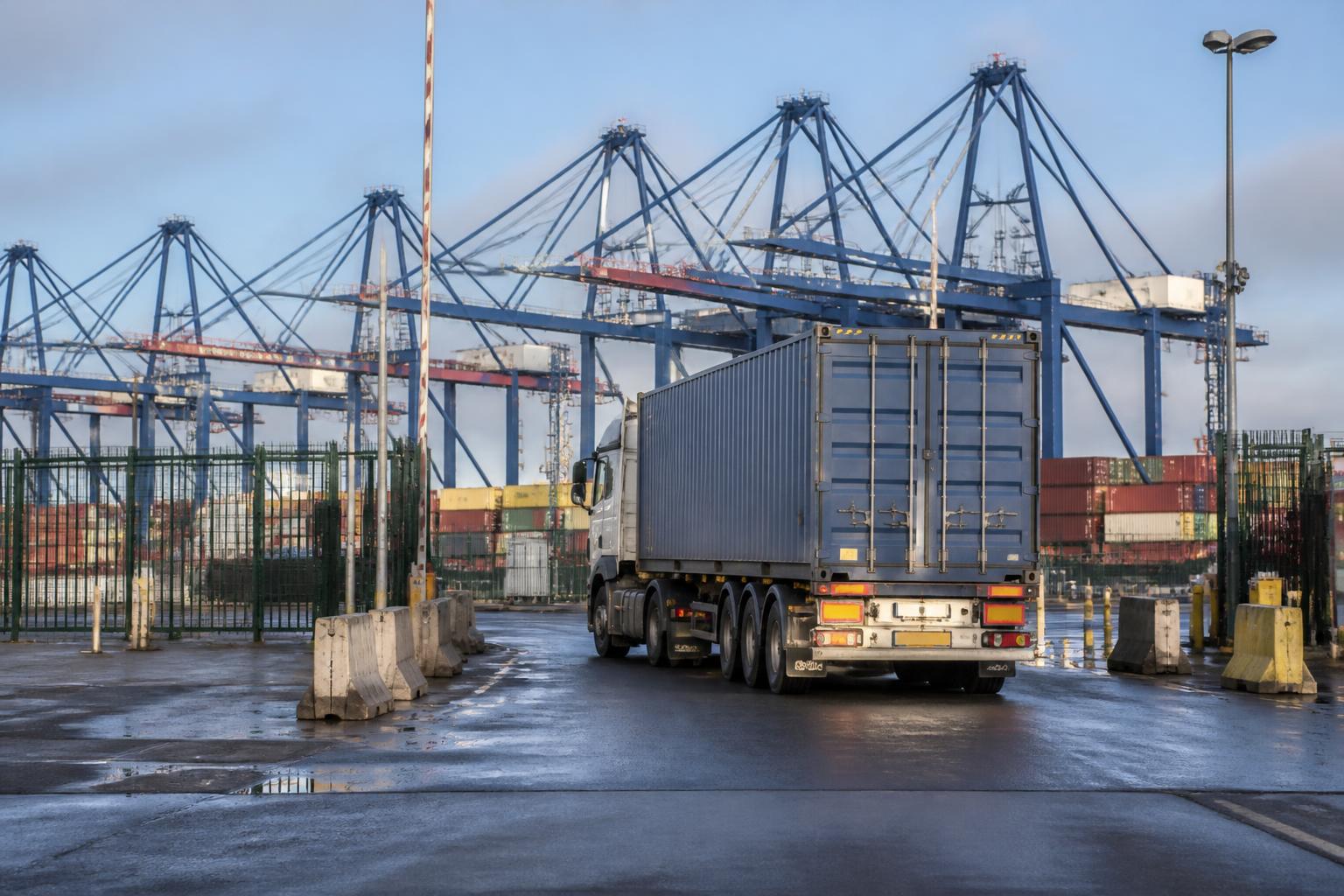
If you want to avoid demurrage, the most useful arrangement is usually simple. The haulier that will collect the container should also control the port slot booking. That puts release status, customs position, transport planning and delivery timing in one place, so the collection is booked when the box is actually collectible and when a vehicle can genuinely attend.
In practice, a container haulier that books port slots is not just pressing a button on a booking screen. We are checking whether the line release is in place, whether there are holds still showing, whether the terminal will accept the move, whether the delivery point can receive the container, and whether the collection date protects free time rather than misses it by a day. That is where avoidable demurrage often starts or ends.
What a haulier is doing when it books the port slot
When we book a port slot for import collection, we are fixing the terminal visit that allows our vehicle to collect your container from the quay or stack. That booking sits in the middle of the job, not at the start and not at the end.
Before the booking point, the container needs to be in a collectible state. That usually means the shipping line or carrier has issued release, terminal and line charges have been dealt with where applicable, and customs status allows the box to move. In UK practice, that may include clearance being complete, a route being resolved, or a hold being lifted. If the container is still under a customs hold, shipping line hold, port health intervention or documentary query, a slot booked too early is often wasted.
After the booking point, the rest of the transport plan has to work. The driver needs a valid collection reference, the container details must match the terminal record, the delivery address must be ready, and any site restrictions must already be known. If the box is a 20ft ISO Container at a site with weight limits, or a 45ft ISO Container going to a yard with turning constraints, we need to know that before we commit the collection window.
This is why a haulier booking the slot matters operationally. The booking is not a standalone admin task. It is the point where release, customs status and delivery planning meet. If those elements are controlled by different parties with no single owner of the collection plan, the risk is predictable. A slot gets booked because free time is running out, but the release is not live. Or the release is live, but the delivery site cannot take the box that day. Or customs status changes after the booking and nobody tells the haulier until the vehicle is already planned.
For import work, especially FCL, we treat slot booking as part of the transport instruction, not as a separate clerical step. For LCL devans, the timing is different because the port collection is not the final delivery in the same way, but the same principle applies. The move should only be booked when the collection can realistically happen.
Why importers and forwarders ask the haulier to handle the booking
Importers and forwarders usually ask us to handle the booking because one party then owns the collection plan from start to finish. That cuts down the number of failed collections and avoids the common gap between what is theoretically collectible and what is actually movable.
The first benefit is control of free time. Demurrage and terminal storage do not wait for internal email chains. If we are responsible for the road move, we can work backwards from last free day, terminal availability and delivery capacity. Where there is pressure on timing, we can flag that early and look for the first workable slot rather than finding out too late that the chosen day was already full.
The second benefit is fewer wasted bookings. A booking made without checking release, holds or delivery readiness can disappear quickly. That can mean a missed collection, abortive planning, or a rebook onto a later date when free time has already expired. When the haulier controls the booking, we are less likely to reserve a slot for a container that still cannot move.
The third benefit is communication. The shipping line, terminal, customs agent, freight forwarder and consignee do not all see the same screen at the same time. Someone has to bring the moving parts together. We do that every day, so we know what to chase first. If release is still pending, we say so. If a customs issue is the real blocker, we say so. If the terminal has availability but the delivery site cannot take a 40ft ISO Container until the next morning, we plan around the site, not just the quay.
This is especially useful where one importer has several containers on different statuses. One box may be clear and ready. One may still have a hold. One may need a Refrigerated Container collection with power and timing constraints. Treating them all as if they can be booked in the same way creates avoidable cost.
For businesses comparing options, our guide on how to find a container haulier that avoids port charges sets out the practical points to look for. The same thinking applies when you want the haulier to own the booking process rather than just accept a date from someone else.
What information the haulier needs before it can book
To book correctly, we need the practical details that determine whether the container can move and when it should move. The minimum information is usually straightforward, but missing one item can waste the booking.
We normally need:
- Container number
- Port of collection
- Shipping line
- Booking or release reference used by the line or terminal
- Confirmation that line release is in place
- Confirmation of customs status, including whether any hold remains
- Last free day, if known
- Container size and type, such as 20ft ISO Container, 40ft ISO Container, 45ft ISO Container or Refrigerated Container
- Gross weight, or a realistic working weight if final figures are still being checked
- Delivery postcode and delivery contact
- Required delivery date, or the last acceptable date
- Any site constraints, including booking-in, opening hours, vehicle restrictions, forklift availability, or whether the box must stay on wheels
- Whether the move is standard merchant haulage or involves any special handling
On some jobs we also need commodity information. That matters where there are compliance or handling requirements. We are registered with APHA to carry Category 3 animal by-products and animal feed in shipping containers, quay to premises, and we are an upper tier waste carrier and dealer. If a load falls into one of those categories, we need to know at instruction stage, not after the booking has been made.
Weight and equipment details matter more than many people expect. A 20ft ISO Container can be physically small but heavy enough to affect routeing and delivery method. A 45ft ISO Container may fit the booking system perfectly but not the consignee's yard layout. A Refrigerated Container may need tighter timing because of product sensitivity, plug-in arrangements or depot instructions after unloading.
For LCL, the box itself may not be your final concern, but if we are collecting a container for devanning or onward handling, we still need the terminal release and timing to be right. For FCL, there is usually less room for error because the container remains your transport unit all the way to site.
If you are moving specialist equipment, our articles on high cube container moves and reefer container haulage without extra port cost cover the extra checks that prevent wasted collections.
How slot booking differs by port
Slot booking is not identical across UK ports. The principle is the same, but the booking point and the information needed can vary by terminal and system.
At Felixstowe, container collections are booked through the Container Booking System, usually shortened to CBS. In day to day work, people will often say the slot is booked on CBS. What matters operationally is that the haulier books a workable collection window against a container that is actually ready to move. If release or customs status is not in order, having a time in the Container Booking System does not solve the underlying problem.
Other ports use different platforms and operating processes. London Gateway uses CARGOES VBS for vehicle bookings. The same applies in principle at Southampton, where the booking process is system led and timing matters just as much as the admin. At Tilbury, Purfleet and Liverpool, the exact booking workflow can differ by terminal or operator, but the practical issue for the customer is unchanged. The slot should be booked by the party that is also managing the road move.
That matters because each port has its own pattern of availability, cut-offs and operational pressure. A collection plan that works at Felixstowe may not translate directly to London Gateway or Southampton. The haulier needs to understand the port rhythm, not just the map distance.
Where readers are comparing port behaviour and charge risk, our piece on container haulage that helps avoid port storage costs is a useful companion, and for Tilbury-specific considerations we have also covered choosing a Tilbury container haulier without extra port cost.
When a container is at risk and early warning matters
A container is usually at risk before the charges appear on an invoice. The warning signs are visible earlier if someone is watching the job properly.
The common risk indicators are familiar:
- Release still not received when free time is already running
- Customs status unresolved close to last free day
- A hold that has not been lifted but a delivery date has already been promised
- No realistic slot availability on the intended collection day
- Delivery site cannot receive on the only day the port slot is available
- Heavy or unusual equipment not matched to the delivery constraints
- Late changes to container number, size or release reference
- Multiple parties assuming someone else has booked the collection
A responsive haulier should not wait until demurrage has accrued before saying there is a problem. We flag the risk when we can still do something about it. Sometimes the answer is to collect earlier. Sometimes it is to move the delivery appointment. Sometimes it is to tell the forwarder or customs agent that the real issue is not transport at all, it is an unresolved release or hold that will make any booking fail.
This early warning matters because free time is a planning tool only if someone uses it actively. Once the last free day is gone, the conversation changes from prevention to cost control. We prefer to be in the first conversation.
It also matters for communication inside your own business. A warehouse may think the container can arrive on Friday because sales have promised stock for Monday. But if the box is still not released on Wednesday afternoon, someone needs to say plainly that Friday is now at risk. That is a better message to give early than after the charges and delay have already landed.
In UK practice, this is especially important because customs and port processes are not simply an EU-wide template. Since Brexit, UK import formalities and intervention points need to be checked against UK requirements, not assumed from EU movements. The operational lesson is straightforward. Never book on hope where the status still needs confirmation.
How Jagelo Haulage Limited handles merchant haulage bookings
At Jagelo Haulage Limited, most of our work is merchant haulage booked directly by importers and freight forwarders. We collect from Felixstowe, London Gateway, Tilbury, Purfleet, Southampton and Liverpool, and deliver throughout Great Britain.
We are based at Bridge Farm, Woolpit, Suffolk, IP30 9PQ, about 35 miles by road from the Port of Felixstowe. That location keeps us close to the UK's main container corridor while still giving us practical reach across the country.
We run 40 vehicles and 40 trailers on operator licence OF2023521. When volume requires it, we also use vetted partner hauliers operating on their own operator licences. That gives us extra capacity without losing control of the job. Subcontracted loads carry the same freight liability limit as our own fleet movements.
Since 2019 we have moved more than 75,000 containers, around 13,000 a year. The business was founded in 2019, and the people running it have worked in container haulage since 2015. That experience shows in the way we handle collections under time pressure. We do not separate booking from planning. The team booking the move is looking at release, port access, equipment type, delivery timing and risk of charges together.
Our standard freight liability cover is £6,500 per tonne under RHA 2024 conditions, five times the usual RHA level of £1,300 per tonne. Where high value cargo needs a higher limit, up to £10,000 per tonne is available by arrangement. For many importers and forwarders, that matters because the road move is only one part of the exposure, but it is still a part that needs to be properly covered.
We also handle regulated and specialist traffic where the container and commodity details need to be right before booking. We are an upper tier waste carrier and dealer, CBDU471791, and we are registered with APHA to carry Category 3 animal by-products and animal feed in shipping containers, quay to premises, U1433815/TRANS.
For customers who want a haulier to book the slot, the practical point is this. We want the instruction early enough to protect free time, but not so early that the booking is based on assumptions. Once we have the release position, customs status, container details and delivery constraints, we book the port slot that fits the real collection plan. If a box is at risk, we say so while there is still time to change the outcome.
Does the haulier need the shipping line release before booking a slot?
In most cases, yes. A slot is only useful if the container can actually be collected. The haulier should know whether release is in place and whether customs or line holds still need clearing.
Can a haulier book slots at Felixstowe?
Yes. At Felixstowe, collections are booked on the Container Booking System (CBS). If you need port-specific detail, see the Felixstowe page on jhaulage.co.uk.
Why does it help if the haulier books the slot as well as the road move?
It keeps collection timing, vehicle planning and delivery timing with one operator. That usually means fewer handoffs, earlier warning if a box is at risk and less chance of a booking that does not match the actual transport plan.
What container details should be sent with a booking request?
Send the container number, size and type, collection port, delivery point, release status, customs status and any delivery restrictions. If the load may be regulated, send the UN number and class and the haulier can confirm whether it can take it.
Can the same haulier cover more than one UK port?
Yes, if it is set up for port container work. Jagelo Haulage Limited collects from Felixstowe, London Gateway, Tilbury, Purfleet, Southampton and Liverpool for deliveries within Great Britain.