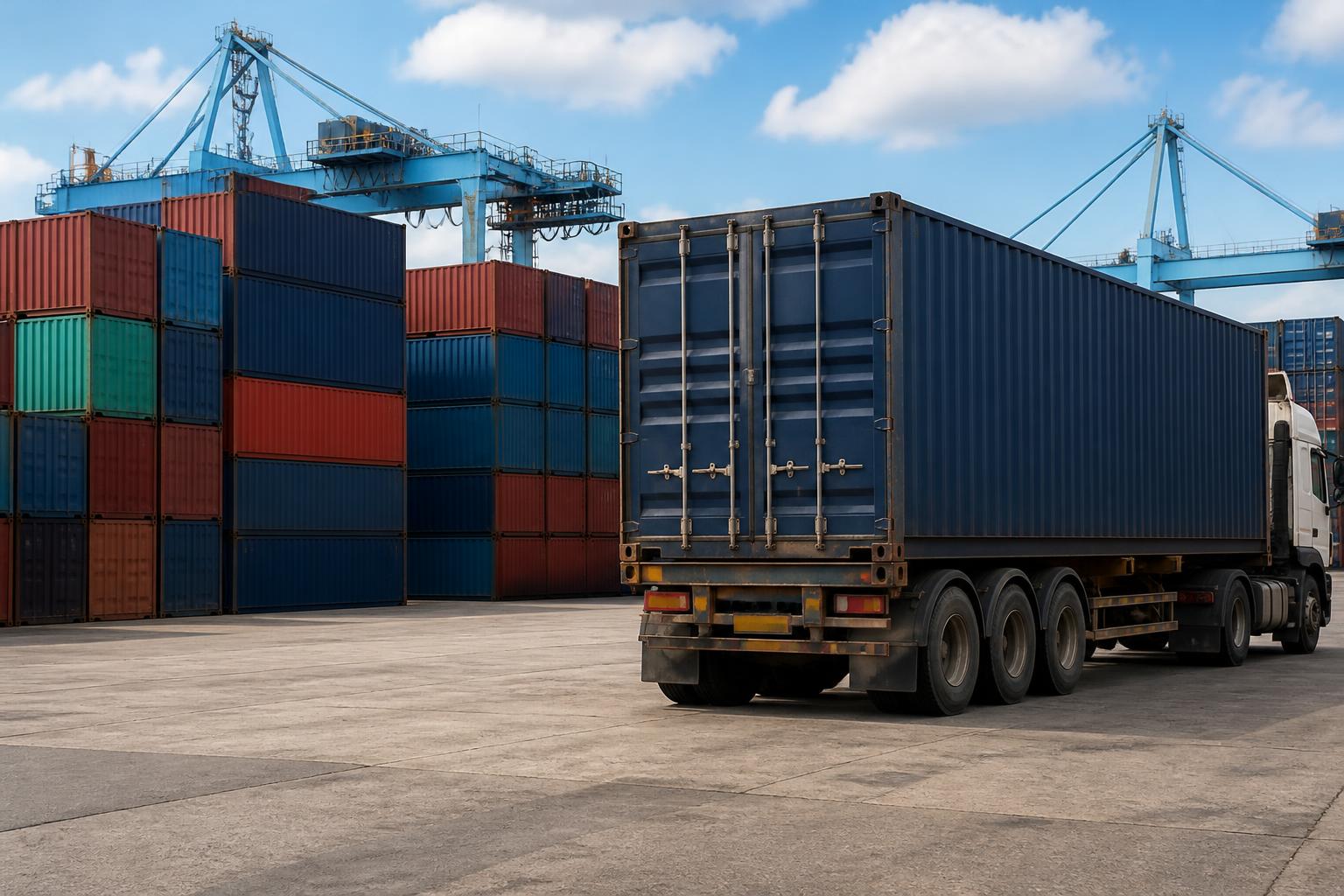
When people search for container transport near me, they usually do not mean the nearest yard on a map. They mean a haulier that can actually collect the box from the correct port, deal with the release and booking sequence properly, and deliver within Great Britain without avoidable storage, demurrage or failed collection costs.
That is the practical test we work to at Jagelo Haulage Limited. We collect from Felixstowe, London Gateway, Tilbury, Purfleet, Southampton and Liverpool, and most of our work is merchant haulage booked directly by importers and freight forwarders. The difference between a smooth move and a costly one is often not road mileage at all. It is whether the haulier understands the port process, checks the release position early, books the slot at the right time, and flags risk before free time runs out.
What people usually mean by container transport near me
In UK container work, "near me" normally means "near the port my goods are landing at, and able to deliver to my site without complications". If your container is arriving at Felixstowe, a haulier based close to Southampton is not local in any useful operational sense. Equally, a haulier with a yard near your warehouse is not the right choice if they do not regularly collect from your port, do not have access to the booking system, or rely on a chain of subcontractors before the job even starts.
For most importers and forwarders, the real requirement is straightforward. You need a haulier that can:
- collect from the correct terminal
- work under merchant haulage
- handle port and line release checks
- book the collection slot
- send the right vehicle and trailer for the box
- deliver within the booked window
- report early if customs, release or terminal issues will cause delay
That matters whether the move is FCL or an urgent port-to-warehouse leg after an LCL devan. It also matters whether the load is a standard 20ft ISO Container, a 40ft ISO Container, a 45ft ISO Container, an open top, or a Refrigerated Container that needs prior confirmation before we accept the move.
The phrase also usually reflects a buying problem. The person searching is trying to avoid paying for a poor handover between shipping line, terminal, customs agent and haulier. In practice, the best result comes from using a carrier that is close enough to the relevant port to cover it efficiently, but more importantly knows that port's release and booking routine well enough to prevent wasted time. That is why we focus on the main UK deep sea and short sea container gateways we collect from every day, rather than claiming to be "local" everywhere.
What to check before you book a container haulier
Before booking any container haulier, we recommend checking five things in a direct, operational way.
First, confirm actual port coverage. Ask which ports they collect from under their own traffic flow, not just whether they can "cover the UK". For import work, that means asking specifically about Felixstowe, London Gateway, Tilbury, Purfleet, Southampton and Liverpool if those are relevant to your shipments. A yes or no answer is not enough. Ask how they handle release checks and slot booking at each port.
Second, check equipment for ISO containers. A haulier should be clear about what they can move and on what trailer type. In normal UK road container work, the practical question is whether they routinely move a 20ft ISO Container, 40ft ISO Container and 45ft ISO Container, and whether there are any restrictions for overweight units, high cube containers, open tops or a Refrigerated Container. If your cargo profile includes heavier 20s, ask the question directly, especially where axle weights may affect routing or whether a skeletal trailer and tractor combination can legally carry the load.
Third, verify operator licensing. In Great Britain, a road haulier carrying goods for hire or reward must hold the correct operator licence. We run 40 vehicles and 40 trailers of our own on operator licence OF2023521. That is the sort of detail you should expect a haulier to provide. If a company cannot tell you which licence it operates under, that is a warning sign.
Fourth, ask how much work is subcontracted. There is nothing unusual about using vetted partner hauliers for overflow or regional balancing, but you need to know whether the company you are booking controls the job properly. Ask whether subcontractors operate on their own operator licences, whether they are vetted, and whether the same freight liability terms apply to subcontracted loads as to vehicles in the core fleet. If a provider cannot answer that clearly, you are the one carrying the uncertainty.
Fifth, ask whether they handle merchant haulage directly. That means the haulier is taking the job from you or your forwarder, collecting under your release arrangements, and managing the port leg as part of your inland move. In real terms, that includes checking whether the container is released, whether customs status allows collection, and whether a booking can be secured inside free time. If you want a more detailed breakdown of where avoidable charges arise, our guide to UK container haulage costs from the ports sets out the main operational points.
How a good haulier helps you avoid demurrage and wasted time
Port charges are often treated as if they are unavoidable. Some are. Many are not. The avoidable ones usually come from poor sequencing.
A good haulier reduces risk by checking the move in the order the port actually needs it handled. That starts with release. If the shipping line has not released the box, or the release has not reached the terminal system, turning up at the gate solves nothing. The same applies if customs status is not clear. In the UK, post-Brexit customs handling is not the same as the wider EU position, and the release path depends on the declaration status and whether any hold remains against the unit. Collection should be planned around that reality, not around a hopeful ETA.
Free time matters just as much. If the line's detention and demurrage clock, or the terminal's storage clock, is close to expiry, the job needs active planning. We look at when the container can actually be collected, not just when the vessel discharged. That means checking whether the release is in place, whether customs has cleared, whether the terminal is accepting bookings, and whether the delivery point can receive the unit on the day the slot is available.
Booking systems are another common source of wasted time. At Felixstowe, slot management runs through CARGOES VBS. Other ports use their own versions of a Container Booking System, often shortened to CBS. The point is not the acronym. The point is whether the haulier knows how to work inside those systems, secure the right booking, and avoid failed attendance caused by incorrect timing, missing references or unresolved release issues.
A failed collection can cost in several ways at once. You lose the slot. You may incur waiting or wasted journey cost. You may then miss the last practical collection window inside free time. That is how storage and demurrage become very real, very quickly.
The best prevention is early visibility. We would rather tell a customer on day one that a box is at risk than tell them on the last free day that no collection slot is available. That is especially important when the cargo is time-sensitive, the delivery point has a narrow booking window, or the box needs specific planning because of weight, cargo type or equipment constraints.
If your cargo profile is specialised, the same principle applies. A bulk box, open top, feed container or heavy 20 can all attract avoidable cost if the collection is not lined up properly. We cover some of those points separately in our articles on choosing a bulk container transporter without added port cost and choosing 20ft container haulage without avoidable port costs.
Which ports matter and why local knowledge is port-specific
"Port knowledge" is not a generic skill. It is port-specific.
Felixstowe is a clear example. Being about 35 miles by road from the port gives us a practical base for regular collections, but the real value is knowing the collection flow, the release timing issues, and how to work with CARGOES VBS without wasting bookable capacity. A haulier that only picks up there occasionally may still be able to move the box, but occasional coverage is not the same as routine operational familiarity.
London Gateway also has its own rhythm. The booking pattern, traffic timing and terminal process need planning on their own terms. The same is true of Tilbury and Purfleet, where service quality depends on knowing how that traffic behaves in practice, not just on having a truck available somewhere in the South East.
Southampton is another case where "near me" can mislead the buyer. A container arriving there needs a haulier that actively works Southampton collections, understands the booking and release process, and can route the inland leg efficiently into the relevant part of Great Britain. A company based closer to your consignee site but unfamiliar with the port is not necessarily the lower-risk option.
Liverpool is equally port-specific. For Northbound and Midlands deliveries, it can be the right gateway, but only if the collection process is managed properly from the start. The operational details are different from East Coast work and should be treated that way.
This is why we do not treat all port work as interchangeable. We collect from Felixstowe, London Gateway, Tilbury, Purfleet, Southampton and Liverpool because those are established parts of our traffic. When customers ask whether we can help, the first question is not "where are you based?" but "which port is the box at, what is its status, and what does the delivery require?"
What to ask about freight liability and special cargo
Freight risk is often left until after the booking, which is the wrong order. Ask about freight liability before the move starts.
Under standard RHA terms, the liability limit is often lower than customers assume. We work on RHA 2024 conditions with freight liability cover of £6,500 per tonne, which is five times the usual RHA standard of £1,300. The same limit applies to subcontracted loads arranged through our vetted partner network. If the cargo is higher value, cover up to £10,000 per tonne is available by arrangement, but that needs to be agreed before the move. It should never be assumed after a loss.
That matters because containerised cargo can vary widely in value per tonne. One FCL shipment may be straightforward consumer goods. The next may contain components, branded stock or specialist materials where the standard limit is not enough. Ask the question early and give the haulier a fair description of the goods.
You should also ask whether any cargo types need prior confirmation. That is normal and sensible. In our case, we are an upper tier waste carrier and dealer, registration CBDU471791, and we are registered with APHA to carry Category 3 animal by-products, animal feed in shipping containers, quay to premises, U1433815/TRANS. If your load involves waste, animal feed or Category 3 material, the haulier should be able to confirm the relevant registration position clearly.
The same applies to other special cases. If the container is a Refrigerated Container, say so at the quoting stage. If it is an open top, overweight, high cube, or unusually loaded unit, say so before the booking is accepted. If the consignee has site restrictions, state them early. If the load is sensitive enough that documentation, seals or delivery procedure need extra control, that should be part of the instruction, not an afterthought.
For feed and ABP traffic, the correct registration position is particularly important in Great Britain. It is not enough to assume that general container haulage capability covers regulated cargo. Where the goods need specific confirmation, ask for it. We have set out more on that in our guides to choosing feed container haulage without avoidable port cost and Category 3 ABP container planning.
A reliable container haulier is not just the one with a truck free on the day. It is the one that can show you, in advance, that the move is legally covered, operationally planned, and realistic against release, customs and free time. That is what actually keeps port charges down.
Does the nearest container haulier always make sense?
No. The better test is whether the haulier regularly collects from your port, books the slot, works to free time and can deliver efficiently to your site in Great Britain.
What should I send when asking for a haulage quote?
Send the port, container size, collection reference, delivery postcode, weight, commodity, customs status and any deadline linked to free time or site booking.
Can one haulier cover more than one UK port?
Yes. Many importers and forwarders prefer one haulier that can collect from multiple ports, especially when shipping lines or routings change between Felixstowe, London Gateway, Tilbury, Purfleet, Southampton and Liverpool.
What is the booking system at Felixstowe called?
At Felixstowe, collections are booked on the Container Booking System (CBS), which replaced the Vehicle Booking System (VBS) in January 2025.
Why does freight liability matter for container haulage?
It sets the haulier's liability limit if cargo is lost or damaged under the agreed conditions. If your goods are high value, check the limit before booking and ask whether a higher level is available by arrangement.