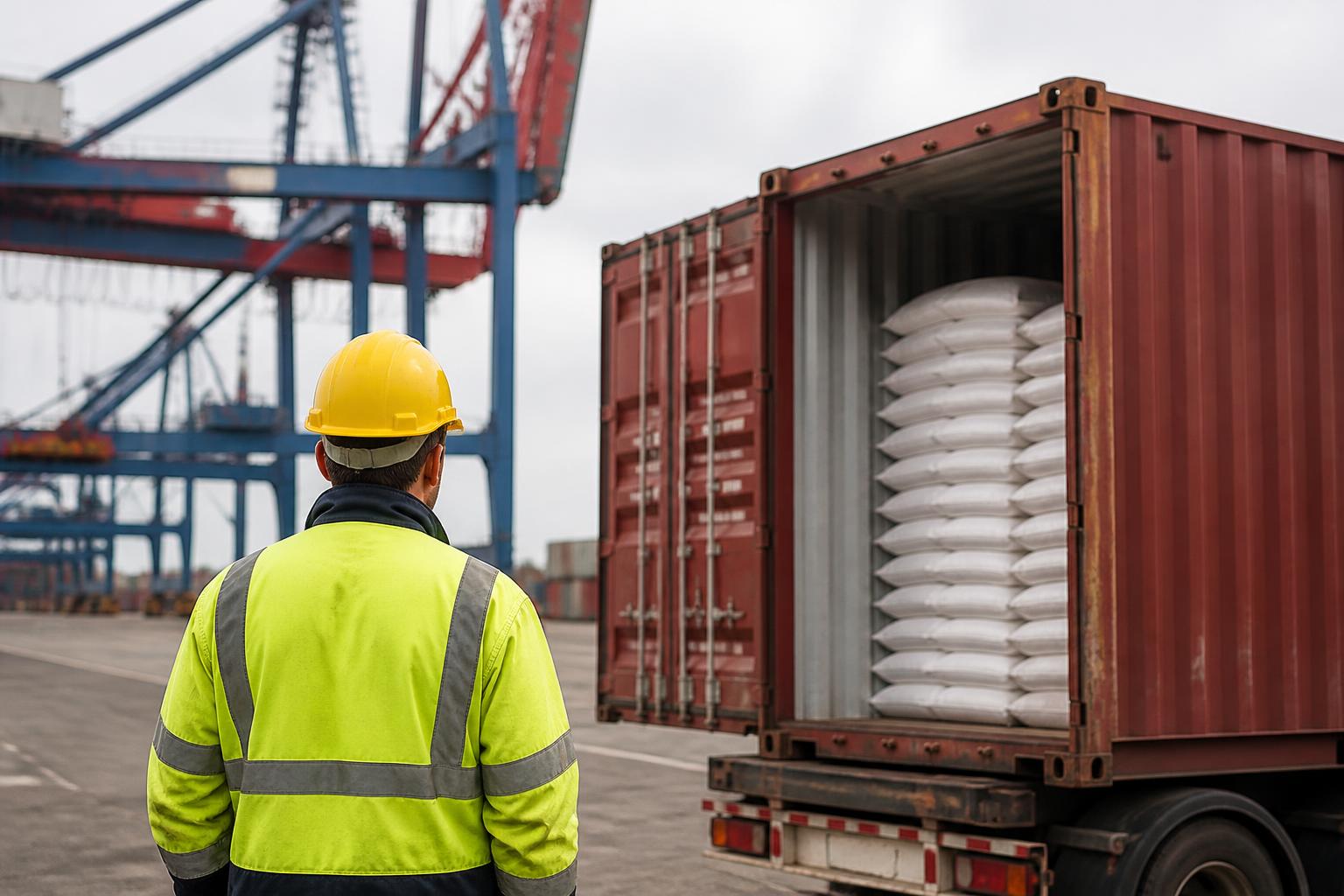
When you are choosing container haulage for imported feed, the main test is simple. Can the haulier lawfully collect the box, secure the port booking in time, deliver within free time where possible, and tell you early when a release, customs hold or quay issue puts cost at risk. If any one of those parts is weak, demurrage, storage, wasted journeys and site disruption follow quickly.
For animal feed imports in Great Britain, that usually means looking beyond a standard port haulier rate sheet. You need to check APHA registration for feed in shipping containers, port booking capability, actual fleet access, liability terms, and how exceptions are handled on live traffic. That is the practical difference between a smooth FCL move and a box that sits on quay while everyone assumes someone else is managing it.
What matters most when comparing animal feed container haulage
When importers and forwarders compare options for animal feed container haulage in the UK, we suggest using an operational checklist rather than a price-only comparison.
First, confirm the haulier can lawfully carry the cargo. In Great Britain, carrying animal feed in shipping containers is not the same as ordinary merchant haulage. A haulier should be able to state clearly whether it is registered with APHA for quay to premises movements of animal feed in containers, and whether that registration covers the work you are booking. If the load involves Category 3 animal by-products, that is a separate point again and should be checked directly.
Second, check the ports actually covered. Many operators say they do UK container haulage, but in practice they are stronger at one port than another. We collect from Felixstowe, London Gateway, Tilbury, Purfleet, Southampton and Liverpool, and the booking process, cut-offs and collection risks are not identical across those ports. A haulier that works a port every day will usually spot a problem earlier than one that only attends occasionally.
Third, ask who manages the port side. If the customer must handle all quay bookings, monitor free time, chase release status and update the haulier manually, the chance of avoidable cost rises. For many customers, the better arrangement is a haulier that can receive the release details, watch progress, secure the slot and flag risk before storage or demurrage starts to build. We cover that in more detail in how container haulage avoids port storage and delay.
Fourth, look at equipment fit. Feed imports may arrive in a 20ft ISO Container, 40ft ISO Container or 45ft ISO Container, and some traffic involves a Refrigerated Container. A general statement that a haulier moves ISO containers is not enough if your import programme includes mixed sizes, heavier 20ft units, or specific receiving constraints on site. The practical question is whether the haulier can cover the unit type, weight profile and delivery pattern you actually ship.
Fifth, ask how the traffic is planned against free time. A competent haulier should want the ETA, line, release status, customs position, delivery postcode, site restrictions and any date sensitivity. If those details are not requested up front, you are likely dealing with a provider that is reacting to boxes after they land rather than planning them before they become urgent.
Finally, check communication. On feed traffic, the useful update is not a generic “we are monitoring”. It is “release still pending”, “customs hold remains in place”, “quay booking not yet available”, “vehicle booked for tomorrow”, or “box at risk of storage from this date unless line clears”. That level of clarity matters more than polished wording.
Registered feed container haulage versus general container haulage
This is the first distinction to make, because it is a legal and compliance issue, not a service preference.
A haulier offering general container work may be perfectly competent on standard imports, exports and merchant haulage, but that does not by itself mean it can carry animal feed in shipping containers. In Great Britain, if the movement is quay to premises and the cargo is animal feed, the haulier should be registered with APHA for that activity. If the cargo falls within animal by-product controls, the registration required must also match that work.
We are registered with APHA to carry Category 3 animal by-products, animal feed in shipping containers, quay to premises, U1433815/TRANS. That matters because it means the legal basis for the movement is already in place. The customer does not have to discover after discharge that the chosen haulier can move standard retail or manufacturing cargo but not a feed container.
A general haulier may also be less familiar with the practical handling of feed-related instructions. Feed importers and receiving sites often have stricter expectations around load integrity, delivery timing, paperwork flow and acceptance conditions. Even where the movement is operationally straightforward, the consequences of using the wrong carrier can include delayed collection while an alternative is found, missed free time, and unnecessary pressure on customs agents and warehouse teams.
This is one area where broad EU discussion can confuse a UK booking. The rules you need to follow are the rules applying in Great Britain to the movement you are arranging, not a general EU summary. If your container is landing at Felixstowe, London Gateway, Tilbury, Purfleet, Southampton or Liverpool for delivery within Great Britain, the question is whether the haulier is correctly registered here for that specific cargo type and route type.
That does not mean every feed import needs a highly specialised operation. It means the baseline legal and operational fit must be right. Once that is confirmed, you can compare service levels, coverage, fleet access and communication.
Port booking and free time control compared
This is where many avoidable costs start.
Some hauliers expect the customer or forwarder to manage the port side entirely. In that model, you obtain the release, monitor customs status, book the port slot through the relevant system, then pass a confirmed collection to the haulier. That can work if your team is set up for it, is online throughout the day, and has enough volume to justify direct control.
The alternative is a haulier that manages the booking process as part of the collection. That usually means we receive the container details and delivery instruction, track the release position, monitor whether the box is available, make the booking through the port system, and plan the collection around free time and delivery capacity. For customers moving regular FCL feed imports, this often removes a major source of delay.
At Felixstowe, for example, booking competence means understanding CARGOES VBS and how booking availability interacts with release timing, quay congestion and delivery planning. At other ports the system and workflow differ, but the principle is the same. If the haulier is not active in the relevant booking platform, or expects the customer to navigate every step, response time slows when conditions change.
The same applies where a port or terminal uses a Container Booking System or CBS process. The operational question is not whether a haulier has heard of the system. It is whether they use the Container Booking System confidently enough to secure workable collection slots without waiting for the customer to prompt every move.
Free time control is not just a shipping line issue. It is a planning discipline. The best results come when the haulier is watching the box before the last free day, not after it. That means checking whether the release is in place, whether customs have cleared, whether quay availability is open, whether delivery can be accepted, and whether the collection should be advanced to avoid storage. If a 20ft unit is likely to become urgent because of weight and slot availability, that should be raised early. Our approach on that point is similar to what we set out in choosing 20ft container haulage without avoidable port costs.
Where the customer keeps port control in house, make sure responsibilities are explicit. Who books the slot. Who checks release status. Who watches free time. Who informs the receiving site. Who reacts if customs do not clear until late afternoon. If those points are vague, avoidable cost follows.
Direct fleet capacity versus broker-only models
There is nothing inherently wrong with subcontracting. Most established container operators use trusted partners at peak periods or for regional balancing. The question is whether there is a real operating core behind the booking.
A direct fleet gives you firmer control over planning, equipment and communication. We run 40 vehicles and 40 trailers of our own on operator licence OF2023521, with vetted partner hauliers on their own operator licences taking extra volume when needed. For customers, that means the traffic is planned by a haulier that is actually running container vehicles day to day, not only placing jobs into the market.
With a broker-only model, service can still be good, but the risks are different. Collection timing may depend on who accepts the job after release. Port bookings may be made later because the broker is waiting to secure a vehicle first. Updates can be slower because the broker is relaying information between port, subcontractor and customer. On urgent feed traffic, that extra layer can matter.
Direct fleet access is especially useful where there are repeated collections from the same port, regular deliveries to the same mill or intake point, or mixed work involving 20ft ISO Container and 40ft ISO Container units across the week. The haulier builds a working picture of your traffic pattern instead of treating each box as a one-off spot move.
It also matters when the delivery site has practical constraints. If the site has restricted access, fixed intake hours, a preference for certain arrival windows, or limited tolerance for failed deliveries, a fleet operator with its own planners and drivers can usually embed those details more reliably. The same goes for unusual equipment profiles such as a 45ft ISO Container or a Refrigerated Container where planning needs to be right before the vehicle leaves port.
That said, no serious operator should pretend every load is always carried on its own trucks. The better question is how subcontracting is controlled. Are partner hauliers vetted. Are they operating on their own licences. Do they receive clear instructions. Does the same liability standard apply. Can the customer still get timely updates from one point of contact. Those points matter more than a simplistic “own fleet only” claim.
Freight liability, communication and exception handling
Container haulage tends to be tested on the bad days, not the easy ones.
When comparing providers, ask for the actual freight liability limit, not just a statement that goods are insured. Under standard RHA terms, the baseline limit is often lower than customers assume. We carry £6,500 per tonne under RHA 2024 conditions, five times the RHA standard of £1,300, and the same limit applies on subcontracted loads. For higher value cargo, up to £10,000 per tonne is available by arrangement. That is a concrete point of comparison, not a marketing phrase.
For feed traffic, liability is only part of the picture. Communication standards are equally important. You need to know how the haulier handles exceptions such as:
- release not yet issued by the line
- customs hold still open
- quay booking unavailable on the preferred day
- VGM or documentation mismatch affecting progress
- late discharge or rolled vessel
- receiving site unable to accept on the planned date
A weak operator tends to go quiet until the customer asks for an update. A stronger one flags the risk before the last free day is lost. For us, that means saying directly when a box is at risk and what the next workable step is. If the issue is outside our control, we still make the position clear so the importer, forwarder or customs agent can act in time.
This is also where one contact point matters. If your team is speaking separately to a sales desk, a port booking clerk and an outsourced transport provider, information fragments quickly. For live container work, especially merchant haulage, concise operational updates are worth more than polished account management.
Tracking visibility helps, but it is not a substitute for judgement. A status feed can show whether a container has been collected or delivered. It does not by itself decide whether a box should be prioritised today to avoid storage tomorrow. We have covered that distinction in container tracking in 2026 without adding avoidable cost.
Which option suits importers, forwarders and receiving sites
The right model depends on what role you play in the move.
If you are an importer booking your own haulage, a specialist container haulier is usually the better fit where you bring in regular FCL feed containers, need the haulier to manage port bookings, and want early warning on anything likely to miss free time. That is particularly true if your boxes move through more than one port, or if your receiving sites expect accurate delivery planning rather than broad estimates.
If you are a freight forwarder or customs agent arranging the inland leg, the best fit is often a haulier that can work as an extension of your operations team. That means understanding releases, customs holds, quay bookings and delivery windows without needing every step explained from first principles. It also means clear communication back to you so you can update your client before costs land.
If you are the receiving site, your interest is usually practical rather than contractual. You want the container collected on time, delivered within the agreed window, and backed by a haulier that knows what to do if the port side changes. Where feed intake is time-sensitive, or where site access is controlled, a specialist operator generally gives you fewer failed arrivals and less uncertainty.
A simpler arrangement may be enough in narrower cases. If the customer controls the release process tightly, books the port slot themselves, has generous free time, and is moving occasional boxes with no unusual compliance element, a general container provider may be adequate, provided they are lawfully able to carry the cargo. The mistake is assuming that a low-touch model will perform well on feed traffic that actually needs active management.
For most regular feed imports into Great Britain, the safer choice is a haulier that can combine compliance, port booking, fleet access and live exception handling in one service. That is the core of how we work at Jagelo Haulage Limited. We collect from Felixstowe, London Gateway, Tilbury, Purfleet, Southampton and Liverpool, deliver across Great Britain, and handle the port side with the urgency container traffic requires. If a box is clear and bookable, we move it. If it is at risk, we say so early.
Does a haulier need specific registration to move animal feed in shipping containers?
Yes. For animal feed in shipping containers, check that the haulier is registered with APHA for quay to premises movements. Do not assume a general container haulier can take the load.
Why does port booking matter on feed container jobs?
Because missed or late bookings can push a container closer to the end of free time. A haulier that books the port slot and plans around release status reduces avoidable demurrage and storage risk.
What should I ask about freight liability?
Ask for the limit per tonne, the trading conditions used and whether the same cover applies to subcontracted loads. If the cargo value is high, ask whether a higher limit is available by arrangement.
Is Felixstowe still booked on VBS?
No. At Felixstowe, collections are booked on the Container Booking System (CBS), which replaced the Vehicle Booking System (VBS) in January 2025.
Can one haulier cover several UK ports for feed imports?
Yes, but confirm the actual port list. Jagelo Haulage Limited collects from Felixstowe, London Gateway, Tilbury, Purfleet, Southampton and Liverpool for delivery within Great Britain.