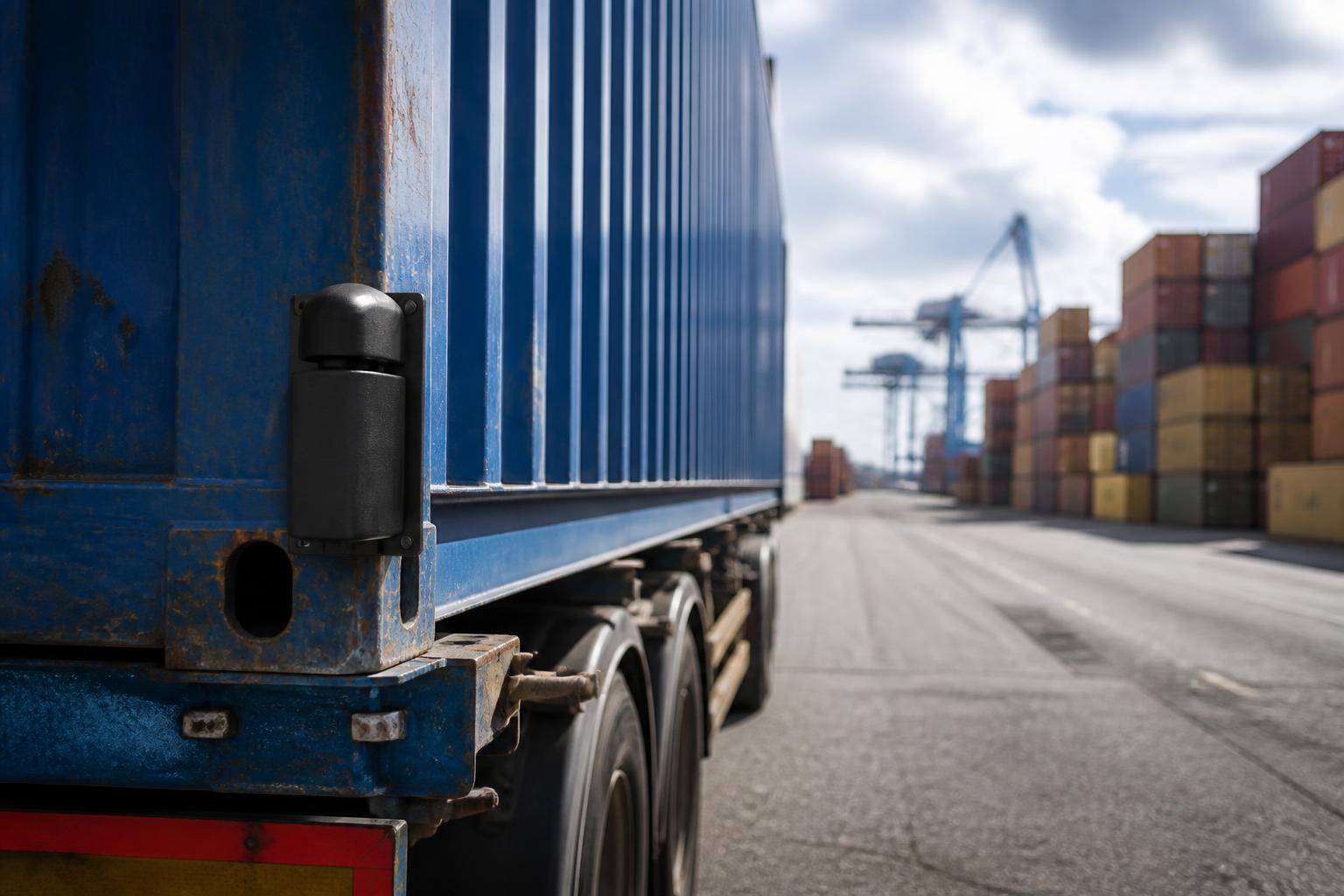
Container tracking earns its keep in 2026 when it prevents a real cost, not when it simply adds another map to look at. For UK importers and forwarders, the useful question is not whether a container can be seen on screen. It is whether tracking changes a decision early enough to avoid a failed collection, a storage day, a detention bill, a wasted driver shift, or a customer delivery that misses its slot.
That matters because most avoidable cost on a GB container move still sits around release, customs position, port booking, free time, quay congestion and delivery coordination. We see that every day on merchant haulage jobs from Felixstowe, London Gateway, Tilbury, Purfleet, Southampton and Liverpool. A tracking device can help on some flows. It cannot fix poor milestone control. Any honest guide to GPS tracking solutions for the shipping containers industry in 2026 needs to start there.
What container tracking is actually for in 2026
In practice, container tracking has four main uses.
First, it helps with exception management on inland moves. Once a box is on a vehicle, live position and route progress can be useful if the consignee has a fixed unloading window, if the delivery point is difficult to access, or if a late arrival triggers labour or equipment cost. This is strongest on long road legs, timed RDC bookings, and sites where a missed slot means rebooking.
Second, it supports security and chain of custody on higher risk cargo. That can include electronics, alcohol, tobacco, branded consumer goods, and other loads where an unexplained stop or route deviation needs quick action. The value here is not the dot on the map by itself. It is the alerting rule, the response process, and the fact that someone actually acts on it.
Third, it can help monitor condition for sensitive cargo. For a Refrigerated Container, temperature data may matter, but only if the sensor source is understood. There is a big difference between reefer unit setpoint information, return air readings, and an independent logger inside the load space. For food, feed and other controlled cargo, the data needs to match the risk you are trying to manage. We covered some of the operating basics in our guide to how temperature control works in a Refrigerated Container.
Fourth, it gives better post-move reporting. That is useful for service reviews, claims handling, customer dispute resolution and lane planning. If a consignee says a vehicle arrived late, or if an importer wants to know where dwell time is building up, movement history can answer it.
What tracking is not for is replacing core container control. It does not create a valid release. It does not clear a customs hold. It does not book a slot in CARGOES VBS at Felixstowe or secure access through another port booking system. It does not tell you whether the line will waive a charge, whether a quay crane stoppage has changed stack access, or whether a merchant haulage collection is realistic within free time.
That is the gap between visibility claims and operational value. A platform may show milestones from the shipping line, the port, the haulier and the device. Useful. But if those milestones are late, estimated, or not tied to who is actually responsible for the next action, the screen looks better than the operation really is.
For most FCL import work in Great Britain, the best use of tracking is selective. Apply it where the cargo risk, delivery sensitivity or inland distance justifies it. Do not assume every 20ft ISO Container or 40ft ISO Container needs a device. Many do not. On some flows, a disciplined milestone process and a responsive haulage team save more money than hardware ever will.
What data these systems can and cannot give you
The practical limit of any tracking system is that a container move is not one continuous data environment.
At sea, GPS device reporting may be intermittent, switched to low power, or blocked by container position in the stack. Shipping line event feeds may tell you vessel departure and arrival, but not precise real time movement of your individual box. If you are buying tracking to solve ocean uncertainty, be careful about what is actually being sold.
In port, signal quality can be poor and event timing can lag. A device may know the container is inside the terminal area, but not whether it is available for collection, grounded in an accessible stack, under customs control, or still awaiting line release. Port systems know some of that, but not always in a form that third party platforms receive instantly. In the UK, that distinction matters. A box can be physically in Felixstowe or London Gateway and still not be collectable for reasons a GPS trace will never show.
On the road, location data is usually strongest. Once the unit is mounted correctly and reporting, you can normally see route progress, stops and ETA movement with reasonable accuracy. That is where tracking delivers the clearest operational value. But even here, it does not always tell you why a vehicle is stationary. Traffic, a driver break, roadside checks, queueing for site access, and a delivery refusal can all look similar until someone checks the job.
At customer handover, data gets thinner again unless the system links to proof of delivery. GPS may show arrival and departure geofences. It does not prove what happened on the bay. If a consignee disputes waiting time, damage condition, seal status or unloading completion, you still need the transport documents, timestamps, driver notes and any photographs.
Sensor data has similar limits. Door open alerts can be useful, but on some moves the doors will open legitimately before final delivery for inspection or official checks. Shock and tilt sensors can show an event, but not automatically whether cargo damage followed. Humidity and temperature readings can support claims analysis, but only if the sensor placement, calibration and reporting interval are suitable for the commodity.
Battery life is another practical constraint people underestimate. Reporting every few minutes with multiple sensors and roaming coverage drains power. Reporting a few times a day preserves battery but reduces usefulness. Some devices are designed for one trip, some for repeated use, some for asset recovery after an exception. If the reporting plan does not match the job length, the data will disappoint.
This is why any serious 2026 industry report on GPS tracking solutions for shipping containers should separate data sources clearly:
- device location data
- sensor data from the device
- telematics from the tractor unit
- line and vessel milestone feeds
- port event feeds
- customs and release status from operating systems or manual updates
- POD and delivery event data from the haulier
They are not the same thing, and they do not fail in the same way.
Where importers and forwarders usually see the return
The best return usually appears where the inland move carries a meaningful cost of failure.
One example is high value cargo with theft exposure. If a container should travel directly from port to a secure delivery point, route deviation alerts and stop duration alerts can justify themselves quickly. The same applies where cargo is attractive and the consignee expects active monitoring.
Another is time critical delivery. If a factory shutdown depends on a single FCL, or if a retail booking window is fixed and expensive to miss, live road visibility can help the delivery team prepare, rebook, or escalate before the vehicle reaches the gate. It will not remove motorway disruption, but it can reduce the knock-on cost.
A third is remote or long distance inland delivery from the main ports. A move from Southampton or Felixstowe into Scotland, Wales, Cornwall or a constrained city site has more time for plans to change and more value in ETA updates than a short local run into the port hinterland.
Tracking can also pay on difficult consignee sites. If the unloading point has crane hire, labour booked by the hour, or restricted access windows, better arrival forecasting matters. The same is true for specialist commodities moved in ISO containers where discharge arrangements are not simple.
There is also a case for selective use on LCL deconsolidation and urgent part loads, but only where the handover points are clear. LCL often involves more warehouse events and less direct control over the full container movement, so the return depends on what part of the chain you actually manage.
Where we usually do not see a strong return is on routine, low risk, short haul port deliveries where the consignee is flexible and the main exposure is not in-transit uncertainty but pre-collection readiness. If the real problem is that the release is late, customs is uncleared, VGM or documentation is wrong, or free time is being consumed before anyone can book the collection, then tracking the road leg does not address the cost driver.
That is also why detention and demurrage control often sits outside the device itself. The money is won or lost in planning the collection date, checking line terms, and avoiding boxes sitting where they should not. We see those costs build when communication is late or assumptions are wrong, which is why we advise clients to focus first on how detention charges build up on UK container moves.
Cargo type matters too. A 45ft ISO Container delivering to a retail network may justify richer ETA management than a standard 20ft ISO Container going to a flexible industrial yard. A Refrigerated Container may justify condition monitoring if the commodity risk supports it. Bulk or overweight containers often benefit more from correct pre-planning than from location data, especially where permits, axle weights or discharge equipment affect the move. On those jobs, the bigger saving often comes from moving overweight containers without port delays.
How to compare tracking options without buying the wrong system
Start with the problem, not the hardware.
Ask what decision the system must improve. Is it theft response, ETA accuracy, temperature assurance, customer reporting, or all of those? If there is no defined operational action tied to the alert, the alert will become noise.
Then compare device types. Broadly, you will see reusable battery devices fixed to the container, disposable or trip devices for one-way moves, telematics linked to the truck, and platform-only products that rely on milestone feeds rather than a physical tracker. Each has a place. For direct merchant haulage road visibility, truck telematics and job milestone updates can be enough. For unattended container security, a container-mounted device may be the right choice.
Battery life should be checked against reporting frequency, trip duration and sensor use. A headline battery claim is meaningless unless you know the ping interval and roaming conditions behind it. Ask for the reporting profile in writing.
Coverage matters in two ways. One is mobile network roaming across the actual countries and ports on your lanes. The other is signal performance in terminals, depots and dense urban delivery points. If your traffic is mainly within Great Britain after discharge, road coverage may be straightforward. If you expect reliable reporting at every point inside every terminal, be cautious.
Integrations are often more important than the device. Can the platform accept line milestones, port events, POD timestamps and your own job references? Can it push ETA updates into your TMS or customer portal? If not, your team may end up rekeying data and paying for visibility that creates admin.
Alerting needs to be configurable and limited to exceptions that matter. Good examples include route deviation beyond a defined tolerance, excessive stop duration on a high risk load, arrival at delivery site, or failure to depart port within an expected window after collection. Poor examples are alerts so frequent that nobody trusts them.
Ownership model affects total cost. Some providers sell hardware, some rent it, some charge per trip, some charge per container per month. Work out who owns the device, who retrieves it, who replaces damaged units, and who bears the loss if a box is returned to the line with the device still attached. On import work, reverse logistics for trackers is often the hidden cost people miss.
Reporting should match commercial and operational use. At minimum, ask for exportable movement history, geofenced timestamps, alert logs and user audit trail. If your customers ask for service reviews by trade lane, consignee or carrier, make sure the platform can report that without manual spreadsheet work.
Finally, check what the system does not cover. If you are reading a polished 2026 report on GPS tracking solutions for the shipping containers industry, look for the exclusions page as carefully as the feature list.
What matters in Great Britain beyond the tracking device
In Great Britain, the outcome of a container move is still decided by readiness and coordination more often than by in-transit visibility.
Port booking is the first obvious example. At Felixstowe, access depends on CARGOES VBS. Other ports use their own Container Booking System or CBS arrangements. If the slot is wrong, unavailable or booked too late, a perfect tracker will simply show that the container is still in port. The same applies if the release has not landed correctly with the line or terminal.
Customs position is another. A container can be discharged and physically present but still not ready to move because customs clearance is incomplete or an intervention is in place. In the UK, you need to treat customs status as its own control point. It is not enough to know the vessel arrived.
Free time and line terms remain central. Detention starts from the contractual position, not from when a map first shows movement. Demurrage and storage depend on where the box sits and under whose control. Tracking may help evidence timing, but it does not alter the underlying tariff.
Haulage coordination matters just as much. The best result comes when the collection plan reflects release status, free time, port booking availability, delivery constraints and driver capacity at the same time. That is where an experienced container haulier changes the cost outcome. We book the slot, check the collection is actually actionable, and flag early when a box is at risk instead of waiting for the planned day to fail.
This is especially important on merchant haulage, where the importer or forwarder has chosen to control the inland move rather than leave it to the carrier. With that control comes responsibility for making sure the handoffs are clean. If the line, customs broker, warehouse and haulier are all working from different assumptions, the device becomes a witness to the problem rather than a solution.
That is also why port-specific knowledge still matters. The practical issues around collecting at Felixstowe are not identical to London Gateway, Tilbury, Purfleet, Southampton or Liverpool. Booking patterns, queue risk, stack access, delivery distances and consignee expectations differ. If your cargo is moving inland from Essex into central England, the transport plan itself may matter more than any extra visibility layer, as we set out in our guide to moving containers from London Gateway to the Midlands.
At Jagelo Haulage Limited, we run 40 vehicles and 40 trailers under operator licence OF2023521, with vetted partner hauliers on their own operator licences covering additional volume when needed. Since 2019 we have moved more than 75,000 containers, mainly FCL import work from Felixstowe, London Gateway, Tilbury, Purfleet, Southampton and Liverpool into destinations across Great Britain. That experience shapes our view of tracking in a simple way.
Use tracking where it changes a decision and protects a real cost. Do not expect it to replace release control, customs readiness, free time management or proper haulage planning. For many importers and forwarders, the cheapest avoidable cost in 2026 will still be the one prevented before the container ever leaves the port.
Does GPS tracking tell me exactly when a container will be delivered?
No. It can improve visibility, but delivery timing still depends on release, customs status, port booking, traffic, site readiness and other operational constraints.
Is GPS tracking useful for every FCL movement?
Not always. It is most useful where cargo value, theft risk, temperature sensitivity, detention exposure or customer reporting needs justify the extra cost.
Can tracking reduce demurrage and detention on its own?
No. It can help teams spot delay risk earlier, but charges are still driven by free time, release timing, customs holds, booking availability and unloading turnaround.
What is the difference between a container tracker and vehicle tracking?
A container tracker follows the box itself. Vehicle tracking follows the lorry. They answer different questions, especially when containers dwell in ports, yards or customer premises.
Should importers ask their haulier about tracking before booking?
Yes. The useful question is not just whether tracking exists, but what milestones, exceptions and handover updates the haulier can actually provide for that move.