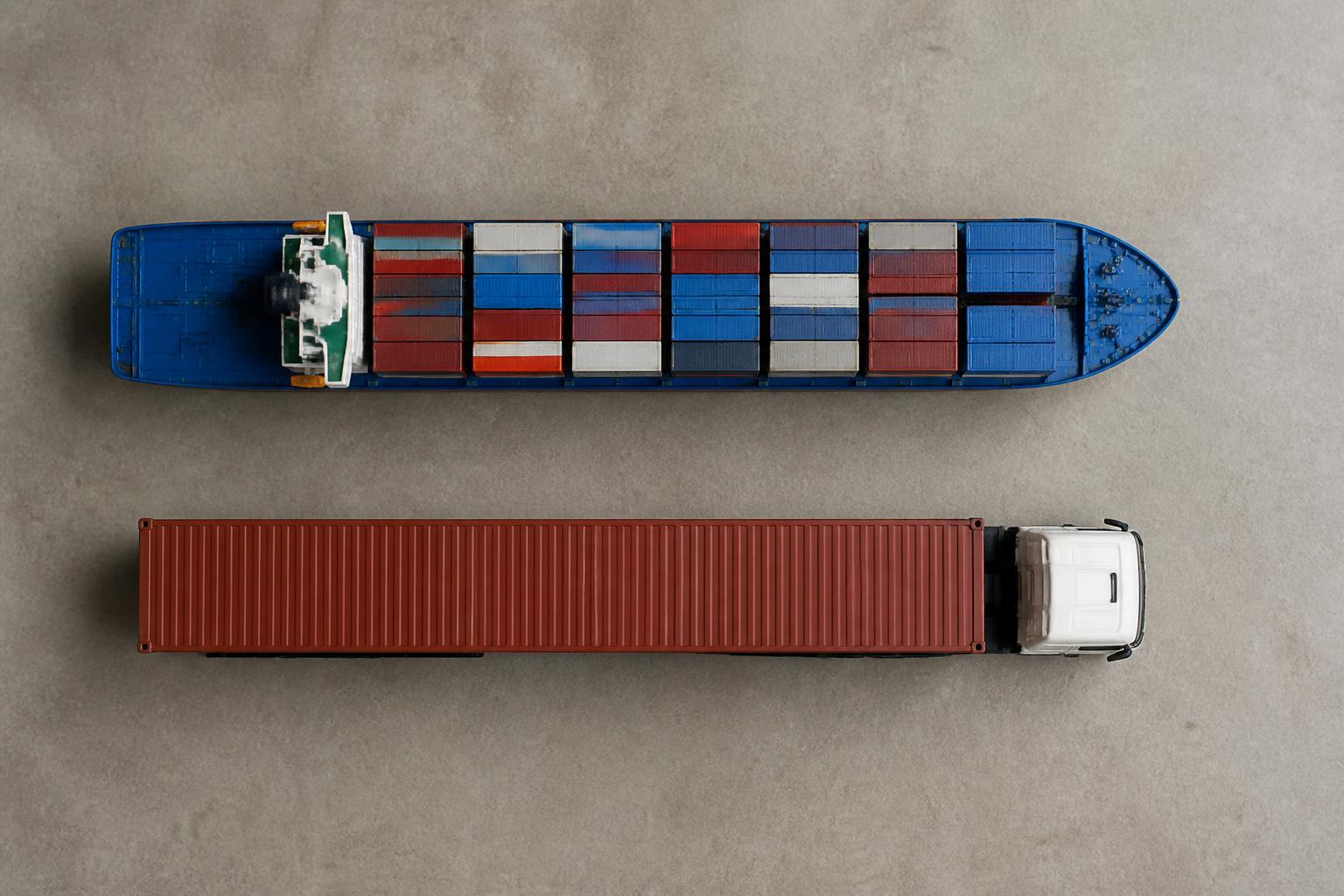
If you are deciding between a freight forwarder and a haulier for a UK container move, the short answer is this. A forwarder coordinates the wider shipment, the bookings, documents and handovers across sea, road and sometimes warehousing. A haulier moves the box on the road, collects from the port, manages the slot, and gets it delivered within the limits of release, customs status, free time and site access.
In practice, the choice is often not freight forwarding or haulage as though one replaces the other. It is about who should lead the move, who controls the road leg, and who is best placed to spot problems early enough to avoid storage, demurrage, detention and failed collections. For many Great Britain import deliveries, especially FCL port to premises work, the strongest setup is a forwarder or importer booking a container haulier directly on merchant haulage terms.
What freight forwarding and haulage each do
Freight forwarding and container haulage sit next to each other, but they are not the same job.
A freight forwarder arranges the shipment as a whole. That can include the ocean booking, routing, pre-alerts, document flow, customs coordination, depot returns, transhipment points, unpack arrangements and communication between shipper, consignee, carrier and agents. If the movement is part of a wider supply chain, the forwarder is usually the party joining the stages together.
A container haulier handles the road movement of the container itself. In UK port work that usually means collecting from Felixstowe, London Gateway, Tilbury, Purfleet, Southampton or Liverpool, booking the port slot, checking release status, monitoring customs position, planning the delivery, and arranging the empty return if that is part of the instruction. The work is operational and time critical. A road plan that is right at 09:00 can be wrong by 11:00 if the release has not landed, the port booking has moved, or the site cannot take the box.
There is overlap. Both a forwarder and a haulier may look at ETA, release, customs clearance and delivery timing. Both may speak to the consignee. Both may need to know whether the unit is a 20ft ISO Container, 40ft ISO Container, 45ft ISO Container or Refrigerated Container. But the overlap does not mean the responsibilities are interchangeable.
The clearest dividing line is this. A forwarder manages the shipment chain. A haulier manages the truck movement and the practical collection and delivery of the container. If the move is a straightforward FCL import into Great Britain, with customs already in hand and a delivery point that can take the box, the road leg can often be booked directly with a haulier without losing control. If the move is more layered, a forwarder usually needs to lead.
At Jagelo Haulage Limited, we work mainly on direct booked merchant haulage for importers, freight forwarders and customs agents. That means we are not trying to be the ocean carrier, the customs broker and the warehouse operator at the same time. We focus on collecting port containers and getting them delivered within Great Britain, with the road leg managed properly from slot booking to POD.
Who controls the container move and why it matters
The biggest operational distinction in UK container work is usually not forwarder versus haulier, but carrier haulage versus merchant haulage.
Under carrier haulage, the shipping line controls the inland road leg. The line appoints the haulier, books the move and usually decides the inland timing options available within its own process. If there is a delay on the road side, the line and its nominated suppliers sit between the cargo owner and the truck. That can work well on some routings, but it also means visibility is filtered. The importer or forwarder may not hear about a problem until after the planned collection window has already been lost.
Under merchant haulage, the importer, forwarder or customs agent books the road leg separately with a container haulier. The ocean carriage stays with the line, but the inland movement is under the customer’s control. That changes two things immediately. First, you decide who moves the box. Second, the party actually trying to collect it from the port sees the obstacles first.
That matters because many UK container delays are not theoretical. They are visible in live operations. A release may not yet be registered against the unit. Customs may still show a hold. The terminal may have no suitable slot left in CARGOES VBS or another Container Booking System. The delivery postcode may push the move outside legal driving time once waiting time is added. The consignee may ask for a date that falls after free time expires. On carrier haulage, you often hear about these issues after they have already reduced your options. On merchant haulage, you can usually act earlier.
This is one reason direct road booking is common for Great Britain imports. If we are instructed early, we can plan around vessel arrival, free time and delivery constraints, and say plainly when a box is at risk. That is especially useful at ports such as Felixstowe, where the timing of release, slot availability and final delivery all need to line up.
Where costs and delays usually arise
Most avoidable cost on UK container moves comes from a short list of pressure points.
The first is release. If the shipping line has not issued a valid release, or the release has not updated in the terminal system, collection cannot proceed even if the truck is ready and the slot is booked. The same applies where line charges remain unpaid or documentary requirements are still open. A road booking made too early without checking the release position can turn into a wasted slot or a failed collection.
The second is customs status. Great Britain import procedures are not the same as a general EU template, and the practical issue for haulage is simple. If the customs entry is not in a collectable state, the container does not move. Whether the hold sits with HMRC, DEFRA or another control point, the effect on the road leg is the same. Time is lost, and free time keeps running.
The third is port booking. At several UK ports, access is managed through terminal booking platforms. Felixstowe uses CARGOES VBS, and other terminals use their own Container Booking System, often shortened to CBS. A booking window that works for the consignee may not be available at the terminal. A booking window that is available at the terminal may not work for the delivery site. Good haulage planning is often about finding the point where those two realities meet.
The fourth is free time. Demurrage and detention are often discussed together, but they arise in different places. Demurrage is linked to use of the container in the port or terminal environment. Detention is linked to use of the equipment outside it. Both can escalate quickly if the delivery date is agreed without checking release, customs, slot availability and return timing. We cover that in more detail in our guide to how UK importers cut demurrage before charges start and our breakdown of how detention charges build up on UK container moves.
The fifth is failed collection or failed delivery. Common causes are incorrect container numbers, missing PIN or release references, VBS bookings made for the wrong day, overweight cargo not declared in advance, unsuitable delivery access, or a site that cannot tip or accept the unit when the vehicle arrives. With ISO containers, details that look minor on an email chain can decide whether the move succeeds first time.
The sixth is handover between parties. A forwarder may assume the customs agent has sent the cleared entry. The customs agent may assume the haulier has the release. The consignee may assume the empty return is days away when in fact detention starts immediately after unloading. This is where clear responsibility matters more than theory.
When a freight forwarder is the right lead
A freight forwarder should lead when the shipment needs one party to coordinate more than the road leg.
That includes multi-leg imports with sea, road, devanning and onward distribution. It includes LCL shipments where the cargo is moving under a consolidation process rather than as a single full container. It includes shipments where the destination, customs treatment or delivery sequence may still change after vessel arrival. It also includes cargo where multiple suppliers, purchase orders or consignee sites need to be managed under one movement plan.
A forwarder is also the right lead where documentation is the main risk. Examples include shipments with letter of credit conditions, controlled goods, special origin requirements, split delivery instructions, or handovers between bonded and free circulation stock. If the critical path runs through documents and cross-party coordination, the forwarder should remain in front.
The same applies where the move involves more than one customs event. If goods are arriving under one status and moving onward under another, or if the container needs to transfer between ports, depots, temporary storage or inspection points before final delivery, somebody needs to own the chain. That is not just a trucking question.
Forwarders also add value when shipment volume is dispersed. If you are managing mixed origins, mixed carriers and mixed UK destinations, a forwarder can standardise communication and exceptions handling. In those cases, the road haulage provider is one specialist within a broader plan.
We work with forwarders in exactly that way. They lead the shipment, and we lead the road operation. If they need a delivery from Felixstowe to an inland site, or a collection from London Gateway, Tilbury, Purfleet, Southampton or Liverpool, we slot into the plan and run the container move. That is often the cleanest division of responsibility.
When direct haulage booking makes more sense
Direct haulage booking makes most sense when the shipment is a straightforward container move inside Great Britain and the main operational risk sits in the road leg, not in the wider transport chain.
A typical example is an FCL import where the ocean booking is already fixed, customs is being handled separately, and the consignee simply needs the container collected and delivered on time. In that situation, booking a haulier directly on merchant haulage terms usually gives better visibility and faster decisions than leaving the inland leg inside carrier haulage.
It also makes sense for freight forwarders who do not want the road leg hidden behind the shipping line. If we are booked directly, we can tell you whether the release is missing, whether the terminal slot is available, whether the delivery date puts free time at risk, and whether the site access works for the unit size. You do not have to wait for that information to filter back through carrier channels.
Customs agents also benefit from direct booking when they are the party closest to clearance status. If the customs agent knows exactly when the hold is expected to lift, direct communication with the haulier can turn that into a realistic collection plan. That is much harder when the road leg sits with the line.
Direct booking is especially useful for businesses receiving containers regularly. If your site already knows what it can take, whether that is a 20ft ISO Container, 40ft ISO Container, 45ft ISO Container or Refrigerated Container, then the key requirement is often dependable execution. We handle port slot booking, collection timing and delivery planning, and we raise issues early rather than after the free time has narrowed.
This is the work we do every day. We operate 40 vehicles and 40 trailers of our own under operator licence OF2023521, with vetted partner hauliers on their own operator licences for extra volume. Since 2019 we have moved more than 75,000 containers, mostly on direct booked merchant haulage. For customers carrying higher value cargo, our freight liability is £6,500 per tonne under RHA 2024 conditions, with the same limit applying to subcontracted loads, and higher cover available by arrangement. Where the cargo type requires it, we are also an upper tier waste carrier and dealer, CBDU471791, and APHA registered for Category 3 animal by-products and animal feed in shipping containers, quay to premises, U1433815/TRANS.
If the decision turns on cost structure, our article on what sets container haulage pricing in Great Britain explains where the road leg price usually moves.
How to choose the right setup for UK port containers
The best setup starts with one practical question. What part of the move is most likely to go wrong?
If the answer is document flow, customs sequencing, multiple handovers or mixed-mode coordination, let the forwarder lead and appoint the haulier as a specialist road provider.
If the answer is release timing, terminal booking, delivery planning, free time exposure or site access, book the road leg directly with a container haulier on merchant haulage terms.
A simple framework helps.
First, look at shipment type. FCL import to one Great Britain delivery point usually suits direct haulage booking. LCL, multi-drop, cross-dock or bonded flows usually suit forwarder-led coordination.
Second, look at responsibility. Who is arranging customs. Who is watching release. Who is confirming that the consignee can receive the box. If those answers sit with different parties, decide who has authority to make the final call on collection timing.
Third, look at communication speed. When a problem appears, who sees it first. In many cases the best answer is the party booking the truck. If that party can act immediately, risk falls.
Fourth, look at free time and return exposure. If the container must be collected and turned quickly, the road leg needs active management. That includes planning the port slot, delivery date, unloading window and empty return as one sequence, not as separate tasks.
Fifth, look at the receiving site. Access limits, booking-in rules, forklift availability, tipping times and weight constraints should be checked before the port slot is committed. A container move fails on details, not on theory. Our guide on keeping container deliveries moving when plans change covers the operational side of that.
For many UK importers, forwarders and customs agents, the conclusion is straightforward. Use a freight forwarder where the shipment needs full chain coordination. Use direct haulage booking where the inland container move needs close control, clear communication and early warning of risk. That is not a contest between forwarding and haulage. It is about putting the lead role with the party best placed to keep the container moving.
From our base at Bridge Farm, Woolpit, Suffolk, about 35 miles by road from Felixstowe, we handle container collections from Felixstowe, London Gateway, Tilbury, Purfleet, Southampton and Liverpool and deliver across Great Britain. If you already know the wider shipment plan and need the road leg run properly, that is where we fit.
Is freight forwarding the same as haulage?
No. Freight forwarding coordinates the shipment and its documents. Haulage is the physical inland move by road. On a container import, both may be involved, but they are different functions.
What is merchant haulage?
merchant haulage means the importer or freight forwarder books the road move directly with the haulier, rather than taking the shipping line’s inland haulage option.
Who books the port slot for a container collection?
That depends on the setup. Under merchant haulage, the haulier usually books the collection slot once release and customs status allow it. At Felixstowe this is done on the Container Booking System, or CBS.
Does a freight forwarder need a separate haulier?
Often yes. A freight forwarder may manage the shipment, but a container still needs a road haulier to collect it from the port and deliver it within Great Britain.
When is direct booking with a haulier useful?
It is useful when the importer or forwarder wants direct control of the road leg, early warning on free time risk, and clear communication on release, customs holds and collection planning.