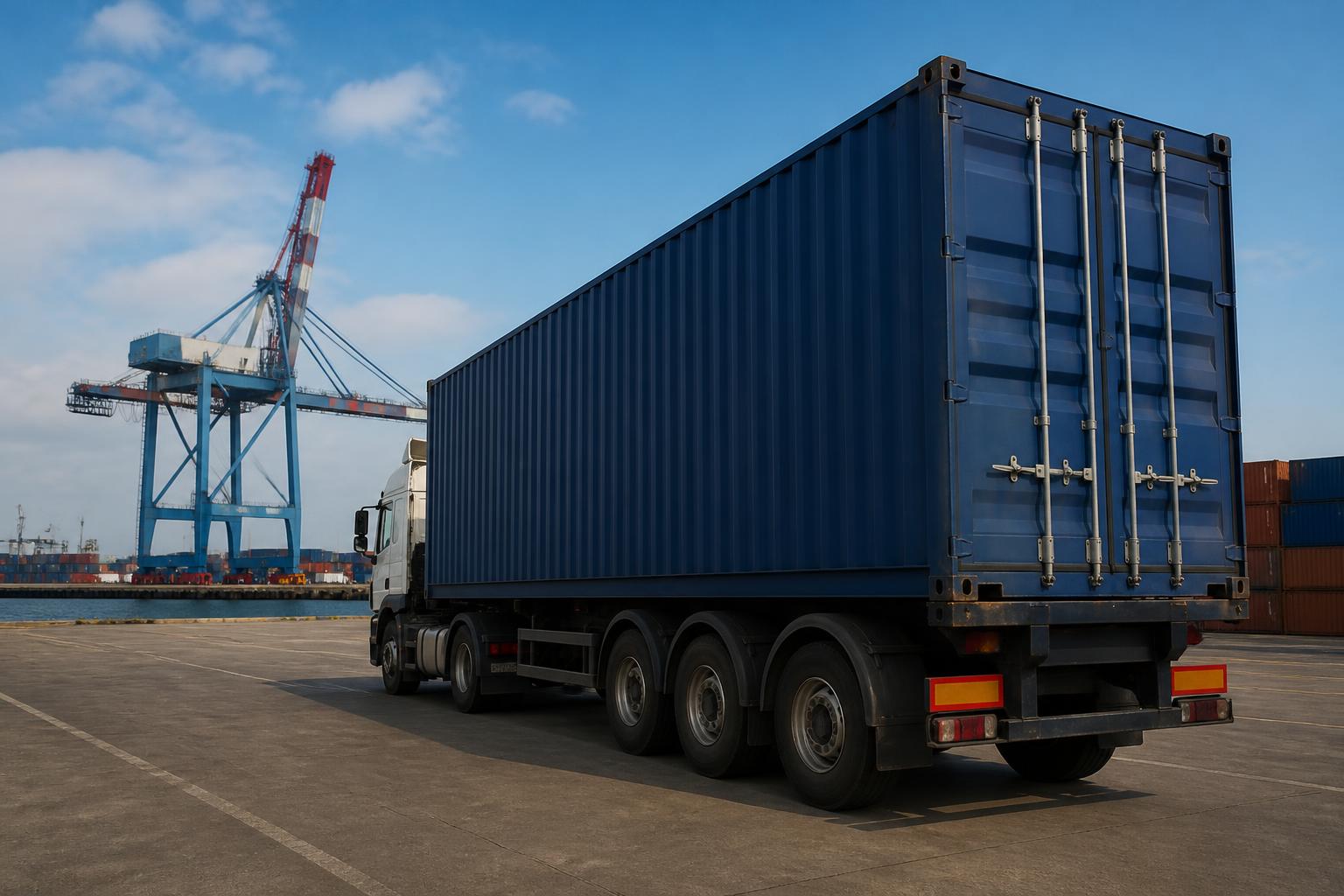
Port storage costs are usually avoidable, but only if the road move is planned around the actual container release, the port booking system, and the free time on the line. In practice, that means getting the paperwork in order early, checking whether the box is genuinely collectable, booking the slot as soon as the release and customs position allow, and saying straight away when a container is likely to roll into demurrage or storage risk.
That is where good container transport services make a difference. For importers, forwarders and customs agents in Great Britain, the haulage job is not just a truck turning up at the quay. It is the operational work between release and delivery, including booking, port collection, timing, equipment choice, and escalation when something in the chain is not ready.
What container transport services include
For deep sea imports, container transport services usually start before the driver enters the port. The road move depends on whether the container has been released by the shipping line, whether customs clearance is in place, whether the terminal booking can be secured, and whether the delivery point can receive the box within the available time.
For importers and freight forwarders, the scope normally includes:
- checking the collection details against the shipping line release
- confirming customs status before dispatch
- booking the port slot
- planning the correct vehicle and trailer for the container size and weight
- collecting loaded ISO containers from the terminal
- delivering to the consignee or unpack point in Great Britain
- reporting problems early, especially where free time is short
In Great Britain, this work often sits with the haulier under merchant haulage, rather than with the ocean carrier under line haulage. That means we are working directly to the importer, forwarder or customs agent’s instructions, while still having to operate within the terminal and shipping line rules that govern release and collection.
The equipment side matters too. Not every move is the same just because it is a container. A 20ft ISO Container with dense cargo needs different planning from a light 40ft ISO Container, and a 45ft ISO Container can bring separate routing or delivery site constraints. A Refrigerated Container may be moved as a standard road leg, but the consignee still needs to be ready for the unit and any power or unloading requirements at destination.
Handling ISO containers properly also means checking practical points that affect the road leg, including:
- container size and type
- gross weight
- whether the cargo is floor loaded or palletised
- whether tipping time is realistic for the delivery site
- whether the delivery address is suitable for an articulated vehicle
- whether the box will be live unloaded, devanned, or tipped and returned later
Where the shipment is specialist, the haulage scope can also include compliance checks beyond the usual road move. We are registered as an upper tier waste carrier and dealer, and with APHA to carry Category 3 animal by-products and animal feed in shipping containers, quay to premises. That matters where the cargo itself affects who can legally handle the move.
How the collection process works from release to delivery
The practical sequence is usually straightforward, but the timing is not forgiving.
First, the shipping line or its agent must issue the release. Without that, the container may be physically in port but not available to collect. The release needs to match the container number and movement instructions, and any holds that sit with the line need to be cleared.
Second, customs clearance must be in place. In Great Britain, that means the import formalities for the movement have to be completed before the container can be collected. If there is a customs hold, an inspection instruction, or missing data on the declaration, the road move cannot simply proceed because the free time is running out. The status has to be clear.
Third, we book the terminal slot. At Felixstowe this is done through the Container Booking System, commonly referred to as CBS. Other ports use their own vehicle booking systems, including CARGOES VBS at London Gateway. The principle is the same. A container may be released and customs cleared, but if no collect slot is available in time, the planning risk changes immediately.
Fourth, we dispatch the vehicle for collection. At that point we are working with the actual operational conditions on the day, including traffic, terminal queues, cut offs, and whether the box is presented without issue. If there is a problem at the port, such as the container not being available in stack, a system discrepancy, or a hold still showing against the unit, that needs escalating at once.
Fifth, once the container is on wheels, we deliver to the consignee or unpack point in Great Britain. Delivery can be same day or planned for a later date, depending on the slot time, the distance from port, and the receiving site’s availability.
In a normal import move, the key documents and references we need before collection are:
- container number
- shipping line release details
- customs clearance status
- port or terminal collection reference where required
- delivery address
- contact details for the receiving site
- gross weight and container size
- any special delivery instructions
This sequence sounds basic because it is basic, but the cost problems usually come from one weak link in it. A release arrives late. Customs is assumed complete but is not. The booking is left until the day before free time ends. The delivery site cannot receive the box after it has been collected. Each of those failures can convert a normal port move into storage exposure.
Why free time and port systems matter
Free time drives the urgency on most import collections. Once the shipping line’s free time expires, demurrage can begin to accrue. Depending on the port and terminal arrangements, storage exposure may also arise if the container is not removed in time. The exact charging structure sits with the line and terminal terms, not the haulier, but the haulage plan has to be built around those dates.
This is why we ask for release and customs status as early as possible. If a container is due out of free time tomorrow, but the release is still pending and no slot has been booked, there is an obvious risk. It is better to flag that immediately than to pretend the move is routine.
At Felixstowe, the Container Booking System and CBS availability can materially affect whether a box can be collected within free time. A container can be legally collectable and still difficult to recover if the available bookings do not line up with the remaining free days. The same applies at other ports through their own systems, including CARGOES VBS at London Gateway.
What matters operationally is not just whether a booking system exists, but how it affects the real collection window. We look at:
- when the release became active
- whether customs is fully clear
- what free time remains
- whether booking slots are open in the right timeframe
- whether the delivery point can receive the box once collected
That last point is often missed. Collecting a container to protect free time only works if there is somewhere lawful and practical to take it. If the delivery site cannot receive until two days later, the answer may be to change the delivery plan early, not to wait and hope the timing fixes itself.
For a closer look at avoiding avoidable charges on port collections, see our guide to choosing a bulk container transporter without added port cost.
Merchant haulage, FCL and LCL in practice
The difference between merchant haulage and line haulage matters because it changes who controls the road move.
Under merchant haulage, the importer, forwarder or customs agent books the haulier directly. The ocean carrier is still involved for release and free time, but the inland transport sits with us under separate instruction. This is common where the customer wants control of timing, routing, communication and delivery planning.
Under line haulage, the shipping line arranges the inland move as part of its own service. In that case the importer may have less direct control over the road leg, and the communication route can be less direct if there is a collection issue.
For port import work in Great Britain, much of what we handle is merchant haulage. That suits customers who want the haulier to book the slot, work against the release and customs position, and raise risk early rather than after free time has been lost.
FCL and LCL also affect the road move in different ways.
With FCL, the container is moving as a full box for one consignee or one controlling shipment. The haulage task is usually to collect the sealed container and deliver it to the named premises or unpack point. Planning then depends on container size, weight, site access and unload method.
With LCL, the cargo is less than container load, usually consolidated with other shipments. In many cases the road move from the port is to a deconsolidation point rather than the final importer’s premises. The consignee may think only in terms of pallet count or CBM, but the road plan still depends on the actual container that has to be collected and where it is going to be unpacked.
CBM matters because it affects unpack planning, even if the road vehicle is carrying the whole box. A low CBM shipment in an LCL environment may be straightforward at destination because the unpack point is set up for rapid devanning. A high CBM or awkwardly stowed FCL may need more receiving time, labour, or equipment. The road move should be aligned with that reality.
The practical questions are:
- is this FCL or LCL
- where is the first unload point
- is the container being live unloaded or left for devanning
- how long will the site need
- does the box type match the cargo and receiving plan
Where container type affects the move, we also plan around that. If your shipment is a dense 20ft unit, our guide to choosing 20ft container haulage without avoidable port costs covers the issues that typically affect timing and handling.
What to check before you book a haulier
Before booking a haulier for port collection, we recommend checking the operator on the points that actually affect whether your container gets moved properly.
First, confirm port coverage. A haulier may be strong in one port and less practical in another. We collect from Felixstowe, London Gateway, Tilbury, Purfleet, Southampton and Liverpool, with delivery across Great Britain. If your volume regularly moves through more than one gateway, that matters.
Second, confirm the operator licence. In the UK, a container haulier running its own vehicles should be operating under a valid goods vehicle operator licence. Our licence is OF2023521. If extra volume is covered through subcontractors, ask whether those partner hauliers are also working on their own operator licences.
Third, check fleet and equipment reality. You need to know whether the haulier is running its own vehicles, what trailer capacity it has, and how overflow is handled. We run 40 vehicles and 40 trailers of our own, with vetted partner hauliers taking additional volume when needed.
Fourth, check freight liability. This is not a minor point. Standard RHA terms are often lower than customers assume. Our freight liability cover is £6,500 per tonne under RHA 2024 conditions, with the same limit applying on subcontracted loads, and up to £10,000 per tonne available by arrangement for high value freight. If your cargo value is sensitive, ask the question before the move, not after a problem.
Fifth, check whether the haulier understands the cargo category if it is regulated. Waste, animal by-products and feed movements are not just normal port jobs with unusual cargo descriptions. They can require specific registrations. If your load falls into those categories, make sure the haulier is actually set up for it. For feed movements, our article on choosing feed container haulage without avoidable port cost covers the practical issues.
Sixth, ask how problems are escalated. The right answer is not “we will see on the day”. You want to know who checks release and customs status, who books the slot, who flags free time risk, and when you will be told if the plan is slipping.
Finally, check whether the haulier speaks in operational terms you recognise. If they cannot tell you how they work around CBS at Felixstowe, CARGOES VBS at London Gateway, release timing, demurrage exposure and delivery site constraints, they are not really discussing port haulage in the way import work requires.
When Jagelo Haulage Limited is a fit for the job
Jagelo Haulage Limited is a UK container haulier based at Bridge Farm, Woolpit, Suffolk, IP30 9PQ, about 35 miles by road from Felixstowe. We collect shipping containers from Felixstowe, London Gateway, Tilbury, Purfleet, Southampton and Liverpool and deliver them within Great Britain.
Most of our work is merchant haulage booked directly by importers and freight forwarders. That means we are used to working from the shipping line release and customs position, booking the port slot, collecting the container, and delivering it to the consignee or unpack point while keeping a close eye on free time risk.
We were founded in 2019, and the people running the business have worked in container haulage since 2015. Since 2019 we have moved more than 75,000 containers, at about 13,000 a year. The work includes standard import collections, heavy and awkward units, and regulated cargo categories where the right registrations matter.
Operationally, we run 40 vehicles and 40 trailers on operator licence OF2023521. Where extra volume is needed, we use vetted partner hauliers operating on their own licences. We also carry enhanced freight liability, £6,500 per tonne under RHA 2024 conditions, rather than the standard £1,300, with higher limits available by arrangement.
For regulated movements, we are an upper tier waste carrier and dealer, CBDU471791, and we are registered with APHA to carry Category 3 animal by-products and animal feed in shipping containers, quay to premises, U1433815/TRANS.
We are a fit where the job is a Great Britain port import move and the customer wants the haulier to handle the practical collection process properly. That includes:
- port collection from the main container gateways we cover
- direct delivery to premises in Great Britain
- FCL import moves
- LCL-related container moves to unpack points
- planning around free time and booking windows
- early escalation where release, customs or slot availability puts the move at risk
If your traffic includes specialist box types or heavier port work, our article on Choosing the right haulier for high cube container moves may also be useful.
The main point is simple. Avoiding port storage costs is rarely about one heroic recovery at the end. It is about getting the release checked, customs cleared, booking made, and delivery plan aligned before the free time disappears. That is the day to day work behind effective container transport services, and it is the part we handle for customers moving containers through Great Britain’s ports.
What is included in container transport services?
Usually the road leg from port to delivery point, plus slot booking, collection planning and delivery of loaded or empty ISO containers. The exact scope depends on whether the move is booked as merchant haulage and whether unpack, return or repositioning is also required.
What is merchant haulage?
merchant haulage means the importer or freight forwarder books the road move directly instead of using the shipping line’s inland arrangement. That gives more control over collection timing, communication and cost visibility.
How do free time and demurrage affect container collection?
Free time is the period allowed before storage or equipment charges start. If release, customs or booking delays push collection past that point, demurrage or related charges can follow, so the haulier needs to plan against the deadline.
What sizes of container can a haulier move?
A container haulier will typically move a 20ft ISO Container, 40ft ISO Container and 45ft ISO Container. Some also handle a Refrigerated Container, subject to the job details, equipment and delivery requirements.
What should I ask about freight liability?
Ask what freight liability applies, under which conditions, and whether the same limit applies to subcontracted loads. If the cargo is high value, check whether a higher limit can be arranged before the move is booked.