Part of our guide to container haulage from Tilbury
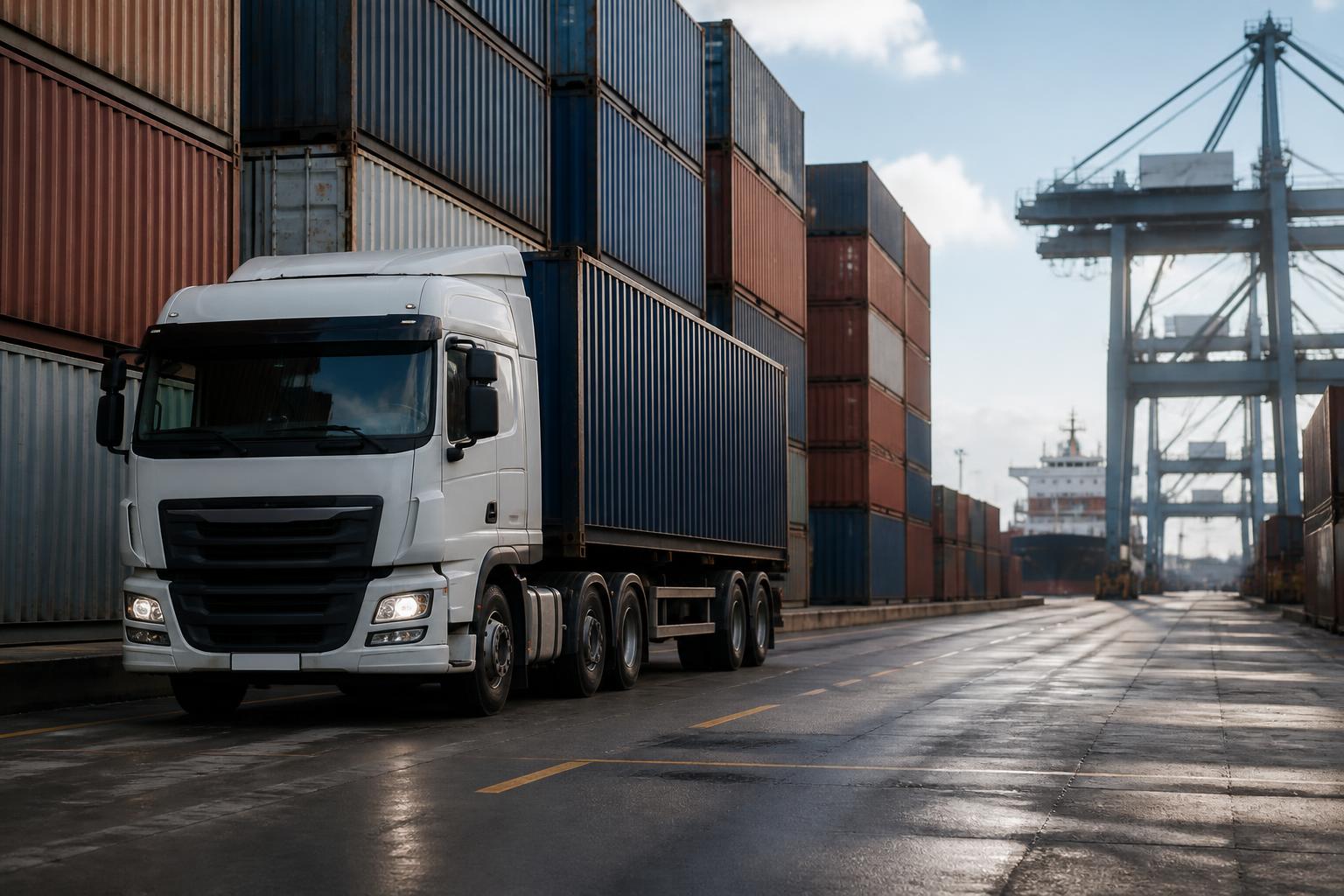
If you are choosing a container haulier for Tilbury, the quickest way to avoid extra port cost is to compare who actually controls the collection. The important difference is not who says they cover the port. It is who books the slot, checks release and customs status before sending a truck, works to the shipping line’s free time, and tells you early when a container is likely to run into storage, demurrage or a missed delivery window.
For most importers, forwarders and customs agents, that means looking past a simple rate per move. A lower linehaul price can disappear very quickly if the haulier cannot secure the right port booking, turns up before the box is clear, or only flags a free time problem once the container is already overdue. When we handle merchant haulage from Tilbury, we treat slot booking and free time management as part of the job, because that is where avoidable cost usually starts.
What matters most when comparing a Tilbury container haulier
When you compare a haulier for Tilbury collections and UK delivery, start with operational control, not sales claims. Ask who is responsible for the collection from the moment the container is released to the moment it leaves the port. If the answer is unclear, that is usually where cost and delay creep in.
The first check is whether the haulier is set up to work directly with port booking systems and shipping line timelines. At Tilbury, that means understanding the port’s vehicle booking process, cut-offs, container availability and how quickly a booking can be changed when customs, line release or delivery instructions move. A haulier that only takes a job once everything is perfectly lined up may suit simple traffic, but it is less useful when the real world intervenes.
The second check is how they plan around the release sequence. On a normal import move, the container still needs the practical basics in place before a truck should be sent. That includes line release, customs clearance or a confirmed route to clearance, and a delivery plan that matches the consignee’s receiving capability. If the delivery site has booking restrictions, forklift limits, weight limits or a strict unloading window, those constraints need to be built in before the port slot is booked, not after.
The third check is whether the haulier can deal with the type of move you are actually booking. Many Tilbury jobs are standard FCL imports on a straightforward quay to premises basis. Others are less simple. You may be moving an LCL devan container to a warehouse, a heavy 20ft ISO Container to a site with axle concerns, or a 45ft ISO Container to a customer with limited turning space. The right comparison point is whether the haulier asks the practical questions early enough to prevent a failed delivery or a redelivery charge.
For importers and forwarders, communication discipline matters as much as transport capacity. We would always want to know the container number, line, size, weight, collection reference, release status, customs status, delivery postcode, booking restrictions and any site equipment limits before confirming the move. If any of that is missing, we chase it early. A container haulier in Tilbury should do the same, because the cost of missing one operational detail is often far higher than the cost of asking one more question.
It is also worth checking whether the haulier works only from one port mindset or can switch between port processes. Businesses that import through more than one gateway often need the same standard of service whether the box lands at Tilbury, Felixstowe or London Gateway. If your traffic changes with vessel schedules or line allocation, consistency across ports matters more than a single-port sales pitch.
Who books the slot and manages the free time risk?
This is usually the point that decides whether a move runs cleanly or becomes expensive. Someone has to book the port slot, monitor the free time and escalate boxes that are drifting toward storage or demurrage. If that responsibility sits in a grey area between the importer, forwarder and haulier, the risk sits there too.
At Tilbury, the practical question is simple. Does the haulier make the booking and manage it actively, or do they wait for somebody else to hand over a finished slot? In our view, a proper merchant haulage service includes handling the booking process as part of the move. That means working with the available information, checking whether the container is actually collectable, and booking a realistic slot against the line’s free time rather than against hope.
The reason this matters is that free time is not a transport theory problem. It is a live operational clock. If customs is still pending, if a release has not landed, if the delivery address cannot receive on the planned day, or if the port booking availability is tightening, somebody needs to identify that before the last free day. Waiting until the container is already in storage is too late.
A good comparison question is, “When do you tell us a box is at risk?” The right answer is not “when the system shows charges.” The right answer is “as soon as we can see the collection is likely to miss free time unless something changes.” That gives the importer or forwarder time to decide whether to prioritise the clearance, move the delivery, arrange a temporary solution, or accept the cost knowingly.
Port booking competence matters here as well. Some operators can move containers perfectly well once they have a confirmed job, but they are less strong on the booking side. At Tilbury, and across other UK ports, the booking itself is part of the service. If your traffic also moves via same-day Tilbury container collection without missed slots, you already know how quickly a booking window can become the main operational issue.
Where a move passes through systems such as CARGOES VBS, Container Booking System or CBS, the process needs to be handled by somebody who uses those systems routinely and understands what the booking status actually means in practice. A slot in a system is not the same as a safe collection plan. The haulier still needs to check that the truck can attend at the right time, that the container is released, and that the delivery end is ready.
This is also where responsiveness separates one haulier from another. If a line amends availability, if a customs hold is lifted late, or if a consignee can suddenly receive earlier, the haulier needs to react fast enough to turn that change into a successful collection. We build that into our day-to-day planning because avoiding avoidable port cost depends on it.
Tilbury only or wider port coverage?
Some importers only need Tilbury. For them, a single-port operator may be enough, provided the service is strong. But many forwarders, customs agents and UK importers do not control where every container lands. Shipping line allocation, service changes, vessel omissions and customer requirements can move traffic between ports quickly. In that situation, choosing a haulier that only works one gateway can create extra admin and inconsistent service.
We collect from Tilbury, Felixstowe, London Gateway, Purfleet, Southampton and Liverpool, and deliver throughout Great Britain. That wider coverage matters when your inbound pattern changes from week to week. It lets you keep one haulage relationship and one operating standard across multiple ports instead of rebuilding the process every time a line routes a shipment differently.
There is also a planning advantage. A haulier with wider port coverage can often spot the knock-on effect of a port change more quickly. A box that was expected at Tilbury might arrive via Southampton instead. A customer who usually lands at Felixstowe may need a London Gateway collection because of schedule changes. If your haulier already runs those ports, the switch is operational, not strategic.
For buyers comparing options, the question is not just “Do you cover other ports?” Ask how often they actually collect there, whether they book those ports directly, and whether the same service terms apply across the network. Some operators advertise broad coverage but rely on ad hoc subcontracting for anything outside their home patch. That can work, but you need to know whether the booking control, communication and liability position stays consistent.
If your business needs both Tilbury and other UK port collections, it is worth reviewing our Tilbury container haulage coverage and collection process alongside our guidance on how to choose a Felixstowe container haulier fast. The same principle applies at both ports. Coverage matters, but control matters more.
Single-port focus can still make sense for a local importer with stable traffic and simple delivery requirements. Wider coverage becomes more valuable when you are managing multiple suppliers, mixed shipping lines, several delivery regions, or regular reallocations between ports. In those cases, consistency of process reduces both cost risk and internal workload.
Own fleet, partner capacity and subcontracting terms
A haulier’s fleet model affects reliability more than many buyers realise. The basic question is how much of the work they control on their own vehicles, and what happens when volume exceeds that capacity.
We run 40 vehicles and 40 trailers of our own on operator licence OF2023521. That gives us direct control over a large part of the work we accept. It matters because fleet control affects planning, booking confidence and communication speed. When the truck is ours, we are not waiting for a third party to confirm whether they can actually cover the slot we have booked.
That does not mean partner capacity is a problem in itself. In container haulage, vetted partner hauliers are often the right way to handle peaks, regional balancing or volume spikes. The key is whether that partner network is structured properly. Buyers should ask whether partner hauliers operate on their own operator licences, whether they are vetted before use, and whether the customer’s service terms remain the same when a load is subcontracted.
This is where many procurement checks are too light. It is not enough to ask, “Do you subcontract?” Almost everybody does at times. The better question is, “What changes for us when you do?” If the answer is that liability reduces, communication becomes indirect, or POD timing becomes uncertain, you need to factor that into the comparison.
We use vetted partner hauliers on their own operator licences for additional volume, but our liability terms do not drop on subcontracted loads. That point matters. If a haulier’s own fleet carries one set of terms and outsourced work carries another in practice, the customer may only discover the difference after a claim.
You should also ask how dispatch works operationally. Does the haulier allocate work centrally, or does each subcontractor manage their own communication with the customer? Who updates ETA? Who flags a failed collection? Who deals with a quay issue or a delivery site refusal? Clear answers here usually indicate a mature operation.
For larger importers and forwarders, it is reasonable to ask for the operator licence number and to confirm that the business is actually running container haulage at the scale it describes. The basics are not glamorous, but they matter. A reliable container haulier in Tilbury should be able to explain their fleet, partner model and subcontracting terms plainly.
Freight liability, container types and special cargo checks
The final comparison point is often left until something goes wrong, but it should be checked before the first booking. That is freight liability, and the scope of cargo the haulier can lawfully and practically move.
Standard RHA conditions are commonly used in UK road haulage, but the liability limit under standard RHA terms is often lower than customers assume. Our freight liability cover is £6,500 per tonne under RHA 2024 conditions, which is five times the usual RHA level of £1,300 per tonne. The same limit applies on subcontracted loads. For higher value freight, up to £10,000 per tonne is available by arrangement.
For importers and forwarders, that affects real risk allocation. If you are moving high value consumer goods, electronics, branded retail stock or any cargo where the invoice value per tonne is high, check the liability figure before the move is booked. Do not assume “insured” means fully covered for the cargo value. Ask what the contractual limit is, whether it changes on subcontracted traffic, and whether increased cover can be arranged in advance.
Container type is the next practical point. A haulier should be clear about what they can collect and deliver, and what extra checks they need. That includes standard ISO containers, a 20ft ISO Container, 40ft ISO Container and 45ft ISO Container, as well as a Refrigerated Container where relevant. The transport requirement may be straightforward, but the cargo inside may not be.
Weight and site access are obvious concerns, especially on heavy 20ft units. Less obvious is whether the consignee can receive the container type safely and within their booking window. A 45ft unit may present turning or bay access issues. A Refrigerated Container may need a site that understands prompt unloading and any temperature-sensitive handling requirements. If reefer traffic is part of your imports, our articles on choosing a reefer container haulier without extra port cost and how temperature control works in a Refrigerated Container cover the practical points in more detail.
Special cargo checks need even more care. In the UK, waste movements require the correct waste registration position. We are an upper tier waste carrier and dealer, CBDU471791. If a shipment is waste or may be classed as waste, that needs to be confirmed before collection, not after the truck arrives.
Animal by-products and feed also need checking against the right registration basis. We are registered with APHA to carry Category 3 animal by-products and animal feed in shipping containers, quay to premises, U1433815/TRANS. Where UK rules differ from wider EU practice, you should always work to the UK registration and movement requirements that apply to the actual load and route.
Finally, any cargo that may fall under dangerous goods rules needs a proper UN number check before the move is accepted. Even when the shipment looks routine in an FCL container, the road movement may require confirmation of classification, packaging status or documentation. The same applies where mixed cargo from an LCL devan is being moved onward. If there is any possibility of a regulated load, the haulier should ask the question early and clearly.
Choosing the right haulier for Tilbury is not mainly about who can put a truck under a box. It is about who can take control of the booking, protect free time, handle the container type, and keep the liability and compliance position clear from the start. That is how we approach Tilbury collections, and that is how extra port cost is usually avoided.
What should I compare first when choosing a haulier for Tilbury?
Start with control of the collection: release status, customs holds, slot booking, free time and early warning if the box is at risk. Price matters, but missed free time usually costs more.
Why does wider port coverage matter if my box is at Tilbury?
It helps when bookings move between ports or when your traffic is split by line or service. A haulier covering Tilbury, Felixstowe, London Gateway, Purfleet, Southampton and Liverpool is easier to keep in one routing plan.
Does it matter whether the haulier uses subcontractors?
Yes. Ask whether the haulier has its own vehicles, whether partner hauliers work on their own operator licences, and whether the same freight liability applies to subcontracted loads.
What freight liability should I ask about?
Ask for the limit per tonne, the trading conditions used and whether the same cover applies when the load is subcontracted. If the cargo is high value, ask whether a higher limit is available by arrangement.
Can one haulier cover different container types?
Check the practical list: 20ft ISO Container, 40ft ISO Container, 45ft ISO Container and Refrigerated Container. If your cargo has special handling points, confirm them before the port booking is made.