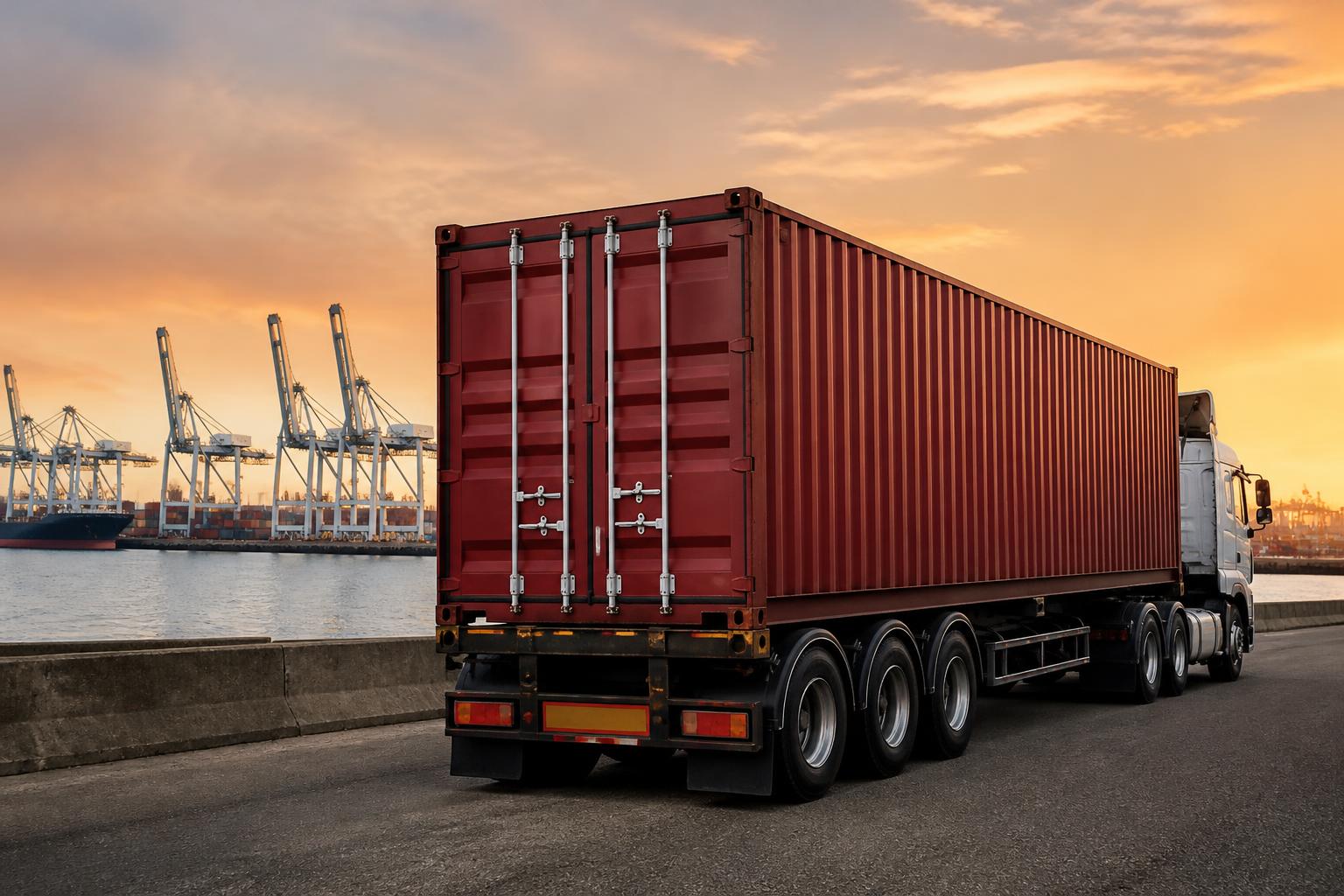
When importers ask us what good container haulage actually saves them, the answer is usually not mileage. It is storage risk, missed free time, failed collections, and the silence that lets a box drift into cost before anyone acts. A container move works best when the haulier is not just turning up at the port, but checking release, customs status, booking windows, delivery constraints and equipment before the vehicle is sent.
That is the job we do every day at Jagelo Haulage Limited. We collect from Felixstowe, London Gateway, Tilbury, Purfleet, Southampton and Liverpool, then deliver across Great Britain, mostly as merchant haulage booked directly by importers and forwarders. The practical value is simple. We plan the move against the box status and the site requirements, book the slot, and flag risk early enough for someone to stop charges building.
What container haulage covers in day-to-day UK movements
In day-to-day UK work, container haulage covers the inland movement of a shipping container between the port, terminal, depot or quay and the delivery point. On imports, that usually means collecting the loaded box from the port and taking it to the consignee, warehouse, cold store, factory or another inland point for devanning. On exports, it can mean positioning an empty, collecting a loaded unit, and returning it to the port.
That sounds obvious, but there is a practical distinction that matters. Moving the container is not the same as arranging the sea freight. Many of our customers buy ocean freight from a shipping line or forwarder, then book us separately for merchant haulage within Great Britain. In that model, the customer or its agent controls the sea leg, line release and customs process, while we handle the road move, the terminal booking, the collection timing and the delivery plan.
For importers, the day-to-day scope often includes more than a tractor unit and trailer. It includes checking whether the container can actually be collected, whether the port slot is available, whether the delivery site can receive that box type, and whether the move should happen that day at all. A well-run haulage container movement is operational work before it becomes transport work.
A typical import move might look like this. The line issues release. Customs are cleared or the relevant status is confirmed. The terminal booking is made through the relevant system, such as CARGOES VBS at Felixstowe, or the applicable Container Booking System at another port. We allocate the right trailer, send the driver with the correct collection details, collect the box, and deliver to site within the booked or agreed window. If the site has restrictions, such as forklift availability, narrow access, fixed unloading slots, or a rule against late arrivals, that gets dealt with before the vehicle leaves.
This is why port collection and inland delivery should be looked at as one joined process. If the delivery point cannot receive a 40ft unit that afternoon, collecting it too early can create waiting time, redelivery cost or storage risk elsewhere. If the line free time ends tomorrow, waiting for a more convenient delivery day may cost more than reorganising the receiving site. The road move has to be planned against the port clock.
How a container move is planned before the vehicle arrives
A container should be treated as collectable only when the practical checks are done, not when someone says it has landed. Before we send a vehicle, we want the core details confirmed.
First is release. That means the shipping line or its agent has made the container available for collection under the correct reference. Without release, a booked slot and an available driver do not help.
Second is customs status. In the UK, import customs formalities and border processes are no longer simply treated as an EU internal movement issue. The position differs from EU domestic practice because UK imports from outside the UK customs territory require the relevant customs clearance or onward movement status before collection can proceed lawfully. If there is a hold, exam instruction or documentation issue, it needs to be known before dispatch. A haulier cannot solve a customs stop at the port gate.
Third is free time. Importers already know the difference between shipping line demurrage and terminal storage, but the key operational point is that both clocks matter. A container can be technically available and still be at risk if collection is left until the end of free time with no margin for slot pressure, traffic disruption or delivery refusal. We plan around the last safe collection point, not just the final free day.
Fourth is the booking system. Every port has its own process and constraints. At Felixstowe, collections are managed through CARGOES VBS. Elsewhere the booking may sit within another Container Booking System, often shortened to CBS, with different cut-offs, amendment rules and slot availability. The booking itself is not admin for its own sake. It determines whether the move can happen when the box needs to move.
Fifth is delivery constraint checking. We need to know where the container is going and what the site can handle. Common issues include restricted opening hours, mandatory booking references, no tipping after a set time, limited turning space, soft ground, overhead obstructions, and whether the box must remain on wheels for live unload. A 20ft box loaded heavy for floor discharge is a different proposition from a lightly loaded 40ft unit going to a wide warehouse yard.
Sixth is equipment choice. Trailer selection depends on the box length, weight distribution and delivery conditions. ISO containers are standardised, but the delivery environment is not. We match the move to the container and site, not just the port and postcode.
When these checks are done early, decisions improve. If a release has not landed, we can hold the booking rather than send a driver into a wasted trip. If a site cannot receive until the following morning, we can decide whether collection still makes sense within free time. If the box is at risk, we say so early. That is the difference between managing a move and reacting to it.
For readers dealing with repeated port collections, our guidance on reducing risk on port-to-site container moves goes further into the handover points that usually decide whether a box moves cleanly.
Where costs build up and how importers reduce them
The largest avoidable costs in container haulage are usually not headline haulage rates. They are exception costs caused by timing, information gaps and failed handoffs.
Demurrage and storage are the obvious ones. They arise when the container is not collected or returned within the available free time. Sometimes the reason is straightforward, such as customs not being cleared. Often it is more operational than that. Release arrives late. The booking slot is missed. The delivery site cannot receive. Nobody notices that the free period expires over a weekend. By the time the issue is escalated, the box is already in chargeable time.
Waiting time is another regular cost point. A vehicle arrives on site and cannot be tipped because labour is not ready, a booking reference is missing, or another vehicle is on the bay. A short delay can be absorbed. A long one affects the driver, the next port booking and the rest of the day’s plan.
Wasted trips happen when a vehicle is dispatched but collection or delivery fails. Common causes are absent release, unresolved customs status, incorrect container details, site refusal, or a mismatch between the container and the receiving equipment. A wasted trip is not only a chargeable event, it also removes capacity that could have been used on another box.
Redelivery costs arise when the first delivery attempt cannot be completed and the container must be represented later. That can follow a site issue, a late cancellation, or an unrealistic assumption that the consignee can unload on arrival. Once a loaded import is on the road, changing the plan is rarely cost-neutral.
Importers reduce these risks with a few disciplined steps. Confirm release before asking for dispatch. Treat customs status as a collection gate, not a background issue. Share the last free day and any line or terminal deadlines with the haulier. Give the unloading constraints at the time of booking, not after the port slot is secured. Make sure the delivery point knows the container length, expected arrival window and unload method. If a box looks exposed, move it up the priority list before the charges start, not after.
The other practical step is choosing a haulier that will tell you when a box is slipping. We do not wait for a customer to discover risk from a terminal screen. If slot availability, release timing or site readiness puts the move under pressure, we flag it while there is still time to change the plan. Readers dealing with recurring port cost issues may also want our note on how UK container haulage avoids port cost and delay.
Which container types and traffic patterns need different handling
Not every container move should be planned the same way. The box type, load pattern and shipment structure all affect how the job is handled.
The most common equipment is standard dry freight in ISO containers. Within that, a 20ft ISO Container is often used for dense cargo. It may be compact in length but heavy in gross weight, which affects tractor and trailer planning, route suitability and delivery-site handling. A 40ft ISO Container is the standard import format for many consumer and industrial loads. It is easier to fit volumetrically but can create access issues where yards are tight or unloading points are awkward. A 45ft ISO Container adds further length and needs the receiving site checked carefully before dispatch.
A Refrigerated Container brings extra considerations. The cargo may be temperature-controlled food, feed or another sensitive product. Delivery timing matters more because unnecessary dwell can create cost and operational risk. Power requirements, monitoring expectations and consignee readiness all need confirming before collection. For temperature-sensitive imports, our article on moving a reefer from Felixstowe without avoidable port cost covers the specific points that tend to catch people out.
Traffic pattern matters as well. FCL moves are generally simpler from a road-planning point of view because the full container is moving under one consignee’s instruction to one delivery point. The main variables are release, free time, slot availability and unloading readiness.
LCL can be more complex in practice, even when the road leg still involves a full container. The box may need to go to a deconsolidation point rather than the final importer. Timing can be tighter because multiple parties are waiting for the cargo. If the shipment is rated by CBM, the inland move still needs to be planned around the physical container, not the invoicing basis of the cargo inside it.
Some traffic also needs regulatory or commodity-specific handling. We are an upper tier waste carrier and dealer, registration CBDU471791, and we are registered with APHA to carry Category 3 animal by-products, animal feed in shipping containers, quay to premises, U1433815/TRANS. That matters where the cargo type limits which operators can lawfully or practically move it.
The practical lesson is straightforward. Container type tells you part of the story. Cargo density, commodity, route, site access and unload method tell you the rest.
What to check when choosing a UK container haulier
If you are choosing a UK container haulier, start with port coverage that matches your actual traffic. A carrier may say it does container work, but that does not mean it is active at the ports you use or familiar with their booking systems. We collect from Felixstowe, London Gateway, Tilbury, Purfleet, Southampton and Liverpool, which means we are working daily with the release, slot and collection routines those ports require.
Then check the operator licence. A proper UK container haulier should be operating under its own valid operator licence, and if subcontracting is used, those subcontractors should be operating under their own licences as well. We run 40 vehicles and 40 trailers on operator licence OF2023521, with vetted partner hauliers taking extra volume on their own operator licences when needed.
Ask how much work is done on the haulier’s own fleet and how overflow is managed. Subcontracting is normal in container transport, especially when import peaks compress collections into the same free-time window. The question is not whether subcontracting exists, but whether it is controlled. We use vetted partners when volume requires it, and the same operating expectations apply to those loads.
Freight liability is another area where buyers should be specific. Do not settle for a vague answer about goods in transit. Ask for the actual limit and the trading conditions. Our freight liability cover is £6,500 per tonne under RHA 2024 conditions, which is five times the standard RHA level of £1,300. The same limit applies on subcontracted loads, and up to £10,000 per tonne is available by arrangement for higher value freight. If your cargo value is materially above standard RHA exposure, that conversation needs to happen before movement, not after a claim event.
Communication is the other buying criterion that matters in real operations. A haulier should tell you when a box is at risk, not simply confirm the booking and go quiet. Ask how they handle containers approaching last free day, failed releases, slot shortages and delivery refusals. You want early warning while there are still options.
Finally, look for a track record in the type of work you are actually booking. Since 2019 we have moved more than 75,000 containers, around 13,000 a year, mostly as merchant haulage for importers and forwarders. That experience matters because most problems in container haulage are not unusual or dramatic. They are routine exceptions handled well, or handled late.
For buyers who use Tilbury regularly, our article on how Tilbury slot booking affects container collection risk is worth reading alongside any rate comparison. The booking process itself often decides whether a move stays inside free time.
Container haulage that cuts storage risk is not about promising that nothing ever goes wrong. It is about controlling the points where cost starts, release, customs status, free time, slot booking, equipment choice and delivery readiness. When those are managed together, the inland move supports the import plan instead of undermining it.
That is how we run at Jagelo Haulage Limited. We book the slot, plan the collection against free time, match the vehicle to the box and the site, and say early when a container is at risk. For importers and forwarders booking UK port collections directly, that is what keeps a routine move routine.
What is container haulage?
Container haulage is the road transport of shipping containers between a port, depot or rail terminal and a delivery or unloading point in Great Britain. It usually includes port slot booking, collection and delivery planning.
What is merchant haulage?
merchant haulage means the importer, freight forwarder or customs agent books the road move directly with the haulier, rather than leaving inland transport under the shipping line’s control.
What information does a haulier need before collecting a container?
Usually the container number, release status, customs status, port, delivery point, weight, commodity, required date, and any site restrictions. If the load may be regulated, send the UN number and class for confirmation.
What is the difference between FCL and LCL?
FCL is a full container load moving as one shipment in one container. LCL is a part load grouped with other cargo, often measured in CBM, and may involve a deconsolidation point before final delivery.
How are Felixstowe collections booked?
At Felixstowe, collections are booked on the Container Booking System (CBS), which replaced the Vehicle Booking System (VBS) in January 2025.