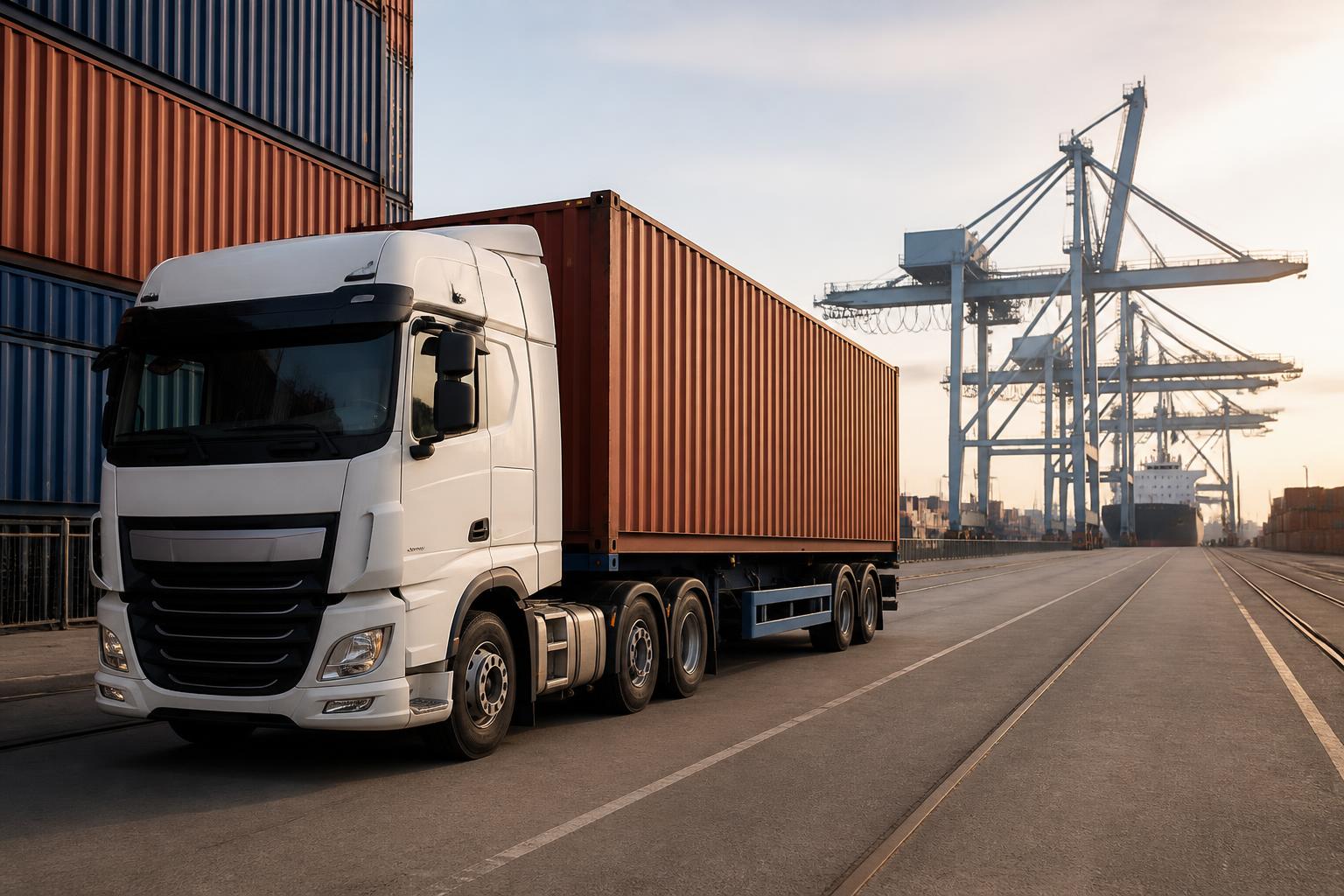
Port cost and delay are usually avoidable when the container move is planned from the moment the line releases the box, not when free time is nearly gone. In UK container work, that means checking release status, customs position, port booking availability, delivery constraints, and empty return instructions before the driver is sent to the quay. If any of those points are unclear, demurrage, storage, waiting time and failed delivery charges arrive quickly.
At Jagelo Haulage Limited, we handle container collections from Felixstowe, London Gateway, Tilbury, Purfleet, Southampton and Liverpool across Great Britain, mainly as merchant haulage booked directly by importers and forwarders. Our job is not just to put a truck under a box. It is to line up the paperwork, the booking, the vehicle, the destination and the return plan so the container moves inside free time and without avoidable disruption.
What haulage means in container transport
In the UK container trade, haulage usually means the road movement of a shipping container between the port and the delivery point, or from one inland point to another. That sounds simple, but port container work is different from general road freight in several important ways.
A standard pallet network or full load road movement normally starts with goods that are already available to load. Container haulage starts with a unit that sits under shipping line control inside a port or terminal system. Before we can collect it, the box needs to be released by the line or its agent, customs must be in order, and the terminal must have a valid booking in place. The container itself also matters. A 20ft ISO Container, 40ft ISO Container, 45ft ISO Container or Refrigerated Container each brings different planning points around weight, trailer type, delivery access and power requirements.
Container work also carries port-specific rules. Driver identity, vehicle details, VBS or slot bookings, PIN releases, quay operating hours, cut-offs and empty return locations all affect whether a job can be done on the day expected. That is why a haulier working in ports needs more than a truck and a postcode.
merchant haulage sits in the middle of this process. It means the importer, exporter or freight forwarder books the road move directly with us, rather than taking inland transport from the shipping line as part of the ocean contract. In practice, that gives the customer more control over timing, communication and cost. It also means we can plan the move around the actual delivery requirement, not just around a line-provided inland leg.
For many importers, especially on FCL cargo, merchant haulage is the cleaner option because one operational contact can watch the box from release through delivery and empty return. For LCL work, the inland leg often sits differently because the cargo may be devanned at a warehouse rather than delivered as a full container, but the same principles about release, customs and booking still apply where a full box move is involved.
How a container move is planned from release to delivery
The sequence starts with release and customs. We need to know that the shipping line has authorised collection and that any customs entry, hold or examination issue has been dealt with, or at least clearly identified. In the UK, that means the import position must be right for the container to leave the terminal. If there is a customs hold, no amount of transport planning will get the box through the gate.
Once release is confirmed, we check free time and terminal position. That tells us how urgent the collection is and whether there is room to book a sensible slot. A container with one day left before storage or demurrage needs different handling from a box with several clear working days available.
The next step is the port booking. At Felixstowe, this means using the Container Booking System, commonly referred to as CBS. Other ports use their own systems and rules. The booking is not just an administrative step. Slot availability can determine whether the box moves today, tomorrow morning, or later than the consignee expects. If the job is urgent, we look at the earliest workable slot and at whether the delivery point can actually receive the container once it is collected.
Then we plan the road move itself. We confirm the container size, gross weight, commodity, delivery postcode, site restrictions, opening hours and any unloading requirement. A heavy 20ft ISO Container may need a different tractor and route planning from a light 40ft ISO Container. A 45ft ISO Container raises separate equipment and access checks. A Refrigerated Container may need immediate delivery to a powered site or a clear instruction that the unit is to remain running until unloading.
After collection, delivery timing depends on road conditions, driver hours, customer booking windows and site access. We plan this before the slot is booked, not after. If the delivery point has a fixed booking, if the warehouse stops unloading at a certain hour, or if the site needs advance vehicle registration, those details must be built into the move from the outset.
Finally, we check whether an empty return is required and where it goes. Some import moves end with a live unload and the empty goes back promptly. Others involve a tipped import where the container remains on site for unloading and then returns within line free time. If empty return instructions are missing, or if the return depot is far from the delivery point, that affects cost and timing. It is part of the job, not an afterthought.
Where delay and extra cost usually come from
The biggest avoidable costs usually come from time pressure and missing information.
Demurrage and storage are often confused, but in practice customers mainly need to know when the clock starts and what event stops it. If the container is not collected from the port within free time, storage can apply at terminal level and demurrage can apply under the shipping line's terms, depending on the contract and the line's tariff structure. The exact charging basis is not uniform across carriers, so we focus first on the operational point, collect and return the box inside the allowed window.
Waiting time is another common issue. It arises when the driver reaches the delivery point and the site is not ready, the unloading equipment is unavailable, the booking has not been recognised, or the container cannot be tipped where expected. Port waiting can also matter when booking systems are congested or the terminal flow is disrupted, but delivery point delays are still one of the most frequent causes of extra cost.
Failed delivery is usually preventable. It happens when the address is wrong, access is unsuitable, the site refuses the container because paperwork is incomplete, or the consignee is not ready to unload. A container vehicle cannot always be diverted easily once loaded, especially if the box is heavy or subject to return deadlines.
Customs holds are another obvious source of delay. If the entry is not cleared, if an examination is called, or if there is a documentary issue, the container may sit while free time runs down. The earlier we know the customs position, the better we can protect the move and tell the customer whether the collection plan is realistic.
Free time pressure becomes more serious when release is late in the week, when the port is congested, or when delivery constraints leave only one practical collection day. The answer is early visibility. We need the release status, line free time, customs position, delivery availability and empty return terms as soon as possible. If the box is at risk, we say so early.
That is particularly important with specialist units. A reefer at London Gateway, for example, needs tighter timing and clearer destination planning than a dry box. We cover that in more detail in our guide to getting a reefer box out of London Gateway without delay.
What the haulier needs before booking the job
To move a container properly, we need more than a container number and a delivery postcode.
First, we need the basic box details. That means container number, size and type, whether it is a 20ft ISO Container, 40ft ISO Container, 45ft ISO Container or Refrigerated Container, and whether the move is import or export. We also need the gross weight. Weight affects vehicle allocation, route planning and whether the delivery site can safely receive the unit.
Second, we need the cargo details. Commodity matters because it can change the handling plan, paperwork and compliance checks. If the goods are hazardous, waste-related, feed-related, or subject to special controls, we need that upfront. We are an upper tier waste carrier and dealer, CBDU471791, and we are registered with APHA to carry Category 3 animal by-products, animal feed in shipping containers, quay to premises, U1433815/TRANS. Those points only help if we know what is in the box before we book the move.
Third, we need the port and release information. Which terminal the box is on, whether the shipping line has released it, whether customs is clear, and what free time applies. If there is a PIN, reference or release code needed for collection, we need that in time to secure the booking.
Fourth, we need delivery instructions that reflect reality on the ground. Exact address, opening hours, booking reference if the warehouse uses one, contact name and number, unloading method, whether the site has a loading bank, forklift, reach stacker or crane, and whether the container is for live unload or for tipping on site. Access restrictions matter too, narrow roads, vehicle length limits, soft ground, overhead cables, timed access, portacabin gates, or neighbour-sensitive arrival times.
Fifth, we need any special handling point. That might be a seal check, temperature setting confirmation on a reefer, a requirement to keep the genset arrangement in mind, or instructions around quay to premises movement for regulated cargo.
Trailer choice also matters more than many customers expect. Different units and delivery conditions may call for different equipment, and poor trailer selection can create avoidable delay at both collection and delivery. We set out the practical points in our article on choosing the right trailer for port container work.
Which ports and booking systems matter in practice
For deep-sea container imports into Great Britain, the main port choices regularly affecting our work are Felixstowe, London Gateway, Tilbury, Purfleet, Southampton and Liverpool. Each has its own traffic patterns, terminal processes and practical booking issues.
Felixstowe remains central to a large volume of UK container haulage, especially for traffic into the Midlands, the South East and East Anglia. Because we are based at Bridge Farm, Woolpit, Suffolk, IP30 9PQ, around 35 miles by road from Felixstowe, it is a key collection point in our daily operation. Booking at Felixstowe uses the Container Booking System, or CBS. In day-to-day conversation many people still refer to the platform simply as CBS, but the full term matters because customers often see it written both ways in operational messages. Slot availability through CBS can be the difference between collecting inside free time and rolling into chargeable days.
London Gateway is another major port for import boxes, particularly where customers want strong road access into the South East and beyond. Tilbury and Purfleet matter in practice for customers moving cargo into London and the wider Thames corridor, and for time-sensitive collections where terminal position and booking availability may make one option easier to work than another. Southampton remains important for deep-sea and specialist cargo, while Liverpool is a practical gateway for the North West and for inland delivery plans that would be inefficient from southern ports.
The right port on paper is not always the easiest port on the day. Booking systems, cut-offs, terminal congestion, line release timing and delivery geography all affect the actual result. For port-specific detail, we have separate guides on whether your container can be collected from Tilbury today and on who can collect from Liverpool for next day delivery.
One other practical point is that UK procedures are not always the same as EU port practice. Readers working across both may be used to different customs messaging flows, terminal processes or inland transport arrangements on the Continent. For Great Britain moves, we plan against the UK port system, the line's release process and the actual terminal booking rules in force here.
How to choose a haulier for merchant haulage
If you are placing merchant haulage, start with coverage and actual port capability. Ask which ports the haulier collects from regularly, whether they book their own slots, and whether they can manage the move from release through empty return rather than only supplying a vehicle once everything else has been arranged.
Then check fleet and equipment. Container work needs the right trailers, enough tractor capacity, and a realistic plan for peaks. At Jagelo Haulage Limited we run 40 vehicles and 40 trailers of our own on operator licence OF2023521, with vetted partner hauliers on their own operator licences taking extra volume when needed. That matters because overflow should still be handled within a controlled operating model, not passed out without visibility.
Communication is the next test. A good haulier tells you early when a box is at risk, when the release is not in place, when the booking window is poor, or when the delivery plan is likely to fail. Silence is expensive in container work. You need updates before free time expires, not after.
Operator compliance should be checked directly. The haulier should hold a valid operator licence, and if subcontractors are used, they should be operating on their own licences as well. For customers moving specialist cargo, the right registrations also matter. Waste, feed and animal by-product rules are not side issues if they apply to your shipment.
freight liability is another point that should be confirmed before work is placed. Many customers assume all cover is the same. It is not. Our freight liability cover is £6,500 per tonne under RHA 2024 conditions, five times the usual RHA standard of £1,300, and subcontracted loads carry the same limit. For high value freight, up to £10,000 per tonne is available by arrangement. If you are placing a valuable load, ask the question before collection, not after an incident.
Experience counts too, but it should be measured in operational terms. We were founded in 2019, and the people running our operation have worked in container haulage since 2015. Since 2019 we have moved more than 75,000 containers, around 13,000 a year. The point of that experience is not a slogan. It is that we know where jobs usually go wrong, and we plan them to avoid the obvious failures.
Finally, ask how the haulier handles subcontracting. During peak periods, most serious operators need extra capacity at times. The important question is whether subcontracted work is placed with vetted carriers, under clear instructions, with matching liability standards and proper communication back to the customer. We explain our approach in our guide to choosing a Felixstowe haulage subcontractor with cover.
Good container haulage is mostly about getting the basics right before the truck moves. Release, customs, booking, equipment, delivery readiness and return planning decide whether the box arrives cleanly or starts generating cost. When those points are checked early, port moves are usually straightforward. When they are left until the last minute, delay gets expensive very quickly.
What is merchant haulage?
merchant haulage means the importer, freight forwarder or customs agent books the road move directly with the haulier, rather than leaving inland transport under the shipping line's control.
What information does a haulier need to collect a container?
Usually the haulier needs the release status, port, container number, size, weight, delivery postcode, commodity, customs position and any site restrictions before booking collection.
What is the difference between FCL and LCL?
FCL is a full container move for one shipment in one box. LCL is groupage, where cargo is consolidated and deconsolidated, often with charges based on CBM.
What container sizes are most common?
The usual units are the 20ft ISO Container, 40ft ISO Container and 45ft ISO Container. Some moves also use a Refrigerated Container for temperature-controlled cargo.
How are Felixstowe collections booked now?
At Felixstowe, collections are booked on the Container Booking System (CBS). CBS replaced the Vehicle Booking System in January 2025.
What should I check on freight liability?
Check the haulier's freight liability limit, the trading conditions used and whether the same cover applies to subcontracted loads if partner hauliers are used for extra volume.