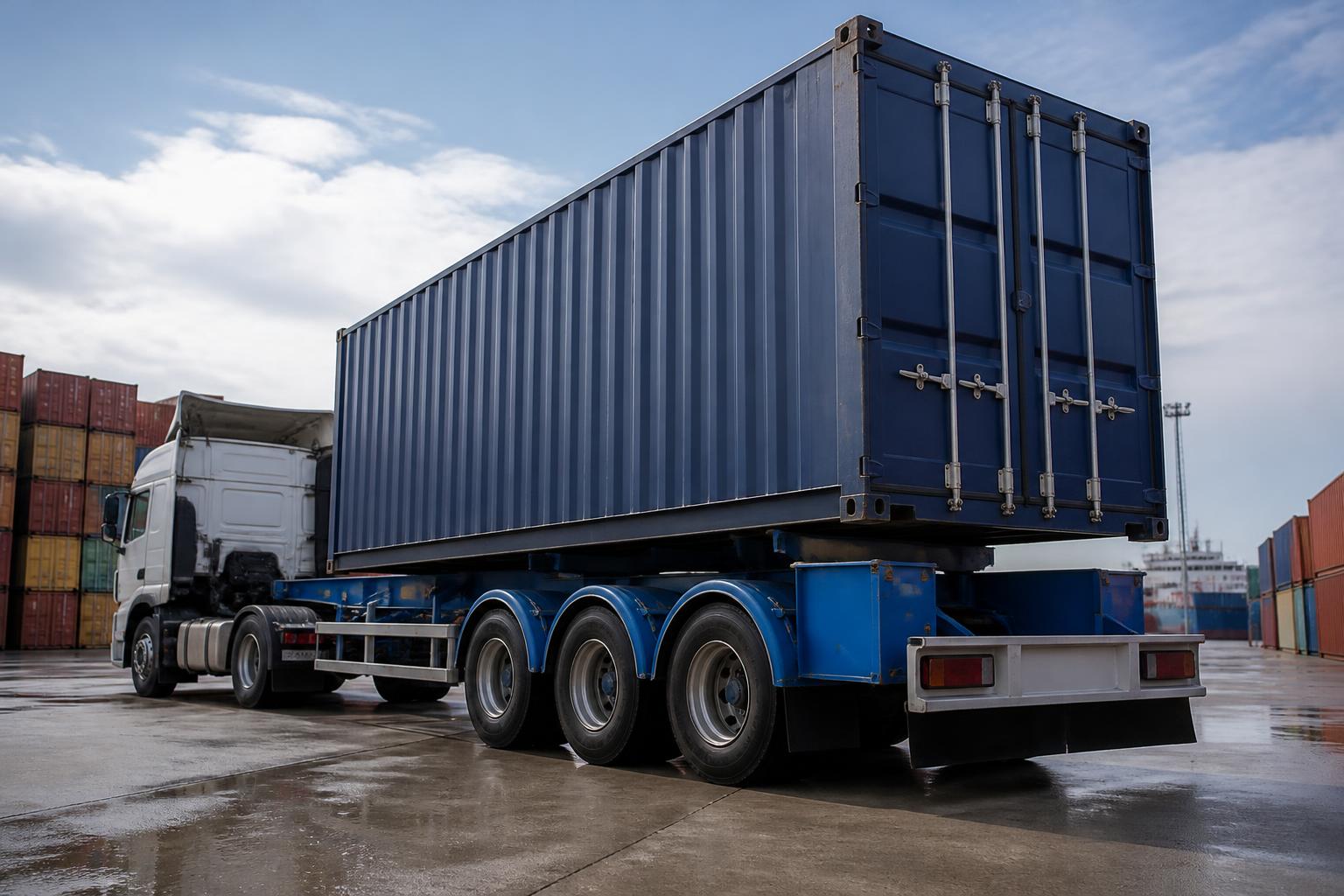
Choosing the right trailer for port container work starts with the box, the weight, and the delivery point. In UK import work, the wrong trailer choice does not just make a job awkward. It can make it non-compliant, unbookable at the port, or undeliverable on site. For importers and forwarders booking merchant haulage, that matters because the trailer decision affects slot timing, payload, waiting time, failed delivery risk, and whether free time is enough.
At Jagelo Haulage Limited, we collect from Felixstowe, London Gateway, Tilbury, Purfleet, Southampton and Liverpool and deliver across Great Britain. Most issues that create delay are visible early if the container type, gross weight, and site conditions are checked properly at booking stage. This is where a practical haulier adds value, by matching the trailer to the job before the box is sitting in port storage.
What a container trailer does in UK port haulage
A container trailer is the road chassis that carries a shipping container between port and delivery point. In merchant haulage, the importer or forwarder books us directly to collect the box from the terminal under the line or forwarder release, move it under our operator licence OF2023521 or through vetted partners on their own operator licences, and deliver it to the consignee.
For FCL work, the trailer has one basic job, carry the container safely and legally from quay to site. In practice, that means much more than simply taking a 20ft or 40ft box. The trailer has to suit the container length, the likely payload, the axle loading, and the place where the unit will stand while unloading. If any one of those is wrong, the job can fail even though the box is customs cleared and ready to collect.
Trailer choice matters because UK road limits and site realities are tighter than many people expect. A container can be within its own maximum gross and still be a problem on the road if the weight distribution loads the tractor and trailer axles badly. A site can have enough space for a rigid or curtainsider and still be unsuitable for an articulated container vehicle reversing a long trailer with a high centre of gravity. A consignee can be ready for pallet offload but not ready to receive a grounded container, because standard merchant haulage is usually live unload rather than drop and swap.
For importers and freight forwarders, the practical question is not just, “Can this box move?” It is, “Can this exact box move on a trailer that will stay legal on the road, get a workable slot, and deliver without burning free time on avoidable problems?” That is why we ask for the container number, size, gross weight, commodity, collection port, customs status, and delivery postcode before we confirm the plan.
Which trailer suits each container size
The trailer needed for a 20ft box is not always the trailer you would choose for a 40ft or 45ft movement. The container size changes turning behaviour, payload options, and the amount of clear space needed at delivery.
For a 20ft ISO Container, the key issue is usually weight. A 20ft box often carries dense cargo, so the trailer choice is driven less by length and more by achieving legal axle weights. A standard skeletal trailer can move many 20ft loads, but a heavier 20ft import may need a trailer configuration that places the box in the right position over the running gear. If the box is loaded heavily at one end, that needs checking before collection, not after the driver is under it in the port.
For a 40ft ISO Container, length becomes more of a site issue and weight is often less severe than with a 20ft, though not always. A standard skeletal trailer is commonly suitable, provided the gross and cargo distribution are workable. The delivery point still needs enough room for an artic to enter, position, and either reverse to a bay or stand safely for devanning.
For a 45ft ISO Container, the operational difference is significant. The extra length can turn a straightforward 40ft delivery into a difficult access job. Some sites that can accept a 40ft unit cannot safely receive a 45ft one because of gate geometry, internal turning space, parked vehicles, overhead obstructions, or the angle needed to reverse to unloading position. If a consignee says, “We take containers all the time,” we still want to know whether they mean 20ft, 40ft, or 45ft. That one detail changes the risk.
A Refrigerated Container adds another layer. On the road it still moves on a suitable skeletal trailer, but reefer work needs the delivery site to be clear about the unloading plan. If the cargo needs temperature integrity maintained to the point of devanning, the consignee must be ready to unload promptly and safely. If they intend to use their own loading team, they need the labour and equipment in place when the vehicle arrives. Delay on a reefer delivery is not just waiting time, it can affect product condition and claims exposure.
Where the shipment is LCL rather than FCL, the trailer issue is often indirect. The box still moves as a full container, but the receiving site may be less used to handling port traffic because they are taking a deconsolidation or part load arrangement. That is where we see more failed assumptions about access, unloading duration, and whether the consignee can accept the box at all.
How weight and payload change the trailer decision
Gross weight on the shipping line paperwork is only the starting point. To decide whether a move is workable, we look at total gross, likely cargo distribution inside the box, the container size, and how that weight will sit across the unit on UK roads.
This is where the UK position matters. Even when a container is compliant in shipping terms and accepted by the terminal, it may still not be suitable for a standard road move without the right trailer setup, route planning, or in some cases a different delivery arrangement. UK axle loading constraints are what matter on the road in Great Britain. A box that is legal to ship is not automatically legal to haul.
A heavy 20ft import is the classic example. The cargo may be within the container’s plated limits, but dense loading can create axle issues once the box is mounted. If the weight is concentrated towards the front or rear, that changes kingpin load and axle distribution. We therefore need the gross weight early, and where possible a realistic description of the cargo, for example tiles, canned goods, bagged feed, machinery, paper reels, or scrap for export positioning. “General cargo” does not help much when the road question is whether the load behaves like 18 tonnes of dense product in half a box.
Payload also affects whether a job should move in one stage or another. If the consignee cannot unload quickly, a heavy box standing on site while labour is organised creates avoidable risk. If the product is palletised and the site has a suitable forklift, live unload may be straightforward. If the goods are floor loaded and need handballing, the time on site can become the main operational issue rather than the road move itself.
This is also where document quality matters. We need the container number, collection reference, release status, and gross weight as shown on the available paperwork. If there is any doubt over the declared weight, we would rather address it before booking than arrive at the port and discover the move is not viable as planned.
For higher value cargo, the trailer decision sits alongside liability planning. Our standard freight liability is £6,500 per tonne under RHA 2024 conditions, with the same limit on subcontracted loads, and up to £10,000 per tonne by arrangement. That does not change what trailer is needed, but it is part of the same booking conversation when the goods are both heavy and commercially sensitive. We cover this in more detail in our guide to choosing container haulage with £6,500 per tonne cover.
What to check at the delivery site before booking
The delivery site causes more failed jobs than the port when the basics have not been checked. Before booking a container trailer, we need to know whether the consignee can actually receive the unit safely.
First is access. We need the full postcode, any site restrictions, and ideally confirmation of gate width, internal turning space, and whether reversing is required from the public highway. A 45ft delivery to a tight industrial estate can be a very different proposition from a 20ft delivery to the same address. If there are school-run restrictions, narrow approach roads, weight-restricted bridges nearby, or a booking-in system with fixed warehouse times, that should be flagged at the start.
Second is ground condition. A container vehicle needs firm, level standing. Soft yards, broken concrete, steep cambers, and loose surfaces increase risk during positioning and unloading. If the forklift will enter the container from the trailer, ground quality matters even more. A site that is acceptable in dry weather can become unsuitable after heavy rain.
Third is unloading method. We need to know whether the box will be live unloaded, stripped by forklift, unloaded by hand, or left sealed pending inspection. Standard merchant haulage is usually live delivery. If the consignee is expecting us to leave the container behind, that needs to be agreed separately and is often not possible in normal port import work. If the cargo is floor loaded, the unloading time may be much longer than for palletised freight. If the site lacks a suitable forklift or enough labour, that is better known before the unit leaves the port.
Fourth is waiting time risk. A site that says “come any time” often creates more delay than a site with a proper booking window. We want to know whether the goods-in team will be ready, whether the forklift driver is on shift, and whether there are known queue times. A port collection planned tightly around free time can still become expensive if the vehicle loses hours at destination and misses the chance to return the equipment efficiently.
Finally, the consignee must be able to receive the container safely. That includes traffic management on site, safe separation from pedestrians, and a clear plan for opening and devanning the box. If the cargo is APHA-related, feed, or Category 3 material, the receiving process may need extra care and site controls. We are registered with APHA to carry Category 3 animal by-products and animal feed in shipping containers, quay to premises, under U1433815/TRANS, so we will ask the right questions where that applies.
How port booking and free time affect trailer planning
Trailer planning starts with release and ends with timing. A suitable trailer is no use if the box is not actually collectable, or if the slot is booked too late to stay within free time.
Before we book collection, we need the release to be in place and any customs hold cleared. Depending on the port and line, that can mean line release, terminal release, and confirmation that any CDS or other customs intervention has been resolved. If the box is on hold, we would rather know immediately than spend time chasing a collection that cannot proceed.
Port systems also shape timing. Felixstowe uses CARGOES VBS. London Gateway uses the Container Booking System. You may also hear people refer to that as CBS. The naming matters because each system has its own slot availability and operational rhythm. A box can be physically in port but still difficult to collect at the preferred time if the booking windows are tight, the release lands late in the day, or there is a surge in demand around free time expiry.
That is why we plan the trailer and the port slot together. If the container is available but the delivery site can only receive on a narrow window, we need to see whether the terminal booking system supports that plan. If not, we may need to collect on another day, deliver direct on a different slot, or warn early that demurrage or storage risk is building.
Free time is not a background admin detail. It drives the collection plan. When a release arrives late, customs clears close to the deadline, or the consignee cannot receive promptly, the practical question is how to use the remaining free time without creating a failed delivery. We handle that by looking at release timing, available port slots, transit distance, and destination readiness as one job, not as separate steps.
If you need a closer look at how collection timing works from Suffolk, our guide to Felixstowe container collection requirements is a useful starting point. We also cover booking strategy in our article on port slot booking that helps avoid demurrage.
When to ask your haulier for an early risk call
The right time to ask for an early risk call is before the box goes urgent. Once free time is nearly gone, options narrow quickly.
We recommend an early call when any of the following applies. The container is a heavy 20ft import. The box is a 45ft delivery to a site that has not taken one before. The cargo is floor loaded and likely to take time to devann. The consignee has limited receiving hours. The release is expected late. Customs status is uncertain. The line free time is short. The delivery point is a farm, soft yard, building site, or older industrial unit with doubtful access. The cargo is high value and needs agreed liability terms. The shipment is a Refrigerated Container with a tight unloading requirement.
What we need from you is straightforward. Container number, size and type. Port of collection, whether Felixstowe, London Gateway, Tilbury, Purfleet, Southampton or Liverpool. Gross weight. Commodity. Customs and release status. Delivery postcode and any access notes. Required delivery date. Whether the goods are palletised or floor loaded. What unloading equipment is on site. Any line free time or known demurrage exposure.
With that information, we can usually tell you early where the risk sits. Sometimes the answer is that the move is routine and just needs a booked slot. Sometimes the answer is that the trailer needs to be matched carefully to the box. Sometimes the answer is that the delivery site, not the port, is the real problem. Early warning is what helps avoid failed collections, port storage, and unnecessary cost.
That is the standard we work to at Jagelo Haulage Limited. We run 40 vehicles and 40 trailers of our own, backed by vetted partner hauliers for extra volume, and we have moved more than 75,000 containers since 2019. If you want a practical benchmark for assessing delay exposure before booking, our article on how to compare UK import container hauliers without delay risk sets out the points we think matter most.
What is a container trailer?
A container trailer is a skeletal trailer built to carry ISO containers by road. It locks the box to the chassis and is selected to suit the container’s size, weight and delivery conditions.
Can the same trailer carry every container size?
Not always. Some trailers are more flexible than others, but 20ft ISO Container, 40ft ISO Container and 45ft ISO Container moves can have different length, weight and axle-loading requirements.
Why does cargo weight matter if the container is already packed?
Because legal road movement depends on total gross weight and axle distribution, not just whether the container is sealed. A packed box can still be unsuitable for a planned trailer.
Do Refrigerated Container loads need anything different?
Yes. A Refrigerated Container may need checks on power-off status, set point instructions, weight and whether the delivery site can receive it without delay.
How are Felixstowe collections booked?
At Felixstowe, collections are booked on the Container Booking System (CBS), which replaced the Vehicle Booking System (VBS) in January 2025.