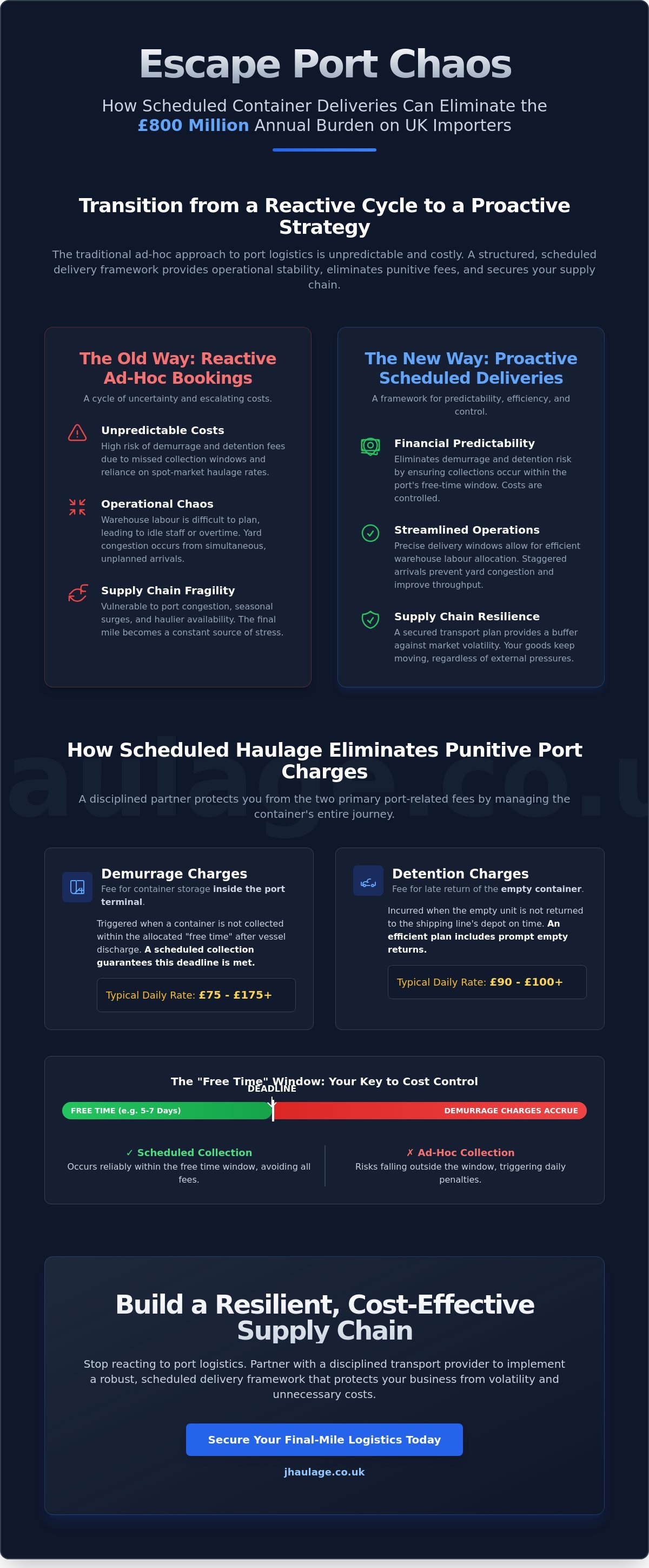
With UK importers incurring an estimated £800 million in annual demurrage and detention charges, the traditional approach to port logistics is no longer sustainable. You likely view these escalating costs as an unavoidable operational burden, yet they often stem from a lack of coordination at the terminal gate. Transitioning to a model of scheduled container deliveries offers a disciplined alternative to this reactive cycle. This strategic shift ensures that your cargo moves according to a fixed plan rather than at the mercy of port congestion.
This guide demonstrates how a structured delivery framework provides operational stability, eliminates the risk of daily demurrage fees, and secures your national supply chain against unpredictable delays. We will examine the specific haulage mechanisms that allow for precise warehouse labour planning and the establishment of a reliable transport partnership. You will discover how to move from ad-hoc bookings to a strategic, protected logistical outcome that prioritises efficiency and cost control. By implementing these protocols, your business can maintain a consistent flow of goods regardless of external market volatility.
Key Takeaways
- Learn how to transition from reactive ad-hoc bookings to a proactive supply chain model through the implementation of scheduled container deliveries.
- Identify the operational mechanisms for eliminating demurrage and detention charges by ensuring all collections occur strictly within port-allocated free time.
- Evaluate the strategic advantages of merchant haulage to gain greater control and flexibility over your inland transport schedules.
- Assess your site capabilities and port volume requirements to establish a robust and repeatable delivery framework for 40ft trailers.
- Understand the value of partnering with a disciplined transport provider that possesses the fleet capacity and industry experience to secure your final-mile logistics.
The Strategic Importance of Scheduled Container Deliveries in UK Logistics
Scheduled container haulage represents a disciplined, pre-planned logistics framework designed for high-volume importers and manufacturers. Unlike ad-hoc transport, which relies on spot-market availability, this model integrates haulage directly into the broader supply chain strategy. It transforms the final mile from a reactive task into a predictable operational component. By establishing a fixed cadence for cargo movement, businesses can bypass the volatility typically associated with UK port operations. This shift from an emergency-response mindset to proactive management ensures that transport is a tool for growth rather than a source of stress.
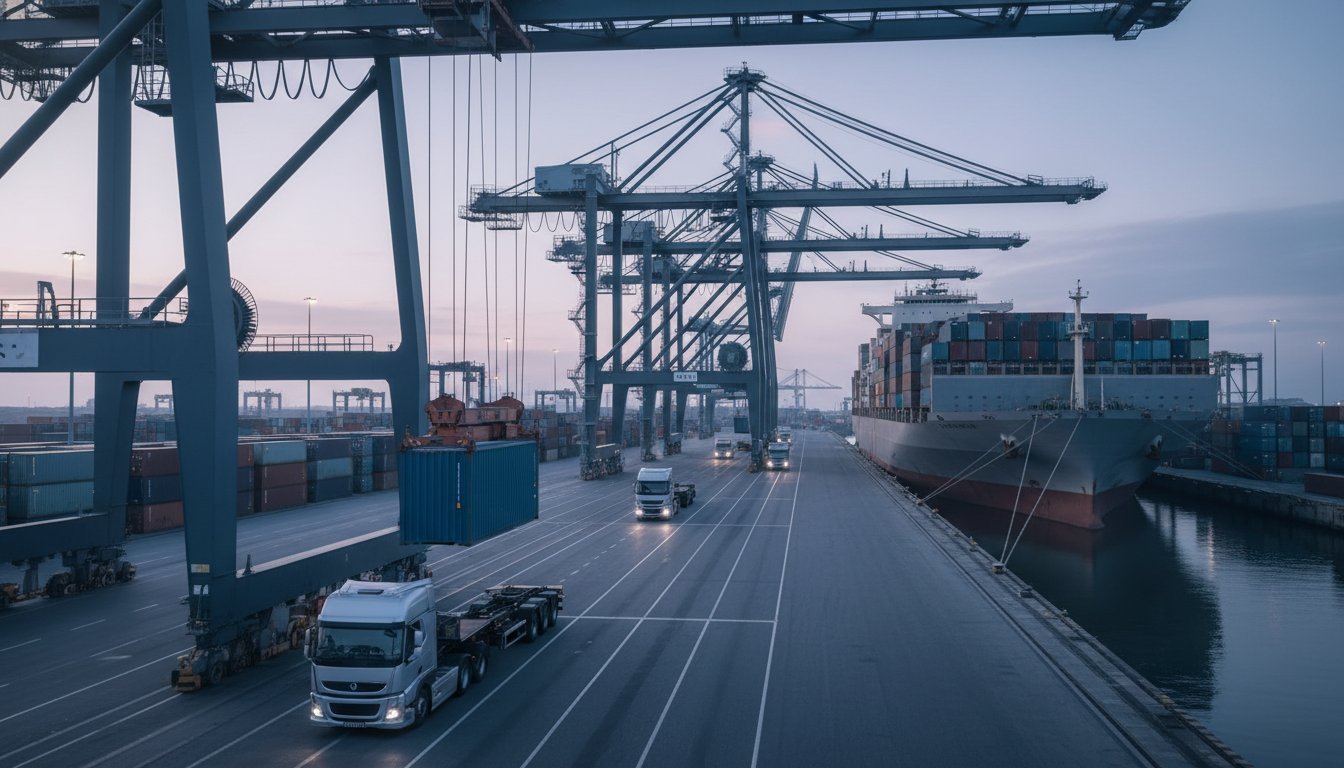
The efficiency of the global containerization system relies on the seamless transition of goods from sea to land. However, this transition often fails at the port gate due to inconsistent haulage capacity. Proactive supply chain management prioritises scheduled container deliveries to ensure that inland transport is secured well in advance of a vessel's arrival. This approach mitigates the risk of containers being left at the quay, which is a primary driver of escalating port fees. When haulage is treated as a strategic buffer, the entire national supply chain becomes more resilient to external shocks.
Predictability in an Uncertain Port Environment
The UK port landscape is frequently subject to peak congestion and seasonal surges. Establishing a scheduled framework creates a necessary buffer against these variables. Professional carriers use terminal appointment systems and slot bookings to guarantee vehicle access during specific windows. This level of coordination protects your cargo from the market fluctuations that often leave ad-hoc shippers without available transport. Consistent haulage capacity ensures that your inventory remains in motion, maintaining the flow of goods even during periods of high demand.
Operational Benefits for Warehouse Management
Reliable delivery windows provide the foundation for precise warehouse labour allocation. When you know exactly when a 40ft trailer will arrive, you can organise your intake teams with confidence. This reduces idle time and ensures that staff are present only when needed. For companies operating under Just-in-Time (JIT) manufacturing or tight retail restocking cycles, this predictability is essential for maintaining inventory turnover. It's about creating a steady rhythm of work that warehouse managers can depend on.
Staggered delivery times also prevent yard congestion. By spreading arrivals throughout the day, you eliminate the bottlenecks that occur when multiple containers arrive simultaneously. This methodical approach to container haulage improves safety and operational throughput at the point of discharge. Strategic planning through a partner like Jagelo Haulage allows businesses to treat the port as an extension of their own facility, ensuring that every container delivery contributes to overall supply chain stability.
How Scheduled Haulage Mitigates Demurrage and Detention Risks
Port delays are a significant financial liability for UK importers. When a container remains at the terminal beyond its allocated free time, the resulting demurrage charges can escalate rapidly. In 2026, typical daily rates at major hubs like the Port of Felixstowe start between £75 and £175 depending on unit size. These penalties aren't merely an inconvenience; they're a direct drain on operational capital. Implementing scheduled container deliveries allows businesses to secure transport slots well before a vessel berths, ensuring that cargo is collected whilst it remains within the free-time window.
A disciplined haulage partner manages the entire lifecycle of the container to protect the client from secondary costs. Whilst demurrage applies to the time a container spends inside the port, detention fees are triggered when equipment isn't returned to the shipping line promptly after unloading. For example, COSCO SHIPPING Lines reefer rates in early 2026 reach £90 to £100 per day once the 13-day threshold is exceeded. Jagelo Haulage expertise ensures that both the initial collection and the subsequent return of empty units are synchronised. This dual-focus approach eliminates the risk of overlapping penalties from both the port and the carrier.
Understanding the Cost of Delay
Managing these deadlines requires a structured monitoring system. To maintain control over your logistics spend, your team should adhere to a strict monitoring checklist for every shipment:
- Confirm the "Last Free Day" for both demurrage and detention upon vessel arrival.
- Cross-reference terminal gate availability with warehouse intake capacity.
- Pre-book haulage slots at least 72 hours prior to estimated discharge.
- Verify that customs clearances are processed through the Customs Declaration Service (CDS) before the container reaches the quay.
Jagelo Haulage manages these deadlines with disciplined precision, providing the visibility needed to avoid administrative oversight. Establishing a pre-planned transport model is the most effective way to eliminate these unnecessary overheads, and you can request a haulage consultation to assess your current port turnaround times.
Proactive Collection Strategies
Maintaining commercial efficiency in UK ports requires more than just gate access; it demands a synchronised approach to equipment movement. Scheduled fleets often utilise "pre-lodgement" protocols and early terminal appointments to bypass morning congestion. If a warehouse cannot accept a delivery immediately, a professional partner can "shuttle" the container to a secure off-port holding area. This tactic clears the port's books and stops the demurrage clock, even if the final-mile delivery occurs a day later.
This level of flexibility is only possible when working with a partner that operates a modern fleet and maintains a consistent presence at the terminal. By prioritising time-sensitive collections, Jagelo Haulage ensures that your cargo moves according to the clock, not the crowd. This proactive stance transforms container haulage from a potential bottleneck into a reliable strategic advantage.
Merchant Haulage vs Shipping Line Haulage: Which Supports Better Scheduling?
The choice between merchant haulage and shipping line haulage dictates the level of control an importer maintains over their final-mile logistics. Merchant haulage allows the cargo owner to appoint an independent transport provider to collect containers from the terminal. This model is the primary driver of successful scheduled container deliveries, as it removes the dependency on a shipping line's internal transport department. When you control the haulage, you control the timing. This distinction is vital in a high-stakes environment where every hour spent at the port gate impacts your bottom line.
The UK port industry handles nearly 500 million tonnes of freight annually, and navigating this volume requires a partner that prioritises your specific business objectives. Shipping line haulage, also known as carrier haulage, often treats transport as a secondary function to sea freight. Carriers manage thousands of containers simultaneously and frequently prioritise their own equipment repositioning over a client's specific warehouse requirements. Merchant haulage reverses this dynamic by placing the client's schedule at the centre of the operation.
The Flexibility Factor
Independent haulage fleets offer the flexibility required for bespoke delivery routes and precise arrival times. Unlike shipping lines, which may use a rotating pool of sub-contractors, a dedicated merchant partner provides consistent drivers and equipment. This consistency is essential when navigating complex site access or strict unloading protocols. If your warehouse capacity changes suddenly, a merchant partner can re-route or delay a container with minimal administrative friction. You can explore these differences in detail through our strategic comparison of merchant vs shipping line haulage.
Accountability and Visibility
A dedicated transport office provides a single point of contact for your entire national logistics operation. You don't have to navigate global call centres to find the status of a delivery. Direct communication with the transport planner allows for real-time adjustments and provides a higher level of visibility for scheduled arrivals. This direct link is a cornerstone of efficient container delivery scheduling, as it ensures that data flows as quickly as the cargo. By removing the layers of carrier bureaucracy, you gain a transparent view of your supply chain that supports better decision-making and long-term stability.
Planning Your Scheduled Delivery Framework: Site and Port Requirements
Successful scheduled container deliveries require a precise assessment of both port-side volume and site-side capacity. You must first determine your weekly container throughput to establish a sustainable delivery cadence. This data allows your haulage partner to allocate specific vehicles and drivers to your account, ensuring that transport is available exactly when needed. Effective planning ensures that the warehouse is never overwhelmed and the port is never used as an expensive storage facility. It's about synchronising the arrival of goods with your ability to process them.
Establishing a communication protocol between the port, the haulage firm, and the warehouse is the next critical step. This ensures that all parties are informed of vessel discharge times and customs release statuses in real time. You should also set clear Key Performance Indicators (KPIs) for on-time delivery and container return cycles. These metrics provide the data required to refine the schedule and identify potential bottlenecks before they impact your budget. A disciplined approach to these requirements creates a robust framework for national container haulage.
Site Readiness for High-Frequency Deliveries
Warehouse managers must verify that their facility can accommodate high-frequency movements. A 40ft trailer requires significant clearance for safe manoeuvring amongst loading bays. Whilst some sites focus on static placement, a high-volume logistics framework demands approximately 30 metres of straight clearance for vehicle approach and exit. Surfaces must be reinforced to withstand heavy, recurring axle loads, particularly in areas where trailers are frequently dropped. Implementing a "drop and swap" operation can significantly increase efficiency by allowing drivers to leave a laden trailer and immediately collect an empty one.
Integrating Technology for Scheduling
Modern logistics relies on digital manifests to organise delivery sequences with precision. These systems ensure that the most urgent cargo is prioritised for collection as soon as it's cleared through the Customs Declaration Service. Real-time GPS tracking provides the transport office with the visibility needed to manage the scheduled window effectively. If a port closure or vessel delay disrupts the primary plan, you might require same day container delivery to maintain your warehouse throughput. To begin building your bespoke transport framework, you can book a site requirements assessment with our logistics team.
Professional Logistics: Why Jagelo Haulage is the Preferred Partner for Scheduled Transport
Jagelo Haulage provides the infrastructure and expertise required to maintain a high-performance supply chain. Our modern fleet of over 40 trucks and trailers ensures that we have the physical capacity to meet demanding schedules at any UK terminal. With 15 years of experience in managing national port logistics, we understand the technical complexities of the sector. This history allows us to anticipate port-side challenges before they disrupt your operations. We don't just move cargo; we deliver a professionally managed, secure, and disciplined transport service that prioritises your commercial objectives.
The integrity of scheduled container deliveries depends on the competence of the transport office. Our responsive customer support team acts as a vital link between the terminal and your warehouse intake. They monitor vessel movements and customs clearances to ensure that every collection is synchronised with your broader operational plan. This level of oversight provides the security and predictability that corporate clients require for long-term stability. By choosing a partner with a proven track record, you eliminate the uncertainty often associated with ad-hoc haulage providers.
National Reach with a Disciplined Approach
Our operational reach extends to all major UK maritime hubs, providing consistent quality across the country. We maintain a no-nonsense, corporate culture that prioritises operational safety and protocol adherence at every stage. Whether you are operating within a merchant haulage or shipping line haulage framework, our team possesses the specialised knowledge to navigate the specific requirements of each. This versatility ensures that your cargo remains protected whilst moving amongst different port environments and transport models.
Building a Long-Term Strategic Partnership
We define our success through performance and results rather than simple self-promotion. Our role is to act as a strategic partner that understands the high stakes of your supply chain. As your business grows, we adapt our scheduling and fleet allocation to meet your evolving logistical needs. This collaborative approach ensures that your transport framework remains robust and efficient regardless of market conditions. To discuss how we can secure your port-to-warehouse logistics, we invite you to contact Jagelo Haulage for a professional logistics consultation.
Securing Your Supply Chain for 2026 and Beyond
Establishing a framework for scheduled container deliveries is a strategic necessity for businesses seeking to eliminate unnecessary port expenses. By prioritising merchant haulage and site readiness, you gain the operational control required to navigate the complexities of UK maritime hubs. This transition ensures that your logistics spend is an investment in stability rather than a response to avoidable penalties. It's about creating a predictable rhythm that supports warehouse efficiency and inventory turnover whilst protecting your bottom line.
Jagelo Haulage provides the disciplined infrastructure needed to support these high-volume operations. With a modern fleet of over 40 specialised trucks and trailers and 15+ years of expertise in UK port logistics, we offer reliable national coverage across all major maritime hubs. We focus on delivering protected outcomes that integrate seamlessly with your warehouse requirements. Contact Jagelo Haulage for a professional container haulage consultation to secure your transport schedule. We look forward to helping you build a more resilient and cost-effective supply chain.
Frequently Asked Questions
How far in advance should I schedule my container deliveries?
You should aim to schedule your transport at least 72 hours before the estimated vessel discharge. This window allows our transport office to secure terminal appointments and allocate specific vehicles to your route. Early booking is essential during peak seasonal periods to ensure that your cargo remains within the port's free-time window and avoids unnecessary storage charges.
What happens if a vessel is delayed at the port?
Our transport team monitors vessel arrival data in real time to manage any potential delays. If a vessel berthing is postponed, we adjust your terminal appointments and reschedule the inland transport accordingly. This proactive monitoring ensures that your delivery window remains synchronised with the actual discharge of the cargo without requiring constant manual intervention from your team.
Can scheduled deliveries help reduce my overall container transport costs?
Implementing scheduled container deliveries reduces costs by eliminating the risk of demurrage and detention charges. By ensuring that collections and empty returns occur within the allocated free time, you avoid the escalating daily penalties often applied by ports and shipping lines. This structured approach also allows for better warehouse labour planning, which reduces idle time and overall operational overheads.
Is it possible to schedule deliveries for multiple UK ports simultaneously?
You can manage deliveries across all major UK maritime hubs simultaneously through our national network. We coordinate transport from ports including Felixstowe, Southampton, and London Gateway under a single management framework. This provides a unified view of your national supply chain and simplifies the administrative process for high-volume importers who manage cargo across various entry points.
What equipment is used for scheduled container haulage?
We utilise a modern fleet of over 40 specialised trucks and skeletal trailers designed to carry standard 20ft and 40ft containers safely. Our equipment is maintained to strict safety standards to ensure operational reliability on long-distance national routes. This dedicated hardware allows for efficient "drop and swap" operations at high-capacity warehouse sites, ensuring that the movement of goods remains constant.
How does Jagelo Haulage ensure on-time delivery for scheduled routes?
Jagelo Haulage ensures punctuality by integrating real-time GPS tracking with terminal appointment systems. Our planners monitor traffic conditions and port gate queues to provide drivers with the most efficient routes. This disciplined coordination allows us to meet strict warehouse intake windows and maintain the integrity of your delivery schedule, even when port congestion levels fluctuate.
Can I adjust my delivery schedule at short notice?
You can request adjustments to your delivery schedule, though changes are subject to terminal slot availability and driver hours. Our transport office works to accommodate urgent re-routing or timing shifts whenever possible to support your changing inventory needs. Clear communication with our planners is vital to ensuring that any modifications don't result in port-side bottlenecks or equipment delays.
What information do I need to provide to set up a delivery schedule?
To establish a schedule, you must provide container numbers, vessel names, and specific warehouse unloading windows. We also require confirmed customs release status and site-specific access instructions for our drivers. Providing this data in a structured format allows our team to integrate your cargo into our national transport framework with professional precision and functional reliability.