Part of our guide to container haulage from Liverpool

Port storage charges are not an inevitable cost of doing business; they're the result of fragmented logistics and timing failures. You're likely familiar with the frustration of watching quay rent and demurrage fees accumulate whilst your cargo remains stationary at the terminal. Securing reliable container haulage Liverpool services is the essential first step in regaining control over these unpredictable overheads. These costs, including the £0.76 per TEU daily fee for off-hire storage effective from January 2026, quickly erode your operational margins. Relying on shipping line haulers often leaves you with limited visibility and missed delivery windows due to gate congestion.
This guide provides a professional framework for mastering UK port logistics to eliminate these unnecessary expenses. We'll show you how to transition to a merchant haulage model that prioritises precision and communication. You'll learn how a disciplined approach and proactive documentation ensure your containers move on schedule. We'll preview the strategic steps required to achieve reliable same-day or scheduled delivery while maintaining a secure, cost-effective supply chain.
Key Takeaways
- Identify the financial triggers of quay rent and demurrage to protect operational margins against tightening port storage windows.
- Master the container lifecycle from discharge to return to identify and eliminate avoidable detention penalties.
- Understand how merchant container haulage Liverpool offers the tactical control needed to bypass terminal congestion and gate delays.
- Adopt a disciplined documentation strategy that includes pre-clearing customs and securing VBS slots whilst cargo is in transit.
- Utilise professional logistics expertise to secure reliable, scheduled transport outcomes across major UK maritime hubs.
The Financial Impact of Port Storage Charges in UK Container Haulage
Congestion at major UK maritime hubs has reached critical levels in 2026. The continued evolution of containerization has led to larger vessel arrivals, which places immense pressure on terminal infrastructure. To maintain fluid movement, the Port of Liverpool and other key terminals have significantly tightened their storage windows. This operational shift means that the period allowed for free storage is shorter, and the penalties for exceeding it are more severe. For businesses managing container haulage Liverpool, these changes necessitate a transition from reactive transport to a disciplined, strategic logistical model.
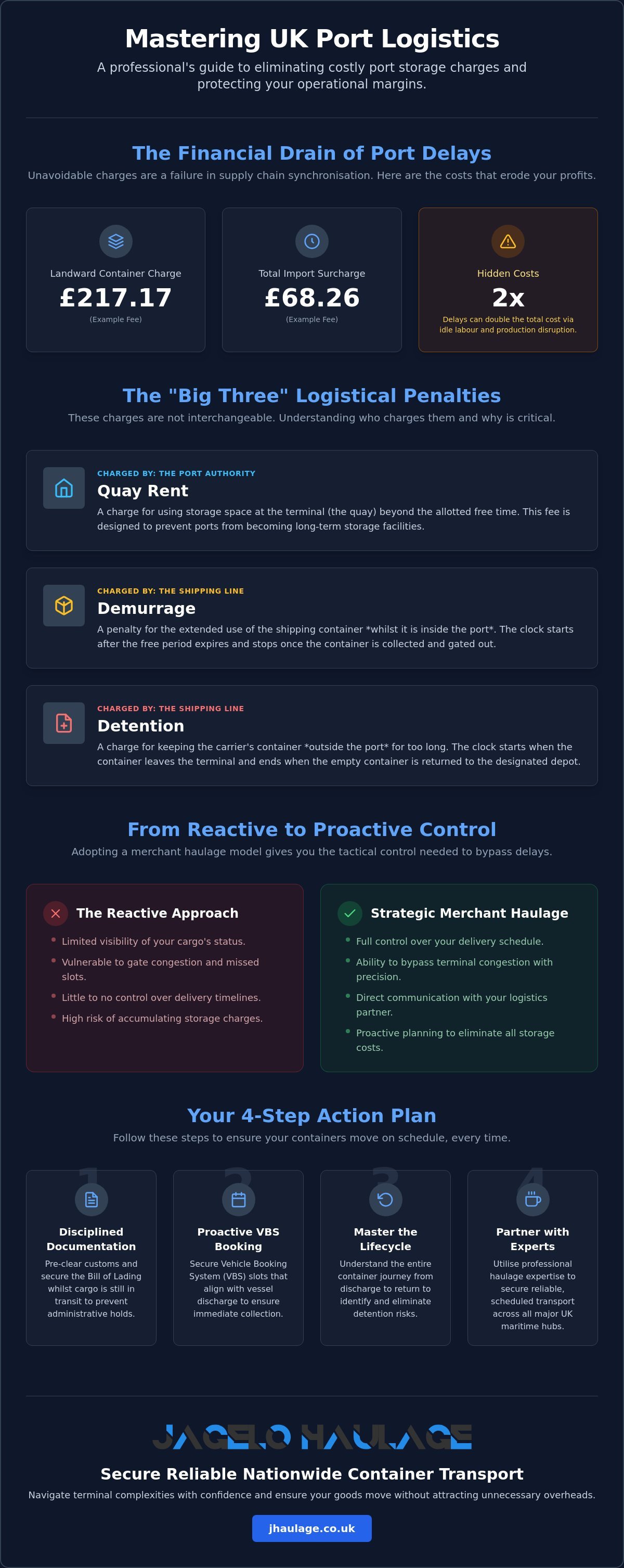
Storage fees represent a direct failure in supply chain synchronisation. These charges don't just appear as isolated line items; they actively erode the profit margins of UK importers and exporters. When a container sits idle on the quay, it attracts various penalties, including quay rent and demurrage. These costs are often compounded by mandatory fees such as the £217.17 Landward Container Charge or the £68.26 total import surcharge seen at modern terminals. Avoiding these variable penalties requires a psychological shift. Professional operators no longer view transport as a simple collection task, but as a timed manoeuvre within a complex terminal gate cycle.
The Real Cost of Logistics Delays
Daily quay rent averages at UK terminals are designed to be punitive to prevent the port from becoming a long-term storage facility. Administrative errors, such as incorrect customs documentation or delayed Bill of Lading releases, are the primary triggers for these physical transport bottlenecks. When a container is held at the port, the financial impact extends far beyond the terminal gates. A missed delivery slot often results in idle warehouse labour and disrupted production schedules. These "hidden" costs can quickly double the original expense of the transport operation, making precision a financial necessity rather than a preference.
Why Timing is Critical for Liverpool Container Operations
Terminal gate cycles at the Royal Seaforth or L2 terminals are governed by strict Vehicle Booking System (VBS) slots. Success in container haulage Liverpool depends on the ability to secure these slots in alignment with vessel discharge. Reliable transport providers maintain responsive customer support to manage these windows effectively, ensuring that drivers aren't caught in peak congestion hours. This level of coordination prevents "dead time" where vehicles are held in queues whilst storage clocks continue to tick. A 24-hour delay in container collection triggers immediate quay rent penalties and disrupts the downstream labour schedules of the receiving warehouse, resulting in a compounded financial loss that exceeds the base haulage rate.
Strategic partnerships with experienced fleets, such as those found at Jagelo Haulage, allow businesses to navigate these terminal complexities with confidence. By prioritising functional reliability, companies can ensure their goods move through the port without attracting unnecessary storage overheads.
Key Logistics Terms: Demurrage, Detention, and Quay Rent Explained
Effective management of container haulage Liverpool requires a precise understanding of the "Big Three" logistical penalties. These charges are not interchangeable; they reflect different stages of the container's journey and are levied by different entities. Failure to distinguish between them often leads to administrative oversights that trigger avoidable costs. A container's timeline begins at vessel discharge and concludes only when the empty equipment is returned to the carrier's designated depot. Within this window, three primary financial risks exist: demurrage, detention, and quay rent.
Demurrage vs Detention: Knowing the Difference
Shipping lines impose Demurrage when a laden container remains inside the terminal past the agreed free time. This fee acts as a liquidated damage for the carrier's inability to use their equipment. Once the container is collected and exits the terminal gates, the demurrage clock stops, but the detention clock begins. Detention refers to charges for the late return of the empty container after devanning. Managing the "Free Time" window effectively involves synchronising the haulage schedule with the warehouse's ability to unload. If you're unsure how these windows apply to your current shipments, you can request a professional logistics assessment to clarify your timeline.
Quay Rent and Terminal Storage Timelines
Quay rent is distinct from shipping line demurrage because it's a terminal-specific charge. Port operators, such as Peel Ports at Liverpool2, levy this fee for the physical space the container occupies on the dock. Whilst demurrage relates to the equipment, quay rent relates to the land. Terminal rules in Liverpool are stringent; the storage clock typically runs continuously, meaning weekends and bank holidays are included in the calculation. You must account for these days when planning collections to avoid sudden spikes in overheads.
Reviewing a port tariff is essential to anticipate these costs. Key indicators to look for include the Landward Container Charge, currently £217.17 per container, and any additional lift fees that apply if the container requires repositioning. Professional container haulage Liverpool providers monitor these tariffs daily to ensure their clients aren't surprised by terminal-mandated expenses. Ultimately, the responsibility for these charges falls upon the merchant in a merchant haulage agreement. This model grants the merchant the authority to select their own transport provider, rather than relying on the shipping line's internal logistics. This shift in control is the most effective way to protect your operations from the compounding effects of detention and quay rent.
Strategic Merchant Haulage: Gaining Control Over Your Delivery Timeline
Choosing the right haulage model is a strategic decision that directly affects your bottom line. Shipping line haulage involves the carrier managing the inland transport. Whilst this appears convenient, it often results in a lack of transparency and rigid scheduling. Merchant haulage allows you to appoint an independent provider for your container haulage Liverpool needs. This shift in control is essential for managing the financial impact of demurrage and detention. It ensures that your transport priorities align with your warehouse requirements rather than the carrier’s limited port slots.
Independent fleets provide the operational reach necessary to handle time-sensitive UK logistics. With a fleet of 40+ trucks, a professional haulier can absorb fluctuations in volume that would otherwise cause delays. Relying on carrier-managed transport often means waiting for their specific network capacity. If their trucks are unavailable, your container remains on the quay, attracting daily rent. Strategic merchant haulage eliminates this dependency by providing dedicated resources for your specific delivery timeline. Choosing an independent partner offers several distinct advantages:
- Reduced dependency on rigid carrier-managed transport networks.
- Elimination of quay rent caused by carrier truck shortages.
- Prioritised resource allocation for your specific delivery windows.
The Flexibility of Independent Port Logistics
Direct communication is a hallmark of disciplined logistics. You deal with the haulier directly rather than navigating a generic call centre. This allows for immediate adjustments to delivery windows based on your real-time warehouse capacity. You can learn more about these differences in our guide to Merchant Haulage vs Shipping Line Haulage. This level of coordination ensures that every move is intentional and efficient. It transforms the transport process from a simple physical task into a strategic outcome that protects your margins.
Reliability Through Fleet Modernisation
Operational reliability is rooted in the quality of the equipment used. We utilise Euro 6 compliant vehicles to ensure unrestricted access to all UK ports and urban centres. Fleet modernisation is not just about environmental compliance; it's about reducing the risk of mechanical failure that leads to missed terminal slots. Professional fleet management provides a consistent level of performance that mirrors the industrial standards of the sector. A modern, well-maintained fleet ensures protected outcomes for your cargo by minimising the variables that lead to transit delays.
A Step-by-Step Guide to Eliminating Unnecessary Port Costs
Eliminating port storage charges requires a proactive strategy that begins whilst the vessel is still in transit. Waiting for a container to reach the quay before organising transport is a high-risk approach that often leads to avoidable penalties. Professional container haulage Liverpool operations are built on a sequence of timed actions designed to keep cargo moving. By following a disciplined logistical framework, you can protect your margins from the rising costs of terminal congestion and administrative bottlenecks.
Early Documentation and Customs Clearance
Step one involves pre-clearing all customs documentation. You must ensure that the PIN and release note are available as soon as the vessel arrives. Administrative delays are the primary cause of containers exceeding their free storage window. Without these documents, a haulier cannot proceed with a collection, regardless of truck availability. This early preparation is a core component of our Guide to UK Container Haulage, which outlines the necessity of documentation in port logistics. Ensuring your paperwork is finalised early allows for a seamless transition from the quay to the road.
Optimising the Vehicle Booking System (VBS)
Step two is the strategic acquisition of Vehicle Booking System (VBS) slots. At terminals like Liverpool and Felixstowe, these slots are managed through a digital platform to control traffic flow. Securing a slot in advance is essential to avoid being locked out during peak hours. A haulier with established port relationships understands terminal gate cycles and can mitigate the risk of congestion through smart scheduling. This coordination leads directly into step three: immediate collection upon discharge. By aligning the VBS slot with the vessel's unloading schedule, you ensure the container exits the port gate before storage fees apply.
Step four focuses on real-time tracking and proactive communication with the delivery site. Maintaining visibility over the vehicle's progress allows your warehouse team to prepare for arrival, which reduces waiting time charges and labour inefficiencies. Finally, step five requires the rapid turnaround of empty containers. Once the cargo is devanned, the haulier must immediately return the empty equipment to the designated carrier depot. This prevents the accumulation of detention fees, which can be as punitive as the initial storage charges. To implement this strategic approach for your next shipment, you can request a professional haulage quote to secure your delivery timeline.
Reliable Port Logistics and Nationwide Container Transport with Jagelo Haulage
Jagelo Haulage delivers over 15 years of specialised expertise to the UK maritime sector. We operate from major logistical hubs including Liverpool, Felixstowe, and Southampton to ensure comprehensive nationwide coverage. Our disciplined approach to container haulage Liverpool prioritises the safety and efficiency of your operations above all else. We understand the high stakes of the modern supply chain. We provide a grounded, professional service that eliminates the uncertainty often associated with port logistics. Our team understands that functional reliability is the foundation of a successful partnership. Every statement we make is backed by a display of competence and a commitment to industrial standards.
Our Modern Fleet and Professional Standards
Our fleet comprises over 40 modern trucks and trailers maintained to the highest industrial standards. Reliability is a core component of our service delivery. We don't just move goods; we provide a protected environment for your cargo. Our professional drivers undergo rigorous training in specific port protocols and safety procedures. This ensures that every vehicle booking system slot is utilised effectively and every terminal gate entry follows strict compliance. Consistency is our primary objective. We maintain a methodical rhythm in our operations to mirror the reliability you require for your inventory management. Our drivers understand the intricacies of the Royal Seaforth and Liverpool2 terminals, ensuring that your collection is handled with seasoned professionalism. This disciplined focus on the fundamentals allows us to avoid the common pitfalls that lead to transit delays.
Partnering for Strategic Supply Chain Success
Successful logistics requires moving beyond simple transport. Jagelo Haulage positions itself as a strategic partner in your broader operational framework. We focus on the fundamentals of the supply chain to ensure your goods move from port to door without the burden of hidden costs. By managing the complexities of merchant haulage, we provide the stability necessary for long-term growth. Our responsive customer support team provides direct, clear information to operators nationwide. This ensures you remain informed at every stage of the transit process. We take pride in our ability to provide protected outcomes through functional excellence and punctuality. We don't rely on hyperbolic marketing; we rely on performance and results. Contact Jagelo Haulage for a professional port haulage quote to secure your delivery timeline and eliminate unnecessary storage overheads.
Securing Your Supply Chain Against Unnecessary Port Costs
Mastering port logistics requires a shift from reactive transport to disciplined, strategic planning. By understanding the distinct triggers for quay rent and demurrage, you can implement a documentation-first approach that ensures your cargo remains fluid. Merchant haulage provides the tactical control necessary to bypass carrier network limitations and secure priority terminal access. Jagelo Haulage brings over 15 years of port logistics experience to every operation, acting as a specialist in both Merchant and Shipping Line haulage. Our modern fleet of 40+ trucks is maintained to high industrial standards to ensure protected outcomes for your goods. When you prioritise functional reliability, you eliminate the variable costs that erode your profit margins. We invite you to request a professional container haulage quote from Jagelo Haulage to stabilise your container haulage Liverpool requirements. We look forward to establishing a secure and efficient transport route for your business.
Frequently Asked Questions
What are the typical port storage charges at UK terminals?
Port storage charges are comprised of several standardised fees. For instance, Peel Ports at the Royal Seaforth Container Terminal has set a £0.76 per TEU daily fee for off-hired container storage effective from January 2026. You will also encounter a Landward Container Charge of £217.17 per container for receiving and delivering via road or rail. These fees are exclusive of VAT and are designed to maintain terminal fluidity.
How much "free time" do I usually get for container storage at the port?
Free time typically ranges from three to seven days, depending on your specific agreement with the shipping line. This window begins once the container is discharged from the vessel and placed on the quay. Terminal operators in 2026 are tightening these windows to prevent congestion. You must confirm the exact duration with your carrier to avoid the immediate onset of quay rent and demurrage.
Can Merchant Haulage help me avoid demurrage fees better than Shipping Line haulage?
Merchant haulage provides superior control over your delivery schedule. By selecting your own provider for container haulage Liverpool, you aren't reliant on the carrier's internal truck availability. This independence allows you to prioritise collections based on your free-time expiry dates. It effectively reduces the risk of containers sitting idle whilst waiting for a shipping line's allocated vehicle.
What happens if my container is not collected before the quay rent starts?
Daily penalties will accumulate once the free-time window expires. These charges, known as quay rent and demurrage, are often punitive and can increase in scale the longer the container remains at the terminal. Administrative fees for additional container lifts, currently priced at £57.03 per move, may also apply if the container requires repositioning within the stack. Proactive collection is the only way to halt these costs.
Is the Port of Liverpool more expensive for storage than Felixstowe or Southampton?
Storage rates at major UK hubs are generally comparable as they follow standardised Schedules of Common User Charges. Whilst the base rates for quay rent are similar, specific surcharges can vary. For example, Liverpool terminals apply a Terminal Infrastructure Charge of £21.32 per laden import container. You should review the specific port tariff for each terminal to accurately forecast your total logistical spend.
What documents does my haulier need to collect a container from the port?
Your haulier requires a valid Release Note containing the unique PIN and confirmation of customs clearance. They also need the container number and the name of the vessel. These documents must be provided in advance to allow the haulier to secure a Vehicle Booking System slot. Without this information, the terminal will not permit the vehicle to enter the gate for collection.
Can Jagelo Haulage provide same-day container delivery from the port?
Delivery timelines depend on the availability of Vehicle Booking System slots and the timing of vessel discharge. Professional hauliers prioritise reliable, scheduled outcomes to ensure your cargo arrives within your warehouse's operational windows. You should check current fleet availability and terminal congestion levels when planning your transport. Securing your container haulage Liverpool in advance is the most effective way to achieve a prompt delivery.
How does the Vehicle Booking System (VBS) affect my haulage costs?
The VBS regulates terminal traffic and requires hauliers to book specific time windows for entry. If a vehicle misses its allocated slot due to documentation delays or congestion, it may incur waiting time charges, typically ranging from £30 to £50 per hour. Efficient VBS management is essential for maintaining a predictable cost structure and avoiding the penalties associated with terminal gate delays.