How to prepare container for UK port delivery

Preparing a container for UK port delivery is defined as the complete process of making a shipping container, its cargo, its documentation, and its delivery site ready to meet the access, structural, and regulatory requirements of UK port operations. This process covers far more than simply loading goods. It spans site ground conditions, Hiab crane clearance, moisture control using kiln-dried pallets and desiccants, customs documentation version control, and Clean Air Zone vehicle compliance. Logistics managers who treat container readiness as a single-step task routinely face failed deliveries, demurrage charges, and costly site re-visits. A systematic approach, from site selection through to post-delivery amendment logging, is the only reliable method.
What site and access preparations are essential for container delivery?
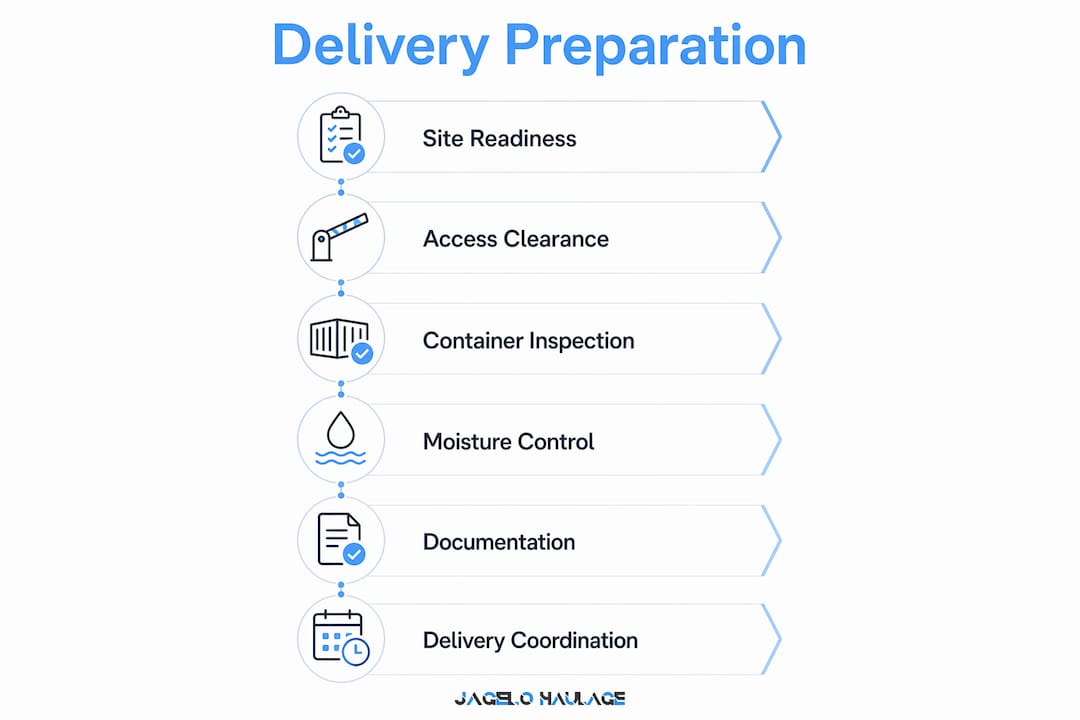
Site readiness is the single most common cause of failed container deliveries in the UK. Before any vehicle arrives, your site must meet specific dimensional and structural thresholds that are non-negotiable for Hiab crane operations.
Hiab crane offloading requires a minimum 4.5m (15ft) access width and 7.3m (24ft) clear offloading space, plus 1.8m (6ft) stabiliser clearance on either side. Failure to meet these dimensions results in aborted deliveries and expensive return visits. Measure your site before booking, not on the day.
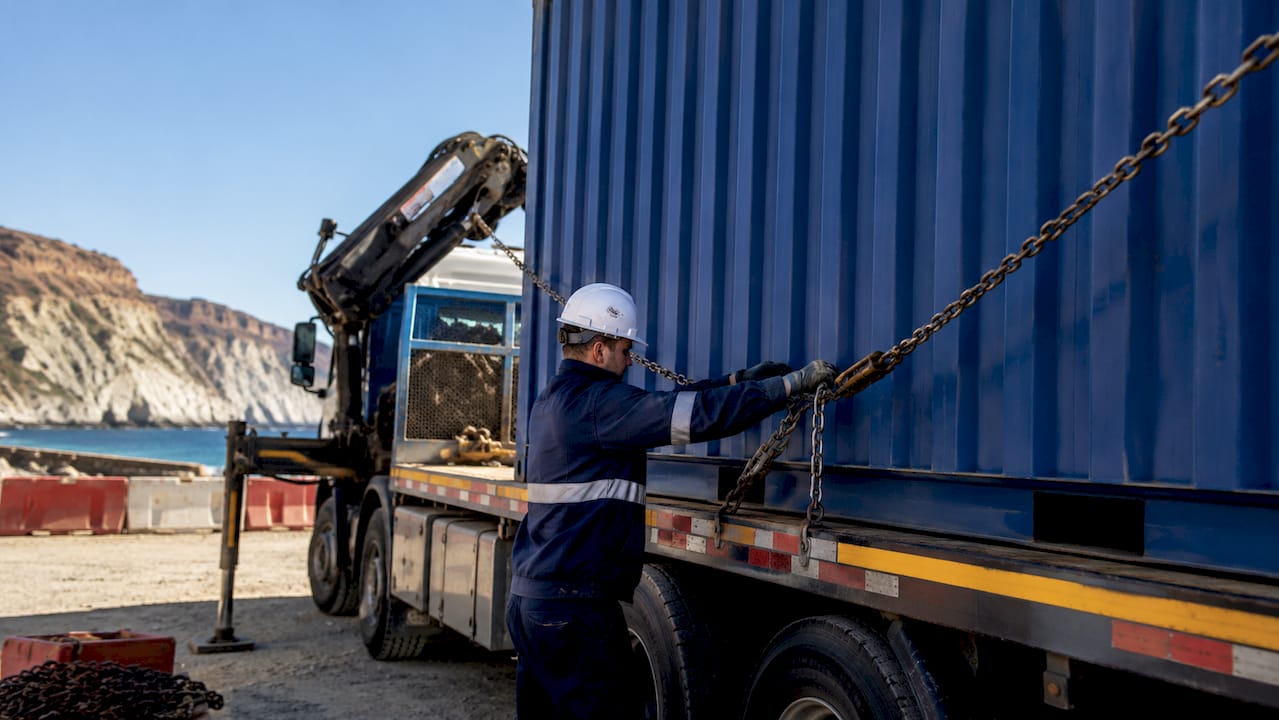
Ground stability is equally critical. Soft or uneven ground causes container racking and door malfunctions after placement. Even apparently solid hardcore can sink under the combined weight of a loaded vehicle and a full container without prior mechanical compaction and levelling. Commission a ground survey and compact the surface before the delivery date.
Overhead clearance must also be confirmed. Power lines, tree canopies, and building overhangs all present obstruction risks for crane jibs. Walk the full access route and remove or report any obstacle that falls within the crane’s operating envelope.
- Confirm access width of at least 4.5m along the full delivery route, not just at the gate
- Mark the container footprint and door swing zone using paint, stakes, or string before the vehicle arrives; site markings prevent costly repositioning disputes
- Check for overhead obstructions including cables, signage, and canopies along the entire approach
- Compact and level the ground surface, particularly on sites with recent groundworks or loose fill
- Confirm any estate or port-specific induction, PPE, or escort requirements well in advance
Pro Tip: If your site is exposed to wet weather, lay temporary trackway panels along the vehicle approach route. Trackway prevents HGV tyres from churning soft ground and blocking the crane’s stabiliser positions.
Industrial estates and port areas frequently impose non-national access rules including induction protocols, PPE standards, and escort requirements that are entirely independent of national regulations. A delivery vehicle that arrives without the correct site induction paperwork faces an immediate stoppage. Contact the estate or port authority at least 48 hours before delivery to confirm all entry requirements.
How should the container be inspected and prepared before delivery?
A container that passes a visual inspection at the port of origin can still arrive at a UK delivery site with structural defects, moisture ingress, or unsecured contents. A pre-delivery inspection checklist is the professional standard, not an optional extra.
- Structural integrity check. Inspect all four walls, the floor, and the roof for rust, deformation, or punctures. Any breach in the container shell creates a moisture pathway.
- Door gasket and locking mechanism verification. Test door seals by closing the container and checking for light ingress from inside. Unsealed doors risk opening in transit and allow condensation to form on cargo.
- Internal fixture security. Check all fixed shelving, racking, or lashing points. Remove any unsecured add-ons that could shift during road transport.
- Weight distribution confirmation. Cargo must be distributed evenly across the floor. Concentrated loads at one end stress the container frame and can cause tipping during crane offloading.
- Moisture control measures. Place kiln-dried pallets, dry cargo, and desiccants inside the container before sealing. Temperature variations across UK shipping routes cause condensation, which leads to mould, corrosion, and packaging failures.
Moisture control is a frequently underestimated risk in container shipping preparation. Experts confirm that humidity prevention is one of the most overlooked aspects of pre-loading checks, particularly on routes with significant temperature variation. Desiccant bags should be hung from container walls rather than placed on the floor, where they are less effective.
Pro Tip: Schedule container loading during dry weather windows. Loading during rain or high humidity introduces moisture before the doors are even sealed. Check the Met Office forecast for your loading date and build a 24-hour weather buffer into your schedule where possible.
What documentation must be completed for UK port delivery?
Documentation errors are the leading cause of customs delays at UK ports including Felixstowe, Tilbury, Southampton, and Liverpool. The solution is consolidation and version control, not simply gathering more paperwork.
A master data sheet consolidates all shipment parties, cargo descriptions, filing deadlines, and carrier references into a single controlled document. This single source of truth prevents the discrepancies between invoice, packing list, and bill of lading that trigger customs queries. Every amendment to any document must be logged with a date, a reason, and the name of the person who made the change.
- Maintain version control across the commercial invoice, packing list, bill of lading, and any certificates of origin or conformity
- Confirm importer and consignee details match exactly across all documents; a single spelling discrepancy can halt customs clearance
- File customs declarations within carrier-specified deadlines; late filings attract penalties and delay port release
- Retain all carrier notices, port authority communications, and booking confirmations in a single accessible folder
- Log post-delivery notes recording any delays linked to documentation gaps; these records guide improvements on subsequent shipments
Documentation consolidation and strict version control are the two practices that most consistently prevent customs delays and costly discrepancies. Professionals who treat documentation as a live, version-controlled record rather than a static file set experience significantly fewer port holds.
How to manage delivery day and troubleshoot common challenges
Delivery day coordination requires direct communication between the logistics manager, the haulier, and the receiving site contact. A gap in any one of these three relationships is where most delivery failures originate.
Failed deliveries most commonly result from poor communication about delivery slots, site access conditions, or vehicle requirements. The cost is not just a wasted journey. It includes demurrage charges if the container cannot be returned to the port on time, detention costs if the vehicle is held beyond its allocated slot, and potential re-booking fees. Confirm the delivery slot, vehicle registration, and driver contact details the evening before.
Vehicle compliance is a growing operational constraint. Delivery vehicles must meet Clean Air Zone regulations, and Zero Emission Zones are expected in over 10 UK cities by 2026, requiring electric or hydrogen HGVs in those areas. Verify that your haulier’s fleet meets the emissions standard for the specific route before booking.
“Confirming delivery details and contingency plans reduces failures and improves scheduling.” Treat this not as a courtesy call but as a formal pre-delivery checklist review with your haulier.
Common delivery challenges and how to address them:
- Access restriction at the gate. Carry copies of all site induction certificates, PPE records, and booking confirmations. Industrial estates impose access rules independently of national regulations; pre-registration is the only reliable safeguard.
- Ground failure under stabilisers. If the ground shifts when stabilisers are deployed, halt the lift immediately. Do not proceed until additional ground protection is in place.
- Container door malfunction after placement. This is almost always caused by an unlevel base. Re-level the container before forcing the doors; forcing a racked door destroys the locking mechanism.
- Crane reach insufficient for the placement position. Reposition the vehicle if the site layout allows. If not, the container must be placed at the nearest reachable point and skidded into position using specialist equipment.
Pro Tip: Build a written contingency plan before delivery day. Specify an alternative placement position, an alternative contact at the receiving site, and the haulier’s out-of-hours number. Share this plan with all parties 24 hours in advance.
For a deeper understanding of UK port transport standards, reviewing the full logistics framework for container movement helps you anticipate constraints before they become problems on site.
Key takeaways
Successful container delivery at UK ports depends on integrating site preparation, container inspection, moisture control, and documentation management into a single coordinated process before the vehicle departs.
| Point | Details |
|---|---|
| Site access dimensions | Confirm 4.5m width and 7.3m offloading space before booking a Hiab crane delivery. |
| Ground compaction | Mechanically compact and level all surfaces; soft ground causes container racking and door failure. |
| Moisture control | Use kiln-dried pallets and desiccants, and load only during dry weather to prevent condensation damage. |
| Documentation version control | Maintain a master data sheet and log every amendment to avoid customs delays at UK ports. |
| Delivery day communication | Confirm slot, vehicle, and contingency plan with all parties at least 24 hours before arrival. |
Why integrated planning separates professional operations from reactive ones
The logistics professionals I respect most treat container delivery preparation as a project, not a task. They begin site assessment weeks before the delivery date, not the morning of. They treat documentation as a live record with version history, not a folder of PDFs assembled at the last minute.
What I find consistently underestimated is the compounding effect of small oversights. A site that is 0.3m too narrow for stabiliser clearance does not produce a minor inconvenience. It produces a failed delivery, a demurrage charge, a rescheduled crane, and a conversation with a client who now doubts your competence. The same logic applies to a single field mismatch between the commercial invoice and the bill of lading. One discrepancy can hold an entire container at Felixstowe for days.
The growing pressure of Clean Air Zone compliance is changing how I think about haulier selection. Choosing a haulier based purely on price without verifying their fleet’s emissions compliance for the specific delivery route is a false economy. With Zero Emission Zones expanding across UK cities, that decision will increasingly determine whether your container reaches its destination on schedule or sits waiting for a compliant vehicle.
My strongest advice is this: communicate early and communicate in writing. Verbal confirmations of delivery slots, site access rules, and ground conditions are not confirmations. They are conversations. Written records, shared with all parties, are the only standard that holds when something goes wrong.
— Vytautas
How Jhaulage supports your UK port container deliveries
Jhaulage, operating as Jagelo Haulage Limited, specialises in container haulage across the UK’s major ports including Felixstowe, Tilbury, Southampton, and Liverpool. With a fleet of over 40 GPS-tracked trucks and trailers, Jhaulage provides port-to-door container haulage services tailored to the access, emissions, and scheduling requirements of each delivery site. Whether you are managing a full container load or a time-critical same-day movement, Jhaulage’s 24/7 support team coordinates every stage from port release to final placement. For professionals who need a haulier that understands road haulage best practices and site-specific constraints, Jhaulage is the dependable choice.
FAQ
What minimum space is needed for Hiab crane container delivery?
Hiab crane offloading requires at least 4.5m (15ft) access width, 7.3m (24ft) clear offloading space, and 1.8m (6ft) stabiliser clearance on either side. Failure to meet these dimensions results in aborted deliveries and additional costs.
How do I prevent moisture damage inside a shipping container?
Use kiln-dried pallets, hang desiccant bags from the container walls, and load only during dry weather conditions. Temperature variations on UK shipping routes cause condensation that leads to mould, corrosion, and packaging failures.
What documents are required for UK port container delivery?
The core documents are the commercial invoice, packing list, and bill of lading, all of which must match exactly. A master data sheet consolidating all shipment parties and filing deadlines prevents customs discrepancies and port holds.
Why do deliveries fail at industrial estates and port sites?
Industrial estates and port areas impose access rules independently of national regulations, including induction protocols and PPE requirements. Arriving without pre-registered compliance documentation causes immediate delivery stoppages.
Do delivery vehicles need to meet Clean Air Zone standards?
Yes. Delivery vehicles must comply with Clean Air Zone regulations for the specific route. Zero Emission Zones are expected in over 10 UK cities by 2026, requiring electric or hydrogen HGVs in those areas.