More on out of gauge from Jagelo Haulage
Out of gauge containers: a practical UK guide for logistics teams
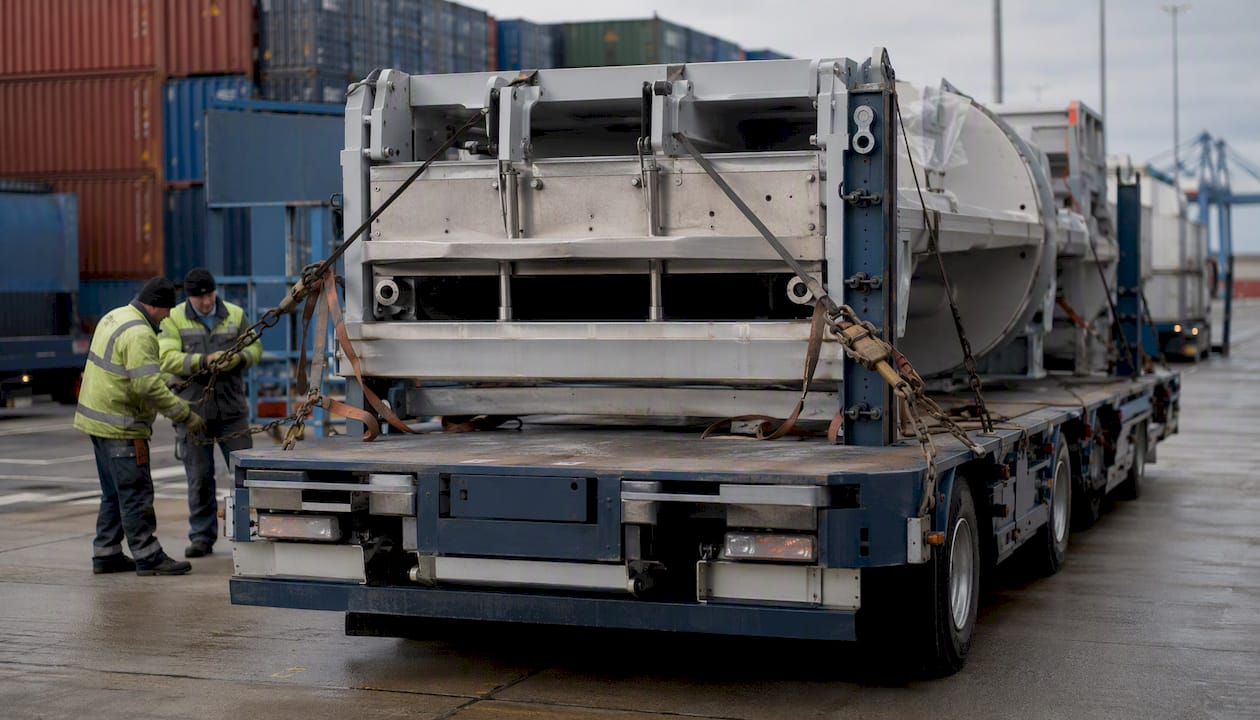
Out of gauge (OOG) cargo describes any shipment whose dimensions or weight exceed the standard ISO container envelope defined under ISO 668, specifically the 2.438 m width, 2.591 m height, and 6.058 m or 12.192 m length of standard 20 ft and 40 ft units. If any single axis of your piece breaches those limits, or if gross weight pushes beyond what standard container handling can accommodate, you are dealing with an OOG movement and need specialist equipment, documentation, and, in most UK road cases, abnormal-load permits.
Your three immediate actions are:
- Measure and diagram the piece — record length, width, height, and weight to the nearest centimetre and kilogram, and note the centre of gravity and lifting point positions.
- Identify suitable OOG equipment — flat rack (FR20 or FR40), open-top (OT), platform (bolster), RoRo, or breakbulk vessel, depending on which axis is exceeded and the piece weight.
- Start permit and route-survey planning — road authority approvals for abnormal loads are time-consuming; begin this process before you book vessel space.
Key takeaways
Out of gauge cargo requires specialist equipment, UK abnormal-load permits, and a planning runway of at least 6–10 weeks from first measurement to vessel departure.
| Point | Details |
|---|---|
| Measure first, book second | Obtain certified dimensions and weight before approaching carriers or booking vessel space. |
| Match equipment to the axis exceeded | Use open-top for over-height, flat rack or platform for over-width or overhang, RoRo for wheeled cargo. |
| Start permits before vessel booking | ESDAL route notifications and physical route surveys take 3–6 weeks; begin them in parallel with carrier enquiries. |
| Lifting plan is a pre-condition | A signed, certified lifting plan must be in the booking pack before terminal arrival, not after. |
| Jhaulage for UK port-to-door OOG | Jhaulage coordinates route surveys, terminal pre-advice, and GPS-tracked delivery across major UK ports. |
Table of Contents
- What counts as an out-of-gauge shipment?
- Which OOG equipment matches your cargo geometry?
- UK abnormal-load rules: permits, route surveys, and escorts
- Booking, declaration, and paperwork for OOG shipments
- How to load, lash, and lift OOG cargo safely
- What drives cost and lead time for OOG moves?
- OOG cargo by sector: common examples and mini case scenarios
- How Jagelo Haulage Limited manages OOG container moves
- What OOG moves in the UK actually teach you
- Jhaulage: specialist OOG haulage from UK ports to final site
- Sources
What counts as an out-of-gauge shipment?
The practical thresholds used across project and breakbulk shipping are well established. Cargo longer than 40 ft, wider than 14 ft, higher than 14 ft, or heavier than approximately 30 tonnes typically triggers OOG or breakbulk handling rather than standard container freight. These are operational rules of thumb, not hard legal limits, but they align closely with what carriers and terminals treat as specialist cargo.
Three distinct handling tiers exist once a shipment leaves standard container dimensions:
- In-gauge open-top — cargo fits within the container’s footprint but protrudes above the roof line; the open-top container accepts it with a tarpaulin cover, and the shipment remains within the vessel’s cell guides.
- Out-of-gauge on flat rack or platform — cargo overhangs the container’s sides, ends, or both; it cannot sit in cell guides and is stowed on deck, with adjacent slots blocked or left empty.
- Breakbulk / project cargo — the piece is too large or too heavy for any containerised option and must be loaded individually onto a multipurpose or heavy-lift vessel.
ISO 668 standardised the 8 ft width and 8 ft 6 in height of a standard unit. The 45 ft and 53 ft boxes used in some domestic markets are not universal ISO sizes and are incompatible with many international intermodal operations, which is why even a marginally oversized piece can create significant sourcing and routing challenges for non-standard container dimensions.
Which OOG equipment matches your cargo geometry?
Flat rack, open-top, and platform containers are the three primary containerised OOG types, each suited to a different combination of overhang, height excess, and payload.
Flat rack (FR20 / FR40) — a steel deck with collapsible end walls and no side walls. Cargo can overhang on all four sides, making flat racks the default choice for machinery, vehicles, and structural steel. The FR40 carries a higher payload and offers more lashing rings than the FR20, making it the preferred option for heavier or longer pieces where the vessel schedule permits.
Open-top (OT20 / OT40) — retains the side and end walls but removes the roof, accepting cargo that exceeds standard height but stays within the container’s footprint. Cranes load from above, and a tarpaulin covers the opening for weather protection. Suitable for tall machinery, coils, or stone blocks that do not overhang laterally.
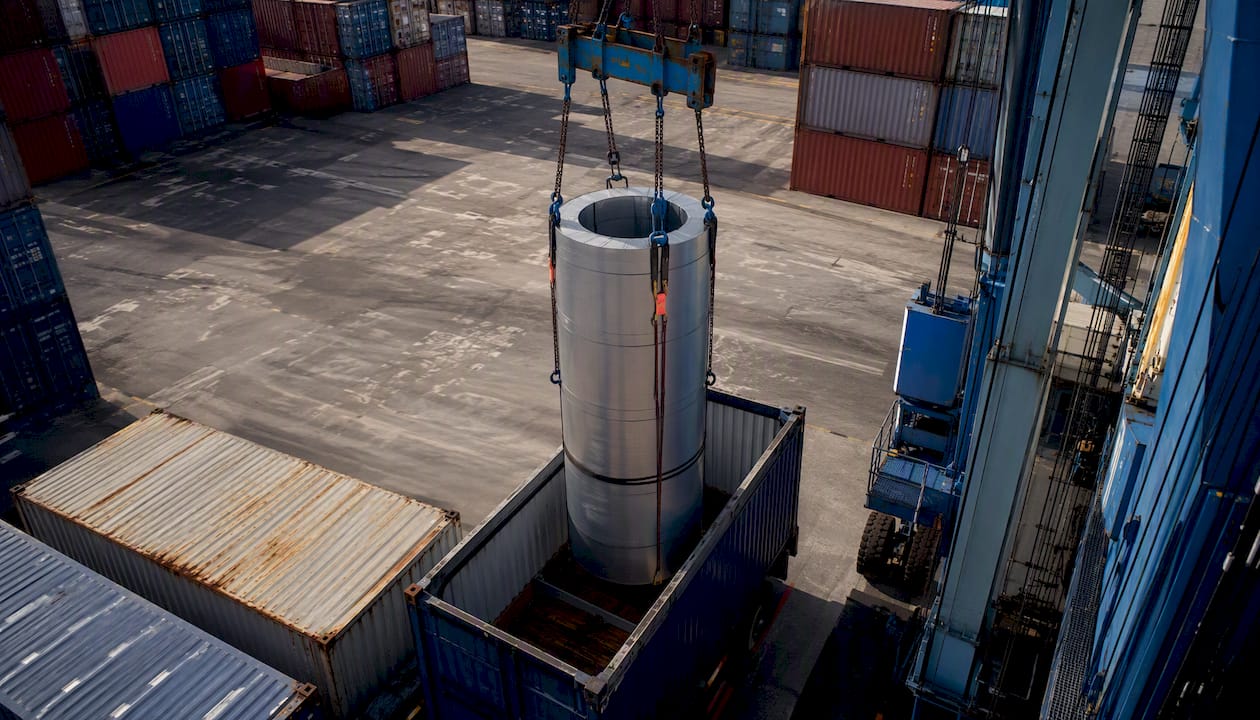
Platform / bolster (PL40) — essentially a flat deck with no walls and no end stanchions. Platform containers can carry payloads commonly cited up to around 45,000 kg and are the standard choice for extremely heavy or irregularly shaped project cargo. Stowage and lashing require signed plans from a competent cargo officer.
RoRo (Roll-on/Roll-off) — wheeled or tracked cargo drives or is towed onto the vessel via a stern ramp, eliminating the need for a crane lift. This is particularly useful for construction plant, agricultural machinery, and vehicles where a lift would be impractical or risk damage.
Breakbulk and heavy-lift vessels — when the piece exceeds the capacity of any containerised OOG option, breakbulk and heavy-lift vessels load each unit individually using ship or shore cranes. These require close coordination of lifting and stowage plans and carry the longest lead times.
Operational considerations across all OOG modes:
- Flat racks and platforms are always stowed on deck, exposing cargo to weather and sea spray.
- Deck stowage blocks adjacent container slots, which is the direct cause of lost-slot surcharges.
- Lashing points on flat racks are fixed; verify the number and spacing against your piece’s tie-down requirements before booking.
- RoRo avoids crane costs but requires the cargo to be road-mobile or fitted with a suitable skid frame.
Pro Tip: Where the cargo weight and length permit either option, specify an FR40 over an FR20. The FR40’s greater floor area reduces the risk of overhang penalties, its higher payload rating gives you headroom for last-minute weight revisions, and carriers typically find it easier to stow a single FR40 than two FR20s side by side.
UK abnormal-load rules: permits, route surveys, and escorts
Road legs connecting port terminals to final delivery sites are where UK-specific compliance obligations become most demanding. The Gov confirms that moves crossing thresholds of approximately 40 ft in length, 14 ft in width, or around 30 tonnes in weight typically trigger abnormal-load planning, including permitting and route surveys.
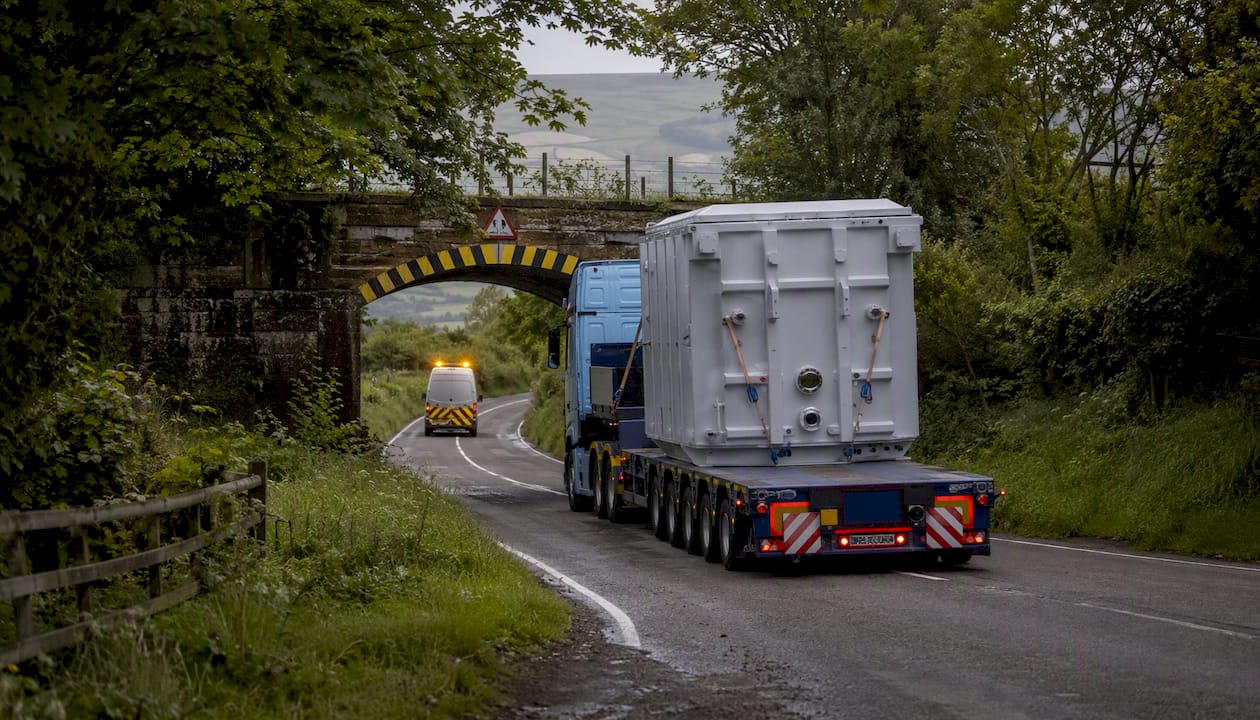
The ESDAL (Electronic Service Delivery for Abnormal Loads) system, administered by National Highways, is the primary portal for notifying and obtaining consent from road authorities across England. Route surveys conducted through this process evaluate overhead power lines, bridge load ratings, narrow toll booths, and turning radii. Failing to complete a survey before booking can prevent delivery to the final site entirely.
A practical weight reference: carrier operational restriction pages commonly reference a total gross vehicle weight referenced for certain road haulage equipment combinations in the UK. Loads approaching or exceeding this figure require careful vehicle configuration planning alongside the permit application.
Permit and planning checklist:
- Confirm the load’s dimensions and gross weight against abnormal-load thresholds before tendering.
- Register on ESDAL and submit route notification to all relevant highway authorities.
- Commission a physical route survey covering bridges, overhead utilities, and restricted junctions.
- Determine whether a police escort or attendant vehicle is required based on width and weight.
- Obtain written consent from each authority along the route before the movement date.
Numbered planning timeline:
- Weeks 6–8 before sail date: complete dimensional survey of the piece and begin ESDAL registration.
- Weeks 4–6: submit route notification and commission the physical route survey.
- Weeks 2–4: receive authority consents, confirm escort requirements, and book specialist road transport.
- Week 1: confirm all permits are in hand, brief the driver and escort team, and notify the terminal of the planned arrival window.
For a detailed walkthrough of the permit process, the abnormal load haulage guide covers the full UK regulatory framework.
Booking, declaration, and paperwork for OOG shipments
Carriers and terminals require a specific set of documents before they will accept an OOG booking. Submitting incomplete or inaccurate information at this stage causes pricing errors, stowage refusals, and, in the worst cases, a missed vessel.
Essential documents for an OOG booking:
- Certified weight certificate and dimensional survey (length × width × height, including protrusions).
- Scaled cargo diagram showing overhang on each axis and the centre of gravity position.
- Lifting-plan diagram identifying certified lifting points and sling angles.
- Method statement covering loading, securing, and discharge procedures.
- Bill of lading with OOG notation and accurate commodity description.
- Cargo insurance certificate rated to the individual piece value, not a blanket container policy.
Pre-declaration to the carrier matters for two reasons. First, the carrier’s stowage planner needs OOG dimensions to allocate deck space and calculate the number of adjacent slots that will be blocked. Second, the freight rate for OOG cargo is calculated on the basis of declared dimensions; an underdeclaration discovered at the terminal results in surcharge adjustments and potential delays. Checking carrier and terminal operational restrictions early also confirms local height, width, and weight constraints before you commit to a routing.
OOG booking preparation checklist:
- Verify dimensions and weight with the manufacturer or a certified surveyor.
- Confirm equipment type (FR, OT, PL, RoRo) with the carrier before issuing the booking request.
- Attach the cargo diagram and lifting plan to the booking confirmation.
- Specify insurance coverage as piece-specific, not container-blanket.
- Confirm the terminal’s vehicle booking system (VBS) requirements for oversized arrivals.
- Retain copies of all documents for customs clearance and port health purposes.
For UK customs clearance, OOG cargo follows the same import/export declaration process as standard freight but requires accurate commodity codes and, for certain plant or machinery, import licences or phytosanitary certificates. The physical size of the piece may also necessitate a customs examination at a location other than the standard examination bay, so pre-advising HMRC Border Force of the arrival is advisable for large or complex pieces.
How to load, lash, and lift OOG cargo safely
Safe loading of OOG cargo depends on three engineering controls: a certified lifting plan, a signed lashing plan, and a pre-lift inspection. Accurate lifting points, centre-of-gravity data, and certified rigging diagrams are among the most common technical causes of a deferred lift or refused terminal service when they are missing or ambiguous.
Step-by-step loading procedure:
- Verify the flat rack or platform is undamaged, with all lashing rings intact and rated to the required capacity.
- Confirm the cargo’s centre of gravity with the shipper’s technical documentation before positioning the piece.
- Position certified slings or spreader beams at the manufacturer-specified lifting points; never improvise lift points on structural members not designed for the load.
- Conduct a trial lift to approximately 300 mm, pause, and check for unexpected tilt or sling movement before proceeding.
- Lower the piece onto the container deck, distributing the load across timber dunnage or steel spreader plates to avoid point loading.
- Apply lashings in accordance with the signed lashing plan, using certified chain or wire with documented safe working loads.
- Conduct a final visual inspection of all lashings, dunnage, and overhang measurements before the unit leaves the terminal gate.
A practical weight reference: the UK road haulage gross vehicle weight limit of around 44,000 kg for certain equipment combinations means that even before the piece reaches the vessel, the road vehicle configuration must be verified against the combined tare and cargo weight.
Pre-lift safety checklist:
- Lifting plan signed by a competent person and available on site.
- All slings, shackles, and spreaders carry current certification (typically annual third-party inspection).
- Terminal crane operator briefed on lift weight, centre of gravity, and any asymmetric load conditions.
- Exclusion zone established around the lift area.
- Weather conditions assessed — wind speed limits for crane operations must be observed.
Pro Tip: Include a scaled lifting-plan diagram in your booking pack, not just a written description of lifting points. Terminal crane operators work faster and more safely when they can see the geometry at a glance, and a diagram reduces the risk of a last-minute query that holds up the vessel.
What drives cost and lead time for OOG moves?
OOG shipments carry a cost premium over standard container freight, and understanding where that premium originates helps procurement teams budget accurately and avoid surprises.
Carriers apply lost-slot surcharges because OOG cargo on deck prevents normal container stacking in adjacent positions. The surcharge reflects the revenue the carrier cannot earn from those blocked slots, and it scales with the number of slots affected — a wide piece on an FR40 may block two or three adjacent positions on each side.
Primary cost drivers:
- Lost-slot charges (per blocked adjacent slot, applied by the carrier).
- Special equipment hire (flat rack, platform, or open-top container day rates).
- Crane and terminal handling fees (often charged per lift, not per container).
- Abnormal-load permit fees and route-survey costs.
- Police or attendant escort fees for road legs.
- Insurance loading above standard cargo rates for high-value or fragile pieces.
| Cost driver | When it applies | Relative impact |
|---|---|---|
| Lost-slot surcharge | All deck-stowed OOG cargo | High |
| Special equipment hire | FR, OT, PL, or RoRo required | Medium–high |
| Crane / terminal handling | Piece requires a crane lift at origin and destination | Medium |
| Permit and escort fees | UK road leg exceeds abnormal-load thresholds | Medium |
| Insurance loading | High-value or fragile project cargo | Variable |
Typical lead-time envelope:
- Planning and dimensional survey: 1–2 weeks.
- Permit applications and route-survey completion: 3–6 weeks (allow more for complex routes).
- Carrier booking and vessel stowage confirmation: 2–4 weeks ahead of sail date.
- Terminal pre-advice and VBS slot booking: 1–2 weeks before arrival.
The total planning runway for a UK OOG move from first measurement to vessel departure is commonly 6–10 weeks for a straightforward piece and longer for heavy-lift or multi-modal project cargo.
OOG cargo by sector: common examples and mini case scenarios
Construction plant, energy, and events
The sectors that generate the most OOG movements in the UK share a common characteristic: their core equipment is designed for function, not for fitting inside a standard container.
- Construction plant — crawler excavators (typically 3–5 m wide with tracks), tower crane sections, and piling rigs regularly exceed standard width and height limits.
- Power generation — wind-turbine nacelles and transformer units often weigh 50–120 tonnes and require platform containers or heavy-lift vessels.
- Marine and leisure — sailing yachts and motorboats up to 15 m in length ship on FR40 flat racks with the mast removed; larger vessels move as breakbulk.
- Events and structures — temporary grandstands, large LED screen rigs, and stage structures frequently exceed standard height on an open-top but stay within footprint.
- Oil and gas — pressure vessels, heat exchangers, and subsea manifolds are among the heaviest and most geometrically complex OOG pieces.
Mini case scenario: FR40 machinery move
A UK importer sourcing a 38-tonne industrial press from a European manufacturer books an FR40 flat rack. The press measures 11.8 m × 2.9 m × 2.6 m, fitting within the FR40’s floor length but overhanging the width by 0.46 m on each side. The carrier blocks one adjacent slot on each side, generating a two-slot lost-slot surcharge. The road leg from Felixstowe to the Midlands requires an ESDAL notification and a route survey, but no police escort, because the width falls below the escort threshold. Total planning time from measurement to delivery: eight weeks.
Mini case scenario: breakbulk heavy-lift alternative
A 95-tonne transformer destined for a Scottish substation cannot be accommodated on any containerised OOG option. The freight forwarder books space on a multipurpose heavy-lift vessel calling at Grangemouth. Shore cranes at the port lift the transformer directly onto a self-propelled modular transporter (SPMT) for the final road leg, which requires a full abnormal-load convoy with police escort. The port-to-door coordination for this movement involves the port authority, National Highways, two local councils, and the network operator at the destination substation.
Pro Tip: On multimodal OOG moves, the handoff between transport modes — vessel to port crane, crane to road vehicle, road vehicle to final site — is where delays most commonly occur. Assign a single point of contact who holds authority across all legs; fragmented communication between the shipping agent, haulier, and site team is the most frequent cause of costly waiting time.
How Jagelo Haulage Limited manages OOG container moves
Jhaulage operates as a specialist container haulage provider across major UK ports including Felixstowe, Tilbury, Southampton, and Liverpool, with a fleet of over 40 GPS-tracked trucks and trailers configured for port-to-door delivery of standard and OOG containers.
What Jhaulage provides for OOG movements:
- Pre-movement route surveys and liaison with highway authorities for abnormal-load notifications.
- Review of lifting plans and method statements before terminal arrival.
- Terminal coordination, including VBS slot booking and pre-advice to port handling teams.
- GPS-tracked transport with real-time visibility throughout the road leg.
- 24/7 operational support for time-critical or multi-leg OOG movements.
| Client expectation | Jhaulage standard |
|---|---|
| Initial response to OOG enquiry | 24-hour acknowledgement with preliminary feasibility assessment |
| Documentation review (lifting plan, dimensions) | Completed before booking confirmation is issued |
| Route survey and permit coordination | Commenced at booking stage, not after vessel confirmation |
| GPS tracking and status updates | Continuous throughout the road leg |
| Port coverage | Felixstowe, Tilbury, Southampton, Liverpool, and additional UK gateways |
Pro Tip: When tendering an OOG move, share your cargo diagram and weight certificate with Jhaulage at the enquiry stage, not after the booking is placed. Early access to the piece’s geometry allows the route survey and permit application to run in parallel with vessel booking, compressing the overall planning timeline.
What OOG moves in the UK actually teach you
The conventional wisdom in logistics is that OOG moves are simply “bigger versions” of standard container shipments. They are not. The planning discipline required is categorically different, and the consequences of treating them as an afterthought are disproportionately expensive.
The single most consistent failure pattern is late engagement with the permit and route-survey process. Operations teams often wait until a vessel booking is confirmed before starting the road leg planning, at which point the permit lead time may already exceed the available window. The correct sequence is the reverse: start the route survey and ESDAL notification before you confirm the vessel, not after.
Lifting diagrams deserve equal attention. A missing or ambiguous lifting plan is not a paperwork inconvenience; it is a genuine operational risk that can ground a lift at the terminal and cause a missed sailing. Insist on manufacturer-certified lifting points and a scaled diagram, and verify that the terminal crane operator has reviewed them before the unit arrives.
On insurance, the standard cargo policy wording that covers a conventional container shipment is almost always inadequate for OOG project cargo. Piece-specific cover, with a nominated surveyor and agreed valuation, is the correct instrument. The difference in premium is modest compared with the exposure on a 50-tonne transformer or a bespoke industrial machine.
My priority checklist for any UK OOG movement:
- Measure the piece and obtain a certified weight before any other step.
- Identify the correct equipment type and confirm carrier acceptance of the dimensions.
- Start the ESDAL route notification and commission the physical route survey immediately.
- Obtain a signed lifting plan from a competent person before the booking is confirmed.
- Review the cargo insurance wording and appoint a nominated surveyor for high-value pieces.
Jhaulage: specialist OOG haulage from UK ports to final site
Port-to-door OOG moves demand a haulier who understands the full chain: terminal pre-advice, abnormal-load permits, route surveys, and GPS-tracked delivery to a site that may itself present access constraints. Jhaulage combines all of those capabilities under one contract, removing the coordination overhead that arises when the shipping agent, haulier, and permit consultant operate independently.
Freight forwarders and importers managing oversized cargo shipping through Felixstowe, Tilbury, Southampton, or Liverpool can engage Jhaulage for the complete road leg, from terminal gate to final delivery address. The fleet of over 40 tracked vehicles, 24/7 operational support, and in-house route-survey coordination means your OOG movement is managed by one team with full visibility at every stage. To discuss your next OOG movement and receive a preliminary feasibility assessment, contact Jhaulage with your cargo dimensions and intended port of discharge.
Sources
The following primary sources are the authoritative references for UK OOG planning:
- Special types enforcement guide
- OOG Container Dimensions — Flat Rack, Open Top & Platform | CalculateCBM
- What Is Out of Gauge (OOG) Cargo? Complete Guide to OOG Meaning, Transport, and Containers
Recommended
- In-Gauge Containers Delivery Explained | Jagelo Haulage
- Heavy Container Haulage: A Strategic Reference Guide for UK Logistics 2026 | Jagelo Haulage
- Logistics for Shipping Containers: A Comprehensive Guide to UK Port Transport | Jagelo Haulage
- Road Haulage for Containers: A Professional Guide to UK Port Logistics | Jagelo Haulage