More on out of gauge from Jagelo Haulage
Abnormal load haulage in the UK: a complete guide
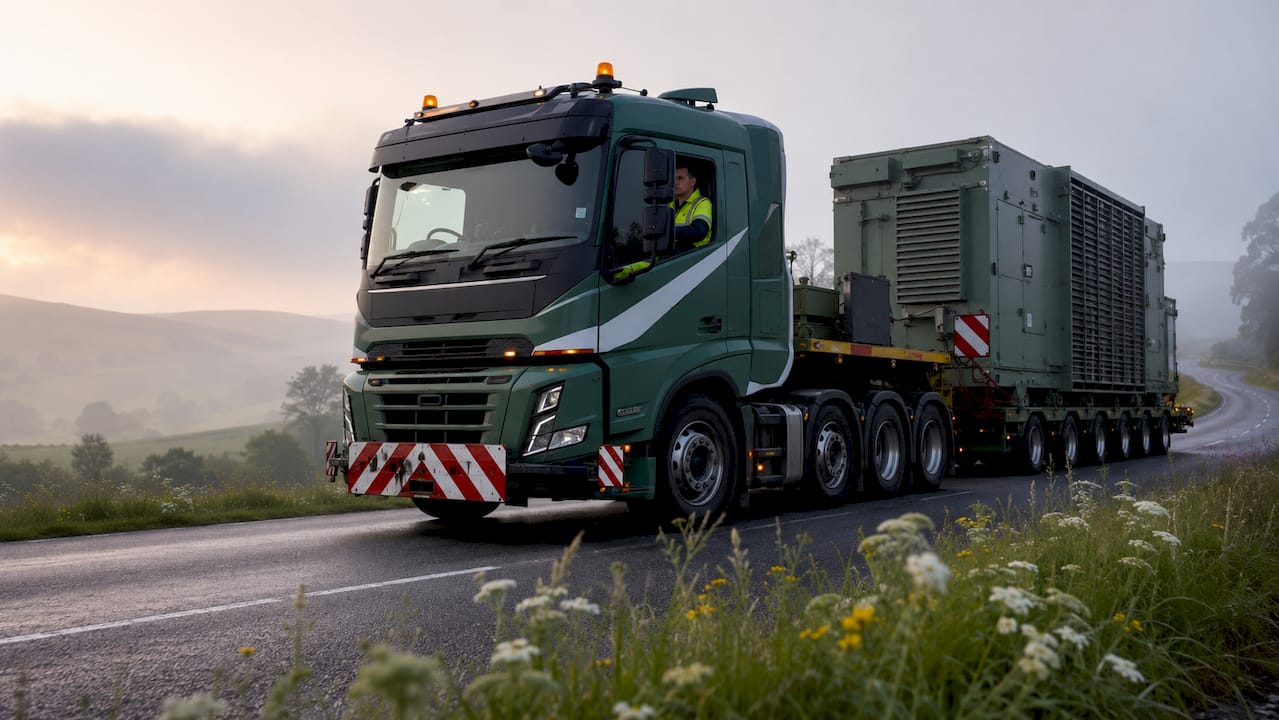
Abnormal load haulage is defined as the transportation of goods that exceed the standard legal limits for weight, width, height, or length permitted on UK public roads. These movements fall under the Special Types General Order (STGO) and the Road Vehicles (Construction and Use) Regulations, which set the thresholds beyond which a standard haulage licence is insufficient. National Highways, local highway authorities, and the police all play a role in authorising and supervising these movements. For logistics managers and transportation coordinators, understanding what is abnormal load haulage means understanding a tightly regulated discipline where a single planning error can halt an entire operation.
What are the UK legal criteria for abnormal load haulage?
Abnormal load transportation begins where standard road haulage ends. In the UK, a load becomes legally “abnormal” when it exceeds 2.9 metres in width, 18.65 metres in overall length, or 44,000 kg in gross weight. Any vehicle or combination that surpasses these thresholds must operate under STGO authority rather than a standard operator’s licence.
STGO defines three permit categories based on gross weight, and each carries specific axle requirements and speed restrictions:
- Category 1: Gross weight up to 50,000 kg. Requires a minimum number of axles and carries a maximum road speed of 40 mph on motorways.
- Category 2: Gross weight up to 80,000 kg. Additional axle requirements apply, and speed limits reduce further on certain road types.
- Category 3: Gross weight up to 150,000 kg. The most heavily regulated category, requiring mandatory police escort and the most detailed permit documentation.
STGO categories dictate not only the permit type but also the speed limits and escort obligations that apply throughout the movement. A Category 3 movement that proceeds without a police escort is not merely a procedural failing. It is a criminal offence.
Permit applications must include accurate load dimensions, axle configurations, proposed routes, and timing windows. Complex routes can require up to 8 weeks for full approval, particularly where multiple local highway authorities must each grant consent. Submitting inaccurate documentation is the fastest route to permit refusal and potential prosecution.

Pro Tip: Submit permit applications at least 10 weeks before your planned movement date on complex multi-authority routes. This buffer absorbs the inevitable back-and-forth with local councils without pushing your delivery date.
Non-compliance carries serious consequences. Fines, load seizure, and operator licence revocation are all on the table. Logistics coordinators who treat permit requirements as administrative formalities rather than legal obligations expose their organisations to significant liability. For a grounding in how UK weight regulations interact with haulage planning more broadly, the compliance picture is consistent: get the paperwork right before the wheels turn.
How is route planning conducted for abnormal load movements?
Route planning for heavy load shipping is not a desk exercise. It requires physical survey work, authority coordination, and detailed risk assessment carried out well before the movement date. The value of a professional haulier lies precisely in this preemptive problem-solving, a role that clients frequently underestimate until something goes wrong.
A thorough route survey addresses the following in sequence:
- Bridge clearance and load bearing. Every bridge on the proposed route must be assessed for both height clearance and structural load capacity. The critical bridge height threshold is 4.95 metres; any structure below this figure requires either a route deviation or a formal engineering assessment.
- Junction geometry. Tight roundabouts and sharp bends can make a long or wide load physically impossible to navigate without temporary traffic management or road furniture removal.
- Overhead utilities. Power lines, signal gantries, and railway bridges all present clearance risks for tall loads. Utility companies must be notified and, in some cases, lines must be temporarily raised.
- Roadworks and timing restrictions. Active roadworks can close the only viable route for weeks. Night-time movement windows, weekend restrictions, and peak-hour bans must all be factored into the movement schedule.
- Local authority consent. Local approvals can take 28 days or longer, and a single refusal forces a complete reroute and restarts the consent process with adjacent authorities.
Specialist route planning software assists in identifying potential conflicts, but it does not replace physical reconnaissance. A software tool will flag a bridge by its recorded height. Only a site visit confirms whether recent resurfacing has reduced the actual clearance below the recorded figure.
Pro Tip: Always conduct a physical recce of the final mile into the delivery site. Access roads on industrial estates are frequently unmapped, poorly surfaced, and too narrow for modular trailer configurations.
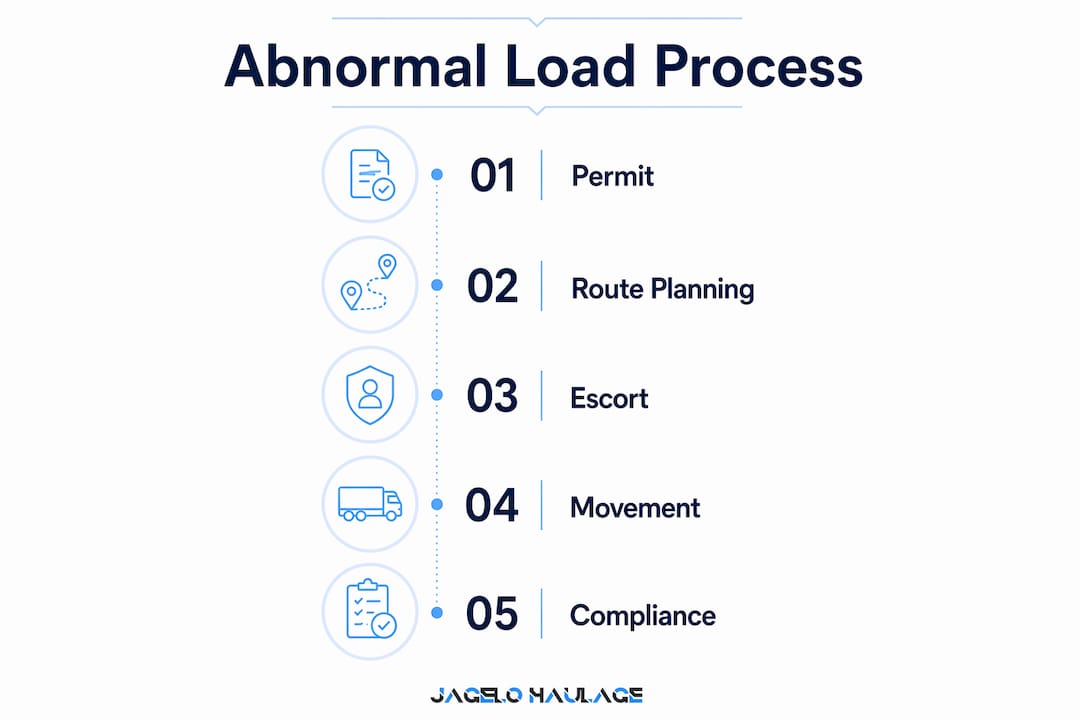
Thorough pre-move investigation resolves complications before they become operational crises. Roadworks discovered on the day of movement, with a 200-tonne transformer on the back of a trailer, are not a planning contingency. They are a planning failure.
What specialised equipment is needed for abnormal loads?
The equipment required for oversized load transportation scales directly with the dimensions and weight of the load. Selecting the wrong trailer configuration is not merely inefficient. It can render the movement illegal or physically impossible.
Trailer types for heavy haulage
| Trailer type | Typical application | Key characteristic |
|---|---|---|
| Low loader | Construction plant, large machinery | Reduced deck height for tall loads |
| Extendable flatbed | Long structural steel, wind turbine blades | Adjustable length up to 36 metres |
| Modular trailer (SPMT) | Very heavy industrial equipment | Axle lines added to distribute weight |
| Girder frame | Reactor vessels, large cylinders | Load suspended between two bogies |
Self-propelled modular transporters (SPMTs) are the equipment of choice for the heaviest Category 3 movements. Their axle lines can be multiplied to spread gross weight across a greater road contact area, keeping individual axle loads within permitted limits even when total gross weight reaches six figures.
Escort vehicle requirements
Escort arrangements are not optional add-ons. They are a legal requirement that scales with load width and weight. Escort vehicles must carry the following as a minimum:
- Amber flashing lights visible from all directions
- ‘ABNORMAL LOAD’ signage front and rear
- Radio communication with the haulage vehicle
- A height gauge calibrated to the load’s maximum height
- First aid equipment
Escort requirements scale from a single pilot car for moderately wide loads to mandatory police escorts for Category 3 movements. Police escorts are not arranged through the haulier. They are requested through the relevant police forces along the route, and their availability must be confirmed before the movement date is fixed.
How to ensure compliance during abnormal load haulage?
Compliance in abnormal load haulage is not a one-time permit check. It is an ongoing discipline that runs from initial load assessment through to final delivery confirmation. Logistics coordinators who treat it as a tick-box exercise consistently encounter the same set of avoidable problems.
The most common compliance failures are:
- Uncertified escort operators. Untrained or uncertified escorts are a primary cause of permits being suspended en route. The haulage operator bears full responsibility for verifying that every escort driver holds the required certification before departure.
- Misrepresenting load divisibility. Loads must be confirmed as genuinely indivisible to qualify for abnormal load permits. Misrepresenting a divisible load as abnormal constitutes fraud and carries severe penalties, including criminal prosecution.
- Incomplete local authority notification. Every local highway authority along the route must receive formal notification within the required timeframe. Missing a single authority invalidates the movement’s legal basis in that jurisdiction.
- Permit condition breaches. Speed limit violations, unauthorised route deviations, and movements outside permitted time windows all constitute permit breaches, even when the load itself is correctly documented.
Pro Tip: Create a pre-departure compliance checklist that requires a signed confirmation from the escort supervisor, the haulage driver, and the traffic manager before any abnormal load movement begins. This single document has prevented more permit suspensions than any other procedural control.
The indivisibility test deserves particular attention. A load qualifies as indivisible only when dividing it would cause disproportionate cost, damage, or safety risk. If a load can be economically separated and transported in standard vehicles, it must be. Applying for an abnormal load permit for a divisible load is not a grey area. It is a misuse of the permit system. For a broader view of how transport compliance frameworks apply across heavy haulage operations, the underlying principles are consistent across load types.
Key takeaways
Abnormal load haulage requires legal permits, certified escorts, indivisible loads, and thorough route surveys to operate lawfully and safely on UK roads.
| Point | Details |
|---|---|
| Legal thresholds trigger STGO | Loads exceeding 2.9 m width, 18.65 m length, or 44,000 kg gross weight require STGO authority. |
| Permit lead times are long | Complex multi-authority routes require up to 8 weeks for approval; apply early to avoid delays. |
| Route surveys are non-negotiable | Physical recce of bridges, junctions, and utilities must precede every abnormal load movement. |
| Escort certification is the operator’s responsibility | Uncertified escorts cause permit suspensions; verify credentials before departure, not after. |
| Indivisibility must be genuine | Misrepresenting a divisible load as abnormal constitutes fraud and risks criminal prosecution. |
What I have learned from managing abnormal load movements
The single biggest mistake I see logistics coordinators make is treating the permit as the hard part. They spend weeks on the application, get the approval, and then hand the movement to an escort contractor without verifying a single credential. Three hours into a Category 2 movement, a police check reveals the escort driver holds no valid certification, and the whole operation stops on the hard shoulder of the A1.
Route planning is where the real expertise lives. I have seen experienced hauliers identify a bridge resurfacing issue that would have reduced clearance by 80 mm, enough to ground a 4.8-metre-high load. That discovery came from a physical site visit, not from a software report. No planning tool replaces boots on the ground.
The indivisibility question also catches people out more than it should. I have reviewed permit applications where the load was clearly separable into two standard flatbed movements. The applicant had not considered it because abnormal load haulage felt like the simpler option. It is never the simpler option. It is the legally necessary option only when no practical alternative exists.
Technology does help. Digital documentation platforms reduce the risk of missing a local authority notification, and GPS tracking on escort vehicles gives traffic managers real-time visibility of the convoy’s position. But technology is a support tool. The discipline, the verification, and the professional judgement still sit with the people running the movement.
Safety is the non-negotiable constant. Every procedural requirement in STGO exists because abnormal loads present genuine risks to other road users, infrastructure, and the load itself. Compliance is not bureaucracy. It is the framework that keeps everyone on the road alive.
— Vytautas
Jhaulage’s approach to specialist haulage operations
Logistics coordinators managing heavy or oversized freight need a haulage partner who understands the regulatory detail, not one who learns it alongside you.
Jhaulage operates a modern fleet of over 40 trucks and trailers across major UK ports including Felixstowe, Tilbury, Southampton, and Liverpool, with GPS tracking providing real-time cargo visibility throughout every movement. The team handles permit coordination, route assessment, and compliance documentation as part of its standard service, reducing the administrative burden on your operations team. For logistics managers who need dependable, regulation-compliant specialist haulage services with 24/7 support, Jhaulage provides the expertise and equipment to move freight safely and on schedule. Contact the team to discuss your specific requirements.
FAQ
What is abnormal load haulage in the UK?
Abnormal load haulage is the regulated transportation of goods that exceed standard UK legal limits for weight, width, height, or length. These movements require STGO permits, route approval from local highway authorities, and in many cases, police escorts.
How long does an abnormal load permit take to obtain?
Permit applications for complex routes can take up to 8 weeks to process, particularly where multiple local highway authorities must each grant consent. Submitting accurate documentation at the outset is the most effective way to avoid delays.
What escort vehicles are required for abnormal loads?
Escort vehicles must carry amber flashing lights, ‘ABNORMAL LOAD’ signage, radio communication equipment, a height gauge, and first aid equipment. The number of escorts required scales with load width and weight, up to mandatory police escort for Category 3 movements.
What makes a load legally “abnormal” under UK law?
A load is legally abnormal when it exceeds 2.9 metres in width, 18.65 metres in overall length, or 44,000 kg in gross weight. Loads must also be genuinely indivisible to qualify for abnormal load permits.
What happens if an abnormal load moves without a valid permit?
Operating without a valid permit exposes the haulage operator to fines, load seizure, and potential operator licence revocation. Misrepresenting a divisible load as abnormal to obtain a permit constitutes fraud and can result in criminal prosecution.
Recommended
- How haulage contracts work in the UK: 2026 guide | Jagelo Haulage
- Heavy Container Haulage: A Strategic Reference Guide for UK Logistics 2026 | Jagelo Haulage
- A Comprehensive Guide to Merchant Haulage: How to Organise Efficient UK Container Transport | Jagelo Haulage
- UK haulage sustainability practices: a logistics manager’s guide | Jagelo Haulage