UK haulage sustainability practices: a logistics manager’s guide

The UK freight sector generates 36 million tonnes of CO2e annually, accounting for 16% of total transport emissions — yet fewer than 8% of the largest logistics operators have implemented fleet-wide decarbonisation programmes. For logistics managers and procurement officers overseeing container haulage operations, this creates a specific and pressing challenge: how do you reduce your carbon footprint in haulage without compromising delivery reliability, inflating costs, or losing visibility over subcontracted carriers? This article provides a structured framework covering evaluation criteria, fuel options, comparative analysis, and practical decision-making steps to help you act with confidence.
Table of Contents
- Key sustainability criteria for evaluating haulage practices
- Sustainable fuel options transforming UK haulage
- Comparing sustainability practices in UK haulage fleets
- Making sustainable haulage decisions for your supply chain
- Reframing sustainability in UK haulage: a practical perspective
- How Jagelo Haulage supports your sustainable container haulage goals
- Frequently asked questions
Key Takeaways
| Point | Details |
|---|---|
| Significant emissions impact | The UK freight sector contributes 16% of total transport emissions, highlighting urgent need for sustainable haulage. |
| Multiple fuel strategies | Using renewable fuels like HVO, biomethane, and electric trucks together delivers fastest emission reductions. |
| Data-driven procurement | Embedding verified emissions KPIs in supplier contracts effectively reduces carbon footprints in haulage. |
| Infrastructure is crucial | Reliable charging and fuel supply infrastructure enables practical deployment of low-carbon haulage fleets. |
| Integrated system approach | Sustainability requires combining fleet, fuel, route, and supplier engagement strategies for best results. |
Key sustainability criteria for evaluating haulage practices
Before committing budget or contracts to any particular approach, you need a clear set of criteria against which to measure haulage industry sustainability practices UK-wide. The British Retail Consortium’s 2026 logistics sustainability guidance recommends treating greenhouse gas (GHG) performance as a formal procurement parameter, alongside HGV fuel efficiency targets, lower-carbon fuel adoption, and electric vehicle integration for short and mid-range deliveries.
In practical terms, this means evaluating potential haulage partners and internal fleet decisions against the following criteria:
- GHG emissions measurement and reporting: Does the operator use a recognised framework such as the Global Logistics Emissions Council (GLEC) Framework to calculate and report verified scope 1, 2, and 3 emissions? Unverified self-reporting is insufficient for credible procurement decisions.
- Fuel type and carbon intensity: What proportion of the fleet runs on renewable diesel (HVO), biomethane, battery-electric, or conventional diesel? Fuel type is the single largest determinant of lifecycle carbon output per tonne-kilometre.
- Fleet operational efficiency: Are telematics systems deployed to monitor driver behaviour, idle time, and route adherence? Operators without telematics data cannot demonstrate efficiency gains with any precision.
- Supplier engagement and procurement incentives: Does the haulier actively require its own subcontractors to submit emissions data? Supply chain carbon leakage through unmonitored subcontractors undermines your own sustainability reporting.
- Infrastructure readiness: Is the depot equipped with, or planning for, electric vehicle charging points and renewable energy supply? Infrastructure investment signals long-term commitment rather than short-term compliance.
You can explore further sustainability criteria in haulage as part of a broader procurement review. The key point is that sustainability is not a single metric. It is a system of interconnected variables, and evaluating only one of them produces misleading conclusions.
Sustainable fuel options transforming UK haulage
The fuel landscape for heavy goods vehicles (HGVs) has changed materially in the past three years. Three options now warrant serious consideration from any logistics manager seeking to reduce the carbon footprint in haulage across container transport operations.
Hydrotreated Vegetable Oil (HVO) is a renewable diesel produced from waste fats and vegetable oils. It achieves over 85% lifecycle GHG savings compared to fossil diesel and can be used in existing diesel engines without any mechanical modification. For fleet operators running long-haul port-to-door container movements, HVO is the most immediately deployable eco-friendly haulage method available. The principal constraint is supply chain availability and a cost premium of approximately 15 to 25 pence per litre above standard diesel.
Biomethane, derived from the anaerobic digestion of organic waste, offers net-negative potential because it captures methane that would otherwise be released into the atmosphere. It requires compressed natural gas (CNG) or liquefied natural gas (LNG) vehicles, which carry a higher purchase cost but lower fuel cost per kilometre on established routes.
Battery-electric HGVs (eHGVs) are growing rapidly. UK electric HGV registrations rose 171% year-on-year as of April 2026, with cost parity with diesel expected within five years and lifetime emissions up to three times lower. The operational constraint remains charging infrastructure, particularly for long-distance container haulage between major ports such as Felixstowe, Tilbury, Southampton, and Liverpool.
Key considerations when selecting a fuel pathway include:
- HVO: Immediate deployment, no fleet modification, high GHG savings, moderate cost premium
- Biomethane: Requires dedicated vehicles, strong emissions case, best suited to fixed routes with depot refuelling
- Electric HGVs: Zero tailpipe emissions, growing model availability, dependent on depot and public charging infrastructure
You can review renewable fuel options in more detail as part of your fleet transition planning.
Pro Tip: Use HVO as a short-term bridge fuel while you assess depot electrical capacity and plan eHGV charging infrastructure. This allows you to report verified GHG reductions immediately without waiting for capital investment cycles.
Comparing sustainability practices in UK haulage fleets
Understanding the options individually is useful. Comparing them against each other, in terms of cost, emissions impact, operational disruption, and scalability, is where procurement decisions are actually made.
| Practice | GHG reduction potential | Upfront cost | Operational disruption | Scalability |
|---|---|---|---|---|
| Fleet electrification (eHGV) | Up to 70% (grid-dependent) | High | Medium to high | High (long-term) |
| HVO renewable diesel | Up to 85% (lifecycle) | Low | Minimal | Immediate |
| Biomethane (CNG/LNG) | 70 to 90% (lifecycle) | Medium | Low to medium | Medium |
| Route optimisation via telematics | 5 to 10% fuel reduction | Low | Low | Immediate |
| Supplier emissions engagement | Variable (up to 11%) | Low | Low | Medium |
Modern telematics and route optimisation can reduce fuel consumption by 5 to 10% and overall fleet costs by 10 to 15%, making them the lowest-barrier entry point for any sustainability programme. They also generate the data needed to identify where higher-impact interventions, such as fuel switching, will deliver the greatest return.
The supplier engagement model is underappreciated. 78% of John Lewis Partnership’s contracted hauliers submitted verified emissions data, and the programme achieved an 11% reduction through fleet renewal and driver training, without the procurement team owning a single vehicle. This is a significant result for any organisation whose container haulage is predominantly subcontracted.
“Lifecycle CO2 accounting, rather than tailpipe-only measurement, is the only credible basis for comparing fuel types and fleet decisions. Organisations that rely on tank-to-wheel figures alone systematically underestimate the emissions impact of their choices.”
Key practices worth combining in a multi-solution approach:
- Deploy HVO immediately across existing diesel HGVs to capture near-term GHG reductions
- Introduce telematics and driver training to reduce idle time and improve route adherence
- Pilot eHGVs on urban short routes where charging infrastructure already exists
- Require verified emissions data from all subcontracted hauliers as a contract condition
You can explore haulage sustainability comparisons to support your internal benchmarking process.
Pro Tip: Integrating telematics data with your transport management system (TMS) allows you to identify the highest-emission routes first, so you can prioritise fuel switching where it reduces your carbon reporting most effectively.
Making sustainable haulage decisions for your supply chain
Knowing what the options are is one thing. Knowing how to sequence and implement them within a real supply chain, with real budget constraints and contractual obligations, is another. The following stepwise approach reflects best practices for sustainable haulage as observed across UK logistics operations.
- Conduct a baseline emissions audit. Use the GLEC Framework to calculate your current scope 1 (direct fleet), scope 2 (energy), and scope 3 (subcontracted haulage) emissions. Without a verified baseline, you cannot measure progress or make credible claims to stakeholders.
- Embed emissions KPIs in procurement contracts. Structure contracts with emissions KPIs and tier your haulage suppliers by their verified data submission. Suppliers who do not report cannot be assessed, and should be treated as higher-risk from a sustainability perspective.
- Pilot HVO on your highest-mileage routes. Because HVO requires no fleet modification, it is the fastest way to demonstrate measurable GHG reductions. Run a 90-day pilot with verified fuel consumption and emissions data before committing to a full-fleet transition.
- Prioritise electric trucks for urban and short-haul routes. Container movements from inland depots to distribution centres, or last-mile port collections in urban areas, are well-suited to current eHGV range capabilities. Identify these routes in your network first.
- Plan grid connections and depot charging infrastructure in advance. Electrical grid upgrades can take 12 to 24 months to complete. If eHGV adoption is part of your three-year plan, the infrastructure conversation needs to start now.
- Train drivers and optimise routes continuously. Driver behaviour accounts for a significant proportion of fuel consumption variance across identical vehicles. Structured driver training, combined with telematics feedback, produces consistent and measurable efficiency gains.
The discipline here is sequencing. Attempting to electrify an entire fleet before charging infrastructure is in place, or demanding verified emissions data from subcontractors without providing reporting tools, creates operational friction without delivering results.
Reframing sustainability in UK haulage: a practical perspective
There is a tendency in discussions about sustainable logistics solutions UK-wide to treat sustainability as a technology problem. The conversation defaults to which vehicle type or which fuel wins the carbon race. In our experience working across UK port logistics and container haulage, this framing misses the more important point.
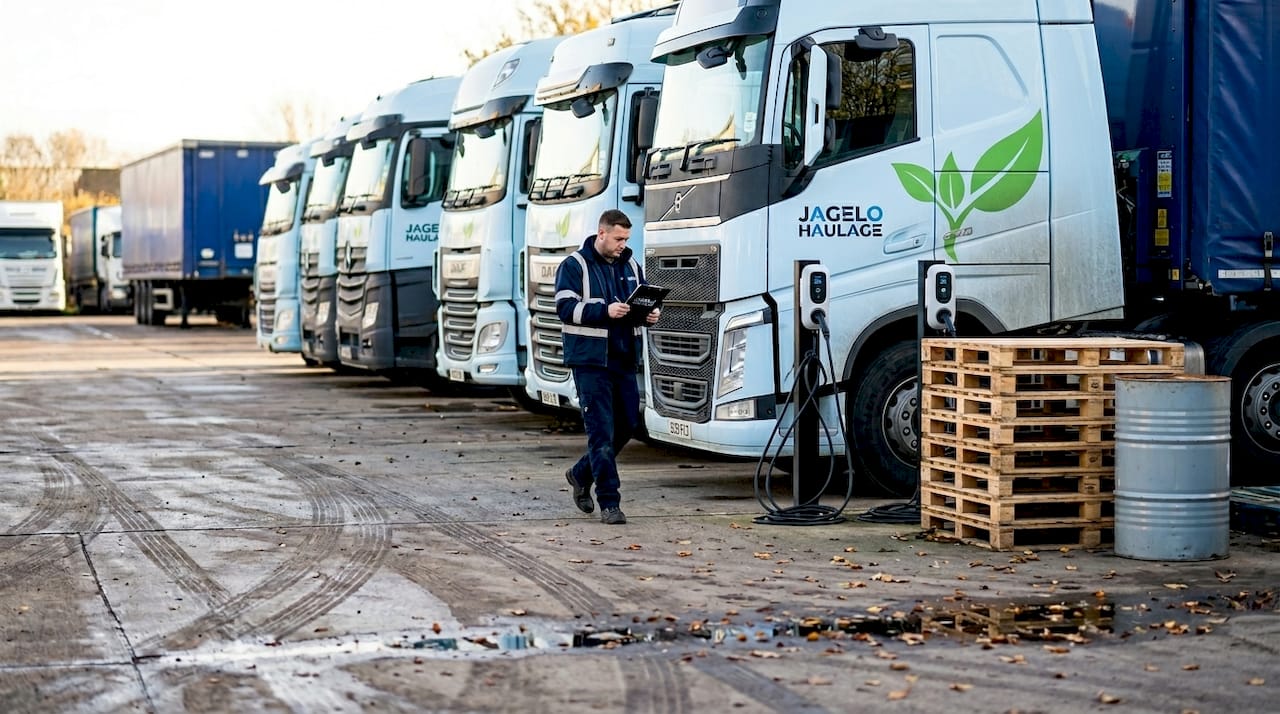
Sustainability in haulage is fundamentally a systems and contracts problem. The vehicle technology matters, but it only delivers results when it sits within a framework of verified supplier data, enforceable procurement conditions, and infrastructure that matches operational reality. An electric HGV parked at a depot without adequate charging capacity is not a sustainability achievement. It is an expensive asset delivering no environmental benefit.
The supplier collaboration dimension is where most logistics managers underinvest. Subcontracted haulage typically represents 40 to 60% of total freight emissions for large shippers, yet it receives a fraction of the attention directed at owned fleets. The John Lewis Partnership model demonstrates that verified data requirements, structured into contracts, can drive meaningful reductions without direct fleet ownership.
“Without reliable, accessible public charging infrastructure, electric trucks cannot be effectively deployed at scale. Public charging hubs are not a nice-to-have; they are a prerequisite for eHGV operations beyond depot range.”
The public charging infrastructure gap is real and it is not closing quickly enough to support aggressive electrification timelines for long-haul container haulage. This is not an argument against electric HGVs. It is an argument for honest planning. Operators who commit to full electrification on a five-year timeline without accounting for public charging availability will face operational compromise. A multi-fuel approach, combining HVO for long-haul routes with electric vehicles for urban movements, is more resilient than a single-technology strategy.
You can find further insight on sustainable haulage through our ongoing analysis of UK logistics industry environmental practices.
How Jagelo Haulage supports your sustainable container haulage goals
Reducing emissions across your container haulage operations requires a partner who understands both the operational demands of port logistics and the practical requirements of sustainable freight transportation UK-wide.
At Jagelo Haulage, we specialise in container haulage across major UK ports including Felixstowe, Tilbury, Southampton, and Liverpool, operating a modern fleet of over 40 GPS-tracked trucks and trailers. We integrate efficient fleet management, route optimisation, and renewable fuel use into our operations, and we work with clients to identify decarbonisation pathways that align with their supply chain requirements and reporting obligations. Whether you are seeking verified emissions data for your scope 3 reporting or exploring how to transition specific container routes to lower-carbon fuel options, our team provides the operational expertise and sustainability insights to support your goals from the outset.
Pro Tip: Engage us early in your procurement cycle. Tailoring sustainable haulage solutions to your specific container volumes, routes, and reporting requirements is far more effective when done at contract design stage rather than retrospectively.
Frequently asked questions
What are the main sustainable fuel options for UK haulage fleets?
Hydrotreated vegetable oil (HVO), biomethane, and battery-electric HGVs are the primary sustainable fuel options currently available. HVO achieves over 85% lifecycle GHG savings and can be deployed immediately in existing diesel fleets without modification.
How can logistics managers verify emissions reductions from subcontracted hauliers?
The GLEC Framework provides a standardised methodology for verified emissions reporting across subcontracted operations. Structuring contracts with emissions KPIs and tiering suppliers by data submission compliance, as demonstrated by the John Lewis Partnership programme, is the most effective procurement mechanism available.
What role does charging infrastructure play in adopting electric HGVs?
Accessible depot and public charging infrastructure is a prerequisite for practical eHGV deployment, particularly for container haulage routes extending beyond depot range. GRIDSERVE identifies public charging hubs as critical to scaling electric HGVs without compromising operational reliability.
Are there government incentives to support sustainable haulage in the UK?
Yes. The UK government has committed £1 billion in funding including grants of up to £120,000 per large lorry under the Plug-in Truck Grant and up to 70% coverage of depot charging installation costs under the Depot Charging Scheme.