Most logistics managers assume that distance is the primary variable in their transport budget, yet the final invoice often reflects a far more complex calculation. When you ask how much to move a shipping container, you are seeking more than a simple per-mile rate. You are looking for a strategy to manage the volatile variables of UK port logistics. Jagelo Haulage recognises that unpredictability is the enemy of a disciplined supply chain.
It's frustrating to deal with fluctuating fuel surcharges and the confusion between merchant and shipping line haulage rates. You deserve a transparent framework that eliminates hidden port fees and secures your operational margins. This guide provides the technical insight required to structure your logistics for maximum cost-efficiency in 2026. We will examine the critical factors that determine haulage rates, including vehicle specialisation and methods to reduce dead mileage. You will gain a clear understanding of how to select a reliable national partner that prioritises the safety and punctuality of every movement.
Key Takeaways
- Analyse how container dimensions and total weight dictate specific trailer requirements and fuel efficiency for more precise financial planning.
- Determine when to utilise standard haulage versus premium Hiab or Sidelifter services based on your site's offloading capabilities.
- Evaluate the operational benefits of merchant haulage to secure greater flexibility and potential cost savings compared to carrier-controlled models.
- Discover how much to move a shipping container by evaluating the impact of port locations and Vehicle Booking System (VBS) charges on your final invoice.
- Establish a robust protocol for site access instructions to prevent costly aborted delivery fees and maintain a disciplined delivery schedule.
Primary Factors Influencing Container Transport Costs
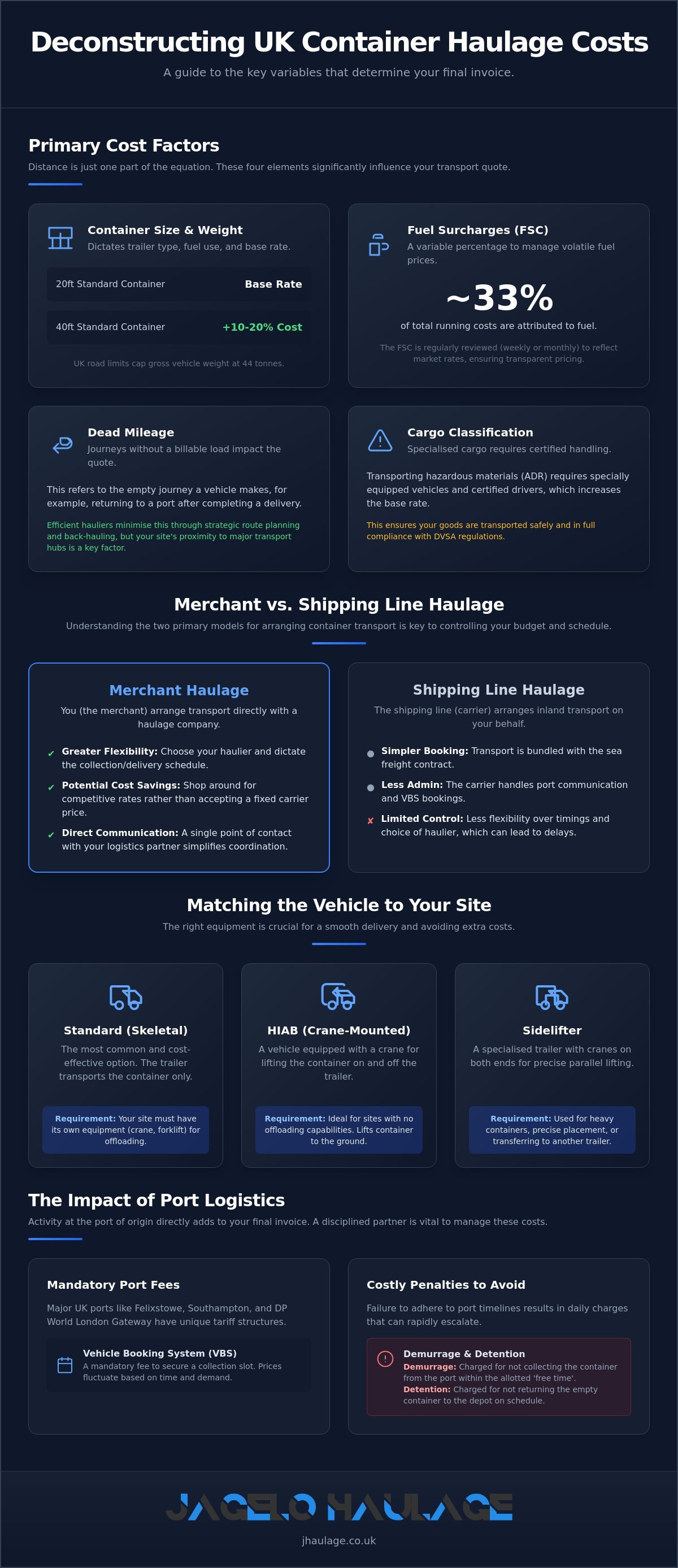
The cost of container transport is rarely a flat fee; it is a strategic calculation that balances equipment availability with operational overheads. When assessing how much to move a shipping container, the physical dimensions of the unit serve as the baseline. A 40ft container generally incurs a 10-20% higher transport cost than a 20ft unit on an identical route. This price difference reflects the increased fuel consumption and the requirement for larger skeletal trailers designed to handle the extended wheelbase. Every millimetre of trailer space and every litre of diesel is accounted for in a professional haulier's quote.
Haulage companies also factor in "dead mileage" when generating a quote. This term refers to the distance a vehicle travels without a billable load, such as returning to a port or depot after a delivery is completed. Efficient logistics providers, such as Jagelo Haulage, minimise these costs through disciplined route planning and back-hauling strategies, but the proximity of your site to major transport hubs remains a decisive factor. Administrative expenses are equally significant. Vehicle Booking System (VBS) charges and port documentation fees are integrated into the final invoice to cover the complex coordination required for Intermodal freight transport. These fees ensure that the transition from sea to road is handled with the necessary precision and security.
Weight and Cargo Classification
The total weight of your cargo dictates the specific tractor unit and trailer configuration required for the journey. Heavy-duty containers approaching the maximum payload necessitate vehicles with high-torque engines and reinforced axles to remain compliant with UK road weight limits, which generally cap gross vehicle weight at 44 tonnes. Transporting hazardous materials (ADR) adds another layer of complexity to the calculation. These shipments require drivers with specialised certifications and vehicles equipped with safety kits, which naturally increases the base rate. Choosing the correct equipment ensures your goods are protected whilst maintaining strict adherence to DVSA regulations and safety protocols.
Fuel Surcharges and Economic Variables
Fuel costs account for roughly one-third of the running costs in UK haulage. To manage this volatility, hauliers apply a Fuel Surcharge (FSC) as a percentage of the base transport rate. In 2026, geopolitical events and fluctuating energy markets mean these surcharges are reviewed frequently, often on a weekly or monthly basis to reflect real-world costs. You might encounter a choice between fixed-rate quotes for short-term projects and variable pricing for long-term contracts. Fixed rates provide budget certainty for specific shipments, but variable pricing can be more cost-effective if fuel prices stabilise. A professional haulage partner will clearly itemise these surcharges to ensure you aren't surprised by unexpected cost spikes during the billing cycle.
The Impact of Port Logistics on Your Quote
The location of the port of origin is the first logistical anchor in determining how much to move a shipping container. In the UK, major hubs like Felixstowe, Southampton, and DP World London Gateway operate under distinct tariff structures and administrative requirements. Each terminal applies its own Vehicle Booking System (VBS) charges, which are mandatory fees for securing a collection slot. These fees aren't static; they often fluctuate based on the time of day and the specific terminal's demand. When calculating your total expenditure, it's essential to reference customs value regulations to understand how these handling and transport costs contribute to the overall valuation of your cargo.
Professional hauliers maintain established accounts with these major ports to streamline the collection process. This level of integration is vital for avoiding demurrage and detention fees. Demurrage occurs when a container remains at the port beyond the agreed "free time," whilst detention is charged when the empty container isn't returned to the port or depot on schedule. These daily penalties can quickly exceed the original transport quote. By partnering with a disciplined operator that manages these timelines strictly, you protect your business from avoidable overheads.
Major UK Port Dynamics
Strategic positioning at hubs like DP World London Gateway and Tilbury offers a significant advantage for inland distribution. These ports provide immediate access to the M25, M1, and M6 motorway networks, which reduces transit times to the Midlands and the North. Efficient port logistics services ensure that your container moves from the quayside to the road without unnecessary delay. This proximity to the national infrastructure allows for more predictable delivery windows and helps to maintain the integrity of your supply chain schedule.
Port Congestion and Waiting Time
Operational efficiency is often challenged by port congestion, which directly impacts your haulage quote. Most transport agreements include a standard period of "free time" for loading and unloading, typically between one and two hours. If a driver is held at the port gate or on-site due to terminal delays, waiting time is billed at an hourly rate. You can mitigate these costs by scheduling collections during off-peak windows or utilising night-time slots when terminal traffic is reduced. Planning your logistics around these peak-time delivery windows ensures higher vehicle availability and more consistent pricing. If you need to secure a specific delivery slot, you can request a precise haulage quote to see how timing affects your final costs.
Comparing Vehicle Types: Standard vs Hiab vs Sidelifter
The choice of transport vehicle is a primary factor in determining how much to move a shipping container. Whilst the distance from the port is a fixed variable, the method of delivery can significantly alter your final invoice. Selecting the incorrect equipment often leads to aborted delivery fees and logistical delays. A disciplined approach to equipment selection ensures that your cargo is delivered safely and within budget. Professional hauliers evaluate your site requirements before dispatching a vehicle to ensure the chosen trailer can manoeuvre safely within the available space.
Standard Haulage for Merchant Logistics
Standard articulated haulage using skeletal trailers remains the most cost-effective solution for port-to-door delivery. These vehicles are the backbone of logistics for shipping containers, designed to move units between high-volume terminals and commercial warehouses. This method requires the recipient to have dedicated offloading equipment, such as a heavy-duty forklift or a mobile crane, already on-site. For businesses managing large-scale merchant haulage, the per-unit cost efficiency of standard trailers is unmatched, provided the site infrastructure supports rapid turnaround times. Strategic collaboration in freight transport often allows operators to maximise these standard routes, reducing the overall financial burden on the merchant by minimising empty running.
Hiab delivery vehicles feature an integrated crane, allowing for self-unloading without external equipment. This is a premium service ideal for sites with limited access or those lacking permanent lifting facilities. Whilst the transport rate is higher than standard haulage, it eliminates the need to hire a separate crane company, which often results in a lower total project cost. For heavier 40ft containers, a sidelifter is the preferred specialised vehicle. These are rare in the UK, with only about 30 currently in operation, making them a strategic choice for ground-level placement of loaded units. Sidelifters use dual cranes to lift containers parallel to the trailer, placing them on the ground with high precision.
Specialised Lifting Equipment Costs
Understanding how much to move a shipping container using specialised lifters requires a breakdown of additional service fees. When requesting a quote for lifting equipment, the pricing structure typically shifts from a pure per-mile rate to include a "per lift" charge. This fee covers the operational wear on the lifting machinery and the additional time required for the driver to secure and stabilise the vehicle. Site access is a critical consideration; these vehicles require significant clearance to extend their stabiliser legs and operate the cranes safely. Failure to provide accurate site dimensions or ground stability information can lead to failed delivery charges. You must also ensure that your insurance coverage accounts for crane-assisted deliveries, as standard RHA liability might not cover the full value of goods during the lifting phase. Selecting a partner like Jagelo Haulage provides the security of a modern, well-maintained fleet and the expertise to navigate these technical requirements.
In cases where a delivery site is cluttered or requires the removal of existing waste to ensure safe vehicle operation, it is advisable to engage a professional clearing team; for instance, you can visit Clear This Ltd House Clearance Services to arrange for comprehensive rubbish removal and site preparation.
Merchant Haulage vs Shipping Line Haulage: Which is Cheaper?
Deciding between merchant haulage and shipping line haulage is a critical strategic choice for any UK importer. Shipping line haulage, also known as carrier haulage, is a managed service where the shipping line organises the final delivery from the port to your facility. This approach offers simplicity through a single point of contact, yet it often restricts your ability to influence delivery schedules or negotiate specific rates. For businesses seeking to optimise how much to move a shipping container, transitioning to merchant haulage provides a path to greater operational control and financial transparency. You can explore the technical differences in our guide on Merchant Haulage vs Shipping Line Haulage: A Strategic Comparison.
Merchant haulage empowers the shipper to appoint an independent transport partner. This model bypasses the standard carrier rates, which frequently include administrative markups that aren't always visible on the surface. By managing the road transport phase directly, you gain the ability to secure competitive quotes that reflect current market conditions rather than fixed carrier tariffs. This shift requires more active management from your logistics team, but the potential for long-term cost savings makes it a preferred choice for high-volume operators.
The Flexibility of Merchant Haulage
One of the primary advantages of merchant haulage is the ability to prioritise specific containers based on production needs rather than carrier availability. You can select precise delivery windows that align with your warehouse staff's capacity, effectively reducing the risk of waiting time charges. This level of granular management is essential for controlling container transport costs. Working with a responsive partner allows for same-day adjustments. It ensures that urgent cargo reaches its destination without being subject to the rigid scheduling of a global shipping line.
Cost Transparency and Booking
Direct communication with a dedicated transport office eliminates the ambiguity often found in shipping line invoices. When you book directly, you receive a clear breakdown of the base rate, fuel surcharges, and port fees without hidden carrier margins. Jagelo Haulage maintains a modern fleet of 40+ trucks, providing the consistent capacity required to support merchant bookings across major UK ports. This scale of operation ensures that your cargo is protected by a professional organisation that understands the high stakes of port logistics. To secure a transparent rate for your next shipment, you can request a merchant haulage quote today.
Securing an Accurate Container Haulage Quote
The transition from logistical planning to physical execution requires a high degree of administrative precision. To determine accurately how much to move a shipping container, you must provide your transport partner with a comprehensive data set that accounts for every variable of the journey. Vague instructions often lead to pricing revisions or, worse, aborted delivery fees that compromise your operational budget. A disciplined haulier uses your specific cargo data to secure the necessary port slots and assign the appropriate vehicle from their fleet. Providing this level of detail allows the transport office to calculate exactly how much to move a shipping container without the need for contingency markups.
Clear site access instructions are the most effective way to prevent failed delivery charges. Most haulage quotes assume standard road conditions and unobstructed access to the delivery point. If your site has narrow entrance gates, weight-restricted bridges, or specific timed access windows, you must declare these in the initial enquiry. Professional fleet management relies on these details to maintain a predictable schedule. When a driver is forced to turn back due to unforeseen site restrictions, the resulting aborted delivery fee is often equivalent to a full transport charge.
Information Checklist for Your Haulier
A structured approach to information sharing ensures that your quote is both firm and competitive. You should have the following details ready before contacting the transport office:
- Container number and ISO type: Specify whether you are moving a 20ft Standard, 40ft Standard, or a 40ft High Cube unit.
- Verified Gross Mass (VGM): Accurate weight data is essential for fuel calculation and trailer selection.
- Collection port and delivery postcode: Precision in the final destination postcode is vital for calculating the exact mileage and identifying potential ULEZ or congestion charges.
- Required delivery date: State any time-sensitive constraints or specific booking slots required at the destination.
Why Choose Jagelo Haulage for Your Move?
Jagelo Haulage brings 15 years of industry experience to every movement, providing a level of competence that independent owner-operators cannot match. Our fleet of 40+ modern trucks and trailers is managed through a central transport office, ensuring consistent capacity and nationwide reach from all major UK maritime hubs. This scale of operation allows us to provide secure container transport that prioritises the safety of your cargo and the reliability of your delivery schedule. We don't just perform a task; we provide a strategic outcome that protects your supply chain margins. You can request a professional container haulage quote today to secure your next movement with a dependable national partner.
Optimising Your UK Container Logistics Strategy
Efficient port logistics in 2026 demand a structured approach to transport planning. You've seen how container dimensions, port specificities, and the choice of haulage model directly impact your operational expenditure. Selecting merchant haulage offers the transparency and flexibility needed to manage your supply chain with precision. By providing detailed site access instructions and ISO data, you eliminate the risk of aborted delivery fees and protect your bottom line from unpredictable surcharges. Understanding exactly how much to move a shipping container requires a disciplined assessment of these variables alongside a partner that recognises the high stakes of UK maritime trade.
Jagelo Haulage delivers the functional reliability your business requires. With over 15 years of port logistics expertise and a modern fleet of 40+ trucks, we maintain a disciplined transport programme from every major UK hub. Our nationwide reach ensures that your cargo moves safely and punctually to any destination. Secure your logistical framework today by choosing a partner that prioritises operational results. Get a Reliable Container Haulage Quote from Jagelo Haulage and establish a stable foundation for your 2026 supply chain. We look forward to providing the professional consistency your operations deserve.
Frequently Asked Questions
How much does it typically cost to move a shipping container 100 miles in the UK?
The total expenditure for a 100-mile journey depends on the port of origin and the required vehicle type. Whilst distance is a key variable, regional moves are also influenced by the availability of back-haul loads and current fuel surcharges. Determining how much to move a shipping container over this distance requires a specific enquiry that accounts for your ISO type and total cargo weight.
What is the difference between a Hiab and a standard container trailer?
A Hiab vehicle features an integrated crane for self-contained offloading, whereas a standard skeletal trailer requires external equipment on-site. Standard trailers are the most cost-effective option for warehouses with loading bays or heavy-duty forklifts. Hiabs are a premium solution for locations without permanent lifting facilities, as they eliminate the need for separate third-party crane hire.
Are there extra charges for collecting a container from Felixstowe or DP World Gateway?
Collections from major maritime hubs like Felixstowe or DP World Gateway incur mandatory Vehicle Booking System (VBS) charges. These terminal fees cover the administration of collection slots and vary depending on the time of day. Some ports also apply congestion surcharges during peak periods to manage traffic flow and terminal efficiency effectively.
How do fuel surcharges work in the haulage industry for 2026?
Fuel surcharges are applied as a percentage of the base transport rate to account for market volatility. In 2026, these are reviewed frequently to ensure that quotes remain fair and reflect real-world energy costs. This mechanism protects both the haulier and the client from sudden spikes in diesel prices during the duration of a transport contract.
Can I move a shipping container myself with a hired truck?
Moving a container yourself is impractical for most businesses due to the requirement for specialised skeletal trailers and HGV Class 1 licences. Professional hauliers also maintain mandatory terminal accounts and VBS registrations that are not available to the general public. Entrusting your cargo to a disciplined partner ensures compliance with all safety protocols and DVSA regulations.
What happens if the driver has to wait at the delivery site?
Most transport agreements include a standard window of "free time" for loading or unloading, typically lasting between one and two hours. If the vehicle is detained on-site beyond this period, an hourly waiting charge is applied to the final invoice. Providing clear access instructions and ensuring your team is ready for the driver's arrival helps to avoid these additional costs.
Do haulage rates include port storage fees or demurrage?
Standard haulage rates do not include port storage fees, demurrage, or detention charges. These are separate penalties issued by the terminal or shipping line if a container is not collected or returned within the agreed free period. A professional haulier will coordinate closely with you to ensure how much to move a shipping container remains within your original budget by avoiding these penalties.
Is it cheaper to move a 20ft container than a 40ft container?
Transporting a 20ft container is generally more cost-effective than moving a 40ft unit. The 20ft ISO type is lighter, which reduces fuel consumption and allows for more flexible trailer configurations. However, the price difference is typically related to the total weight and the specific equipment required rather than a direct percentage of the container's length.