How haulage contracts work in the UK: 2026 guide

Understanding how haulage contracts work in the UK is something many businesses get wrong until a dispute, a missed delivery, or an unexpected invoice forces the issue. These agreements govern not just the movement of goods but also the allocation of liability, the burden of compliance, and the financial exposure your business carries on every load. Get them right and you have a stable, cost-predictable supply chain. Get them wrong and you face uncapped liability, regulatory risk, and a haulier relationship that collapses under pressure. This guide cuts through the confusion and gives you the framework to make informed decisions.
Table of Contents
- Key takeaways
- How haulage contracts work in the UK
- Legal liability and the RHA conditions
- Negotiating haulage contracts effectively
- Compliance and operational control
- Building a strategic contract framework
- What I have learned about haulage contracts
- Work with a haulage provider built for your contract needs
- FAQ
Key takeaways
| Point | Details |
|---|---|
| Two core contract types | Full haulage and traction contracts serve different operational profiles; choosing correctly affects cost, control, and liability. |
| Liability limits matter | Under RHA Conditions of Carriage, standard liability is set at £1,300 per tonne, so high-value cargo requires supplementary insurance. |
| Escalation clauses protect you | Price caps tied to public inflation indices, typically capped at 3 to 5%, shield your business from sudden rate increases. |
| Compliance stays with you | Outsourcing haulage does not transfer your legal compliance responsibilities; you must actively audit your haulage providers. |
| Data sharing drives better rates | Providing hauliers with volume forecasts and usage dashboards reduces their operational risk, which directly reduces your contract rates. |
How haulage contracts work in the UK
At their core, haulage contracts are legally binding agreements that set out the terms under which a carrier moves goods on your behalf. The contract defines the service scope, pricing structure, liability allocation, transit timelines, and the obligations of both parties throughout the carriage cycle. UK haulage contracts typically fall into two primary models: full haulage and traction contracts, with lengths ranging from three months to three years depending on volume commitments and operational complexity.
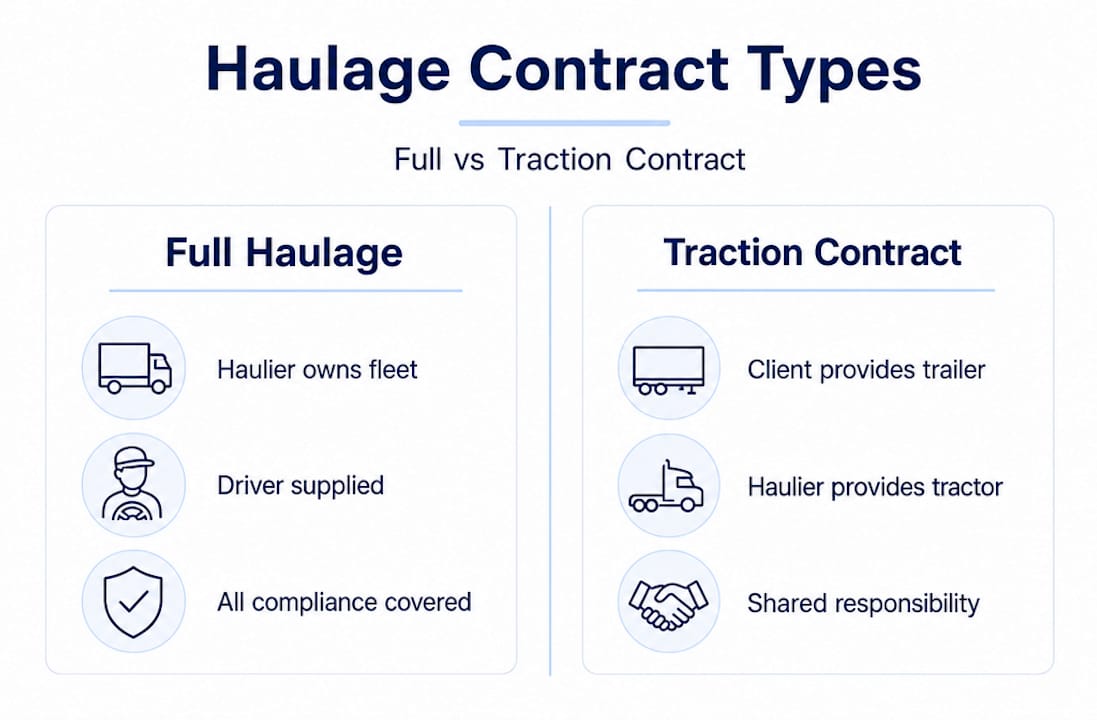
In a full haulage arrangement, the haulier provides the tractor unit, trailer, driver, and all associated compliance obligations including operator licensing, driver hours management, and vehicle maintenance. This model suits businesses that have no fleet assets of their own and want a single point of accountability for the entire movement. Pricing is typically structured on a per-drop, per-mile, or flat-fee basis, with the haulier absorbing fuel, maintenance, and compliance costs within the agreed rate.
A traction contract works differently. The client owns and manages the trailer; the haulier supplies the tractor unit and driver to move it. This arrangement is common where a business already has a significant trailer fleet but lacks sufficient motive power, often found in grocery, manufacturing, and retail supply chains. The cost structure is leaner because the haulier’s asset exposure is lower, but the compliance picture becomes shared. Understanding haulage quotes is particularly useful here, as traction rates and full haulage rates are structured quite differently.
| Feature | Full haulage | Traction contract |
|---|---|---|
| Tractor unit | Haulier provides | Haulier provides |
| Trailer | Haulier provides | Client provides |
| Driver | Haulier provides | Haulier provides |
| Compliance responsibility | Haulier (primary) | Shared |
| Pricing model | Per drop, mileage, or flat fee | Per hour or mileage |
| Best suited for | Businesses without fleet assets | Businesses with trailer fleets |
| Contract length | 3 months to 3 years | Typically 12 months or more |
Traction contracts demand that you maintain your trailer fleet to a rigorous standard. Trailer safety inspections are required every 13 weeks, and documentation must be current at the point of handover to the haulier. Failing to meet this requirement creates liability conflicts that can be both costly and time-consuming to resolve.
Legal liability and the RHA conditions
Most UK haulage contracts are governed, at least in part, by the RHA Conditions of Carriage, which set standard liability limits across the industry. The default liability coverage is £1,300 per tonne, which is adequate for bulk commodities but wholly inadequate for high-value electronics, pharmaceuticals, or speciality components. If your cargo value per tonne exceeds this threshold, you need to negotiate increased declared value coverage or take out supplementary cargo insurance.
Several liability nuances catch businesses off guard:
- Loading and unloading: Under standard RHA terms, carriers are not liable for loss or damage that occurs during loading and unloading unless the contract specifically assigns that responsibility to the driver. If your operatives load the trailer, the liability for securing the load generally stays with you.
- Force majeure: Fire damage and events classified as force majeure carry limited carrier liability. The 2026 regulatory environment has seen renewed scrutiny of force majeure clauses, particularly in contracts touching cross-border movements where supply chain disruptions remain frequent.
- Transit damage: The carrier’s liability during transit is active, but only up to the stated per-tonne limit unless a higher value is declared and agreed in the contract.
- Insurance verification: Always request a current certificate of insurance from your haulage provider before the contract commences, and confirm that the policy covers your specific cargo type and route.
Pro Tip: Request a written breakdown of how your haulier’s insurance policy interacts with RHA liability limits before signing. Many businesses discover coverage gaps only after a claim.
The intersection of carrier and customer responsibility during traction operations adds a further layer of complexity. In a traction arrangement, while the client owns the trailer, the haulier assumes legal responsibility for its roadworthiness once it is on the public highway. Both parties must therefore maintain clear documentation to avoid disputes in the event of an incident. This principle of joint oversight is one the courts have repeatedly confirmed in UK transport litigation.
Negotiating haulage contracts effectively
With contract rates rising 8.9 points year-on-year in 2026, driven in part by a 26% increase in EU diesel prices, entering a haulage negotiation without preparation is an expensive mistake. Negotiation that focuses solely on headline rate misses the structural clauses that determine your actual cost exposure over the contract term.
A well-structured approach to negotiation covers the following stages:
- Spend and volume analysis: Before any discussion, prepare 12 months of historic shipment data by lane, weight, and frequency. Hauliers price risk into contracts when they cannot forecast demand. Providing predictive volume data reduces their uncertainty and gives you a direct basis for a lower base rate.
- SLA definition: Agree on an on-time in-full (OTIF) target in writing. High-performing operations, such as the Weetabix haulage extension, have achieved 98.7% on-time performance through precisely defined service level agreements with financial remedies for underperformance.
- Price escalation clauses: Negotiate annual rate adjustment mechanisms tied to a recognised inflation index such as the Office for National Statistics Producer Price Index, with a hard cap of 3 to 5%. Escalation clauses typically require 60 to 90 days’ written notice of any rate change.
- Ramp clauses: For new lanes or increased volumes, include ramp clauses that allow pricing to adjust as actual volumes reach committed levels. This protects both parties during the early months of a contract.
- Dispute resolution: Define a clear escalation pathway. A two-stage process, commencing with account manager review then progressing to director-level mediation before any legal action, keeps disputes from damaging an otherwise productive relationship.
Pro Tip: Treat the negotiation as the beginning of a partnership, not a transaction. Hauliers who understand your business model and seasonal patterns will allocate better capacity to your account, which matters far more than a fractionally lower base rate.
Recognising that treating contracts as strategic partnerships rather than transactional vendor arrangements produces measurably better logistics outcomes is a principle that the UK’s most sophisticated shippers already apply. The most common failure point is leaving force majeure and escalation rules undefined, which creates costly disputes precisely when the market is most volatile.
Compliance and operational control
Outsourcing haulage does not transfer your legal compliance responsibilities. Traffic Commissioners are explicit that businesses using third-party hauliers retain oversight obligations and can be held accountable for failures that occur within contracted services. This applies whether you hold your own operator licence or rely entirely on the haulier’s.
Your compliance framework when working with contract hauliers should include:
- Operator licence verification: Confirm that your haulier holds a valid Standard National or Standard International operator licence, appropriate to the routes operated. Licence status can be checked through the Driver and Vehicle Licensing Agency public register.
- Transport Manager oversight: Each licensed operator must employ a nominated Transport Manager holding a Certificate of Professional Competence (CPC). Confirm this appointment is current and that the individual is actively managing compliance rather than serving as a nominal figurehead.
- Maintenance documentation: Request copies of the haulier’s preventative maintenance schedule and the most recent Vehicle Safety Inspection reports. Under the Traffic Commissioner’s guidance, inspections should occur at intervals no greater than 13 weeks for HGVs.
- Driver compliance records: Confirm that the haulier operates within the EU drivers’ hours regulations (which still apply in the UK post-Brexit for most international operations) and maintains tachograph records appropriately.
Regular audits of your haulage providers are not a bureaucratic formality. They are the mechanism by which you identify deteriorating standards before they affect your cargo or expose your business to reputational and legal risk. For businesses operating in regulated sectors such as food, pharmaceuticals, or hazardous materials, the compliance requirements for container haulage are more detailed still and warrant dedicated contractual provisions.
Building a strategic contract framework

With the foundational concepts understood, the practical task is to build a contract strategy that balances cost certainty, operational flexibility, and risk management across your supply chain.
A hybrid model works well for most businesses with significant volume. Use full haulage contracts for your base load, the predictable, year-round volume that forms the core of your distribution requirement. Layer traction arrangements on top during peak demand periods where you have sufficient trailer assets. This combination keeps your core cost predictable while giving you the flexibility to scale without renegotiating primary contracts under time pressure.
Sustainability considerations are increasingly a formal part of contract terms in 2026. Scope 3 emissions reporting requirements mean that businesses must now seek hauliers capable of providing verified fuel consumption and CO2 data per shipment. Build this reporting obligation into the contract rather than requesting it retrospectively.
| Business need | Recommended approach |
|---|---|
| Stable, predictable volumes | Full haulage contract, 12 to 36 months, flat fee or per drop |
| Owned trailer fleet | Traction contract, mileage-based pricing |
| Peak demand flexibility | Spot traction or short-term full haulage overlay |
| High-value cargo | Full haulage with declared value and supplementary insurance |
| Sustainability reporting | Contract clause requiring verified emissions data per shipment |
Mid-term renegotiation rights, typically triggered by volume changes exceeding 20% in either direction, should be written into every contract that runs beyond 12 months. The current freight market is too volatile to lock yourself into fixed terms without an adjustment mechanism. Container haulage across major UK ports adds further complexity given the port-specific Vehicle Booking Systems, detention charges, and demurrage risk that must be addressed contractually.
What I have learned about haulage contracts
I have seen the same pattern repeat itself too many times: a business signs a haulage contract that looks clean on paper, and the relationship works well until it does not. The moment a lane goes wrong, a container is delayed at Felixstowe, or a price increase letter arrives with 30 days’ notice instead of 90, the gaps in the contract become very expensive very quickly.
The clause most businesses undervalue is not the rate. It is the escalation and force majeure section. Vague language in those provisions consistently produces the disputes that damage supply chains and reputations. I have seen businesses lose six-figure sums to a force majeure clause that neither party fully understood at signing.
The deeper lesson is about data. When you give a haulier real visibility of your demand, they stop pricing uncertainty into your rate. That is not a philosophical point about partnership. It is a practical mechanism that produces lower costs and better capacity allocation. Businesses that share real-time dashboards with their hauliers consistently negotiate better renewal terms than those who treat operational data as commercially sensitive.
Haulage contracts in 2026 are not purely legal instruments. They are the operating system of your supply chain. Treat them with that level of rigour.
— Vytautas
Work with a haulage provider built for your contract needs
Jhaulage operates as a specialist container haulage provider across the UK’s major ports, including Felixstowe, Tilbury, Southampton, and Liverpool. Whether your business requires a full haulage solution or a traction arrangement aligned with your existing fleet, Jhaulage structures agreements to match your operational profile and 2026 compliance requirements.
With a fleet of over 40 GPS-tracked trucks and trailers and 24/7 operational support, Jhaulage provides the transparency and reliability that modern haulage contracts demand. Speak with the team at Jhaulage to discuss contract terms, service levels, and how a dedicated container haulage specialist can remove the uncertainty from your UK logistics operations.
FAQ
What is a haulage contract in the UK?
A haulage contract is a legally binding agreement between a business and a carrier that sets out the terms for transporting goods, including pricing, liability, service levels, and compliance responsibilities. Most UK haulage contracts reference the RHA Conditions of Carriage as their liability framework.
What are the main types of haulage contracts for UK businesses?
The two primary types are full haulage contracts, where the haulier provides the tractor, trailer, and driver, and traction contracts, where the client owns the trailer and the haulier provides the tractor and driver. Contract lengths typically range from three months to three years.
How is liability handled in a UK haulage contract?
Under standard RHA Conditions of Carriage, carrier liability is set at £1,300 per tonne. Businesses with high-value cargo should negotiate a higher declared value or take out supplementary cargo insurance, as the default limit is frequently insufficient for specialist goods.
How do I negotiate better terms in a UK haulage contract?
Prepare 12 months of volume and lane data before negotiations, define OTIF service level targets above 95%, and negotiate price escalation clauses capped at 3 to 5% tied to a recognised inflation index. Clear dispute resolution pathways and ramp clauses for new lanes also materially improve contract outcomes.
Does outsourcing haulage remove my compliance obligations?
No. Traffic Commissioners confirm that businesses retain legal responsibility for regulatory compliance even when haulage is fully outsourced. You must actively audit your haulage provider’s operator licence, maintenance records, and Transport Manager status throughout the contract term.