How to understand haulage quotes: a clear guide

Receiving three haulage quotes for the same container movement and finding that no two look remotely alike is a frustration familiar to most logistics managers and procurement officers in the UK. Knowing how to understand haulage quotes is not simply a matter of comparing headline figures; it requires reading the structure behind each quote, identifying what is included, what is chargeable as an extra, and what terminology refers to which leg of the journey. Get this right, and you protect your budget. Get it wrong, and a quote that appeared competitive can become a significantly more expensive final invoice.
Table of Contents
- Essential data to provide for accurate haulage quotes
- Breaking down key charge components in haulage quotes
- How to evaluate service levels and inclusions in haulage quotes
- Common mistakes and pitfalls when comparing haulage quotes
- Framework for comparing and selecting the best haulage quote
- Our perspective: why the cheapest quote is rarely the right question
- Move with confidence: container haulage from Jagelo Haulage
- Frequently asked questions
Key Takeaways
| Point | Details |
|---|---|
| Provide accurate shipment data | Exact addresses, weight, and dimensions help get precise, comparable haulage quotes and avoid invoice surprises. |
| Understand all cost components | Know the differences between base rates, fuel surcharges, Inland Haulage Charges, and Terminal Handling Charges. |
| Check service inclusions | Verify whether collection, delivery, tracking, and liability are included to assess quote value fully. |
| Avoid common quoting mistakes | Thoroughly read quote details and question extra fees to prevent unexpected charges. |
| Use a systematic comparison | Gather multiple quotes and evaluate them side-by-side with a structured checklist for best selection. |
Essential data to provide for accurate haulage quotes
Having introduced the importance of understanding haulage quotes, let’s first consider the data you must provide to get precise and comparable quotes. The quality of a haulage quote is directly proportional to the quality of the information you supply. Vague or incomplete shipment data produces vague or padded quotes, which are nearly impossible to compare fairly.
The most common source of quote-to-invoice discrepancies is inaccurate cargo weight or dimensions. When a haulier discovers at the point of collection that the declared weight is incorrect, a reweigh or reclassification fee is applied, often at a rate that is considerably higher than the original base charge. As standardised quote data demonstrates, providing exact pickup and delivery addresses with full postcodes, verified container size, accurate gross weight, packaging type, and clear timing requirements is the single most effective way to ensure quotes are genuinely comparable and that the invoice matches what you agreed.
Key data points to prepare before requesting any haulage quote:
- Full collection and delivery addresses, including postcodes (not just town names)
- Verified container size: 20ft, 40ft, or 45ft, and whether it is a standard, high cube, or flat rack unit
- Accurate gross weight, confirmed against the shipping line’s verified gross mass (VGM) where applicable
- Packaging and handling requirements, including any hazardous goods classifications (IMO/ADR status)
- Preferred collection and delivery dates, along with any site access restrictions such as height barriers, weight limits, or restricted operating hours
- Port of origin or destination (Felixstowe, Tilbury, Southampton, Liverpool, etc.) and any relevant Vehicle Booking System (VBS) slot requirements
Pro Tip: Always supply the VGM figure rather than an estimated weight. Hauliers calculating axle load compliance for UK roads use the verified gross mass, and a discrepancy between your estimate and the actual weight can trigger both a reweigh surcharge and a delay at the port gate.
You can find further haulage quote comparison tips on the Jagelo Haulage blog, which covers practical guidance for UK logistics operations.
Breaking down key charge components in haulage quotes
With accurate shipment data provided, understanding the main cost components in haulage quotes helps reveal what influences pricing and how to interpret quote line items. A haulage quote is rarely a single number. It is a structured document, and each line item represents a distinct cost driver.
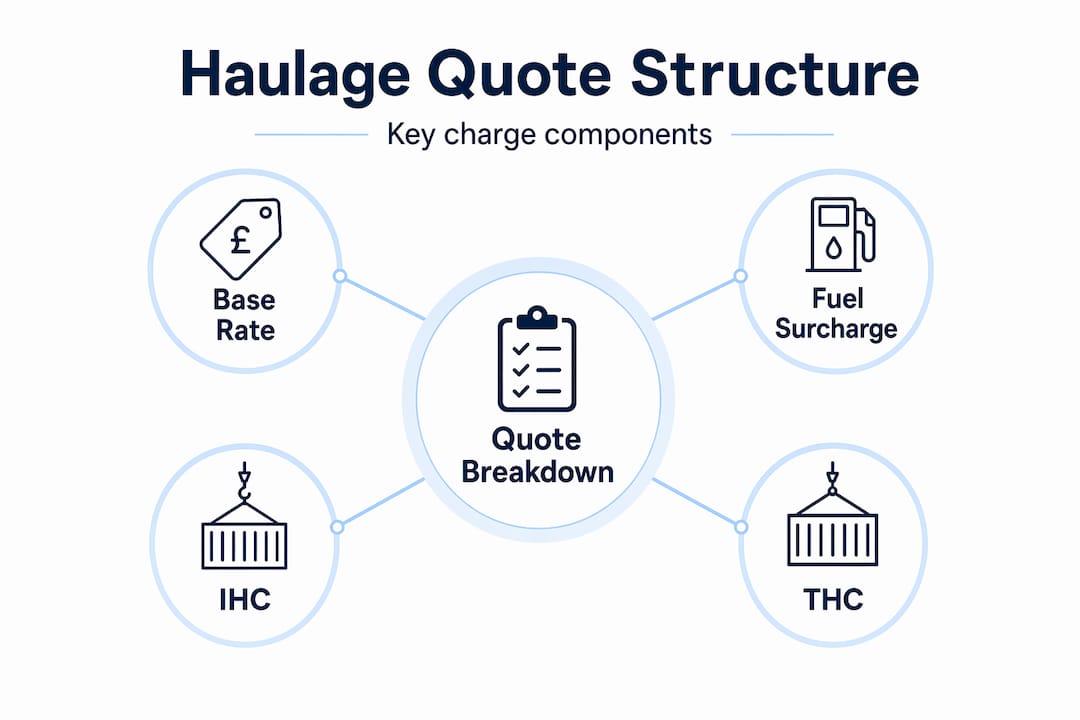
The base rate is the fundamental transportation charge, calculated primarily on distance and, in some cases, on container weight or type. This is the figure most procurement teams focus on, but it is rarely the complete picture.
Fuel surcharges are one of the most variable elements in any transport quote. They are calculated as a percentage of the base rate, tied to a baseline diesel price index. When diesel prices rise above that baseline, the surcharge increases proportionally. Some hauliers include the fuel surcharge within the base rate for simplicity; others list it separately. To compare quotes fairly, you must confirm three things: whether fuel is included or quoted separately, what the baseline diesel price trigger is, and how frequently the surcharge is recalculated between the date of quotation and the date of execution.
Inland Haulage Charges (IHC) and Terminal Handling Charges (THC) are two categories that cause significant confusion. IHC refers to the road transport cost between an inland point (such as a distribution centre or warehouse) and the port or terminal. THC, by contrast, is the fee charged by the port terminal for handling the container within the terminal itself, including crane lifts, storage, and gate processing. As IHC and THC distinctions confirm, these two charges relate to entirely different legs of the move, and conflating them produces incorrect cost comparisons between hauliers.
| Charge component | What it covers | Included or separate? |
|---|---|---|
| Base rate | Road transport, distance and weight related | Usually included |
| Fuel surcharge | Diesel price fluctuation adjustment | Often separate; confirm trigger |
| Inland Haulage Charge (IHC) | Land transport between inland point and port | Separate line item |
| Terminal Handling Charge (THC) | Port terminal handling, crane lifts, gate fees | Separate; may be carrier-billed |
| Waiting time | Driver waiting beyond agreed free time | Chargeable extra |
| Accessorial charges | Tail-lift, specialist equipment, out-of-hours | Chargeable extra |
| Liability insurance | Cargo liability above standard RHA rate | Optional add-on |
Pro Tip: Request that every haulier quotes with a fully itemised breakdown, not a single all-in figure. When you receive an all-in rate, you cannot identify which cost driver is responsible for a price difference between suppliers, making negotiation and audit nearly impossible.
For a detailed haulage charge breakdown guide, the Jagelo Haulage blog provides further reading on UK port-specific charges and how they are structured.
How to evaluate service levels and inclusions in haulage quotes
Beyond cost components, evaluating the service level behind each quote reveals hidden differences affecting overall value. Two quotes at identical headline prices can represent very different propositions once you examine what is and is not included.

The first question to ask is whether the quote covers the full door-to-door movement or only the transport segment between two fixed points. A port-to-door service that includes collection from the terminal, inland haulage, and final delivery to your premises is inherently more comprehensive than a quote covering only the trunk haul. As service level inclusions confirm, missing inclusions are the most common reason a cheaper quote becomes more expensive once add-ons are applied.
Service level checklist for evaluating haulage quotes:
- Does the quote cover collection, trunk haul, and final delivery, or only one segment?
- Is real-time GPS tracking included, and will you receive live status updates?
- Is proof of delivery (POD) provided as standard, and in what format (electronic or paper)?
- What is the liability coverage limit? The Road Haulage Association (RHA) standard is £1.30 per kilogram, but high-value cargo may require an agreed higher limit or separate cargo insurance.
- What is the haulier’s policy on delivery amendments, such as address changes or rescheduling after collection?
- Are waiting time charges applied after a specific free-time window (commonly 30 to 60 minutes), and what is the hourly rate?
- Are there access restriction surcharges for sites with low bridges, weight-restricted roads, or time-of-day delivery windows?
Pro Tip: Ask specifically about demurrage and detention exposure. If the haulier is responsible for collecting a container from a port terminal and the collection is delayed due to their operational issues, the demurrage costs (charges levied by the shipping line for exceeding free storage time at the terminal) may fall to you unless the contract clearly assigns liability.
Common mistakes and pitfalls when comparing haulage quotes
Knowing what to look for makes it easier to avoid common mistakes that can inflate haulage costs unexpectedly. Even experienced procurement teams fall into patterns that undermine the value of their quote comparison process.
-
Comparing headline rates without reading the structure. The biggest avoidable mistakes in procurement are failing to read what is included versus separately chargeable, and not querying waiting time or accessorial charge triggers. A low headline rate with multiple chargeable extras will almost always exceed a slightly higher all-inclusive quote.
-
Providing inaccurate cargo data. Errors in weight or dimensions trigger reweigh and reclassification charges that directly undermine budget accuracy. Procurement teams should require hauliers to quote against validated shipment parameters, not estimates.
-
Confusing IHC and THC line items. Misidentifying IHC and THC leads to either double-counting costs or missing them entirely. Map each quote line item to the specific leg of the journey before comparing vendors.
-
Accepting non-itemised quotes. A single all-in figure tells you nothing about which cost components are driving the price. Always request a fully itemised breakdown, and query any line item that is not clearly defined.
-
Obtaining too few quotes. Requesting only one or two quotes provides insufficient market context. A minimum of three to five quotes from hauliers with relevant port coverage gives you a credible picture of the market rate and strengthens your negotiating position.
“The structure of a haulage quote matters as much as the number at the bottom. A procurement team that reads only the total price is not comparing quotes; it is comparing invoices it has not yet received.”
Pro Tip: Create a standardised quote request template that specifies exactly what information you need in return, including itemised charges, fuel surcharge methodology, free waiting time allowance, and liability limits. Hauliers who cannot or will not complete a structured template are telling you something important about their operational transparency.
You can access practical guidance on avoiding haulage quote errors through the Jagelo Haulage resource library.
Framework for comparing and selecting the best haulage quote
Armed with understanding and awareness of common pitfalls, here is a clear framework to objectively compare and select haulage quotes.
-
Standardise your inputs. Before sending any requests, compile a single, validated shipment data sheet covering all the elements listed in section one. Send identical data to every haulier so that differences in quoted price reflect genuine cost differences, not variations in what was requested.
-
Gather a minimum of three to five quotes. Fewer than three quotes cannot establish a reliable market rate. Five quotes from hauliers with relevant coverage of your required ports (for example, Felixstowe or Southampton for deep-sea container movements) give you a defensible benchmark.
-
Build a comparison table. Populate a structured table for each quote received, covering the following elements:
| Comparison factor | Haulier A | Haulier B | Haulier C |
|---|---|---|---|
| Base rate (£) | |||
| Fuel surcharge (% or £) | |||
| IHC (if applicable) | |||
| THC (if applicable) | |||
| Waiting time (free period + hourly rate) | |||
| Liability limit (£/kg) | |||
| Tracking included? | |||
| POD included? | |||
| Total estimated cost (£) |
-
Verify fuel surcharge mechanisms. Confirm the baseline diesel price each haulier uses and how frequently adjustments are made. A quote valid for 30 days with a weekly fuel adjustment clause carries more price risk than one with a fixed all-in rate for the same period.
-
Negotiate with data. Once you have identified your preferred haulier, use the comparison table to negotiate. If a competitor is offering the same service level at a lower base rate, present this clearly. Most established hauliers will engage on rate if the volume and data justify it.
Pro Tip: Do not negotiate on price alone. Delivery flexibility, priority slot allocation at busy ports, and dedicated account management have measurable operational value that a purely price-driven selection process will miss.
For a structured haulage quote comparison framework tailored to UK container movements, the Jagelo Haulage blog offers practical templates and guidance.
Our perspective: why the cheapest quote is rarely the right question
In our experience working with UK logistics operators across Felixstowe, Tilbury, Southampton, and Liverpool, the most costly procurement decisions we observe are not the ones where a manager paid too much. They are the ones where a manager paid too little for a quote that excluded the services their operation actually required.
The conventional wisdom in freight procurement is to drive down the headline rate. We would argue that the more productive question is: “What does this quote actually include, and what will I pay when something does not go to plan?” Waiting time charges, demurrage exposure, and the absence of real-time tracking are not edge cases in container haulage. They are routine operational realities, particularly at high-volume UK ports where congestion and slot availability are constant variables.
A haulier quoting £50 less per movement but applying a £75 per hour waiting time charge after a 30-minute free period will cost more than a haulier quoting £50 more with a 90-minute free period and no waiting time surcharge in the majority of real-world scenarios. The quote comparison process should be built around total cost of delivery, not the figure on line one.
We also observe that procurement teams who invest time in building long-term relationships with two or three trusted hauliers with genuine port expertise consistently achieve better outcomes than those who re-tender every movement on price. Consistency, reliability, and operational knowledge of specific port environments are worth quantifying in your selection criteria.
Move with confidence: container haulage from Jagelo Haulage
Understanding the structure of haulage quotes is the first step. The second is working with a haulier whose quotes are transparent, fully itemised, and backed by the operational capability to deliver what they promise.
At Jagelo Haulage Limited, we provide fully itemised container haulage quotes covering all major UK ports, including Felixstowe, Tilbury, Southampton, and Liverpool. Our fleet of over 40 GPS-tracked trucks and trailers ensures real-time visibility on every movement, with proof of delivery and 24/7 support included as standard. Whether you require port-to-door container transport, same-day collections, or full container load shipments, our team is available to provide clear, competitive quotes that reflect the true cost of your movement. Contact us today to request a quote or visit our resource hub for further guidance.
Frequently asked questions
What information should I provide to get an accurate haulage quote?
You should give exact pickup and delivery addresses with postcodes, verified container dimensions and gross weight, packaging and handling details, and confirmed timing requirements, as standardised quote inputs are the foundation of comparable and accurate pricing.
How do fuel surcharges work in haulage quotes?
Fuel surcharges are calculated as a percentage of the base rate against a baseline diesel price index and may be recalculated frequently; always confirm whether they are included in the quoted figure and what the adjustment mechanism is.
What is the difference between Inland Haulage Charges and Terminal Handling Charges?
Inland Haulage Charges cover road transport between an inland point and the port, while Terminal Handling Charges are fees for container handling within the port terminal itself; as IHC versus THC guidance confirms, conflating the two leads to incorrect cost comparisons.
Why do some haulage quotes seem cheaper but end up more expensive?
Cheaper quotes frequently exclude key services such as waiting time allowances, tracking, proof of delivery, or adequate liability coverage, and as quote inclusion analysis shows, these omissions are the primary reason a low headline rate produces a higher final invoice.
How can I avoid common mistakes when comparing haulage quotes?
Request fully itemised quotes using standardised shipment data, confirm all surcharge mechanisms and accessorial charge triggers, map each line item to the correct shipment leg, and compare a minimum of three to five quotes before making a selection decision.