Hazardous cargo container haulage: UK compliance guide
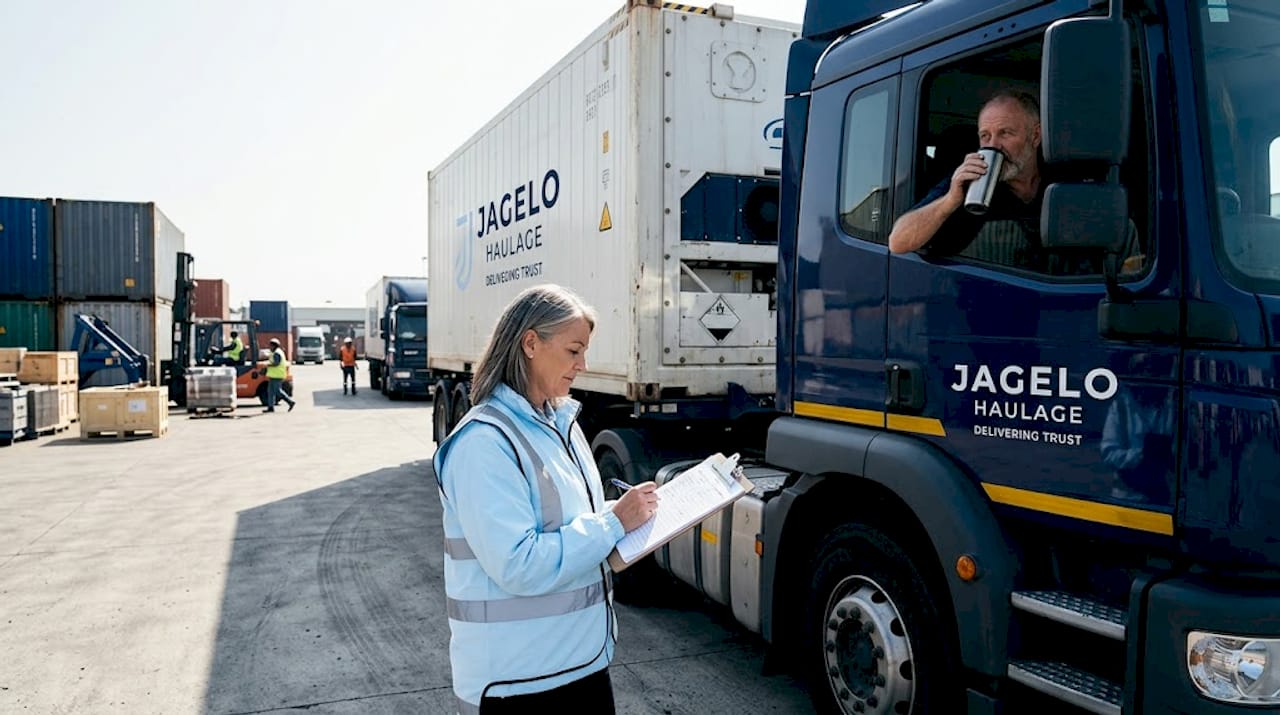
Hauling hazardous cargo containers is one of the most regulated and consequential activities in UK logistics, and the cost of getting it wrong extends well beyond a fine. Logistics managers who need to handle hazardous cargo container haulage face a layered web of obligations under the Carriage of Dangerous Goods and Use of Transportable Pressure Equipment Regulations 2009 (CDG 2009), ADR international road transport rules, and IMDG Code requirements for sea freight. A single mis-declaration, expired driver certificate, or unmarked container can trigger immediate DVSA prohibitions, port rejections, and serious reputational damage. This guide walks you through every critical stage, from regulatory obligations and staff training to physical preparation, loading execution, and ongoing verification.
Table of Contents
- Handle hazardous cargo container haulage: legal requirements and DGSA appointment
- Ensure driver and staff training compliance
- Prepare containers and vehicles for safe hazardous cargo haulage
- Execute loading, securing, and documentation correctly
- Verify compliance and monitor for continuous safety
- Rethinking hazardous cargo container haulage: beyond compliance to operational excellence
- Partner with expert container haulage specialists for hazardous cargo
- Frequently asked questions
Key Takeaways
| Point | Details |
|---|---|
| DGSA appointment is mandatory | All companies handling hazardous goods in the UK road transport sector must appoint a qualified Dangerous Goods Safety Adviser. |
| Maintain up-to-date training | Drivers and staff require specific ADR training and refresher courses to remain legally qualified and safe. |
| Proper container identification | Display required placards on all container sides with accurate hazard labels inside to comply with IMDG Code. |
| Follow loading and documentation protocols | Physically inspect loads post-packing and maintain complete, accurate transport documentation to avoid incidents and delays. |
| Use continuous monitoring for safety | Leverage DGSA reports, regular audits, and technology tools to proactively manage compliance and prevent costly penalties. |
Handle hazardous cargo container haulage: legal requirements and DGSA appointment
To start, your organisation must fulfil the core legal responsibilities around hazardous cargo haulage, beginning with securing qualified advisory support.
The CDG 2009 regulations place a clear legal duty on consignors, carriers, and packers to appoint a qualified Dangerous Goods Safety Adviser (DGSA). The DGSA is not a passive figurehead. Their role encompasses active monitoring of operations, regulatory compliance checks, incident investigation, and liaison with enforcement bodies including the DVSA and the Health and Safety Executive (HSE). Companies transporting dangerous goods by road must appoint a qualified DGSA who prepares an annual compliance report, making this a non-negotiable legal requirement rather than a best-practice recommendation.
That annual report is itself a legal document. It must assess compliance levels, document any incidents, and set out corrective recommendations. Many freight forwarders and consignors overlook this requirement entirely, particularly when they arrange haulage through third-party carriers and assume the carrier’s DGSA covers their own obligations. It does not. Your organisation’s role in the supply chain determines whether you need your own DGSA appointment, regardless of who physically moves the container.
Key obligations under CDG 2009:
- Appoint a qualified DGSA covering all relevant transport modes
- Ensure the DGSA actively monitors loading, packing, and consignment processes
- Commission and retain the annual DGSA compliance report
- Provide the DGSA with access to all relevant operational records and incident data
- Ensure the DGSA liaises directly with DVSA and HSE when required
For a broader overview of container haulage regulations in the UK, including port-specific requirements, it is worth reviewing current guidance before finalising your compliance framework.
Pro Tip: If your business arranges haulage but does not physically transport goods, you may still be classified as a consignor under CDG 2009 and therefore legally required to appoint your own DGSA. Verify your classification with a qualified adviser before assuming you are exempt.
Ensure driver and staff training compliance
With qualified advisory oversight in place, the next critical step is ensuring all personnel involved hold the correct hazardous goods training for their specific roles.
Drivers transporting dangerous goods above threshold quantities must hold a valid ADR Driver Training Certificate, which covers the relevant hazard classes for the goods they carry. ADR certificates must be renewed every five years, and drivers must complete refresher training within the 12 months preceding certificate expiry to maintain uninterrupted validity. A lapsed certificate does not simply trigger a warning. Lapsed certificates ground drivers immediately, meaning your vehicle cannot legally depart until a compliant driver takes over, which directly affects delivery schedules and port slot bookings.
Training obligations extend beyond drivers. Warehouse operatives, packing staff, and even office personnel who process dangerous goods documentation must receive general awareness training proportionate to their role and risk exposure. A loading bay operative handling UN-classified packages requires more detailed instruction than a customer service agent processing paperwork, but both carry legal training obligations under CDG 2009.
Training requirements by role:
- Drivers: Full ADR certificate covering applicable hazard classes, renewed every five years with refresher training within 12 months of expiry
- Loading and packing staff: Function-specific training covering segregation, labelling, and emergency procedures
- Office and documentation staff: General awareness of dangerous goods classifications, documentation requirements, and incident reporting
- Supervisors and managers: Broader understanding of CDG 2009 obligations, DGSA reporting, and audit responsibilities
Maintaining accurate training records is a legal requirement in its own right. During a DVSA roadside inspection or an HSE audit, inspectors will request evidence of training currency. A well-maintained training register, cross-referenced against certificate expiry dates, is your first line of defence.
For further detail on hazardous goods training structures and documentation standards, reviewing current ADR guidance will help you build a compliant training programme from the ground up.
Pro Tip: Build certificate expiry dates into your fleet management or HR system with automated alerts set 14 months before expiry. This gives you a full two-month buffer to schedule and complete refresher training before the 12-month pre-expiry window closes.
Prepare containers and vehicles for safe hazardous cargo haulage
Having trained your team, the next focus is on physical preparation and equipment compliance for containers and vehicles to mitigate haulage risks.
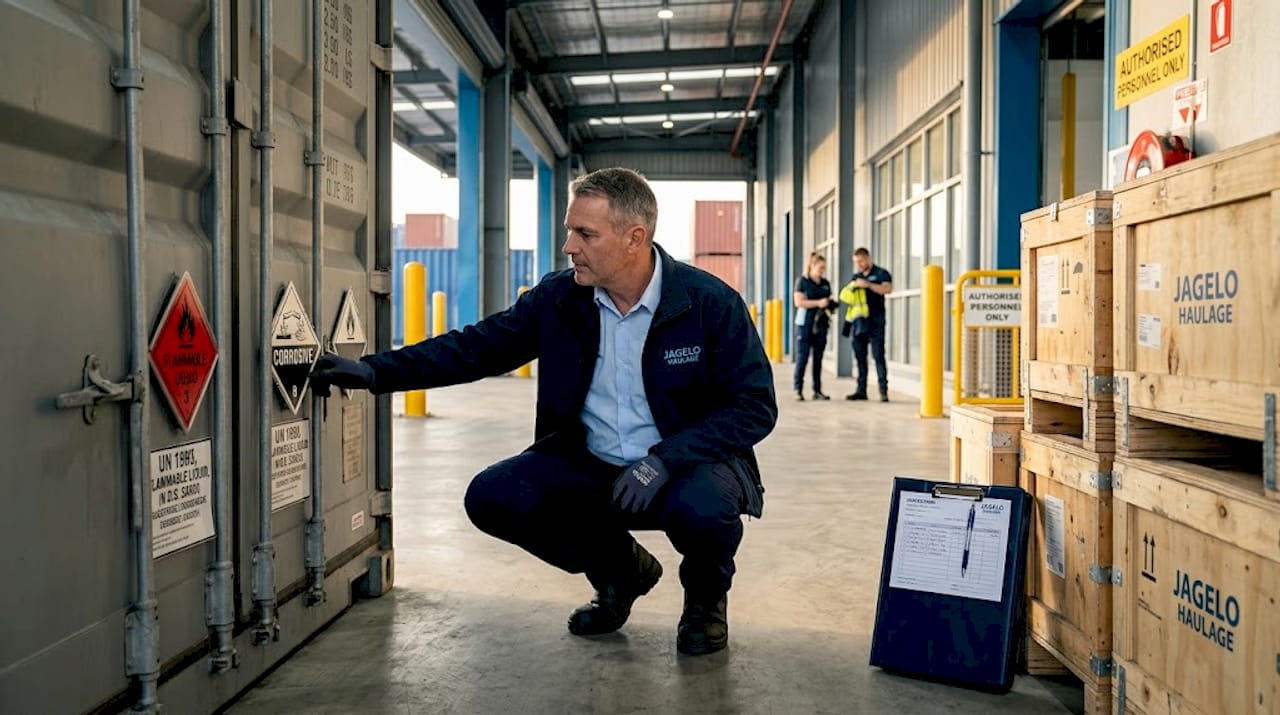
Every container carrying hazardous goods must display 250mm placards on all four sides, showing the correct hazard class diamond and, where applicable, the UN number. Containers must display 250mm placards on all four sides and carry marking labels compliant with the IMDG Code for sea freight. Individual packages inside the container must bear 100mm square hazard labels. Faded, obscured, or incorrectly positioned labels are among the most common reasons containers are rejected at Felixstowe, Tilbury, and Southampton.
ADR vehicles require prescribed safety equipment and an approval certificate for tanker configurations, plus accurate transport documentation for every movement. The mandatory equipment list for ADR vehicles includes fire extinguishers of the correct type and rating, spill kits, wheel chocks, warning triangles, and personal protective equipment (PPE) appropriate to the hazard class being carried.
Container and vehicle preparation checklist:
| Requirement | Standard | Applicable to |
|---|---|---|
| 250mm hazard placards | IMDG Code / ADR | All containers |
| 100mm package labels | UN packaging standards | Individual packages |
| Container/Vehicle Packing Certificate | CDG 2009 / IMDG | All stuffed containers |
| ADR vehicle approval certificate | ADR Annex B | Tanker vehicles |
| Fire extinguishers | ADR Chapter 8.1 | All ADR vehicles |
| Spill kit and PPE | ADR Chapter 8.1 | All ADR vehicles |
| Transport document | ADR 5.4.1 | All movements |
The Container/Vehicle Packing Certificate is a signed declaration confirming that the container has been packed correctly, goods are properly segregated, cargo is secured against movement, and all markings are in place. Without this certificate, your container will not be accepted at most UK port terminals.
For a full breakdown of container haulage compliance requirements, including documentation templates and vehicle specification guidance, consult current CDG 2009 and ADR technical annexes.
Pro Tip: Never accept a container for haulage without first verifying that the Container/Vehicle Packing Certificate has been completed and signed by the responsible party. Accepting an uncertified container makes your organisation liable for the consequences of any non-compliance discovered during transit or at the port gate.
Execute loading, securing, and documentation correctly
With preparations complete, following precise loading and documentation steps is essential to secure hazardous cargo and ensure smooth transit.
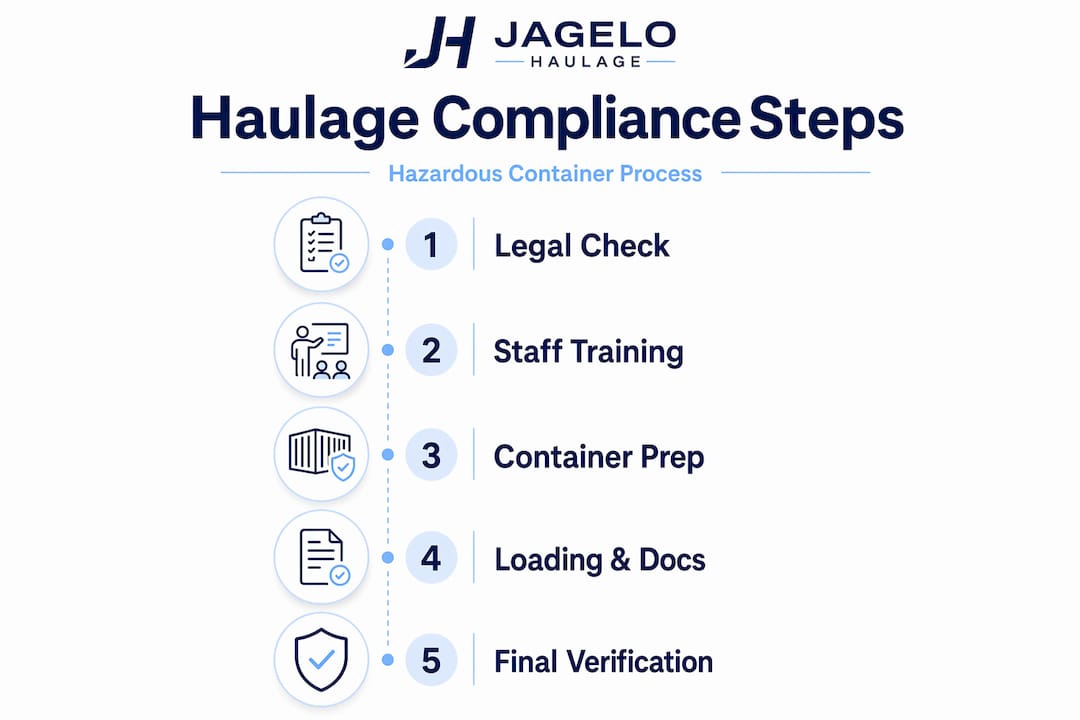
Physical inspection after loading is vital to verify that placards match declarations, check for leaks or unusual odours, and confirm stowage correctness, given that mis-declaration is a leading cause of container incidents at UK ports. This is not a bureaucratic formality. It is the last practical opportunity to catch errors before a container enters the port system, where corrections become significantly more disruptive and costly.
Step-by-step loading and documentation process:
- Verify the UN number, proper shipping name, hazard class, and packing group on all packages against the transport document before loading begins
- Apply IMDG Code segregation tables to determine which goods can share a container and which must be separated
- Load heavier packages at the base and secure all cargo with appropriate dunnage, lashing, and blocking to prevent shifting during road transport
- Inspect the loaded container externally for placard accuracy, physical integrity, and the absence of leaks or damage
- Complete and sign the Container/Vehicle Packing Certificate, confirming all stowage and marking requirements have been met
- Compile the full transport documentation set, including the Dangerous Goods Note (DGN), before the vehicle departs
“Mis-declaration of dangerous goods in containers remains one of the most persistent causes of serious incidents in the container shipping chain. The consequences range from fire and explosion at sea to DVSA prohibitions on road. Accuracy at the point of loading is not optional.”
Segregation errors are particularly costly. Certain hazard classes react violently when combined, and the IMDG segregation tables exist precisely to prevent accidental co-loading of incompatible goods. A common example is oxidising agents (Class 5.1) loaded alongside flammable liquids (Class 3), which creates a fire risk that no amount of securing can mitigate.
For practical guidance on hazardous cargo loading procedures and segregation requirements, cross-referencing IMDG Code Chapter 7.2 with your specific cargo types is strongly recommended.
Pro Tip: Conduct a documented pre-trip trailer inspection covering placard condition, seal integrity, and equipment completeness before every hazardous cargo movement. A brief inspection record, signed by the driver, provides evidence of due diligence if a DVSA officer stops the vehicle en route.
Verify compliance and monitor for continuous safety
After execution, consistent verification and proactive monitoring lock in safety and regulatory compliance for hazardous haulage.
The DGSA must prepare annual reports evaluating compliance, incidents, and recommendations, supporting continuous improvement and providing a documented audit trail that demonstrates regulatory diligence to enforcement bodies. These reports should not be filed and forgotten. They are a working tool for identifying recurring non-compliances, tracking corrective actions, and benchmarking year-on-year performance.
DVSA inspections focus on placarding, transport documents, driver ADR certificates, and on-vehicle safety equipment, with non-compliance resulting in immediate prohibitions and financial penalties. Roadside checks are unannounced and thorough. A vehicle stopped with a lapsed ADR certificate, missing equipment, or incorrect placarding faces an immediate prohibition notice, which grounds the vehicle until the deficiency is rectified.
Ongoing compliance monitoring actions:
- Schedule DVSA-style internal inspections at regular intervals, covering placards, certificates, equipment, and documentation
- Track all driver ADR certificate expiry dates centrally and cross-reference against planned movements
- Review DGSA annual reports within 30 days of receipt and assign ownership for each corrective recommendation
- Implement electronic data interchange (EDI) systems to reduce manual documentation errors and accelerate port approvals
- Conduct physical inspections at container handover points, particularly when containers transfer between hauliers or modes
“Non-compliance leads to immediate prohibitions and hefty fines, which can cripple operations.”
Encouraging drivers and loading staff to report potential non-compliances before they become incidents is one of the most cost-effective risk management tools available. A culture where early reporting is rewarded rather than penalised consistently outperforms a culture built on fear of blame.
For further reading on compliance monitoring frameworks in container haulage, including EDI integration and audit scheduling, current DVSA guidance provides a practical starting point.
Pro Tip: Create a simple digital reporting channel, such as a shared form or app, that allows drivers and warehouse staff to flag potential compliance issues in real time. Rapid escalation to the DGSA prevents minor observations from becoming costly prohibitions.
Rethinking hazardous cargo container haulage: beyond compliance to operational excellence
Most logistics managers approach hazardous cargo haulage as a compliance exercise. Tick the boxes, file the certificates, and hope the DVSA does not stop your vehicle. That framing is understandable, but it is also the reason so many operations find themselves repeatedly firefighting the same problems.
The DGSA role is not passive oversight but involves active monitoring and root cause identification to prevent incidents. The most effective DGSAs we have seen operate as embedded operational partners, not external consultants who appear once a year to write a report. They attend pre-movement briefings, review loading procedures in person, and challenge practices that have become normalised simply through repetition.
The uncomfortable truth about hazardous cargo haulage is that most incidents are not caused by ignorance of the regulations. They are caused by familiarity. Experienced staff who have loaded the same commodity hundreds of times begin to skip steps. Placards that were perfectly positioned six months ago are now faded and unchecked. The Container/Vehicle Packing Certificate is signed before the inspection is completed rather than after. These are not reckless decisions. They are the predictable result of routine without accountability.
The operational excellence approach treats every movement as if it were the first. Systematic checklists, structured refresher training, and technology such as EDI systems that flag documentation errors before a vehicle departs all serve this goal. Digital tools do not replace human judgement, but they do remove the cognitive load that leads to shortcuts. When your documentation system automatically validates UN numbers against the transport document, your loading staff can focus entirely on the physical inspection rather than cross-referencing paperwork.
The logistics managers who consistently achieve clean DVSA inspections and zero port rejections are not the ones with the most complex compliance frameworks. They are the ones who have made correct procedure the path of least resistance for every person in their operation.
Partner with expert container haulage specialists for hazardous cargo
For logistics managers seeking a trusted partner who understands hazardous cargo complexities, Jagelo Haulage provides expert solutions to keep your operations safe and compliant.
Navigating hazardous material transport regulations whilst managing port deadlines, driver availability, and documentation accuracy is a significant operational burden. Jagelo Haulage Limited specialises in container haulage across major UK ports including Felixstowe, Tilbury, Southampton, and Liverpool, with a modern fleet of over 40 GPS-tracked vehicles ensuring full chain-of-custody visibility on every movement.
Our team supports DGSA oversight requirements, ADR driver certification management, and container preparation compliance, providing freight forwarders, shippers, and distribution companies with a single point of accountability for hazardous cargo movements. With 24/7 operational support and real-time tracking, documentation errors and compliance gaps are identified and resolved before they reach the port gate. Contact Jagelo Haulage today to discuss your hazardous cargo requirements and request a tailored consultation.
Frequently asked questions
Who must appoint a Dangerous Goods Safety Adviser (DGSA) in the UK?
Any business involved in transporting, loading, packing, or consigning dangerous goods by road, rail, or inland waterways must appoint a qualified DGSA as required by CDG 2009 regulations. This obligation applies to consignors and freight forwarders arranging haulage, not only to the carrier physically moving the goods. Companies transporting dangerous goods by road must appoint a qualified DGSA.
What training is required for drivers hauling hazardous cargo containers?
Drivers must hold a valid ADR Driver Training Certificate covering the relevant hazard classes, with refresher training completed within 12 months before certificate expiry to remain legally qualified. Drivers transporting dangerous goods must hold valid ADR Driver Training Certificates with timely refresher training to avoid immediate grounding.
What are the key container marking requirements for hazardous cargo?
Containers must display 250mm placards on all four sides showing the correct hazard class, and packages inside must carry 100mm square labels, all complying with IMDG Code standards. Placards measuring 250mm must be fixed on all four sides of containers carrying dangerous goods.
What documentation is essential for legally compliant hazardous cargo container haulage?
A signed Container/Vehicle Packing Certificate confirming correct segregation and securing, plus transport documents stating the UN number, proper shipping name, hazard class, and packing group, are essential for every movement. A signed Container/Vehicle Packing Certificate is required confirming proper segregation, securing, and marking before departure.
How can logistics managers ensure continuous compliance and safety?
They should monitor DGSA annual reports, maintain driver ADR certifications, conduct regular internal inspections covering placarding and equipment, and support a proactive safety culture reinforced by technology such as EDI systems. DGSA annual reports evaluating compliance support continuous improvement and provide a documented audit trail for enforcement bodies.