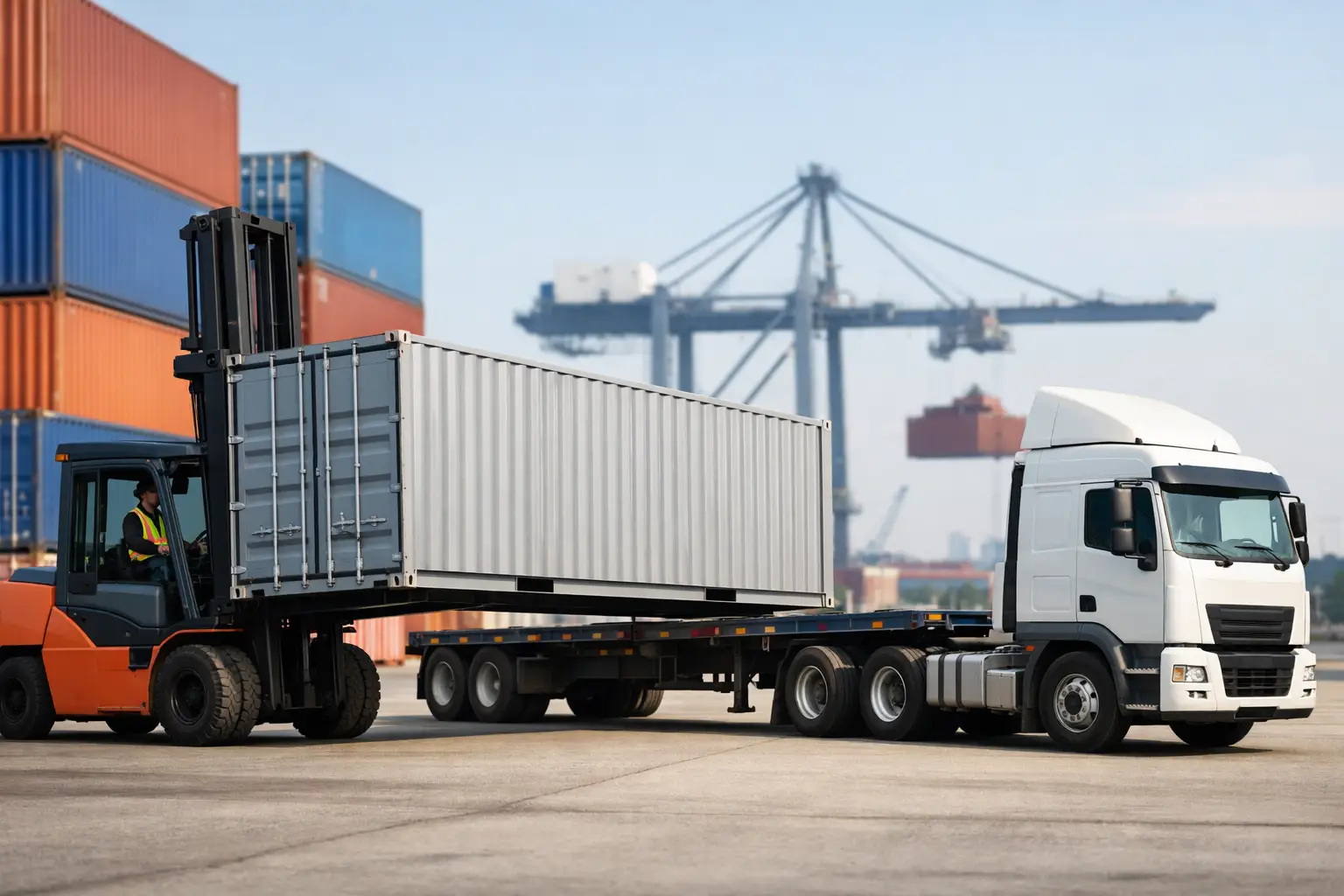
A container that is technically ready to move can still become a problem if its dimensions are wrong on paper, loaded badly in practice, or booked with the wrong assumptions. That is why in-gauge containers delivery matters. When a container remains within standard ISO dimensions, road planning is simpler, equipment options are broader, and the risk of delay, extra permits or avoidable cost stays lower.
For importers, freight forwarders and logistics managers, that is not a minor detail. It affects whether a collection can be scheduled promptly, whether the right trailer is assigned first time, and whether delivery reaches site without the usual chain of phone calls asking for revised dimensions, repacking or access checks.
What in-gauge containers delivery actually means
In practical haulage terms, in-gauge containers delivery refers to the movement of containers whose cargo sits within the standard external dimensions of the unit. Nothing projects beyond the roofline, side walls or end frame. The load fits the box as intended, so the container can generally be handled, stacked and transported using normal container equipment.
That sounds straightforward because, in many cases, it is. A 20ft, 40ft or 45ft ISO container carrying cargo fully contained within its structure is usually treated as in gauge. The delivery process is then based on standard operational planning rather than abnormal load planning.
Where issues start is when bookings assume a load is in gauge, but the reality is less tidy. Poor weight distribution, internal packing errors, undeclared over-height cargo or confusion between container size and cargo profile can all change what should have been a routine move into a more expensive and time-sensitive job.
Why in-gauge containers delivery is usually faster to arrange
The main advantage of in-gauge containers delivery is that it removes unnecessary complexity. If the container is within standard dimensions and declared correctly, transport planners can match it with the right lorry and trailer more quickly. Port collection, route planning and delivery scheduling are all more predictable.
That predictability matters when storage, detention and demurrage are in play. A straightforward in-gauge move is easier to slot into an existing schedule, particularly when collections are needed from busy UK port locations where timing windows and driver availability can tighten quickly.
It also improves communication between everyone involved. The shipping line, the haulage provider, the consignee and the receiving site are all working from a standard set of assumptions. Fewer surprises usually means fewer delays.
The commercial value of staying in gauge
For most operators, the first question is cost. In-gauge containers delivery is typically more economical than moving out-of-gauge cargo because it avoids specialist routing, escort requirements, additional permissions or niche equipment. Standard equipment is easier to allocate, which helps keep lead times under control as well.
There is also less operational friction. A standard container can usually move through normal planning channels without the extra checks that oversized cargo often triggers. That has a direct commercial benefit when a delivery deadline affects warehouse labour, production schedules or onward distribution.
None of this means in-gauge delivery is effortless. Weight, commodity type, terminal processes and site access still matter. Hazardous goods, refrigerated units and urgent same-day requirements all need proper planning. But when the dimensions are standard, one major variable is already under control.
Where in-gauge moves still go wrong
The most common problem is bad information. A booking may say 40ft standard, but key details are missing, such as verified gross mass, commodity restrictions, collection reference accuracy or whether the consignee site can actually accept the vehicle configuration required.
Another issue is treating all standard containers as operationally identical. They are not. A 20ft unit with dense cargo can create axle weight considerations that need careful planning even though the container is fully in gauge. A 45ft container may be dimensionally standard for the task in hand, but delivery still depends on route suitability and delivery point access.
Then there is timing. An in-gauge container can still incur avoidable cost if documents are late, customs clearance is incomplete, the site is not ready to unload, or communication between port and delivery point breaks down. In gauge does not cancel the need for disciplined execution.
Planning in-gauge containers delivery properly
Good planning starts with accurate container data. That means container size, gross weight, collection point, release status, delivery postcode, required delivery time and any site restrictions should all be confirmed before collection is booked. If the cargo needs temperature control or falls under hazardous goods rules, that should be declared at the outset rather than added later.
The next step is matching the move to the right operating window. Some deliveries can be planned into a standard next-day schedule. Others need same-day support because the commercial impact of delay is too high. The point is not to overcomplicate every movement, but to avoid underestimating one that has tight timing or delivery constraints.
For businesses collecting from ports such as Felixstowe, Southampton, London Gateway or Liverpool, this matters even more. Collection slots, traffic conditions and terminal processes can change the shape of the day quickly. Reliable haulage planning depends on having enough accurate information early enough to act on it.
In-gauge containers delivery and site access
A container may be fully compliant on the road and still cause difficulty at the final delivery point. Narrow approach roads, restricted yard space, poor turning circles, limited unloading equipment or tightly controlled booking systems can all affect whether the delivery goes smoothly.
That is why site details should never be treated as an afterthought. If the destination has limited access, restricted hours or specific vehicle rules, the haulage provider needs to know before the container leaves the port. It is far better to adjust the plan early than to have a vehicle arrive on site and find the container cannot be accepted safely.
This is one area where experienced container operators add real value. They know that a routine in-gauge booking can still fail if the delivery point has not been checked properly. Practical questions save time. Can the site take a full-length articulated vehicle? Is there space to manoeuvre? Is unloading available on arrival? Those details protect the delivery window.
Why tracking and communication matter even on standard moves
Because an in-gauge container is simpler to move, some businesses assume it needs less oversight. In reality, standard jobs still benefit from real-time tracking and clear communication. If a collection is running late, the delivery point needs warning. If terminal conditions change, the customer needs an update they can act on.
The best haulage support is not just about moving the box. It is about controlling the job from collection through to delivery and giving the customer enough visibility to manage their own operation around it. For time-sensitive loads, that level of control helps avoid idle labour, missed bookings and unnecessary escalation.
A dependable operator will also flag issues early rather than letting them surface at the worst point in the chain. That could be a documentation problem, a weight concern, a delivery access risk or a timing conflict. Straight answers are more useful than vague reassurance.
When standard delivery is not the same as simple delivery
Some container moves look standard but carry extra operational weight. Refrigerated units are one example. They may be in gauge, but they still require attention to equipment compatibility, monitoring and timing. Hazardous goods create another layer. The container dimensions may be normal, yet compliance and handling standards remain strict.
This is why experienced customers tend to look beyond basic labels. They know that in-gauge containers delivery is easier than oversized transport, but not every in-gauge movement carries the same level of risk. Commodity type, urgency, security and receiving-site requirements can all change the delivery profile.
That is also where specialist container haulage support earns its place. A provider with the right fleet, planning discipline and port experience is better equipped to keep standard jobs standard, rather than allowing minor issues to turn into costly disruption.
Choosing a haulage partner for in-gauge containers delivery
If your container is in gauge, the service should feel controlled from the start. You should get clear confirmation of collection, realistic timing, tracked movement and direct communication if anything changes. There should be no uncertainty about whether the operator understands port procedures, inland routing or the demands of commercial delivery points.
A capable provider will not overstate the job, but they will ask the right questions. That is usually the difference between a clean delivery and a chain of avoidable problems. Jagelo Haulage works with businesses that need this handled properly - with experienced drivers, modern fleet capacity and a service structure built around secure, time-sensitive container movement.
When dimensions are correct, details are confirmed and the delivery is managed with discipline, in-gauge work should stay exactly what it ought to be: efficient, predictable and commercially sound. If you want fewer surprises on the road, start by getting the container data right before the wheels move.