Freight forwarding UK: a complete guide for businesses

Freight forwarding in the UK is a specialist logistics service that organises and manages the international movement of goods on behalf of importers and exporters. A freight forwarder does not own ships, aircraft, or lorries as a rule. Instead, they act as an expert intermediary, coordinating transport, customs clearance, and documentation across multiple carriers and regulatory bodies. For any UK business moving goods across borders, a forwarder is the operational backbone that keeps shipments compliant and on schedule.
The scope of the service is broader than most businesses initially expect. UK freight forwarders handle:
- Route planning and carrier selection across road, sea, air, and rail
- Customs clearance, either directly or through a specialist customs broker
- Trade documentation, including commercial invoices, bills of lading, and export declarations
- Cargo packing oversight to meet export standards and multimodal transport requirements
- Dangerous goods compliance under ADR, IMDG, and IATA regulations
- Risk management and advisory services, covering insurance, Incoterms, and liability
Two regulatory requirements underpin virtually every UK international shipment. First, any business moving goods internationally must hold an Economic Operators Registration and Identification (EORI) number, which is mandatory for UK customs declarations. Second, membership of the British International Freight Association (BIFA) signals that a forwarder operates under a recognised professional framework with standardised trading conditions. CDS compliance is required for all UK customs declarations, and every UK business moving goods internationally must hold an EORI number. BIFA membership, while not legally mandated, is a key indicator of professional standards and credibility in the UK freight forwarding sector.
How customs and border controls shape UK freight forwarding
Customs clearance sits at the heart of UK freight forwarding, and since Brexit it has become considerably more complex for businesses trading with the EU. Every consignment crossing the UK border requires a formal customs declaration, and since January 2021 that declaration must be submitted through the Customs Declaration Service (CDS), the HMRC system that replaced the older CHIEF platform.

Freight forwarders manage this process either by acting as a direct customs agent or by subcontracting to a specialist customs broker. The distinction matters: the forwarder retains overall responsibility for the shipment, while the broker handles the regulatory filing at the frontier. For UK businesses, the practical implication is that your forwarder should be able to demonstrate either in-house CDS capability or a reliable brokerage relationship.
Key compliance obligations in UK customs include:
- EORI registration: mandatory for all UK businesses importing or exporting goods
- Commodity codes: assigned using the UK Trade Tariff, which determines duty rates and import controls
- Import and export declarations: submitted via CDS for every consignment
- Rules of origin documentation: required to claim preferential tariff rates under UK trade agreements
- Sanitary and phytosanitary (SPS) checks: applied to food, plants, and animal products at designated border control posts
Non-compliance carries real financial consequences. HMRC can levy penalties for incorrect or late declarations, and goods may be detained pending investigation. A competent forwarder reduces this risk by verifying commodity codes, checking licence requirements against the UK Trade Tariff, and submitting accurate declarations before goods arrive at the port.

What trade documents does a UK freight forwarder manage?
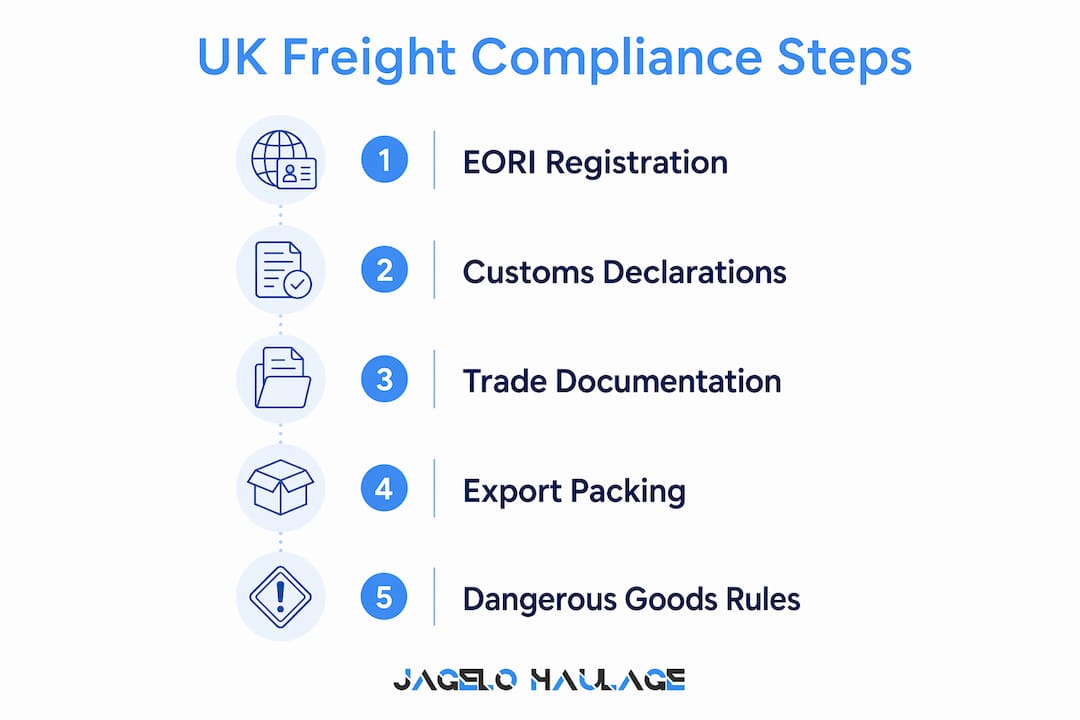
Documentation errors are one of the most common causes of customs delays, and a freight forwarder’s ability to prepare and verify paperwork accurately is a core part of the service. Freight forwarders handle the full suite of international trade documents, from the commercial invoice through to the bill of lading, ensuring each one meets the requirements of both UK authorities and the destination country.
The principal documents in a typical UK international shipment are:
- Commercial invoice: confirms the value, description, and terms of sale; used by customs to assess duty liability
- Packing list: details the contents, weight, and dimensions of each package in the consignment
- Bill of lading (sea) or air waybill: the contract of carriage between shipper and carrier, and the document of title for sea freight
- Export declaration (CDS): the formal customs submission required for all goods leaving the UK
- Import declaration: required by the destination country’s customs authority
- Certificates of origin: confirm where goods were manufactured, relevant to preferential tariff claims
- Licences and permits: required for controlled goods such as dual-use items, firearms, or certain chemicals
Digital documentation systems have become standard practice among UK forwarders, reducing manual errors and accelerating the exchange of paperwork between shippers, carriers, and customs authorities. Cargo insurance certificates also form part of the documentation package; forwarders typically arrange cover or advise clients on obtaining it, though the client bears responsibility for ensuring adequate protection.
How UK freight forwarders approach export packing
Correct packing is not simply a matter of protecting goods in transit. It directly affects customs inspection outcomes, insurance validity, and compliance with carrier requirements across different transport modes. UK forwarders advise on materials and methods suited to the specific journey, whether that involves a road trailer, an ocean container, or an aircraft hold.
The practical considerations vary by mode:
- Sea freight: goods must withstand humidity, vibration, and extended transit times; palletised cargo should be shrink-wrapped and secured to prevent movement within the container
- Air freight: weight restrictions are strict, so lightweight but protective materials such as foam inserts and reinforced cartons are preferred
- Road transport: goods must be secured against shifting during braking and cornering, with appropriate dunnage or void fill
Forwarders also check that packaging meets the International Standards for Phytosanitary Measures No. 15 (ISPM 15) requirements for wooden packing materials, which apply to most UK export destinations. Failure to use heat-treated or fumigated timber can result in consignment rejection at the destination port. Poor packing that leads to damage can also invalidate an insurance claim if the carrier or insurer determines that inadequate packaging was the proximate cause of the loss.
Regulations for moving dangerous goods through UK freight forwarding
Dangerous goods, formally classified as hazardous materials, require a separate layer of compliance that goes well beyond standard freight procedures. UK freight forwarders handling such cargo must comply with a framework of international and domestic regulations, each specific to the mode of transport involved.
The principal regulatory codes are:
- ADR (European Agreement Concerning the International Carriage of Dangerous Goods by Road): applies to road transport within the UK and across Europe
- IMDG Code (International Maritime Dangerous Goods Code): governs sea shipments of hazardous cargo
- IATA Dangerous Goods Regulations: the standard for air freight, published annually by the International Air Transport Association
- RID: covers dangerous goods carried by rail
Under these frameworks, forwarders must comply with precise requirements for classification, packing, labelling, marking, and documentation. Each dangerous good is assigned a UN number and a hazard class, and the shipper must provide a Dangerous Goods Declaration confirming that the consignment has been prepared in accordance with the applicable regulations.
The consequences of non-compliance are severe. Carriers can refuse to accept improperly declared or labelled dangerous goods, and regulatory authorities can impose fines or prosecute responsible parties. In the UK, the Health and Safety Executive (HSE) and the Driver and Vehicle Standards Agency (DVSA) both have enforcement powers in this area. Forwarders with specialist dangerous goods training, evidenced by qualifications such as the IATA DGR certificate, provide a material risk reduction for businesses shipping hazardous cargo.
Freight forwarding realities and best practices from UK industry experts
The freight forwarding sector is frequently misunderstood, and the gap between perception and operational reality can be costly for UK businesses. According to FIATA industry standards, freight forwarders provide far more than a booking service. Their advisory and risk management functions, covering routing decisions, Incoterms selection, and regulatory compliance, represent a substantial part of the value they deliver.
A common point of confusion is the distinction between a freight forwarder and a customs broker. These are operationally distinct roles: a forwarder manages the end-to-end logistics of a shipment, while a customs broker focuses specifically on regulatory compliance at the border. Many UK forwarders offer both functions, but not all do. Businesses should confirm which services are included before engaging a provider.
On the question of cost versus value, the instinct to select the lowest freight quote is understandable but often counterproductive. Total shipment cost includes delays, demurrage charges, customs penalties, and cargo damage, none of which appear on a headline freight rate. Experienced UK forwarders price in reliability, compliance expertise, and carrier relationships that reduce the likelihood of these additional costs materialising.
Pro Tip: Before signing any freight forwarding contract, ask to see the forwarder’s Trading Conditions and confirm whether their liability limit covers the full commercial value of your cargo. If it does not, arrange separate cargo insurance. Forwarders limit their liability under their Trading Conditions, meaning full value compensation requires a specific cargo insurance policy secured by the client.
Jhaulage operates within this same framework of professional accountability. With a fleet of over 40 GPS-tracked trucks and trailers serving major UK ports including Felixstowe, Tilbury, Southampton, and Liverpool, Jhaulage provides the port-to-door container haulage that sits at the final stage of the freight forwarding chain. Understanding how forwarders and hauliers differ helps businesses assign the right provider to each part of the supply chain.
What does freight forwarding in the UK actually cost?
Freight forwarding fees are not a single line item. They comprise a combination of carrier charges, forwarder service fees, and third-party costs, each of which varies by shipment type, route, and the level of service required.
The main cost components you should expect to see on a freight forwarding invoice include:
- Freight rate: the base charge levied by the carrier (shipping line, airline, or road haulier), negotiated by the forwarder on your behalf
- Origin and destination charges: port handling fees, terminal handling charges (THC), and documentation fees at each end of the journey
- Customs clearance fees: charged by the forwarder or customs broker for preparing and submitting declarations via CDS
- Duty and VAT: levied by HMRC on imported goods, calculated against the commodity code and declared customs value
- Fuel surcharges and peak season surcharges: variable charges applied by carriers, particularly in air freight
- Demurrage and detention: charges that accrue when containers are not collected from the port or returned to the carrier within the agreed free time
- Cargo insurance premium: if arranged through the forwarder, this appears as a separate line item
Rates fluctuate with global market conditions, fuel prices, and port congestion. Demurrage in particular can escalate quickly at busy UK ports such as Felixstowe, where container dwell times are closely monitored. A forwarder with strong carrier relationships and real-time port visibility can help you avoid these avoidable costs.
How to choose a freight forwarder in the UK
Selecting the right forwarder is one of the most consequential decisions a UK importer or exporter makes. The wrong choice can result in delayed shipments, customs penalties, and cargo damage. The right one becomes an extension of your logistics operation.
Criteria to evaluate:
- BIFA membership: BIFA members operate under a standardised set of trading conditions and are subject to the association’s professional standards. Membership is a baseline indicator of credibility in the UK market.
- CDS capability: confirm that the forwarder can submit customs declarations directly through the Customs Declaration Service, not just via a third-party broker they have no direct relationship with.
- Mode and route specialisation: a forwarder with deep experience on your specific trade lane (for example, UK to Southeast Asia via sea freight) will have better carrier rates and fewer operational surprises than a generalist.
- Dangerous goods accreditation: if your cargo includes hazardous materials, verify that the forwarder holds the relevant certifications and has documented procedures for ADR or IMDG compliance.
- Technology and visibility: real-time shipment tracking, digital documentation, and proactive exception management are now standard expectations, not premium features.
- Financial stability: a forwarder that goes into administration mid-shipment can leave your cargo stranded. Check Companies House records and ask for trade references.
Red flags to watch for:
- Vague or verbal-only trading conditions, with no written document provided before contract
- Inability to explain commodity code classification or rules of origin requirements
- No clear answer on who handles customs declarations and under what authorisation
- Unusually low quotes that exclude port charges, customs fees, or surcharges
Freight forwarders reduce complexity for UK businesses by managing logistics, customs, and multiple carriers, freeing you to focus on your core operations. That value is only realised, however, when the forwarder has the expertise and infrastructure to deliver on their commitments. For the container haulage leg of your supply chain, UK port logistics specialists such as Jhaulage provide the dedicated port-to-door transport that completes the freight forwarding process.
Key takeaways
Freight forwarding in the UK is a regulated, multi-service discipline that requires EORI registration, CDS compliance, and professional trading conditions to operate legally and effectively.
| Point | Details |
|---|---|
| EORI is mandatory | Every UK business moving goods internationally must hold an EORI number for customs declarations. |
| CDS replaced CHIEF post-Brexit | All UK customs declarations must now be submitted through the Customs Declaration Service. |
| Forwarders and brokers differ | Forwarders manage end-to-end logistics; customs brokers focus on regulatory compliance at the border. |
| Liability limits apply | Forwarders limit liability under Trading Conditions; full cargo value protection requires separate cargo insurance. |
| BIFA membership signals credibility | BIFA membership indicates a forwarder operates under standardised professional trading conditions in the UK. |
Recommended
- Freight forwarder vs haulier UK: how to choose | Jagelo Haulage
- A Comprehensive Guide to Merchant Haulage: How to Organise Efficient UK Container Transport | Jagelo Haulage
- Inland Container Transport UK: A Professional Guide to Port-to-Door Logistics | Jagelo Haulage
- Logistics for Shipping Containers: A Comprehensive Guide to UK Port Transport | Jagelo Haulage