More on FCL container transport from Jagelo Haulage
FCL shipment examples: a practical guide for UK shippers

An example of a full container load shipment is any booking where a single shipper exclusively uses one ISO container, sealed at origin and not opened until the destination. Common FCL shipment examples include:
- Palletised retail stock destined for Amazon FBA or a 3PL warehouse
- Furniture consignments (boxed sofas, flat-pack units) for UK retailers
- Single-machine exports such as CNC equipment or forklift trucks
- Reefer loads of seafood, fresh produce or pharmaceuticals requiring temperature control
- Bulk textile or garment shipments sealed at the factory
- Hazardous-limited cargo such as lithium-ion battery-powered equipment (subject to IMO classification)
The rule of thumb for UK logistics teams: if your shipment approaches a moderate volume threshold, or you need security, direct routing, or faster customs clearance, FCL shipping is almost always the right call. Jhaulage handles the port-to-door leg across Felixstowe, Tilbury, Southampton, and Liverpool once your container arrives.
Table of Contents
- What does FCL mean, and how does it differ from LCL?
- When should you choose FCL over LCL for UK operations?
- How do you choose the right container size?
- Concrete examples of FCL shipments: scenarios UK logistics teams recognise
- End-to-end stages of an FCL shipment and a practical checklist
- Packing, stuffing and load-securing best practices for FCL
- Typical cost drivers and sample timelines for UK FCL shipments
- Common pitfalls, compliance notes and dangerous goods considerations
- How Jhaulage handles FCL shipments from UK port to door
- Key takeaways
- The detail that separates a smooth FCL from an expensive one
- Jhaulage: port-to-door FCL haulage across the UK’s major container ports
- Useful sources and further reading
What does FCL mean, and how does it differ from LCL?
FCL stands for Full Container Load. The booking gives one shipper exclusive use of an ISO container from the point of stuffing to the point of delivery. The container is sealed at origin, and that seal is not broken until the consignee receives it. Critically, the term ‘full’ is a commercial booking term, not a physical description: you pay for exclusive control of the container, not for filling every cubic centimetre of it.
LCL (Less than Container Load) works differently. Multiple shippers share one container, each paying per cubic metre (CBM). That model suits small shipments but introduces additional handling touches at consolidation and deconsolidation depots, which raises both damage risk and transit time.
| Dimension | FCL | LCL |
|---|---|---|
| Pricing model | Flat container rate | Per-CBM rate |
| Handling touches | Minimal (origin to destination) | Multiple (CFS consolidation/deconsolidation) |
| Customs entry | Single shipper, single entry | Shared manifest, potential delays |
| Transit time | Direct vessel schedule | Subject to groupage cut-offs |
| Damage/pilferage risk | Lower (sealed unit) | Higher (multiple handling points) |
| Ideal volume | Typically 13 CBM+ | Below 13–15 CBM |
Quick glossary
- CBM — cubic metre; the standard unit for measuring cargo volume
- TEU/FEU — Twenty-foot Equivalent Unit / Forty-foot Equivalent Unit; the standard container count metrics
- HC (High Cube) — a container with an internal height of approximately 2.69 m versus the standard 2.39 m
- Reefer — a refrigerated container maintaining a set temperature range
- Flat rack — an open-sided container for oversized or out-of-gauge cargo
When should you choose FCL over LCL for UK operations?
Volume is the primary trigger, but it is rarely the only one. Switching to FCL around 13–15 CBM is the widely accepted industry threshold, because at that point the flat container rate typically undercuts the per-CBM LCL cost and the operational benefits compound.
Beyond volume, several non-volume factors make FCL the correct choice:
- Security and pilferage sensitivity — high-value electronics, branded goods, or pharmaceuticals benefit from a sealed, unshared container
- Contamination risk — food-grade cargo, cosmetics, or anything odour-sensitive should not share space with unknown co-loaders
- Lead-time predictability — FCL moves on a direct vessel schedule; LCL is subject to groupage cut-offs and deconsolidation delays
- Single consignee — if one buyer receives the entire shipment, there is no benefit to sharing a container
- Fragile or specialised cargo — machinery, glass, or temperature-sensitive goods need controlled loading and no third-party interference
- Dangerous goods (DG) — certain IMO-classified cargo cannot be co-loaded with other shippers’ goods without complex segregation
UK-specific considerations: Post-Brexit, UK imports require a full customs entry regardless of shipment mode, but FCL simplifies the process because there is one shipper, one commodity declaration, and one set of documents. Port dwell charges at Felixstowe or Tilbury accumulate quickly; FCL’s predictable release timing makes it easier to pre-book drayage and avoid demurrage.
FCL decision checklist
- Is the shipment volume above 13–15 CBM, or approaching half a container?
- Does the cargo require a sealed, unshared environment (food-grade, high-value, branded)?
- Is there a single consignee at the UK destination?
- Does the cargo include temperature-sensitive, hazardous, or fragile items?
- Is lead-time predictability critical to the consignee’s production or retail schedule?
- Are you importing into a UK port where drayage pre-booking is time-sensitive?
Pro Tip: If you answer yes to three or more of the above, book FCL. The cost premium over LCL at 13–15 CBM is marginal, and the operational control you gain is substantial.
How do you choose the right container size?
Standard ISO container sizes and their usable internal capacities are the starting point for every FCL booking.
| Container type | Internal volume | Typical max payload | Standard UK pallets (approx.) |
|---|---|---|---|
| 20ft standard | ~33 m³ | Up to 28 tonnes | 10–11 |
| 40ft standard | Approximately 67–70 m³ | Approximately 15,454 kg | 20–22 |
| 40ft High Cube | Approximately 76–78 m³ | Approximately 15,454 kg | 22–24 |
The 20ft container suits dense, heavy cargo where you reach the weight limit before the volume limit. A full pallet of steel components, for example, will hit 28 tonnes well before filling 33 m³. The 40ft and 40ft High Cube suit voluminous, lighter cargo where you need the cubic capacity. The High Cube’s extra 30 cm of internal height is particularly useful for tall pallets or double-stacked goods.
Simple CBM-to-container calculation: A standard UK euro pallet (1,200 × 800 mm) loaded to 1.8 m height occupies approximately 1.73 m³. A 40ft High Cube at 76–78 m³ usable capacity can therefore accommodate roughly 43–45 pallet positions on paper, though practical loading (aisle clearance, weight distribution, door access) typically yields 22–24 pallets.
- Calculate total cargo CBM (length × width × height per unit, summed)
- Add 10–15% for packaging, dunnage, and load-securing materials
- Match to the container type whose usable volume exceeds your adjusted total
- Cross-check against the container’s payload limit — whichever limit (weight or volume) you hit first governs the choice
Specialised container types to know:
- Reefer (20ft/40ft) — for perishables and pharmaceuticals; confirm availability by trade lane before booking, as not every carrier offers reefer on every route
- Open-top — for cargo loaded by crane that exceeds standard door height
- Flat rack — for out-of-gauge machinery, vehicles, or structural steel
- 45ft High Cube — available on certain European short-sea and road-ferry services; useful for very high-volume, low-density loads
Concrete examples of FCL shipments: scenarios UK logistics teams recognise
The following scenarios illustrate the types of full container loads that move through UK ports regularly. Each maps a commodity to a container choice and highlights the key operational consideration.
Palletised retail stock to Amazon FBA or a 3PL
A UK importer brings 22 pallets of consumer electronics accessories from Shenzhen. Volume: approximately 68 m³, weight: 9,500 kg. A 40ft High Cube is the natural fit. The container is stuffed at the factory, sealed, and booked on a direct service to Felixstowe. The consignee pre-books a delivery slot at the fulfilment centre before the vessel arrives. Key operational note: Amazon FBA requires pallet labels and appointment booking before the driver arrives; missing either causes a refused delivery.
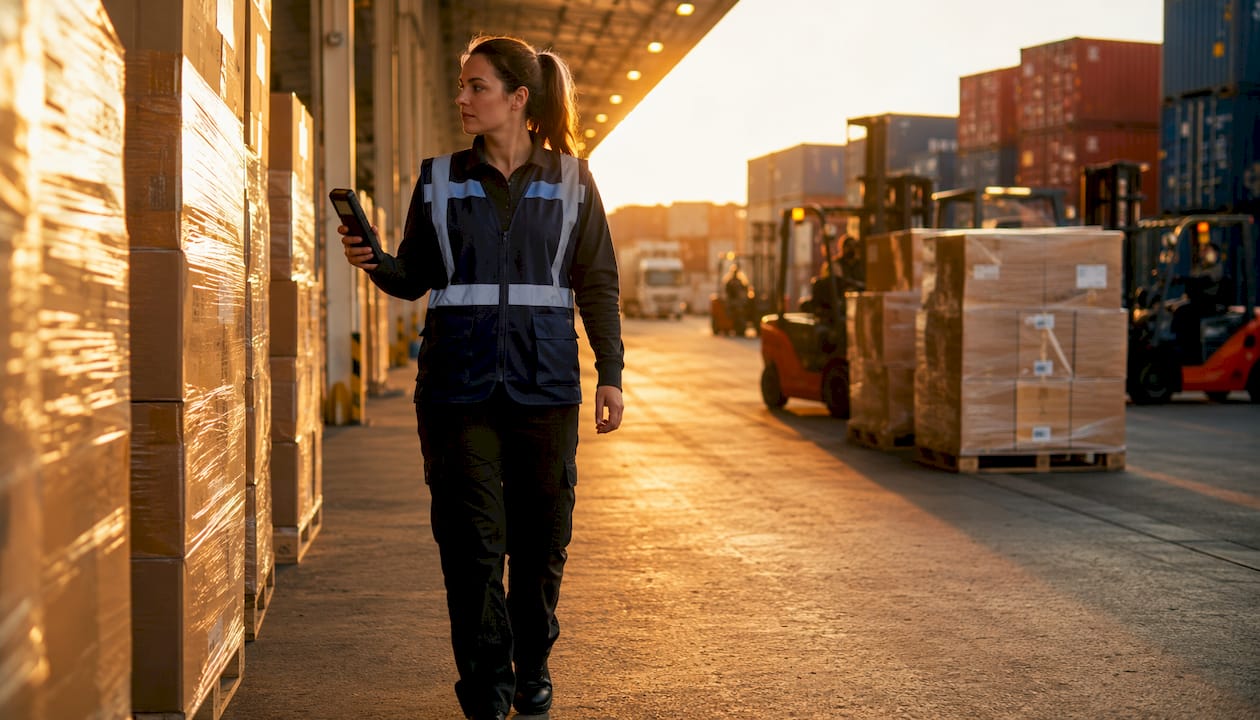
A comparable real-world case: an 11,300 kg, 68 m³ toy shipment from Shenzhen to Felixstowe used a 40ft High Cube on a direct vessel schedule, demonstrating exactly this profile: light cargo, high volume, direct routing. The internal capacity of a 40ft High Cube is typically 76–78 m³, providing surplus volume for this shipment type.
Furniture consignment for a UK retailer
A furniture exporter books one 40ft High Cube, loads 12 pallets of boxed chairs at their warehouse, applies a numbered seal, and the carrier transports that closed container to the UK consignee. No other shipper’s cargo shares the container. FCL is chosen here for contamination control (fabric goods absorb odours) and because the volume justifies the flat container rate.
Single-machine export: CNC equipment or forklift trucks
Heavy machinery presents a density challenge. A forklift shipment from Shanghai to a European port — 15,454 kg in 24.78 CBM — illustrates the point: the weight limit is approached long before the volume limit. A standard 40ft container is selected, and the forklifts are secured with wooden blocks and heavy-duty ratchet straps. FCL is the only practical option here; no co-loader would accept shared space with rolling, battery-equipped machinery.
Reefer consignment: seafood or pharmaceuticals
A Scottish seafood exporter ships 18 tonnes of frozen prawns to a Far East buyer in a 40ft reefer set to -18°C. The reefer unit maintains temperature throughout the ocean leg. Booking lead time is longer than standard FCL because reefer equipment availability varies by trade lane; confirm the unit before committing to a vessel.

Hazardous-limited export: lithium-ion battery equipment
A UK manufacturer exports battery-powered warehouse equipment. The lithium-ion batteries trigger IMO Class 9 classification. The shipper must provide a Dangerous Goods Declaration, confirm UN numbers, and verify that the carrier accepts the commodity. A multimodal case involving 16 containers of forklifts with Li-ion batteries from Ningbo required corridor planning and terminal deconsolidation to manage the hazard safely. The lesson: DG cargo demands specialist freight management and cannot be treated as standard FCL.
Bulk textiles sealed at the factory
A garment exporter in Bangladesh fills a 40ft container with 2,400 cartons of knitwear destined for a UK fashion retailer. The container is sealed at the factory gate. FCL is chosen because the retailer’s distribution centre requires a single-shipper customs entry, and the volume (approximately 55 m³) makes LCL uneconomical.
Pro Tip: Photograph the cargo, the load plan, and the seal number at the point of stuffing. If a customs query or damage claim arises at the UK port, those images are your primary evidence.
End-to-end stages of an FCL shipment and a practical checklist
Understanding the full operational sequence prevents the costly gaps that cause demurrage and detention charges.
- Booking and container allocation — freight forwarder places booking with carrier; container number and booking reference issued (allow 3–7 days before cargo ready date on main lanes)
- Empty container delivery — carrier or depot delivers empty container to stuffing location; inspect for cleanliness, structural damage, and lashing ring condition before accepting
- Stuffing and load securing — cargo loaded per the Container Load Plan (CLP); weight distributed evenly, centre of gravity kept low; lashing and blocking applied
- Sealing — a numbered security seal is applied; the seal number is recorded on the packing list, the Bill of Lading, and the shipper’s internal records
- VGM submission — Verified Gross Mass submitted to the carrier per SOLAS requirements before the port cut-off (typically 24–48 hours before vessel loading)
- Export customs clearance — export declaration lodged with HMRC; for UK exporters, this is an electronic submission via the Customs Declaration Service (CDS)
- Port intake and vessel loading — container delivered to the terminal within the port’s Vehicle Booking System (VBS) window; loaded onto the vessel
- Ocean transit — duration varies by trade lane (typically 10–35 days for Asia-UK main lanes)
- Pre-arrival notification — freight forwarder lodges import customs entry with HMRC; Entry Summary Declaration (ENS) submitted
- Discharge and port release — container discharged and moved to the terminal stack; customs clearance confirmed; port releases container for collection
- Drayage to consignee — haulier collects from the terminal within the free time window (typically 3–5 days); delivers to the consignee’s premises
- Container return — empty container returned to the carrier’s nominated depot within the detention-free period to avoid detention charges
Pro Tip: Pre-book your drayage appointment before the vessel arrives. At busy UK ports, a 24-hour delay in booking can push collection into the demurrage window, adding costs that no freight budget absorbs comfortably.
Typical UK import FCL timeline (Asia origin): cargo ready to UK delivery averages 30–45 days on main Asia-UK lanes, with customs clearance adding 1–3 days if documentation is complete on arrival.
Practical documentation checklist
- Commercial invoice and packing list (with seal number)
- Bill of Lading (original or express release confirmed)
- Export/import customs declarations (CDS entries)
- VGM certificate
- Certificate of Origin (where preferential tariff applies)
- DG Declaration (where applicable)
- Phytosanitary certificate (for plant-based products entering the UK)
Packing, stuffing and load-securing best practices for FCL
Load quality at the stuffing stage determines whether cargo arrives intact and whether the container clears UK port inspection without delay.
Packing choices that improve utilisation: Switching from retail-ready packaging to industrial bulk formats can increase the usable load per container significantly. Moving from retail bags to FIBC (Flexible Intermediate Bulk Container) ton bags, for example, allows taller stacking and eliminates the wasted space created by irregular retail packaging geometry. Optimising pallet patterns and case orientations is a low-cost intervention that often recovers several CBM per container.
Load distribution: Weight must be distributed evenly across the container floor, with heavier items placed low and towards the centre. For UK road haulage, the loaded container must comply with the 44-tonne gross vehicle weight limit and individual axle limits. A container loaded with all weight at one end creates an axle overload that is both illegal and dangerous on UK roads.
Lashing, blocking and bracing: Cargo must be secured against longitudinal and lateral movement. Timber blocking and bracing, combined with ratchet straps through the container’s lashing rings, is the standard method for machinery and palletised goods. For heavy or specialised cargo such as forklifts or battery equipment, heavy-duty ratchet straps and custom wooden blocking are required to prevent rolling and shifting during the ocean voyage.
Where cargo contains batteries or other IMO-classified hazardous elements, the packing and securing method must comply with IMDG Code requirements. Segregation distances, packaging specifications, and labelling are all prescribed; a shipper who treats DG cargo as standard FCL risks a port hold, a fine, or carrier rejection.
Pro Tip: To increase container utilisation without raising damage risk, consider moving high-volume, low-value consignments from retail-ready to industrial bulk packaging such as FIBC ton bags. The format eliminates retail packaging waste and allows maximum safe stacking height.
Typical cost drivers and sample timelines for UK FCL shipments
FCL pricing is not a single line item. Understanding each cost component allows procurement teams to unbundle freight from EXW supplier quotes and see the true landed cost rather than absorbing hidden markups in the supplier price.
Main cost drivers
- Ocean freight rate — the base container rate, which varies by trade lane, carrier, and market conditions
- Bunker Adjustment Factor (BAF) / fuel surcharge — fluctuates with fuel prices; can be a significant addition on long-haul lanes
- Peak Season Surcharge (PSS) — applied by carriers during high-demand periods (typically Q3 pre-Christmas)
- Terminal Handling Charges (THC) — levied at origin and destination ports; not always included in the ocean rate quote
- Port congestion surcharges — applied when port capacity is constrained; Felixstowe and Southampton have both seen these in recent years
- Drayage (port haulage) — cost of moving the container from the UK port to the consignee; varies by distance and port
- Customs fees — HMRC import VAT, duty, and CDS entry fees; calculated on the customs value of the goods
- Demurrage and detention — charges for exceeding the carrier’s free time at the port (demurrage) or for late return of the empty container (detention)
Sample FCL timeline: Asia to UK
| Stage | Typical duration |
|---|---|
| Booking to cargo ready | 3–7 days |
| Stuffing and port intake | 1–2 days |
| Ocean transit (Asia-UK main lane) | 25–35 days |
| Port discharge to customs release | 1–3 days |
| Drayage to UK consignee | 1–2 days |
Port choice and its cost implications: Felixstowe handles the largest volume of UK container traffic and offers the widest carrier choice, but drayage costs to the Midlands or North are higher than from Liverpool. Tilbury suits London and South East consignees. Southampton is strong for automotive and retail trade lanes. Liverpool is the natural choice for North West and Irish Sea distribution. Choosing the right UK port for your trade lane can reduce drayage costs and dwell time materially.
Cost-reduction actions: Book at least 3–4 weeks ahead of cargo ready date on competitive lanes. Confirm the correct container type before booking to avoid last-minute equipment changes. Where multiple containers arrive at the same port within a short window, consolidated port pickups reduce per-unit drayage cost.
Common pitfalls, compliance notes and dangerous goods considerations
The most expensive FCL mistakes are almost always documentation failures, not physical cargo problems.
Top compliance pitfalls
- Incorrect HS codes — a wrong tariff code triggers a customs query, delays release, and can result in underpaid duty and a penalty
- Seal/manifest mismatch — if the seal number on the container does not match the Bill of Lading or the manifest, customs will hold the container for inspection
- Misdeclared weight — under-declaring gross mass is a SOLAS violation; VGM must be verified by weighing, not estimated
- Missing phytosanitary or health certificates — post-Brexit, UK Border Force applies phytosanitary checks to plant-based products; missing certificates cause port holds
- Incorrect or absent DG documentation — the most serious category; carriers can refuse the container at the terminal gate
Dangerous goods and IMO requirements: Any shipment containing lithium-ion batteries, fuel cells, flammable liquids, or other IMO-classified substances requires a Dangerous Goods Declaration prepared by a competent person, correct UN numbers and packing group designations, and carrier pre-approval. The IMDG Code governs sea transport of DG; shippers must verify compliance before booking. Attempting to move DG cargo as standard FCL without declaration is a criminal offence under UK law.
Mitigations
- Conduct a pre-shipment DG check for any cargo containing batteries, chemicals, or pressurised items
- Verify gross mass by weighing and submit VGM to the carrier within the required window
- Cross-check the seal number against the Bill of Lading before the container leaves the stuffing location
- Use a freight forwarder or customs broker with UK post-Brexit experience for import entries
- Engage an experienced haulage partner familiar with terminal VBS systems to avoid missed collection windows
Pro Tip: Request a copy of the carrier’s DG acceptance confirmation in writing before the container is stuffed. If the carrier later rejects the container at the terminal gate, you have documentary evidence to support a claim and a faster resolution path.
Brexit impact summary: UK importers now face additional documentary requirements compared with pre-2021 procedures. Safety and Security declarations, full customs entries, and in some cases physical inspections at the border are standard. For agricultural and food products, UK Border Target Operating Model (BTOM) checks apply at designated Border Control Posts. Consult HMRC import guidance and your customs broker for the current requirements applicable to your commodity.
How Jhaulage handles FCL shipments from UK port to door
Jhaulage (trading as Jagelo Haulage Limited) operates as a specialist container haulage provider covering the UK’s principal container ports: Felixstowe, Tilbury, Southampton, and Liverpool. The fleet comprises over 40 GPS-tracked trucks and trailers, providing real-time visibility on every container movement from port gate to consignee.
Service capabilities at a glance
- Port-to-door container haulage across all four major UK container ports
- GPS-tracked fleet with real-time monitoring and 24/7 operational support
- Same-day delivery options for time-critical consignments
- Cross-dock and terminal handling for containers requiring transshipment or deconsolidation
- Vehicle Booking System (VBS) appointment management at UK terminals
- Experienced drivers familiar with port procedures, seal checks, and document verification
Example workflow: container arrival at Felixstowe to UK delivery
- Pre-arrival: Jhaulage receives the container number, Bill of Lading reference, and customs release confirmation from the freight forwarder
- VBS booking: a terminal appointment is secured within the free-time window to avoid demurrage
- Port collection: the driver collects the container, verifies the seal number against the shipping documents, and photographs the seal before departure
- Transit: GPS tracking provides live location data; the consignee receives an estimated delivery window
- Delivery: the container is delivered to the consignee’s premises; the driver records the delivery and the seal break
Pro Tip: When booking drayage with Jhaulage, provide the container number and customs release reference as early as possible. Early notification allows the VBS appointment to be secured before the free-time clock starts, which is the single most effective way to avoid demurrage on UK port collections.
Jhaulage’s port coverage and fleet scale make it a practical partner for logistics teams managing regular FCL imports across multiple UK ports. For guidance on selecting a container haulage company that fits your operational requirements, the linked resource covers the key evaluation criteria.
Key takeaways
FCL shipments give logistics teams exclusive container control, predictable routing, and simplified customs clearance — the right choice once volume exceeds 13–15 CBM or cargo requires security, temperature control, or DG compliance.
| Point | Details |
|---|---|
| FCL threshold | Switch from LCL to FCL when shipment volume approaches 13–15 CBM or half a container. |
| Container size selection | Match container type to cargo density: 20ft for heavy/dense loads, 40ft High Cube for voluminous/light cargo up to approximately 76–78 m³. |
| Documentation discipline | Verify seal number, VGM, and customs entry before the vessel arrives to avoid port holds and demurrage. |
| DG compliance | Any cargo containing lithium-ion batteries or IMO-classified substances requires a Dangerous Goods Declaration and carrier pre-approval. |
| Jhaulage port coverage | Jhaulage provides GPS-tracked, port-to-door FCL haulage across Felixstowe, Tilbury, Southampton, and Liverpool with 24/7 support. |
The detail that separates a smooth FCL from an expensive one
The operational gap between a well-executed FCL shipment and a costly one almost always comes down to the same handful of controllable factors: seal control, VGM accuracy, and the timing of the customs entry relative to vessel arrival.
Seal control is underestimated. A seal number discrepancy between the container and the Bill of Lading is one of the most common triggers for a customs examination hold at UK ports. The fix is straightforward: photograph the seal at stuffing, record the number on every shipping document, and verify it again at port collection. That 30-second check at the stuffing location can prevent a 3-day port hold.
VGM is the other area where shippers cut corners and pay for it. Estimating gross mass rather than weighing the loaded container is a SOLAS violation and a practical risk: an overloaded container on a UK road is a legal liability for the haulier and the shipper. Weigh it, certify it, submit it on time.
The customs entry timing matters more post-Brexit than it did before 2021. A complete, accurate import entry lodged before the vessel arrives means the container can be released within hours of discharge. An entry lodged after discharge, or one with errors, means the container sits in the terminal stack accumulating demurrage while the broker corrects the paperwork.
Jhaulage: port-to-door FCL haulage across the UK’s major container ports
When your FCL shipment clears customs at Felixstowe, Tilbury, Southampton, or Liverpool, the final leg determines whether the supply chain promise holds. Jhaulage provides dedicated, GPS-tracked container haulage from port gate to consignee, with a fleet of over 40 trucks, 24/7 operational support, and VBS appointment management built into every collection.
For time-critical consignments, same-day delivery options are available. For regular FCL programmes, Jhaulage’s port coverage and driver familiarity with UK terminal procedures reduce the risk of missed collection windows and the demurrage charges that follow. Whether you are managing a single container import or a multi-port FCL programme, the team at Jhaulage can provide a quote and confirm port availability for your next shipment.
Useful sources and further reading
The following sources provide authoritative guidance on container specifications, UK customs requirements, and FCL operations.
| Source | What it covers |
|---|---|
| HMRC: importing goods into the UK | UK customs entry requirements, Safety and Security declarations, and Border Control Post procedures post-Brexit |
| Alconet Containers: container sizes | ISO container internal dimensions and capacity specifications for 20ft, 40ft, and High Cube units |
| DCL Logistics: FCL guide | Practical explanation of FCL vs LCL decision thresholds and operational benefits |
| UFI Shipping: FCL complete guide | Reefer availability, the commercial definition of ‘full’, and carrier selection guidance |
| Mihan Logistics: Shenzhen to Felixstowe case | Real FCL case study: 40HQ toy shipment from Shenzhen to Felixstowe |
| Framex Group: multimodal DG case study | Multimodal FCL with Li-ion battery forklifts; corridor planning and DG compliance |
| QAF Xpress: FCL Nansha to Shuwaikh | FCL case study showing EXW unbundling and 4-day booking-to-carrier timeline |
| Jhaulage: FCL explained | FCL basics and container selection guidance for UK shippers |
| Jhaulage: UK port logistics guide | Port selection, drayage considerations, and UK terminal operations |
For dangerous goods classification and IMDG Code requirements, consult the IMO’s published guidance directly. For UK customs procedures, HMRC’s import guidance and your appointed customs broker are the authoritative references for your specific commodity and origin.
Recommended
- Streamlining Container Delivery to Amazon FBA: A Professional UK Haulage Guide | Jagelo Haulage
- What is a full container load? FCL shipping explained | Jagelo Haulage
- Logistics for Shipping Containers: A Comprehensive Guide to UK Port Transport | Jagelo Haulage
- Freight forwarding UK: a complete guide for businesses | Jagelo Haulage