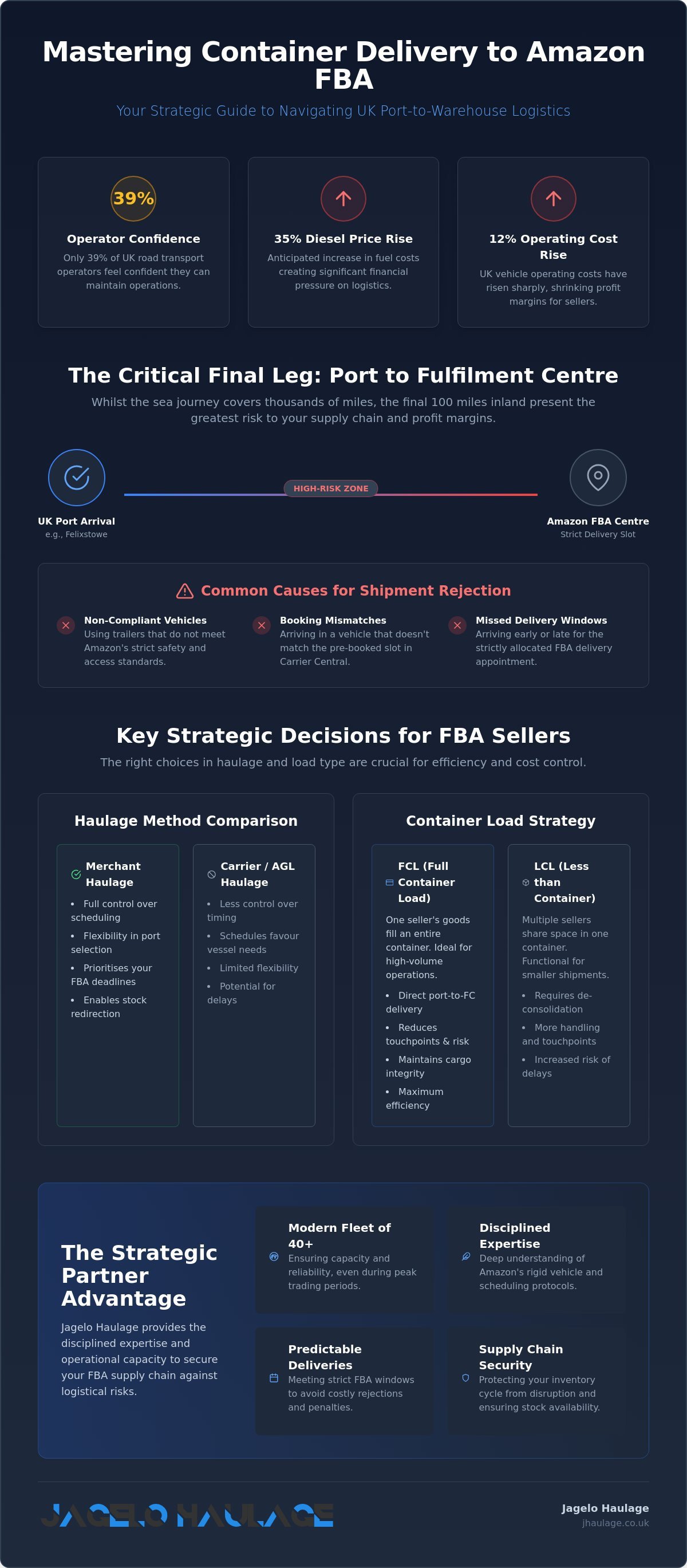
Only 39% of UK road transport operators feel confident they can maintain operations under the 35% diesel price increase recorded in early 2026. This volatility creates a high stakes environment for sellers who depend on precise timing. You recognise that a single rejected vehicle at an Amazon Fulfilment Centre gate can disrupt your entire inventory cycle and result in costly penalties. Managing container delivery to Amazon FBA is no longer a simple transport task. It's a strategic operation that requires strict adherence to Amazon’s rigid vehicle and scheduling protocols.
Jagelo Haulage provides the disciplined expertise needed to secure your supply chain against these logistical risks. This guide explains how to navigate the complexities of port to warehouse transport while avoiding the high costs and communication gaps often found with large scale carriers. You'll discover how to ensure your shipping containers reach their destination without delays or rejections. We'll outline the specific vehicle requirements, the benefits of merchant haulage, and the methods used to achieve predictable delivery times in a challenging economic market.
Key Takeaways
- Identify why the final stage of container haulage from UK ports is the most critical factor in maintaining inventory levels at Amazon Fulfilment Centres.
- Evaluate the operational advantages of Full Container Load (FCL) transport for high-volume sellers requiring direct-to-warehouse efficiency.
- Compare the flexibility of merchant haulage against Amazon Global Logistics (AGL) for stock redirection and port selection.
- Recognise the strict vehicle compliance standards and booking protocols required for successful container delivery to Amazon FBA to prevent shipment rejections.
- Understand how a modern fleet of over 40 trucks provides the reliability needed to meet strict FBA delivery windows.
The Complexity of Container Delivery to Amazon FBA in the UK
Moving a shipping container from a vessel at Felixstowe or Southampton to an Amazon Fulfilment Centre (FC) requires more than just a truck. It demands a disciplined understanding of Intermodal freight transport and the specific gate requirements of the world’s largest retailer. Whilst the sea journey covers thousands of miles, the final 100 miles of inland transport often present the greatest risk to your profit margins. A single error during container delivery to Amazon FBA can result in immediate rejection at the warehouse gate, forcing the haulier to return the load to a holding yard at your expense.
Common reasons for these rejections include the use of non-compliant trailers, lack of proper rear-door access, or the arrival of a vehicle that doesn't match the pre-booked slot in the Carrier Central system. The financial impact is severe. Beyond the cost of a failed delivery, you face potential demurrage charges at the port and Amazon’s own internal penalties for missed appointments. With UK vehicle operating costs increasing by 12% in the year leading to April 2026, sellers can't afford the inefficiency of repeated attempts or wasted fuel. Professional haulage isn't just about movement; it's about protecting the integrity of your supply chain.
The High Stakes of FBA Logistics
Amazon operates on a rigid, time-sensitive rhythm. Every FC has a specific capacity for intake, and their scheduling systems leave no room for haulier delays. If your container arrives outside its allocated window, it's likely to be turned away. These delays often cascade into broader inventory issues. If goods aren't booked in on time, you may face stock-outs during peak periods or be hit with increased FBA storage fees as your shipping schedule is forced to reset. You need a partner who understands that punctuality is a functional requirement, not a secondary goal.
Navigating Port to Warehouse Challenges
Successful logistics starts at the quay. Coordinating collections from major hubs like Felixstowe, Southampton, and Tilbury requires constant communication with port authorities. Choosing merchant haulage gives you significantly more control over this process than relying on shipping lines. Shipping lines often prioritise their own vessel schedules over your specific Amazon deadlines. Generic courier services simply aren't equipped for full container loads (FCL). They lack the heavy-duty HGVs and specialised trailers required to meet Amazon’s safety and operational standards at the point of delivery.
Understanding FCL vs LCL for Amazon Fulfilment Centres
FCL (Full Container Load) refers to a shipment where one seller occupies the entire space of a 20ft or 40ft container. LCL (Less than Container Load) involves multiple sellers sharing space within a single unit. FCL container delivery to Amazon FBA involves a single container being transported directly from port to an FC. This approach is prioritised by high-volume sellers to ensure their goods remain untouched from the point of origin to the warehouse gate.
High-volume operations often choose FCL to avoid the complexities of de-consolidation warehouses. In a UK haulage context, this means the container is lifted from the vessel and placed directly onto an HGV trailer. The logistics of floor-loaded containers versus palletised goods are a critical consideration here. Whilst floor-loading maximises the volume of goods per container, it requires specific unloading arrangements at the Amazon FC. Palletised shipments are faster to unload but reduce the total cubic capacity of the container.
FCL: Direct Port to Fulfilment Centre
Direct delivery reduces the number of touchpoints in your logistics chain. Every time a container is opened or goods are moved between vehicles, the risk of transit damage or inventory discrepancy increases. Maintaining supply chain resiliency depends on minimising these variables. Jagelo Haulage operates a modern fleet of over 40 trucks and trailers to ensure that FCL capacity is available even during peak trading periods. This operational reach allows for sealed container transport, where the original seal remains intact until it reaches the Amazon security team.
LCL: The Consolidation and De-consolidation Process
LCL is a functional choice for smaller restocks or testing new product lines. However, it introduces extra steps into the inland journey. Goods must be moved from the port to a de-consolidation warehouse, palletised to Amazon’s exact specifications, and then re-loaded onto a compliant vehicle. This process can lead to longer lead times amongst multiple UK delivery points as the haulier must coordinate several different shipments. For sellers prioritising speed and security, the direct nature of FCL is usually the superior strategic outcome for container delivery to Amazon FBA.
If you are planning your next shipment, you can request a professional haulage quote to secure your delivery slot.
Merchant Haulage vs Amazon Global Logistics (AGL)
Sellers must choose between using Amazon’s integrated logistics network or an independent container haulage specialist for the inland movement of their goods. Whilst Amazon Global Logistics (AGL) is marketed as a seamless, all-in-one solution, it often functions as a rigid system that lacks the granular control required for complex UK operations. Merchant haulage allows the seller to retain authority over the transport process. This distinction is critical when following official UK import guidance to ensure that customs clearances and port-side protocols align with your specific delivery schedule. By managing the haulage independently, you avoid being locked into Amazon’s automated workflows which don't always account for local port congestion or specific warehouse needs.
Cost transparency is another significant factor in your operational planning. As of April 2026, Amazon applied a 3.5% fuel and logistics surcharge to its fulfilment fees. When using AGL, these costs are often bundled, making it difficult to isolate the price of the inland transport leg. Professional merchant haulage provides clear, itemised rates. This allows for better financial planning, especially as UK diesel prices saw a 36% increase in the year leading to April 2026. Beyond the financial aspect, the value of human communication cannot be overstated. Resolving a gate issue at an FC or a collection delay at the port is significantly faster when you can speak directly to a UK-based fleet manager rather than navigating an automated global ticketing system.
The Advantages of Independent Merchant Haulage
Merchant haulage provides the flexibility to choose your entry point into the UK. You can direct your goods to the port that best suits your final destination, whether that is Felixstowe, Southampton, or DP World London Gateway. This strategic choice reduces road miles and fuel consumption. Specialist hauliers also offer a more responsive service for urgent inventory needs. If a shipment is delayed at sea, a professional fleet can often reorganise schedules to ensure container delivery to Amazon FBA occurs as soon as the container is released from the quay. This speed is essential for protecting your Featured Offer eligibility and maintaining consistent stock levels.
Potential Drawbacks of Relying Solely on Amazon Logistics
One of the primary frustrations for sellers using AGL is the risk of split shipments. Amazon may require a single container's contents to be distributed across multiple warehouses, which complicates the logistics of FCL transport. AGL is also designed for high-volume, standardised cargo. It often lacks the specialised handling required for heavy container haulage or non-standard dimensions. If a container is held at the port due to a customs query, resolving the issue through Amazon’s network isn't always immediate. A dedicated haulier understands the high stakes of the supply chain and acts as a strategic partner to resolve these bottlenecks immediately.
Managing your own logistics ensures that your container delivery to Amazon FBA remains under your control at every stage of the inland journey.
Compliance: Amazon’s Strict Requirements for Container Delivery
Operational success at the warehouse gate depends entirely on strict adherence to Amazon’s compliance framework. Every vehicle entering an Amazon site is subject to rigorous inspection to ensure it meets safety and throughput standards. Failure to comply with these regulations results in immediate rejection, regardless of the shipment's urgency. The Carrier Appointment Request Portal (CARP) is the mandatory portal for scheduling all UK container deliveries to Amazon. Professional hauliers use this system, or the Carrier Central interface, to secure specific arrival windows that align with the warehouse’s intake capacity. Managing container delivery to Amazon FBA requires a haulier who treats these digital protocols with the same discipline as the physical transport of the goods.
Paperwork must be precise and match the physical load exactly. Drivers must present a valid Bill of Lading (BOL) and a detailed packing list upon arrival. Amazon-specific labelling, including the FBA shipment ID, must be visible and scannable. If the digital booking in the CARP system does not mirror the physical paperwork held by the driver, the shipment will be turned away. This administrative accuracy is a functional requirement for maintaining a fluid supply chain. To ensure your operations remain compliant, you can request a professional haulage consultation to review your delivery requirements.
Vehicle and Driver Compliance
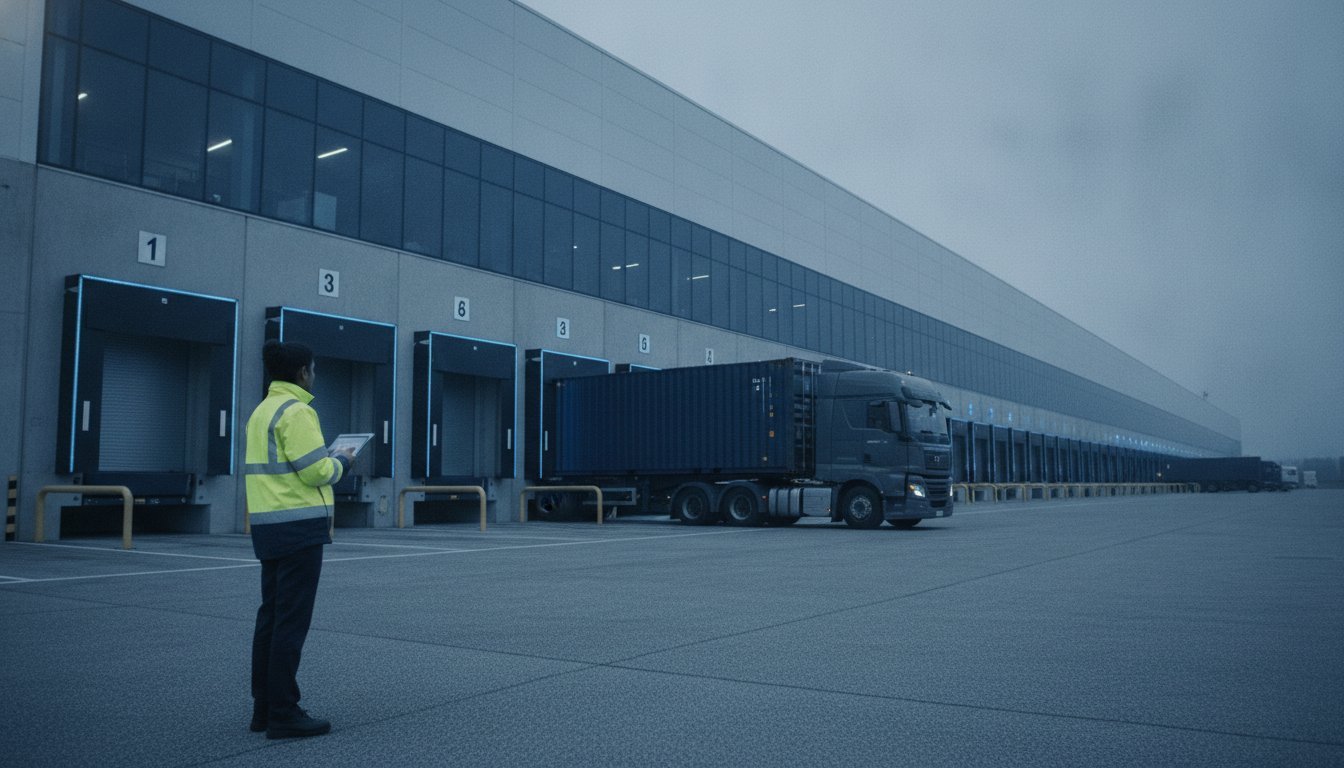
Amazon enforces specific standards for the HGVs and trailers permitted on their premises. Vehicles must allow for rear-door unloading, and trailers must be in sound structural condition with no leaks or floor damage. Whilst curtain-side trailers are common for palletised goods, full containers require specialised chassis that position the container at the correct height for the warehouse loading docks. Driver behaviour is equally scrutinised. Drivers must follow site-specific safety protocols, including the use of high-visibility clothing and adherence to strict speed limits. A modern fleet that meets current UK emission and safety standards is essential for consistent access to these high-security sites.
The Booking and Appointment Process
A professional haulier manages the entire booking process on behalf of the seller. This involves coordinating the container release from the port with the available slots in Carrier Central. Port congestion at hubs like Felixstowe or Southampton can frequently disrupt these schedules. If a delivery slot is missed due to external delays, the haulier must proactively communicate with Amazon to reschedule. This requires a high level of administrative competence to ensure all port logistics services are synchronised with the warehouse appointment. Effective coordination prevents the accumulation of port storage fees and ensures that container delivery to Amazon FBA remains a predictable part of your business model.
Why Jagelo Haulage is the Strategic Partner for Your FBA Business
Jagelo Haulage positions itself as a master of the fundamentals in the UK transport sector. We understand that for an FBA seller, haulage is not just a physical task but a critical component of inventory health. Our 15-year history of providing reliable container haulage gives us the technical capability to handle complex delivery windows without error. We maintain a modern fleet of over 40 trucks and trailers. This scale ensures that we have the physical capacity to move your containers from the port as soon as they are released. This operational reach prevents your goods from accumulating unnecessary port storage fees at hubs like Felixstowe, Southampton, or Tilbury.
The high stakes of container delivery to Amazon FBA require a partner who prioritises performance over self-promotion. We follow protocols strictly and understand the operational rhythm of every major UK fulfilment centre. This disciplined approach ensures that your shipments are never rejected due to vehicle non-compliance or scheduling errors. By choosing a specialist in merchant haulage, you gain a level of control that shipping line logistics cannot provide. We manage the final leg of your journey with a focus on functional reliability and punctuality.
Experience and Reliability in Every Mile
Our corporate structure is designed to mirror the rigid requirements of the Amazon network. We prioritise your specific operational needs, providing a level of responsiveness that large scale carriers often lack. By maintaining a direct line of communication between our fleet managers and your team, we minimise the potential for misunderstanding. This ensures that your supply chain remains fluid. Every route is planned with methodical precision to guarantee punctual arrival at the warehouse gate, protecting your Featured Offer eligibility and seller performance metrics.
Securing Your Supply Chain
Security and protection are inseparable from our service quality. We offer fully insured transport solutions, providing a secure environment for high-value FBA inventory from the moment it leaves the port. Our nationwide reach allows us to deliver to any Amazon Fulfilment Centre across the UK with consistent reliability. We don't just move containers; we provide a strategic outcome that secures your market position in a volatile economic climate. Our 15 years of experience allow us to navigate the complexities of container delivery to Amazon FBA with quiet confidence and technical expertise.
To discuss your FBA container delivery requirements, contact Jagelo Haulage today.
Securing Your Amazon Supply Chain with Professional Haulage
Navigating the rigid intersection of UK port logistics and Amazon’s intake protocols requires a disciplined approach to transport. You've seen how choosing merchant haulage provides the flexibility needed to manage inventory during periods of market volatility. Compliance isn't just a suggestion; it's a functional requirement for maintaining your Featured Offer status and avoiding costly gate rejections. Successful container delivery to Amazon FBA is a strategic outcome of matching your high-value inventory with a haulier that understands the nuances of the CARP system and mandatory vehicle standards.
Jagelo Haulage offers the technical capability and operational reach needed to protect your supply chain. With a fleet of 40+ modern trucks and 15+ years of specialist experience, we provide comprehensive coverage across all major UK maritime hubs. Whilst port congestion remains a factor, our team manages every booking slot with methodical precision to ensure your goods move from the quay to the warehouse without interruption. We focus on the fundamentals of punctuality and security to ensure your business remains competitive.
Request a professional container haulage quote from Jagelo Haulage to secure your next delivery slot. We look forward to supporting your business through reliable and disciplined transport operations.
Frequently Asked Questions
Do I need a special haulier for Amazon FBA container deliveries?
You require a haulier who understands Amazon’s rigid site protocols and vehicle standards. Standard transport providers often lack the specialised trailers or the necessary accounts to book slots via Carrier Central. Using a specialist ensures your vehicle meets safety requirements and your driver is familiar with the specific operational rhythm of a fulfilment centre. Generic couriers are usually unsuitable for full container loads due to these strict access rules.
What is the CARP system and why does my haulier need to use it?
The Carrier Appointment Request Portal (CARP) is the mandatory digital interface used to schedule all deliveries to Amazon warehouses. Your haulier must use this system to request a specific arrival window that matches the facility’s intake capacity. Without a confirmed CARP appointment, a vehicle will be denied entry at the gate. This leads to costly delays and potential penalties for your business, making a disciplined booking process essential.
Can I ship a full container (FCL) directly from the port to an Amazon warehouse?
You can ship a Full Container Load (FCL) directly from the port to an Amazon warehouse if the specific fulfilment centre is equipped to handle it. This method is a standard strategic outcome for high-volume sellers who wish to minimise touchpoints. However, you must ensure the goods are either palletised to Amazon's specifications or that the facility accepts floor-loaded containers for container delivery to Amazon FBA.
What happens if Amazon rejects my container delivery?
If Amazon rejects a delivery, the vehicle is immediately turned away from the gate. Your haulier must then return the container to a secure holding yard or the port, which incurs additional transport and storage fees. You may also face internal penalties from Amazon for a missed appointment. Rejections usually occur due to non-compliant vehicles, incorrect paperwork, or arriving outside the scheduled window.
Which UK ports are best for Amazon FBA shipments?
The best port depends on the location of your assigned Amazon Fulfilment Centre to minimise inland road miles. Felixstowe and Southampton handle the highest volume of deep-sea containers, whilst DP World London Gateway and Tilbury offer excellent proximity to warehouses in the South East and Midlands. Selecting a port near your target warehouse is a practical way to reduce transport costs and manage fuel surcharges effectively.
How much does it cost to transport a shipping container to an Amazon FC?
Transport costs are determined by the distance from the port to the fulfilment centre and current market variables such as fuel surcharges. UK vehicle operating costs increased by 12% in the year to April 2026, which impacts overall rates. Professional hauliers provide itemised quotes based on your specific route and the container size to ensure financial transparency throughout the logistics process. We don't provide fixed pricing without assessing your specific route.
How long does container delivery to Amazon FBA typically take?
The duration of container delivery to Amazon FBA depends on the time required for port release and the availability of delivery slots in Carrier Central. Once a container is cleared by customs and released from the quay, inland transport typically occurs within 24 to 72 hours. Proactive scheduling by your haulier is essential to ensure the vehicle arrives exactly when the warehouse is ready to receive the goods.
Does Jagelo Haulage handle the paperwork for Amazon deliveries?
Jagelo Haulage manages the essential transport documentation and the digital booking process on behalf of our clients. We ensure that the Bill of Lading and packing lists are correct and that the delivery appointment is confirmed through the appropriate Amazon portal. This disciplined management of paperwork is a core part of our service. It protects your shipment from administrative rejections at the warehouse gate and ensures a secure delivery outcome.