More on FCL container transport from Jagelo Haulage
What is a full container load? FCL shipping explained

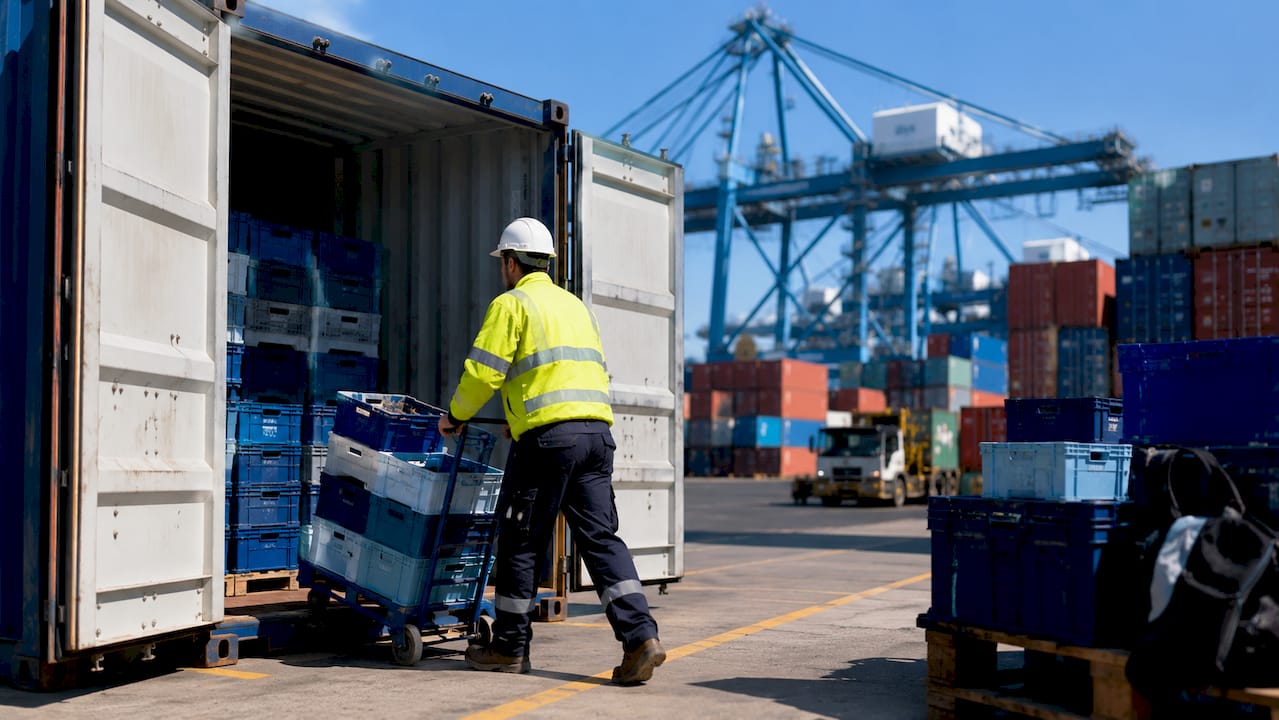
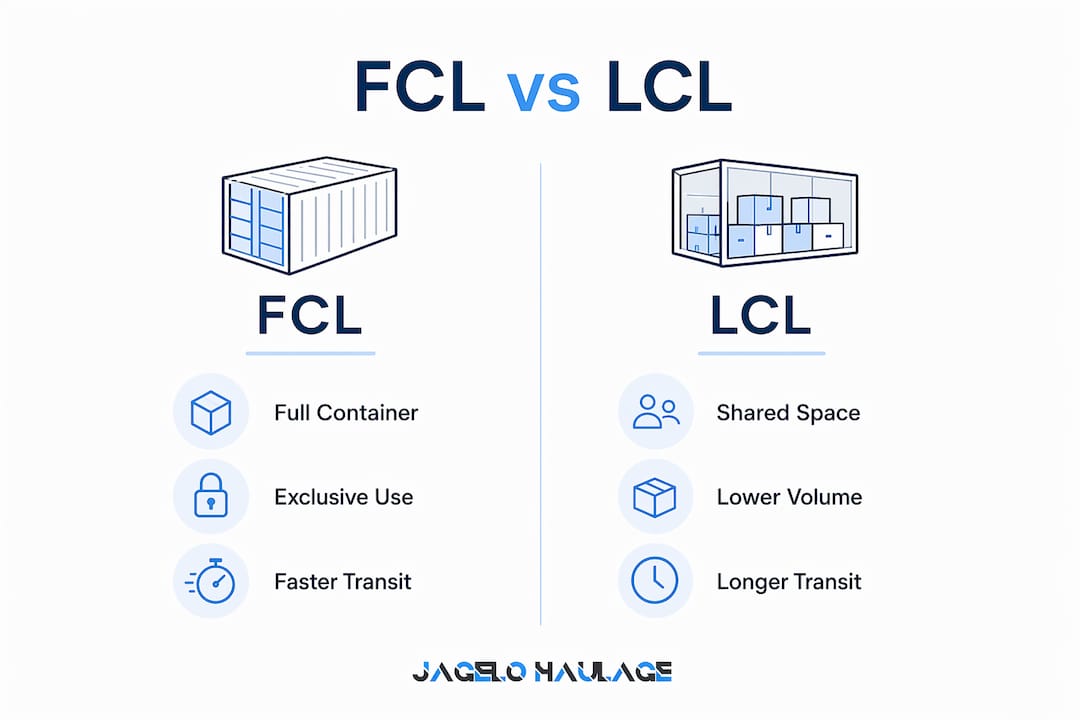
A full container load (FCL) is defined as an ocean freight arrangement where a single shipper reserves an entire shipping container exclusively for their own cargo. The term “full” is deliberately misleading: the container need not be physically full to qualify as FCL. The shipper pays for exclusive use of the container space, not for a percentage of physical fill. FCL shipping underpins distinct advantages in transit speed, cargo security, and supply chain control that shared shipping alternatives cannot match. Understanding what is a full container load, and when to use it, is a foundational decision for any business moving significant freight volumes internationally.
How does full container load shipping work?
The FCL shipping process follows a defined sequence of steps, each with specific operational and regulatory requirements.
-
Booking and reservation. The shipper contacts a freight forwarder or shipping line to reserve a container on a specific vessel departure. Standard container sizes are 20-foot (TEU) and 40-foot (FEU) units. The booking confirms the container type, estimated departure, and port of loading.
-
Container drayage to origin. Once the booking is confirmed, the empty container is transported by road to the shipper’s factory or warehouse. This drayage leg is a vital link in the full load shipping process, connecting the port to the point of loading.
-
Loading and sealing. The shipper’s team loads the cargo directly into the container. Once loading is complete, the container is secured with a high-security bolt seal, which acts as a tamper-evident device. Breaking or replacing the seal without authorisation indicates potential interference.
-
Vessel loading and ocean transit. The sealed container is transported back to the port and loaded onto the vessel. The container remains sealed throughout the ocean voyage, with no intermediate handling of the cargo itself.
-
Customs clearance at destination. On arrival, customs authorities inspect the seal integrity before clearing the container. A broken or missing seal triggers a formal inspection. Regulatory compliance at this stage depends on accurate documentation, including the bill of lading and commercial invoice.
-
Final delivery to consignee. After customs clearance, the container is transported by road to the consignee’s warehouse or distribution centre, where it is unloaded and the container returned to the shipping line.
The maximum payload capacity of a standard 20-foot container is approximately 26–28 tonnes. Exceeding this limit risks fines, vessel loading refusals, and structural damage to the container itself.
Pro Tip: Always confirm the verified gross mass (VGM) of your loaded container before port cut-off. Shipping lines require VGM declarations under SOLAS regulations, and non-compliance can result in the container being offloaded from the vessel.
What are the cost and time advantages of FCL over LCL?
FCL and less than container load (LCL) serve different volume profiles, and choosing the wrong method carries real cost and time penalties.
When FCL becomes cost-competitive
FCL becomes cost-competitive at approximately 13–15 cubic metres (CBM) of cargo volume. Below that threshold, LCL typically offers a lower headline price because the shipper pays only for the space their cargo occupies within a shared container. Above 15 CBM, the FCL flat rate delivers a lower cost per cubic metre than LCL pricing, which scales linearly with volume.
Hidden costs in LCL such as consolidation fees, de-consolidation charges, and cargo handling surcharges frequently erode the apparent price advantage. Logistics managers who map total landed cost rather than freight rate alone consistently find FCL more economical for bulk shipments.
Transit time differences
FCL is generally 5–10 days faster than LCL on equivalent routes. The reason is structural: LCL shipments must be consolidated at origin with other shippers’ cargo and de-consolidated at destination before delivery can proceed. FCL containers bypass both stages entirely, moving directly from origin to destination without intermediate handling.
That speed advantage compounds when you factor in scheduling certainty. LCL consolidation windows depend on other shippers filling the shared container, which introduces variability. FCL departures follow fixed vessel schedules, giving you reliable estimated time of arrival (ETA) data for production planning and inventory management.
FCL vs LCL: key metrics compared
| Metric | FCL | LCL |
|---|---|---|
| Cost efficiency | Better above 15 CBM | Better below 13 CBM |
| Transit time | 5–10 days faster | Slower due to consolidation |
| Cargo handling | Factory load and final unload only | Multiple handling stages |
| Hidden charges | Minimal | Consolidation and handling fees common |
| Schedule certainty | Fixed vessel departure | Dependent on consolidation window |
| Security | Sealed container, single shipper | Shared space, multiple touchpoints |
Efficient bulk container haulage planning starts with an honest volume assessment. Businesses that regularly ship above 15 CBM and treat LCL as the default option are paying a premium for a service that no longer fits their freight profile.
Pro Tip: Request a total cost breakdown from your freight forwarder that includes origin charges, destination handling, and any surcharges for both FCL and LCL options. The headline freight rate rarely tells the full story.
How does FCL reduce shipment risk and improve cargo security?
FCL is not simply a volume-driven choice. It is a risk management strategy that protects cargo by reducing the number of times it is physically handled.
Fewer touchpoints mean less damage
FCL minimises cargo damage by limiting handling to two events: factory loading at origin and warehouse unloading at destination. LCL shipments pass through consolidation warehouses at both ends of the journey, where cargo is moved, stacked, and repositioned alongside other shippers’ goods. Each additional handling event is an opportunity for damage, loss, or misplacement.
Seal integrity as a security control
The high-security bolt seal applied at the point of loading is the primary security control for an FCL shipment. Customs authorities at the destination port inspect the seal number against the shipping documentation. Any discrepancy triggers a physical inspection of the container contents. This process creates a clear chain of custody from origin to destination.
Key risk management benefits of FCL include:
- Reduced theft exposure. Cargo in a sealed, single-shipper container is not accessible to warehouse staff at consolidation facilities.
- Clearer liability. Because only one shipper’s goods occupy the container, responsibility for damage is straightforward to attribute and claim against.
- Contamination prevention. Pharmaceutical, food-grade, and chemical shipments avoid cross-contamination risks that arise in shared containers.
- Customs compliance. A single shipper’s documentation covers the entire container, reducing the risk of delays caused by another shipper’s paperwork errors.
Buyer’s consolidation as a strategic alternative
Buyer’s consolidation allows businesses sourcing from multiple suppliers to aggregate shipments into one full container load. Rather than booking separate LCL shipments from each supplier, the buyer arranges for all goods to be moved to a single consolidation point before the container is sealed. The result is FCL security and pricing on a multi-supplier cargo profile. This approach is particularly effective for importers working with several factories in the same manufacturing region.
For businesses managing UK port logistics, understanding how container security integrates with port procedures at Felixstowe, Tilbury, Southampton, and Liverpool is critical to maintaining supply chain control.
Who should choose full container load shipping?
FCL is the right choice for a specific set of cargo profiles and business conditions. The decision is not purely about volume.
Businesses that benefit most from FCL shipping share several characteristics:
- Volume above 15 CBM per shipment. At this threshold, FCL flat-rate pricing delivers a lower cost per cubic metre than LCL alternatives.
- High-value or fragile cargo. Electronics, machinery, glassware, and luxury goods justify the FCL premium because reduced handling directly lowers damage and loss rates.
- Time-sensitive supply chains. Businesses with fixed production schedules or retail replenishment windows need the scheduling certainty that FCL vessel bookings provide.
- Hazardous or regulated goods. Chemicals, pharmaceuticals, and food products often require dedicated container space to meet regulatory and safety requirements.
- Frequent, predictable shipment patterns. Regular shippers who can forecast volumes accurately gain the most from FCL rate negotiations with shipping lines.
One persistent misconception about FCL is that the container must be physically full to justify the booking. The shipper pays for exclusive space, not for fill percentage. A business shipping 18 CBM in a 20-foot container is still making a sound FCL decision if the cargo is high-value or time-sensitive, even though the container is not physically full.
A second misconception concerns fee structures. Some logistics managers assume FCL always carries a higher total cost than LCL. FCL offers better supply chain exclusivity and time certainty, and when hidden LCL charges are factored in, FCL frequently proves more economical for shipments above the 15 CBM threshold.
Operational planning also matters. Businesses that maintain well-managed logistics yards, including reliable fuel supply for their transport fleets, tend to achieve better freight yard efficiency and fewer delays at the point of container collection and return.
Key takeaways
FCL shipping is the most cost-effective and secure freight method for businesses moving more than 15 CBM per shipment, offering faster transit, lower handling risk, and greater supply chain control than LCL alternatives.
| Point | Details |
|---|---|
| FCL definition | A single shipper reserves an entire container exclusively, regardless of physical fill level. |
| Cost threshold | FCL becomes cost-competitive above approximately 15 CBM per shipment. |
| Transit speed | FCL is typically 5–10 days faster than LCL due to no consolidation stages. |
| Security advantage | Sealed containers with bolt seals limit handling to two events, reducing damage and theft risk. |
| Buyer’s consolidation | Businesses sourcing from multiple suppliers can aggregate shipments to access FCL benefits. |
FCL in practice: what most guides get wrong
The logistics industry has a habit of framing the FCL versus LCL decision as a simple volume calculation. In my experience, that framing causes businesses to leave money and security on the table.
The volume threshold of 13–15 CBM is a useful starting point, but it is not the whole picture. I have seen high-value electronics shipments of 10 CBM booked as FCL because the cost of a single damaged pallet far exceeded the FCL premium. The risk calculus matters as much as the cubic metre count.
The other issue I see repeatedly is the underestimation of LCL’s hidden costs. Consolidation fees, destination handling charges, and delays caused by other shippers’ documentation problems are rarely visible in the initial quote. By the time the final invoice arrives, the apparent LCL saving has often evaporated. Logistics managers who map total landed cost rather than headline freight rate make better decisions consistently.
The trend I am watching in 2026 is the growing use of buyer’s consolidation among mid-sized importers. As sourcing from multiple Asian factories becomes standard practice, the ability to aggregate shipments into a single sealed container is a genuine competitive advantage. It delivers FCL security and pricing without requiring a single supplier to fill the box alone. For UK businesses managing port-to-door movements through Felixstowe or Southampton, this approach is worth serious consideration.
— Vytautas
Jhaulage: container haulage specialists for UK FCL freight
Jagelo Haulage Limited provides dedicated container haulage services across the UK’s major ports, including Felixstowe, Tilbury, Southampton, and Liverpool. With a fleet of over 40 GPS-tracked trucks and trailers, Jhaulage delivers the scheduling reliability and cargo security that FCL shipments demand.
Whether you are managing regular FCL imports, coordinating buyer’s consolidation, or require same-day port collection, Jhaulage offers 24/7 support and port-to-door delivery tailored to your freight requirements. Contact Jhaulage to discuss your container haulage needs and receive a direct quote from a team with proven expertise in UK port logistics.
FAQ
What is a full container load in shipping?
A full container load (FCL) is an ocean freight arrangement where one shipper reserves an entire container exclusively for their cargo. The container need not be physically full; the shipper pays for exclusive use of the space.
What is the difference between FCL and LCL?
FCL gives a single shipper exclusive use of a container, while LCL shares container space among multiple shippers. FCL is typically faster by 5–10 days and more cost-effective above approximately 15 CBM per shipment.
What is the maximum weight for an FCL container?
A standard 20-foot FCL container has a maximum payload capacity of approximately 26–28 tonnes. Exceeding this limit risks fines, vessel loading refusals, and potential structural damage.
When does FCL become cheaper than LCL?
FCL becomes cost-competitive at approximately 13–15 CBM of cargo volume. Above this threshold, the FCL flat rate delivers a lower cost per cubic metre than LCL pricing, particularly when consolidation and handling fees are included in the total cost calculation.
Can I book FCL if my cargo does not fill the container?
Yes. FCL is a booking arrangement for exclusive container space, not a requirement to fill the container physically. Businesses regularly book FCL for partially loaded containers when cargo value, security requirements, or scheduling certainty justify the cost.
Recommended
- How containers are loaded onto trucks: 2026 guide | Jagelo Haulage
- What is Container Haulage? A Comprehensive Guide to UK Port Logistics | Jagelo Haulage
- Logistics for Shipping Containers: A Comprehensive Guide to UK Port Transport | Jagelo Haulage
- Heavy Container Haulage: A Strategic Reference Guide for UK Logistics 2026 | Jagelo Haulage