How containers are loaded onto trucks: 2026 guide
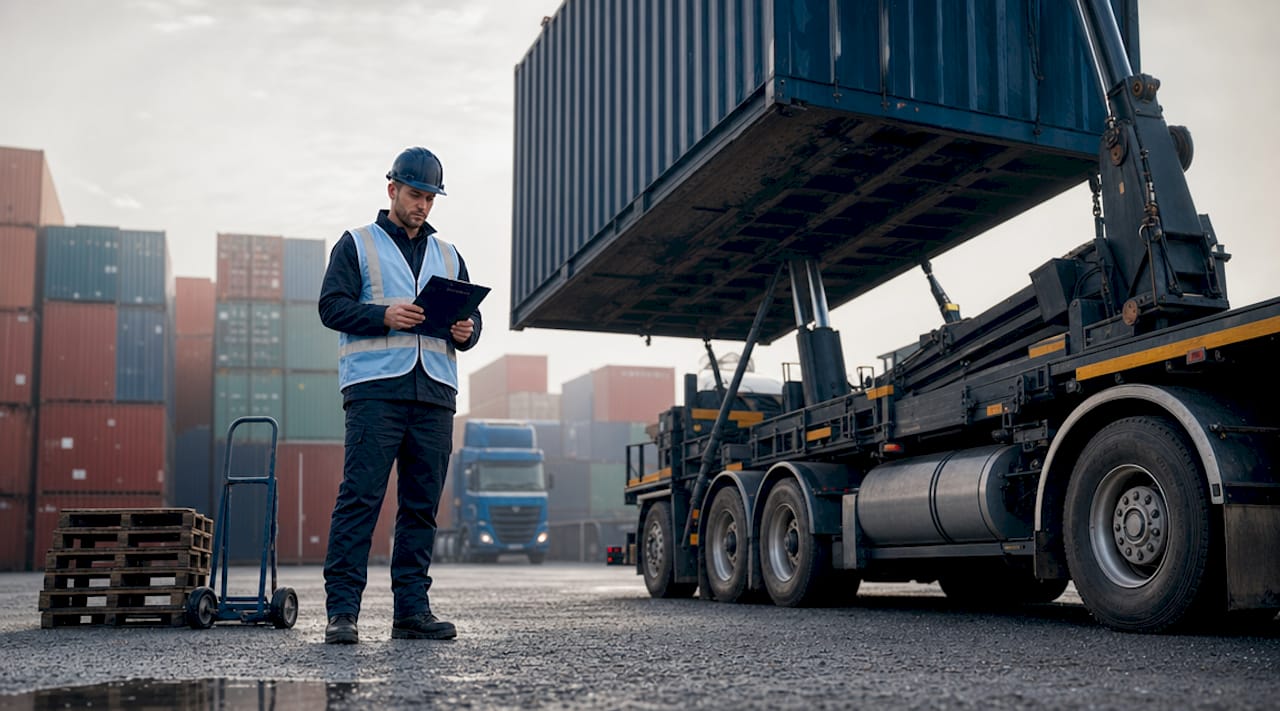
Container loading onto trucks is defined as the mechanical process of lifting, positioning, and securing ISO shipping containers onto road vehicles using specialised equipment that engages standardised corner castings. The primary methods employed across UK freight operations include sidelifter trucks with hydraulic arms, lorry-mounted Hiab cranes, and fixed port cranes, each requiring specific site conditions, vehicle configurations, and securement protocols. Understanding how containers are loaded onto trucks is not optional knowledge for logistics professionals. It directly determines equipment selection, site planning, compliance with transport regulations, and the prevention of costly load failures in transit.
What are the main methods and equipment used for loading containers onto trucks?
The container loading process relies on three principal equipment types, each suited to distinct operational environments and site constraints. Selecting the correct method before a vehicle departs the yard prevents costly delays, repositioning, and compliance failures at the point of delivery.
1. Sidelifter trucks
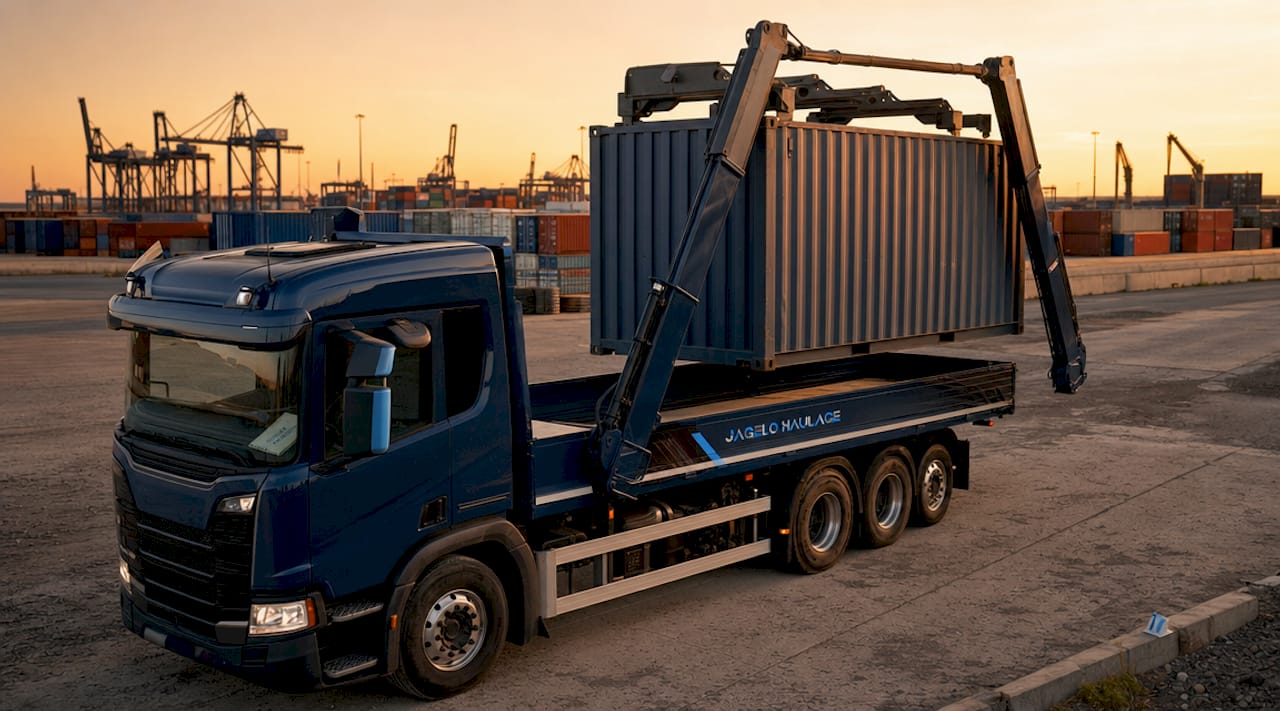
A sidelifter is a self-contained loading vehicle fitted with hydraulically controlled lifting arms on each side of the chassis. The sidelifter loading sequence begins with vehicle stabilisation via outriggers, followed by arm deployment, twist-lock engagement at the container’s ISO corner castings, vertical lifting, lateral swing over the chassis, and final locking. This sequence enables single-operator container handling without external crane support, making sidelifters particularly valuable for off-port deliveries where no lifting infrastructure exists.
2. Lorry-mounted Hiab cranes
In UK freight operations, Hiab cranes with stabilisers are the most common method for side-loading containers at customer premises. The vehicle is positioned parallel to the placement area, stabilisers are deployed onto firm ground, and the crane lifts the container off the trailer and places it onto prepared hardstanding. Hiab cranes offer greater reach flexibility than sidelifters but require a trained operator and sufficient overhead clearance, typically a minimum of 6 metres for a standard 20-foot container lift.
3. Fixed port cranes and reach stackers
At major UK ports including Felixstowe, Tilbury, Southampton, and Liverpool, fixed gantry cranes and reach stackers handle the bulk of container transfers between vessels and road vehicles. These machines operate at high throughput speeds but are confined to port infrastructure. Once a container leaves the port gate, road-based lifting equipment takes over.
4. Roll-off trailers
Roll-off or tilt-deck trailers allow containers to be loaded by tilting the trailer bed and winching the container into position. This method suits empty or lightly loaded containers and locations where crane access is restricted.
Pro Tip: Before dispatching a vehicle, confirm the destination site has adequate hardstanding for stabiliser deployment and at least 6 metres of overhead clearance. A site survey conducted in advance eliminates the most common cause of failed deliveries.
How are containers securely fastened to trucks for safe transport?
Container securement is governed by a formal mechanical system, not a discretionary arrangement of straps and ropes. NSC Standard 10 mandates that loaded containers must be secured to the chassis using chains, wire rope, or integral locking devices such as twist locks. Synthetic webbing straps alone are non-compliant for loaded containers, a point frequently misunderstood in mixed-fleet operations. This distinction matters because a failed inspection or a load shift in transit carries both financial and legal consequences.
Twist locks: the primary securing device
Twist locks engage the ISO corner fittings at the base of every shipping container, providing a mechanical connection between the container and the trailer chassis. Manual twist locks require the operator to rotate the locking head by hand after the container is seated. Semi-automatic twist locks engage automatically under the container’s weight via spring action and are disengaged manually during unloading, reducing the need for operators to work at height during the loading phase. This design improvement meaningfully reduces handling risk on busy freight yards.
Chains and wire rope as supplementary securement
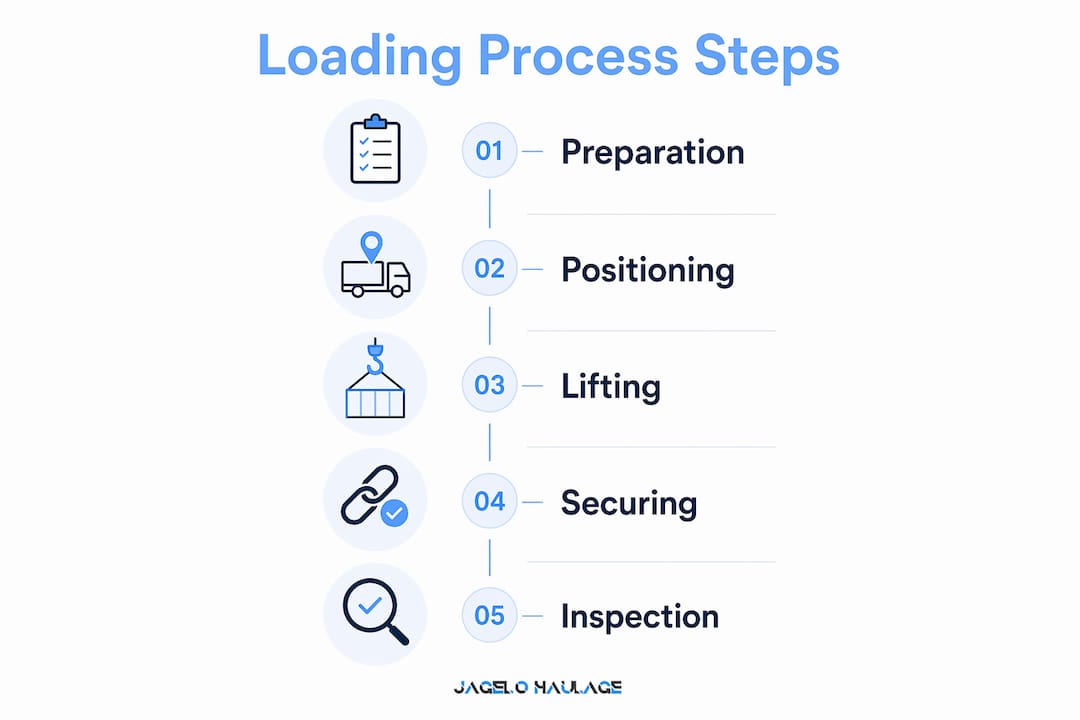
For loaded containers, chains and wire rope provide the compliance layer required beyond twist locks alone. These tie-downs are rated by working load limit (WLL) and must be calculated against the container’s gross weight. The securement verification steps include confirming stable ground support for stabilisers, verifying parallel vehicle positioning relative to the container, checking twist-lock engagement at all four corners, and completing a final visual inspection before departure.
Empty vs loaded container securing
Empty and loaded containers require different securing approaches. Empty containers on tilt-deck trailers may use twist locks alone, as the reduced mass presents lower inertial risk. Loaded containers require chains or integral locking devices in addition to twist locks to meet compliance standards and prevent shifting under braking or cornering forces.
| Securing method | Compliance status | Typical application |
|---|---|---|
| Twist locks (integral) | Fully compliant | All loaded and empty containers on chassis |
| Chains and wire rope | Fully compliant | Loaded containers requiring supplementary tie-down |
| Synthetic webbing straps | Non-compliant for loaded containers | Empty containers only, with restrictions |
| Tilt-deck with twist locks | Compliant for empty containers | Off-port delivery of unloaded units |
Pro Tip: Treat twist locks as a formal securement system, not a convenience feature. Verifying engagement at all four ISO corner fittings before departure takes under two minutes and prevents the most common category of load securement failures.
What operational considerations affect container loading onto trucks?
Site geometry and ground conditions are the two factors that most frequently determine whether a planned container loading operation succeeds or requires costly rescheduling. Equipment choice must be integrated with site access and route engineering rather than made as an ad-hoc decision at the point of delivery. The following considerations apply across UK logistics operations:
- Ground conditions and hardstanding: Stabiliser legs on Hiab cranes and sidelifters require firm, level ground capable of bearing point loads exceeding several tonnes. Soft ground, gravel, or uneven surfaces require spreader plates and may render certain equipment types unsuitable.
- Access width and overhead clearance: Side-loading with a Hiab crane requires the vehicle to position parallel to the container, demanding a clear working width of approximately 8 to 10 metres depending on crane reach and container size. Overhead obstructions including power lines, trees, and building eaves must be assessed before arrival.
- Site geometry and container rotation: Containers can be rotated up to 90 degrees during placement to fit site constraints, but this requires additional crane reach and a larger working radius. Yard planning should account for this possibility when positioning containers for collection.
- Vehicle and trailer type: Articulated units offer greater payload capacity and are standard for port haulage. Rigid vehicles and wagon-and-drag combinations suit tighter urban sites where articulated manoeuvrability is limited. The trailer type, whether skeletal, flatbed, or tilt-deck, determines which securing methods are available.
- Route planning: Abnormal load considerations, bridge weight restrictions, and low-clearance routes must be assessed when transporting 40-foot high-cube containers, which exceed standard height limits on certain UK road networks.
What is container loading supervision (CLS) and why does it matter?
Container loading supervision (CLS) is a formal quality control process in which an independent inspector monitors and documents every stage of the container loading operation, from pre-loading inspection through to sealing and documentation. CLS transforms the loading process from a best-effort activity into a repeatable, auditable quality control procedure, reducing damage claims and regulatory risk for all parties in the supply chain.
The standard CLS process covers the following stages:
- Pre-loading inspection: The inspector verifies the condition of the container itself, checking for structural damage, moisture ingress, contamination, and the integrity of door seals before any cargo is loaded.
- Goods and packaging verification: Cargo is checked against the packing list for quantity, condition, and packaging adequacy before it enters the container.
- Supervised loading arrangement: The inspector monitors the physical placement of goods within the container, verifying weight distribution, dunnage use, and compliance with any hazardous goods requirements.
- Sealing and documentation: Once loading is complete, the inspector oversees container sealing and completes the documentation package, creating an auditable quality record that supports downstream claims management and customs compliance.
CLS is particularly valuable for high-value cargo, perishable goods, and shipments subject to letter of credit requirements where documentary evidence of loading condition is contractually mandated. For logistics managers, the paper trail generated by CLS is a direct risk management tool.
How do container loading methods compare in efficiency and applicability?
Selecting the correct loading method requires weighing setup time, site requirements, operator skill, and cost against the operational context. The table below summarises the principal methods used in UK freight operations.
| Method | Setup time | Site requirements | Best application | Operator skill level |
|---|---|---|---|---|
| Sidelifter truck | 10 to 15 minutes | Firm ground, 8m working width | Off-port delivery, no crane infrastructure | Specialist trained |
| Hiab crane (lorry-mounted) | 5 to 10 minutes | Firm ground, 6m overhead clearance | Customer premises, urban delivery | Hiab-certified operator |
| Fixed port crane / reach stacker | Under 5 minutes | Port infrastructure only | High-volume port transfers | Port-qualified operator |
| Roll-off / tilt-deck trailer | 10 to 20 minutes | Level ground, winch access | Empty containers, restricted access sites | Standard HGV driver |
Sidelifters offer the greatest operational independence, as they carry their own lifting capability and require no external infrastructure. Hiab cranes are faster to deploy and more widely available across UK haulage fleets, making them the default choice for most container haulage at UK ports and customer delivery points. Fixed port cranes deliver the highest throughput but are entirely site-dependent. Roll-off trailers serve a specific niche where crane access is unavailable and the container is empty or lightly loaded.
The cost differential between methods is significant. Sidelifter hire typically commands a premium over standard Hiab-equipped vehicles, reflecting the specialist equipment and operator certification required. For logistics planners, the decision should be driven by site constraints first and cost second, as a failed delivery attempt costs more than the premium for the correct equipment.
Key takeaways
Effective container loading onto trucks requires matching the correct lifting equipment to site conditions, applying compliant mechanical securement at all four ISO corner fittings, and integrating supervision processes that generate auditable documentation.
| Point | Details |
|---|---|
| Equipment selection is site-driven | Choose between sidelifters, Hiab cranes, and port machinery based on ground conditions and access width, not cost alone. |
| Twist locks are a compliance requirement | Engage twist locks at all four ISO corner fittings and supplement with chains or wire rope for loaded containers per NSC Standard 10. |
| Synthetic straps are non-compliant | Webbing straps alone do not meet securement standards for loaded containers and will fail inspection. |
| CLS creates auditable quality records | Container loading supervision reduces damage claims and supports customs and letter of credit documentation requirements. |
| Site planning prevents failed deliveries | Confirm hardstanding, overhead clearance, and access width before dispatch to avoid costly repositioning. |
What I have learned from years of container loading operations
The most persistent problem I observe in container loading operations is not equipment failure. It is the assumption that a container is secure because it looks secure. Twist locks that appear engaged but have not fully rotated, chains with insufficient WLL for the container’s gross weight, and sites assessed by phone rather than physical survey account for the majority of preventable incidents I have encountered.
The secure container transport checklist exists precisely because verbal confirmation is not a substitute for physical verification. In my experience, operations that treat the four-corner twist-lock check as a non-negotiable departure procedure, rather than an optional step, have materially fewer incidents and faster turnaround times at delivery points.
Site planning is the other area where I see consistent underinvestment. Sending an articulated Hiab vehicle to a site with a narrow access road and soft ground is not a logistics decision. It is a rescheduling decision made at the worst possible time. Mixed fleet operations that integrate fleet management best practices into their pre-dispatch workflow, matching vehicle type and lifting method to confirmed site data, consistently outperform those that treat equipment selection as a last-minute call.
Training matters more than most operators acknowledge. A Hiab-certified driver who understands load securement calculations and can read a site for stabiliser placement is worth considerably more to a container haulage operation than one who simply holds the licence. Investing in that depth of competence pays back in reduced claims, faster operations, and fewer compliance failures.
— Vytautas
How Jhaulage supports compliant container loading and transport
Jhaulage operates a modern fleet of over 40 trucks and trailers across major UK ports including Felixstowe, Tilbury, Southampton, and Liverpool, providing specialist container haulage with full compliance across securement and loading best practices. Every vehicle in the Jhaulage fleet is GPS-tracked, and operations are supported by 24/7 logistics coordination to manage port bookings, site surveys, and same-day delivery requirements. For freight forwarders, shipping operators, and supply chain managers who need a dependable container haulage partner with the equipment, training, and compliance knowledge to handle every loading scenario, Jhaulage delivers the precision and reliability your cargo demands. Contact Jhaulage today to discuss your container transport requirements.
FAQ
What equipment is used to load containers onto trucks?
The primary equipment types are sidelifter trucks with hydraulic arms, lorry-mounted Hiab cranes, fixed port gantry cranes, and roll-off tilt-deck trailers. Equipment selection depends on site conditions, container weight, and available infrastructure.
Are synthetic webbing straps sufficient to secure a loaded container?
No. NSC Standard 10 requires loaded containers to be secured using chains, wire rope, or integral locking devices such as twist locks. Synthetic webbing straps alone are non-compliant for loaded container transport.
How do semi-automatic twist locks work?
Semi-automatic twist locks engage automatically under the container’s weight via spring action when the container is lowered onto the chassis. They are released manually by the operator during unloading, reducing the need to work at height during the loading phase.
What is container loading supervision (CLS)?
CLS is a formal inspection process in which an independent supervisor monitors and documents the entire loading operation, from pre-loading container inspection through to sealing and paperwork completion, creating an auditable record that supports claims management and customs compliance.
What site conditions are required for Hiab crane container loading?
Hiab crane loading requires firm, level hardstanding capable of bearing stabiliser point loads, a working width of approximately 8 to 10 metres for parallel vehicle positioning, and a minimum overhead clearance of around 6 metres for standard container lifts.
Recommended
- Heavy Container Haulage: A Strategic Reference Guide for UK Logistics 2026 | Jagelo Haulage
- Road Haulage for Containers: A Professional Guide to UK Port Logistics | Jagelo Haulage
- The Professional Guide to Cost-Effective Container Haulage in 2026 | Jagelo Haulage
- Secure container load for transport: the UK guide | Jagelo Haulage