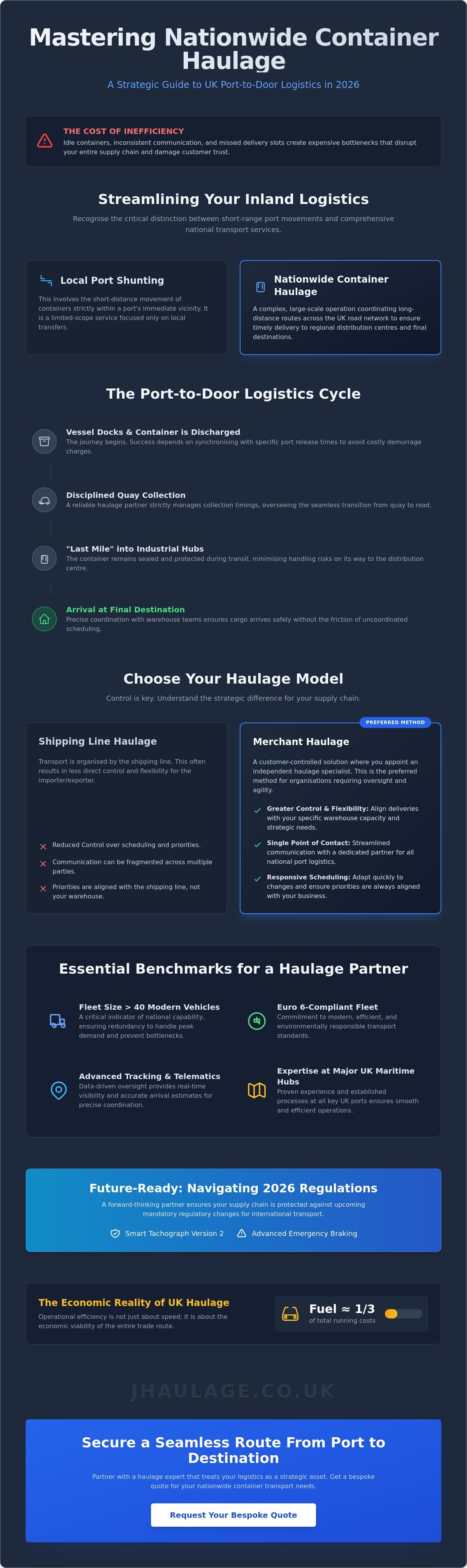
A shipping container sitting idle at a port isn't just a delay; it's a direct threat to your warehouse efficiency and customer trust. You recognise that the final leg of the journey is often the most volatile. Inconsistent communication and missed delivery slots create expensive bottlenecks that disrupt your entire supply chain. This guide provides the technical clarity you need to master nationwide container haulage in 2026, ensuring your goods move from the quay to the destination with disciplined precision.
We'll examine the operational mechanics of port-to-door logistics and the impact of new 2026 regulations, such as the mandatory fitting of Smart Tachograph Version 2 for international transport. You'll learn how to manage the complexities of UK-wide transport, from the mechanics of merchant haulage to the implementation of Advanced Emergency Braking systems. This article outlines the essential benchmarks for choosing a transport partner that prioritises your operational security and treats your logistics as a strategic asset. By the end of this guide, you'll understand how to secure a seamless route from port to destination whilst maintaining consistent communication across your supply chain.
Key Takeaways
- Recognise the distinction between local port shunting and comprehensive transport services to streamline your inland logistics.
- Evaluate why a fleet size of over 40 modern, Euro 6-compliant vehicles is a critical indicator of a provider's national capability.
- Learn how merchant haulage offers greater flexibility and a single point of contact compared to shipping line-controlled logistics.
- Identify the essential benchmarks for a nationwide container haulage partner, including proven expertise at major UK maritime hubs and professional communication standards.
- Gain technical clarity on the 2026 regulatory landscape to maintain a protected and efficient supply chain from port to door.
Defining Nationwide Container Haulage and its Role in the UK Supply Chain
Container haulage serves as the essential link between the UK's major maritime gateways and the final inland destination. It transforms the arrival of a vessel into a functional delivery. Whilst some providers focus solely on local port shunting, which is the short-distance movement of containers within a port's immediate vicinity, nationwide container haulage involves a more complex operational scope. This service requires the coordination of long-distance routes across the UK road network to ensure goods reach regional distribution centres on schedule. It demands a higher level of planning and equipment reliability to manage the variables of national transit.
Professional road haulage remains the primary choice for secure, large-scale movement. It provides a direct, point-to-point solution that minimises the risks associated with cargo handling. This process is a fundamental component of intermodal freight transport, allowing the container to remain sealed and protected from the moment it leaves the vessel until it reaches the warehouse floor. Efficient national transport operations support the broader UK economy by maintaining supply chain stability. They prevent the costly bottlenecks that occur when port clearances aren't matched by available road capacity. With fuel accounting for approximately one-third of running costs in UK haulage, operational efficiency isn't just about speed; it's about the economic viability of the entire trade route.
The Port-to-Door Logistics Cycle
The journey begins once a vessel docks and the container is discharged. Success depends on synchronising the collection with specific port release times. Delays at this stage often lead to demurrage charges or increased port fees, such as the Energy Adjustment Mechanism at DP World locations. A disciplined haulage partner manages these timings strictly. They oversee the transition from the quay through the "last mile" into industrial hubs. This ensures the cargo arrives safely at its final destination without the friction of uncoordinated scheduling.
Merchant vs. Shipping Line Haulage: An Introduction
Businesses generally choose between shipping line haulage or merchant haulage. Merchant haulage is a customer-controlled transport solution where the importer or exporter appoints an independent contractor. Many organisations now prefer this method for better oversight and flexibility. Using an independent specialist like Jagelo Haulage provides a single point of contact for all national port logistics. This approach allows for more responsive scheduling and a deeper understanding of the specific strategic requirements of your supply chain. It moves the control of the final leg back into the hands of the business, ensuring that delivery priorities align with warehouse capacity rather than shipping line availability.
The Infrastructure and Equipment Behind National Container Transport
Operational reliability in nationwide container haulage depends entirely on the quality and scale of the physical fleet. A provider operating more than 40 modern vehicles offers the redundancy required to handle peak demands without compromising on schedule integrity. Fleet size serves as a critical indicator of a provider's national capability; it ensures that if a vehicle requires unscheduled maintenance, a replacement is available to keep your cargo moving. This level of capacity is essential for businesses that cannot afford warehouse bottlenecks caused by a single point of failure in their logistics chain.
Advanced tracking and telematics systems provide the technical oversight necessary for managing long-distance routes. These tools allow for real-time visibility, ensuring that transport managers can monitor progress and provide accurate arrival estimates. This data-driven approach maintains schedule integrity across the UK's road network, allowing for precise coordination with your warehouse teams. According to Logistics UK's annual report, the industry continues to face rising operational costs, making fleet efficiency and technological integration primary differentiators for reliable service. Securing a bespoke haulage quote allows you to align these technical capabilities with your specific delivery requirements.
Specialised Trailer Technology
The use of sliding skeletal trailers is a fundamental requirement for versatile national transport. These trailers adjust to accommodate various container lengths, including 20ft, 40ft, and 45ft units. This flexibility is vital when delivering to tight industrial centres or warehouses with limited turning circles. By adjusting the trailer length, drivers can navigate restricted spaces more safely and efficiently. Regular maintenance and safety checks on this specialised equipment prevent mechanical failures during transit, ensuring that high-value or heavy cargo remains protected throughout its journey.
The Importance of a Modern Fleet
A modern fleet is defined by its compliance with the latest environmental and safety standards. Euro 6 compliant trucks are essential for reducing environmental impact whilst maintaining the high performance needed for heavy container transport. These vehicles also ensure access to Clean Air Zones across the UK without incurring additional penalties. In 2026, the introduction of mandatory Advanced Emergency Braking (AEB) systems and stricter Direct Vision Standard (DVS) requirements further emphasizes the need for up-to-date equipment. Older fleets correlate directly with a higher likelihood of transit delays and breakdowns. Professional fleet management ensures that every vehicle in a nationwide container haulage operation is fitted with the necessary safety features, such as Smart Tachograph Version 2, to meet 2026 regulatory deadlines and provide a secure transport solution.
Strategic Benefits of Merchant Haulage for National Distribution
Choosing merchant haulage for your nationwide container haulage requirements is a strategic decision that shifts control from the carrier to the cargo owner. It eliminates the rigid scheduling often associated with shipping line operations. This model allows for a more integrated approach to logistics, aligning transport precisely with your internal warehouse capacity. By selecting an independent partner, you secure a dedicated transport desk that understands the specific nuances of your supply chain. Direct control over transport scheduling reduces the risk of costly disruptions and helps manage port-specific surcharges, such as the Energy Adjustment Mechanism fees at DP World ports, by ensuring timely collections.
Research into the Future of UK Supply Chains highlights that resilience and security are paramount for national prosperity. Merchant haulage supports this by providing a single point of contact for all national port logistics. You don't have to navigate the complex administrative layers of multiple shipping lines. Instead, you manage your inland distribution through a disciplined partner that prioritises your specific delivery windows. This strategic oversight ensures that your transport operations remain a functional asset rather than a logistical bottleneck.
Enhanced Control and Visibility
Integrating haulage into your broader strategy improves inventory management. It allows for the implementation of precise "Just-in-Time" delivery models. Real-time communication with a dedicated transport desk ensures you're informed of any port-side developments immediately. This visibility is essential for managing the high stakes of modern retail and industrial supply chains. You can adjust delivery priorities based on actual warehouse stock levels rather than external carrier constraints. This level of responsiveness is only possible when you have direct oversight of your nationwide container haulage provider.
Cost-Effectiveness on a National Scale
Ad-hoc bookings often lead to higher costs and unpredictable service levels. A dedicated national partner provides a more stable financial framework for your logistics. You avoid the hidden inefficiencies and potential delays inherent in shipping line-controlled models. For a detailed breakdown of the financial considerations involved, consult our guide on Understanding Container Transport Costs: A Comprehensive UK Buying Guide for 2026. This strategic approach ensures that your transport budget is utilised effectively to maintain a consistent and protected flow of goods across the country, whilst avoiding the rigid structures of standard carrier agreements.
Key Considerations for Selecting a Reliable National Haulage Partner
Selecting a partner for nationwide container haulage is a critical risk-management decision. You need a provider with established experience at major UK maritime hubs such as Felixstowe, London Gateway, and Southampton. A firm that understands the specific entry protocols and local infrastructure of these ports can prevent avoidable delays. In a volatile logistics market, a track record of 15 years or more serves as a reliable indicator of operational stability. It demonstrates a provider's ability to navigate shifting fuel costs and regulatory changes whilst maintaining consistent service levels for their clients. This historical competence provides the security you need when committing to long-term supply chain contracts.
Security protocols and comprehensive insurance coverage are non-negotiable requirements for nationwide transit. You must ensure your partner has the financial and operational capacity to protect high-value cargo over long distances. This includes robust vehicle security and a disciplined approach to route planning that avoids high-risk areas. Evaluating these factors allows you to transition from a simple service arrangement to a strategic partnership that secures your supply chain. You can request a professional haulage quote to assess how these standards align with your specific operational needs.
Operational Reliability and Safety Standards
Reliability is built on a foundation of strict safety standards and continuous training. You should verify that a provider invests in Driver CPC training and holds relevant industry certifications. These benchmarks ensure that drivers are equipped to handle various container types and weights safely. Disciplined operational management is necessary to meet on-time delivery targets consistently. It involves rigorous maintenance schedules for the fleet and a protocol-driven approach to every collection and delivery. This methodical focus on the fundamentals is what prevents transit failures and protects your warehouse schedule. It's the difference between a reactive service and a proactive logistics solution.
Communication and Professionalism
Professional haulage firms use clear, declarative communication to provide factual updates on your cargo's status. They don't rely on vague promises or marketing jargon. Instead, they provide specific information regarding transit times and potential challenges. A reliable partner handles unforeseen delays, such as port congestion or road closures, by providing immediate notifications and alternative solutions. This no-nonsense, corporate approach to logistics management reflects a serious commitment to your business outcomes. It ensures that you're never left without the information needed to manage your internal operations effectively. When you choose a provider that values discipline, you're choosing a partner that understands the high stakes of nationwide container haulage.
Ensuring Operational Excellence with Jagelo Haulage
Jagelo Haulage provides a disciplined framework for nationwide container haulage across the United Kingdom. We've spent over 15 years refining our operational protocols to ensure every delivery meets the highest standards of professional competence. Our team understands that haulage is not merely a task; it's a critical component of your broader corporate strategy. This experience allows us to navigate the complexities of the 2026 logistics environment with quiet confidence and functional reliability. We focus on the fundamentals of the supply chain to provide a secure and predictable service for every client.
Our fleet of over 40 modern trucks serves as the backbone of our national logistics capability. Every vehicle is maintained to strict Euro 6 standards and equipped with the latest telematics to ensure protected outcomes for your cargo. This scale allows us to provide the consistency required for large-scale operations whilst maintaining the flexibility to respond to specific warehouse needs. We prioritise the safety and efficiency of every route, ensuring your goods remain secure from the moment they leave the quay. By maintaining a modern and compliant fleet, we minimise the risk of transit delays and ensure your operations remain disciplined and on schedule.
Comprehensive National Coverage
Providing seamless transport from all major UK ports to any inland destination requires a methodical approach. We manage the entire process, from synchronising with port release times at hubs like Felixstowe and London Gateway to the final delivery at your regional distribution centre. Our strategic coordination minimises the risk of port-side bottlenecks and ensures your supply chain remains fluid. This managed transport solution is designed to handle the "last mile" of industrial delivery with precision. For technical advice on budgeting for these services, see our guide on How to Secure an Accurate Port Haulage Quote: The Professional Guide for 2026.
A Partner in Your Supply Chain
We move beyond the role of a simple service provider to become a strategic partner in your supply chain. Our corporate culture is rooted in discipline and punctuality, aligning perfectly with the requirements of national operators who demand results over self-promotion. We understand that your business depends on the reliability of your transport partner to maintain warehouse efficiency. Our team provides the stability needed to master the complexities of nationwide container haulage. Contact Jagelo Haulage today to discuss your nationwide requirements and secure a dependable partner for your 2026 transport operations.
Securing Your National Logistics Strategy for 2026
Success in the 2026 logistics landscape requires a disciplined approach to every leg of the journey. You've seen that merchant haulage provides the oversight necessary to align port collections with warehouse capacity. Selecting a partner with a modern fleet of over 40 Euro 6 compliant trucks ensures your operations remain resilient against regulatory changes and environmental standards. Reliability isn't a marketing claim; it's a strategic outcome of rigorous fleet management and established expertise.
Jagelo Haulage brings over 15 years of industry experience to every route. We specialise in both merchant and shipping line haulage, providing a stable foundation for your nationwide container haulage requirements. Our team focuses on the fundamentals of punctuality and protection to ensure your goods move from the quay to the destination without disruption. You can Request a Professional Container Haulage Quote today to secure a dependable partner for your supply chain. We're ready to provide the steadfast support your national operations deserve.
Frequently Asked Questions
What is the difference between merchant haulage and shipping line haulage?
Merchant haulage allows the cargo owner to appoint an independent transport partner, whilst shipping line haulage is controlled by the ocean carrier. Choosing the merchant option provides greater control over delivery timings and warehouse coordination. It eliminates the rigid scheduling constraints often found in carrier-led logistics. This independence is essential for businesses that require a responsive and strategically aligned supply chain.
How much does nationwide container haulage typically cost in the UK?
The cost of road transport is determined by the distance from the port and current fuel surcharges. Rates are influenced by port-specific infrastructure fees and fuel adjustment mechanisms, such as those applied at Felixstowe or London Gateway. Every route is calculated based on the specific mileage and the equipment required for the cargo. Securing a bespoke quote ensures your pricing reflects the actual operational requirements of your delivery.
Which container sizes can be transported via road haulage?
Standard road transport equipment accommodates 20ft, 40ft, and 45ft containers. Sliding skeletal trailers are utilised to adjust the vehicle's length to the specific unit being moved. This ensures that both standard and high-cube containers are transported safely and legally on UK roads. Specialised trailers also allow for better manoeuvrability at restricted delivery sites or warehouses with limited space.
How do you ensure the security of containers during nationwide transit?
Security is ensured through the use of advanced telematics and disciplined operational protocols. Real-time tracking allows for constant monitoring of the container's location throughout the journey. Drivers adhere to strict security procedures during transit and rest periods to protect high-value cargo. This methodical approach to nationwide container haulage reduces the risk of theft or tampering during long-distance routes.
Can you collect containers from any major UK port?
Containers can be collected from all major UK maritime gateways, including Felixstowe, London Gateway, Southampton, and Liverpool. A professional haulage partner maintains established relationships with these ports to ensure smooth entry and exit. This comprehensive coverage allows for a seamless transport link from any primary port to your inland destination. Strategic port selection helps to minimise road miles and overall operational costs.
What information is required to receive an accurate container haulage quote?
To receive an accurate quote, you need to provide the container's size, weight, and the specific collection port. You should also include the final delivery postcode and any preferred arrival windows. Detailed information regarding site access or specific handling requirements ensures the quote reflects the true operational cost. Providing the container number and release references early facilitates a more efficient booking process.
How do you manage empty container returns to the port?
Empty containers are returned to the port or an authorised inland depot once the cargo is discharged. This process is carefully coordinated to meet the shipping line's return deadlines and avoid detention charges. Managed haulage solutions include the de-hire of the equipment as part of the strategic logistics cycle. Efficient return management ensures that the equipment is released back into the global supply chain promptly to support nationwide container haulage efficiency.
What measures are in place to ensure on-time delivery across long distances?
On-time delivery is managed through rigorous fleet maintenance and real-time traffic monitoring. Professional transport desks use telematics to identify road closures and port congestion before they cause delays. Drivers utilise Smart Tachograph Version 2 to ensure compliance with rest requirements whilst maintaining schedule integrity. This disciplined approach to national logistics ensures that goods arrive at your warehouse within the agreed delivery window.