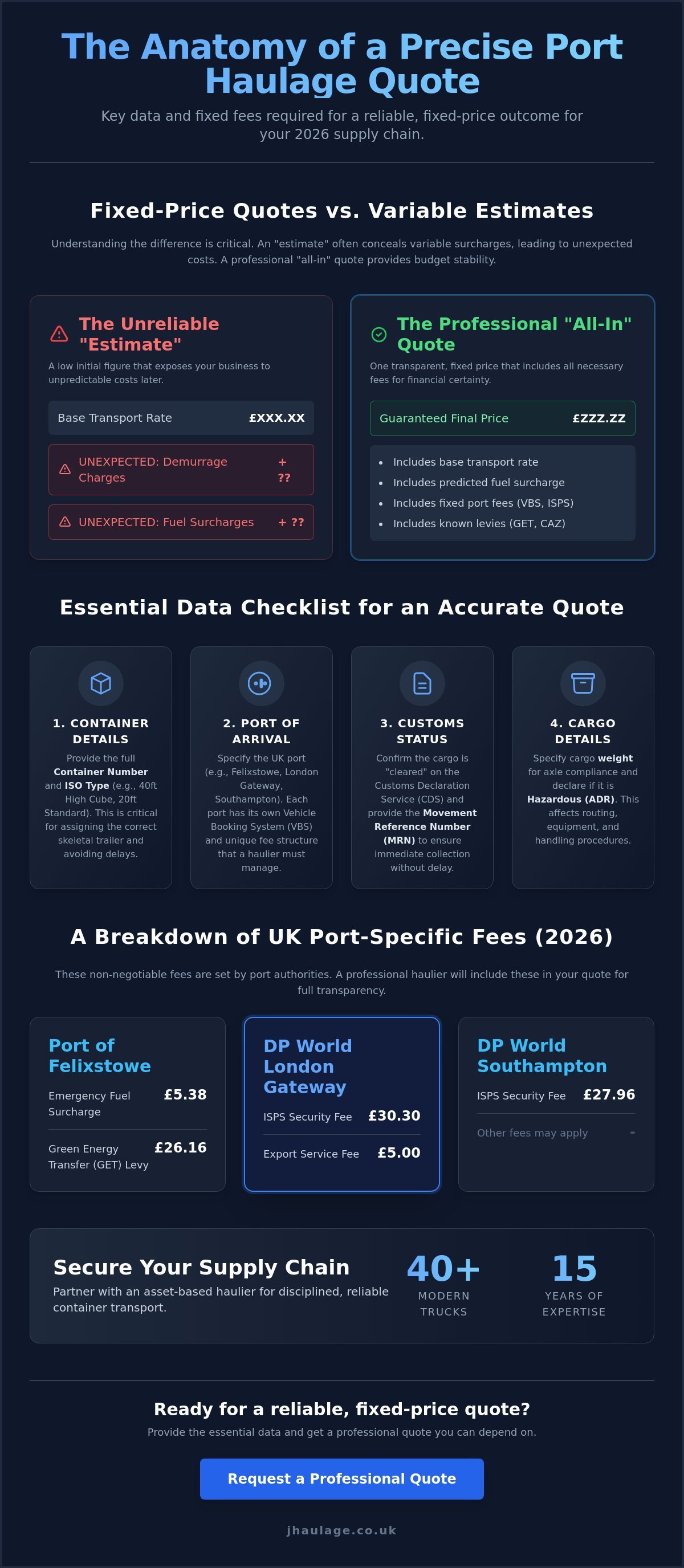
A professional port haulage quote is not a simple estimate of distance; it is a strategic technical agreement that ensures the stability of your supply chain. You likely recognise the frustration of receiving a baseline figure only to face unexpected demurrage charges or the £5.38 Felixstowe Emergency Fuel Surcharge later in the month. Navigating these complex pricing structures requires a disciplined approach to data accuracy and a deep understanding of current port fees. Reliability in 2026 depends on your ability to provide precise information whilst accounting for shifting regulatory costs.
This guide provides the specific framework needed to master the technical requirements of modern container transport. You'll learn how to account for the mandatory ICS2 requirements and the £30.30 ISPS fees at London Gateway to achieve a fixed-price outcome. We will outline the essential data points your haulier requires to provide a reliable, seamless transition from the quayside to your delivery destination. By the end of this professional guide, you'll have the confidence to manage logistics without the common pitfalls of unreliable delivery windows or hidden fuel surcharges.
Key Takeaways
- Identify the technical variables that influence a port haulage quote, including container dimensions and the specific fuel surcharge rates for 2026.
- Master the essential data requirements, such as ISO types and port release documentation, to ensure precise equipment dispatch and scheduling.
- Evaluate the operational differences between merchant haulage and shipping line haulage to determine which model offers the necessary flexibility for your supply chain.
- Follow a structured step-by-step process to gather documentation and engage with asset-based hauliers for reliable inland container haulage.
- Understand how 15 years of specialised expertise and a modern fleet of over 40 trucks support a secure and disciplined logistical outcome.
The Fundamentals of Port Haulage Pricing in the UK
A professional port haulage quote is built upon three primary pillars: distance, container specifications, and fluctuating operational surcharges. It's a technical calculation rather than a simple mileage rate. For cargo owners, understanding these fundamentals is the only way to avoid the budget creep associated with modular fee structures. Most base rates anchor to the journey between the port of arrival and the final delivery point, but this figure is rarely the final cost in 2026's complex regulatory environment.
Fuel remains the most volatile variable in the supply chain. Recent data indicates that fuel surcharges can fluctuate by as much as 10% in a single month, with some logistics providers recording a rise from 15% in March to 25% by May 2026. This volatility is often compounded by port-specific levies that must be paid before a container is released. For instance, the Port of Felixstowe currently applies an Emergency Fuel Surcharge of £5.38 per import laden container. These costs are non-negotiable and must be integrated into any strategic port haulage quote to ensure financial accuracy.
Effective transport management relies on Intermodal freight transport standards to move goods seamlessly between ship and shore. When requesting pricing, you must account for port-specific variables such as peak-hour congestion and the GET (Green Energy Transfer) levy, which currently stands at £26.16 at Felixstowe. A disciplined haulier will provide an "all-in" price that accounts for these variables, whereas a modular quote might leave your business vulnerable to unexpected invoices after the delivery is complete.
Fixed Rates vs Variable Surcharges
The core transport rate covers the physical movement of the container across the UK road network. It's vital to distinguish between a "guaranteed quote" and an "estimate" that excludes variable fees. In 2026, variable surcharges often include Clean Air Zone (CAZ) penalties in cities like Birmingham or Sheffield, alongside the new £5.00 Export Service Fee at DP World hubs. A reliable partner like Jagelo Haulage ensures these technical details are transparent from the initial enquiry, providing a grounded approach to cost management.
The Impact of Container Weight and Dimensions
Container size directly dictates the equipment required for delivery. While a 20ft container might seem simpler to transport, its weight density often requires specialised skeletal (skelly) trailers to maintain axle weight compliance. Conversely, 40ft high-cube containers require specific height clearances and routing. If your cargo exceeds standard weight limits, expect additional logistical considerations and potential equipment surcharges. Precise data on container ISO types is essential for an accurate port haulage quote, as it prevents the dispatch of incompatible vehicle configurations and subsequent delays at the quayside.
Essential Data Required for a Precise Container Transport Quote
Accuracy starts with the Container Number and ISO Type. A 40ft High Cube requires different height clearances and routing than a standard 20ft unit. Providing these technical details allows the haulier to assign the correct skeletal trailer from the start of the operation. Without a specific ISO code, a port haulage quote remains a provisional estimate rather than a binding agreement. This granular data is the foundation of a reliable transport schedule.
Port selection dictates the administrative burden of the journey. Every UK hub operates its own Vehicle Booking System (VBS) which requires disciplined management. At DP World London Gateway, the ISPS fee is £30.30; Southampton charges £27.96. These fees are fixed by the port authorities, but the haulier must manage the VBS time-slot precisely to avoid missed-window penalties. Misalignment here often results in wasted journeys and additional costs that should be accounted for in the initial pricing.
Hazardous cargo (ADR) and customs status are critical friction points in the supply chain. Since February 2026, all declarations must be processed through the Customs Declaration Service (CDS). A haulier cannot legally collect a container until it has achieved "cleared" status. Including the Movement Reference Number (MRN) when requesting a port haulage quote confirms the cargo is ready for immediate inland transport. This ensures the driver is not delayed at the quayside by administrative blocks.
Operational Details That Prevent Delays
Route optimisation depends on exact collection and delivery postcodes. Industrial sites often have restricted access or require ground-level delivery via side-loaders. If your site requires a crane or has specific timed windows, these must be declared early. A valid Container Release Note is the final requirement for port exit. Without it, the driver will be turned away at the gate regardless of the booking status. You can request a technical consultation to ensure your documentation meets these strict port requirements.
Specialised Cargo Considerations
Refrigerated (reefer) containers require active power management and consistent monitoring throughout the delivery. High-value goods may necessitate increased insurance cover beyond standard RHA (Road Haulage Association) limits to protect the assets. For merchant haulage bookings, ensure you have the full shipping line release details and any specific PIN codes required for collection. This disciplined approach to data ensures the transport operation remains predictable, secure, and free from hidden logistical costs.
Comparing Merchant Haulage and Shipping Line Haulage Quotes
Choosing between merchant haulage and shipping line haulage is a decision that impacts both the final cost and the reliability of the delivery window. Shipping line haulage, often referred to as carrier haulage, involves the shipping line managing the inland transport leg. Whilst this model appears convenient, it typically lacks the flexibility required for complex supply chains. Conversely, merchant haulage grants the importer direct control over the selection of the transport provider. This distinction is critical when requesting a port haulage quote, as it determines whether you are a priority or simply one of many containers in a carrier's automated system.
Merchant haulage allows for a more personalised service level. You interact directly with the fleet operators who manage the physical movement of your goods. This direct line of communication eliminates the administrative layers found in shipping line models, where updates are often delayed by automated portals. By opting for merchant haulage, businesses can secure a port haulage quote that reflects a committed delivery schedule rather than a vague arrival window. This model prioritises functional reliability over the "all-in-one" convenience that often results in logistical bottlenecks.
The Flexibility of Merchant Haulage
The primary benefit of merchant haulage is the ability to prioritise specific containers based on urgent inventory needs. During peak periods, shipping lines often face internal backlogs, leading to delays in their carrier-controlled transport. Merchant haulage bypasses these queues by utilising independent, asset-based fleets. This provides several strategic advantages:
- Direct scheduling with the transport manager to meet specific warehouse windows.
- Real-time updates on vehicle location and port status without waiting for carrier portal refreshes.
- The ability to redirect containers to inland storage depots if warehouse space becomes limited.
Cost Control and Surcharge Avoidance
Financial discipline is easier to maintain with merchant haulage. Shipping lines often apply standardised detention and demurrage rates that can escalate quickly if the carrier's own transport is delayed. When you control the haulage, you can coordinate the VBS slots and container collection to align exactly with your port free-time. A modern fleet, such as the one operated by Jagelo Haulage, provides the reliability needed to avoid these costly penalties. This model ensures transparency on quay rent and provides a fixed-price structure that protects your margins from the hidden fees often buried in shipping line invoices. It's a grounded approach that prioritises performance over administrative simplicity.
How to Request a Professional Haulage Quote: A Step-by-Step Guide
Securing a professional port haulage quote requires a methodical approach to technical documentation. You must move beyond the generic enquiry forms found on price-comparison sites to ensure operational success. A disciplined process prevents the administrative friction that leads to port congestion and additional fees. By following a structured sequence, you ensure that the haulier has the exact data points needed to provide a fixed-price agreement that protects your supply chain margins.
Step 1: Information Gathering and Verification
Success begins with data accuracy. Before you contact a transport provider, verify the container's weight and specific ISO type. This ensures the correct vehicle configuration is assigned to the task. You should also confirm the "last free day" at the port to avoid quay rent and demurrage. If your delivery site has restricted access or requires specific unloading equipment, these details must be declared early. For requirements involving precise lifting or positioning, Bewlake Lift & Haul Ltd offers the specialised crane hire needed to support your logistical needs. Accurate postcodes are essential for route optimisation, especially when navigating Clean Air Zones in cities like Birmingham or Sheffield. Checking these variables beforehand ensures your port haulage quote is grounded in reality rather than speculation.
Step 2: Evaluating the Quote and Service Level
A strategic transport agreement should be transparent regarding inclusive fees. Look beyond the headline price and check if the quote accounts for port-specific levies, such as the Felixstowe GET levy or the DP World ISPS charges. Verify that the haulier maintains active RHA (Road Haulage Association) membership and carries adequate Goods in Transit insurance. It's also vital to confirm their communication protocols. Reliable operators use modern fleet tracking to provide real-time updates, ensuring you aren't left waiting for information during the inland transit leg. A professional port haulage quote is a display of competence and functional reliability.
Step 3: Finalising the Booking
Once you are satisfied with the technical proposal, provide the Container Number and the collection PIN. This PIN is the essential security key for merchant haulage collections. You must also establish a clear point of contact at the delivery destination to coordinate the driver's arrival and ensure the VBS time slot is utilised efficiently. Establishing these protocols early creates a seamless port-to-door transition. You can organise your port logistics with our expert team to ensure every technical requirement is met. For a detailed breakdown of costs tailored to your specific route, request a professional transport consultation from our operations desk.
Securing Your Supply Chain with Jagelo Haulage
Jagelo Haulage provides a foundation of steadfast professionalism for UK importers and exporters. With over 15 years of specialised expertise in UK port logistics, our operations are designed to meet the high stakes of modern supply chain management. We operate as an asset-based haulier, which means we maintain direct control over our equipment and personnel. This structure allows us to provide a port haulage quote that is backed by physical capacity rather than third-party availability. Our clients benefit from a disciplined approach where safety, punctuality, and operational efficiency are the primary objectives.
Our fleet consists of over 40 modern trucks, each equipped with the latest tracking technology to ensure complete transparency. This investment in physical assets distinguishes us from logistics aggregators who lack direct oversight of the transport process. Whether you require merchant haulage or shipping line haulage support, our team understands the technical nuances of port release protocols and VBS management. This expertise ensures that your cargo moves through the port without the administrative delays that often lead to detention charges. It's a grounded approach that prioritises functional reliability over simple service provision.
Nationwide Reach and Reliability
We provide comprehensive transport solutions from all major UK maritime hubs to any inland destination. Our fleet is positioned to handle time-sensitive cargo, offering same-day delivery capabilities when the port schedule allows. This nationwide reach is supported by a methodical communication rhythm, ensuring you receive updates at every critical stage of the journey. You can learn more about our container haulage services to understand how we optimise routes for maximum efficiency and security.
A Partnership Built on Performance
Choosing a haulage partner is a strategic decision that affects your long-term stability. Jagelo Haulage positions itself as a master of the fundamentals, following strict protocols to protect your goods and your reputation. We don't rely on marketing appeals; we rely on performance and results. Our seasoned professionals understand the complexities of the 2026 logistical landscape, from CDS requirements to expanding Clean Air Zones. This grounded approach ensures that every port haulage quote we issue represents a commitment to a secure, strategic outcome. Request your port haulage quote today to secure your inland transport with a dependable partner.
Optimising Your Inland Logistics Strategy
A reliable supply chain is built on precise data and disciplined execution. Managing inland transport requires a thorough understanding of port release protocols and the specific technical requirements of your cargo. By prioritising data accuracy and choosing the flexibility of merchant haulage, you eliminate the administrative friction that leads to detention charges. Obtaining a professional port haulage quote is a strategic decision that ensures your goods move from the quayside to their destination without unnecessary delay.
Jagelo Haulage supports your operations with over 15 years of industry experience and a modern fleet of more than 40 trucks. As a committed RHA Member, we provide nationwide coverage from all major UK ports, delivering functional reliability and secure transport outcomes. It's our asset-based model that ensures we maintain direct control over every journey, providing the stability your business requires in a complex global market. We invite you to Request a Professional Port Haulage Quote to secure your 2026 logistics schedule. We look forward to strengthening your supply chain with our specialised expertise.
Frequently Asked Questions
What factors most significantly influence a port haulage quote?
The most significant factors affecting a port haulage quote include the distance between the port and the delivery site, container dimensions, and current fuel surcharges. Technical requirements such as heavy-load equipment or specialised trailers also impact the final figure. Additionally, port-specific levies like the Green Energy Transfer levy at Felixstowe are integrated into the calculation to ensure operational accuracy and financial transparency for the client.
How far in advance should I book my container haulage?
You should ideally book container haulage at least seven to ten days before the vessel arrives at the port. This lead time is necessary to secure a Vehicle Booking System (VBS) slot, which can be scarce during peak periods. Early booking allows the haulier to organise the fleet efficiently and ensures that your delivery window is protected against sudden surges in port volume or logistical bottlenecks.
Does a port haulage quote include port storage or demurrage fees?
A standard port haulage quote does not include port storage, quay rent, or demurrage charges. These fees are determined by the port authority or shipping line based on the container's "free time" on the quayside. Whilst a professional haulier manages the transport to minimise these risks, the charges themselves are external to the transport rate and remain the responsibility of the cargo owner.
What is the difference between an estimate and a fixed port haulage quote?
An estimate provides a baseline figure based on distance, but a fixed port haulage quote is a technical agreement that includes all known variables. Fixed quotes require specific data such as the container number, ISO type, and delivery requirements. This disciplined approach ensures that the price you receive is final and accounts for current surcharges, whereas an estimate may be subject to change as technical details emerge.
Can I get a quote for hazardous (ADR) container transport?
Quotes for hazardous (ADR) container transport are available and require the submission of a Dangerous Goods (DG) declaration. These jobs necessitate specialised drivers with ADR certification and vehicles equipped with safety kits. Providing the exact UN class and packaging group ensures that the haulier assigns the correct technical resources to the movement, maintaining compliance with safety protocols and environmental regulations throughout the journey.
What happens if my container is delayed at the port after I have received a quote?
If a container is delayed at the port beyond the standard free waiting time, additional hourly charges typically apply. Most professional hauliers provide a one to two-hour window for collection or delivery. Beyond this, industry-standard rates of £30 to £50 per hour are often applied to cover the vehicle's standing time. Clear communication regarding the container release status helps to prevent these avoidable operational costs.
Why should I choose merchant haulage over shipping line haulage?
Choosing merchant haulage allows you to select a specific transport partner rather than relying on the shipping line's automated systems. This model provides direct access to the transport manager and prioritises your specific delivery windows. It's often more cost-effective for complex supply chains, as it reduces the risk of detention fees that frequently occur within the more rigid, carrier-controlled shipping line haulage model.
Are fuel surcharges included in the initial haulage quote?
Fuel surcharges are typically calculated as a percentage of the base rate and are updated monthly to reflect market volatility. In May 2026, some operators recorded surcharges as high as 25%. A professional quote will clearly define whether the price includes the Port of Felixstowe's £5.38 Emergency Fuel Surcharge or other energy levies, ensuring that the financial outcome of the transport remains predictable and transparent.