A padlock on a container door is no longer a sufficient deterrent against the sophisticated methods used by modern organised crime. You recognise that every hour your cargo spends stationary at an overnight stop increases the risk of theft or tampering. It's a constant pressure for operations managers who require absolute certainty that their goods will arrive intact and on schedule. Maintaining secure container transport across the UK requires more than just basic equipment; it demands a disciplined approach to fleet management and personnel integrity.
This guide provides a comprehensive checklist of the protocols, technologies, and professional standards required to ensure your cargo remains protected from the port to its final destination. We examine how the Road Transport Security Standards (RTSS) introduced in June 2025 and real-time tracking systems provide the visibility you need to eliminate uncertainty. You'll learn the specific criteria for selecting a haulier that prioritises operational safety, helping you to achieve zero cargo loss and complete confidence in your supply chain.
Key Takeaways
- Understand why secure container transport in the UK requires a disciplined logistics framework rather than simple haulage.
- Identify how modern fleet infrastructure and real-time monitoring software eliminate visibility gaps and mechanical security risks.
- Apply a 10-point checklist to evaluate the operational integrity and security protocols of your haulage partners.
- Learn strategic route planning techniques to mitigate risks like organised cargo theft and unauthorised access during transit.
- Recognise the value of partnering with an established haulier that maintains a modern fleet to ensure consistent cargo protection.
What Constitutes Secure Container Transport in the UK?
Secure container transport involves more than the physical movement of goods from a port to a warehouse. It represents a multi-disciplinary logistics approach where security is treated as a strategic outcome rather than an afterthought. Whilst basic haulage focuses on the simple delivery of an intermodal container, professionally managed secure transport integrates rigorous risk assessment with operational precision. This distinction is critical for businesses that cannot afford the financial or reputational damage caused by cargo theft or transit delays.
Security has become the primary Key Performance Indicator (KPI) for modern UK supply chains. The haulier acts as the final guardian of the cargo's integrity, whether it's part of a global cold chain or a shipment of high-value dry goods. A failure in security at the road transport stage can invalidate hours of careful handling at sea or in the warehouse. Reliability in this sector is built on a foundation of disciplined protocols and functional competence.
The Core Pillars of Cargo Protection
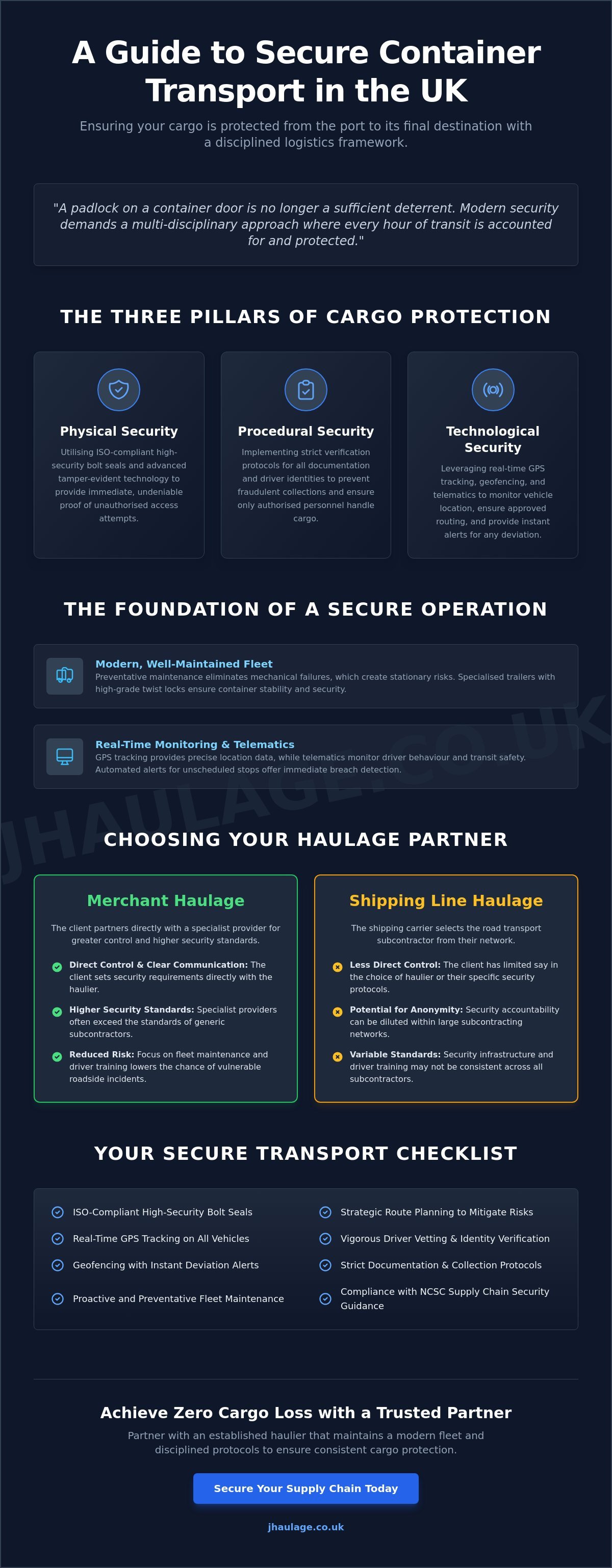
A robust security framework rests on three distinct pillars that must function in unison to protect the client's assets:
- Physical security: This involves the use of ISO-compliant high-security bolt seals and tamper-evident technology that provides immediate evidence of unauthorised access.
- Procedural security: Reliable hauliers implement strict verification processes for all documentation and driver identities. These protocols are designed to prevent fraudulent collections and ensure that only authorised personnel handle the cargo.
- Technological security: Modern fleets utilise real-time GPS tracking and geofencing capabilities. These tools ensure vehicles remain on pre-approved routes and provide immediate alerts if a vehicle deviates from its planned path.
Why Merchant Haulage Demands Higher Security Standards
Many importers choose merchant haulage to gain greater control over their logistics. Unlike shipping line haulage, where the carrier selects the subcontractor, merchant haulage allows the client to partner directly with a specialist provider. This direct relationship facilitates clearer communication and a deeper understanding of the specific security requirements for a particular cargo type. It removes the layer of anonymity often found in large-scale subcontracting networks.
Specialised haulage providers often maintain higher standards than generic subcontractors. They focus on the fundamentals of fleet maintenance and driver training, which reduces the risk of mechanical failures that leave containers vulnerable at the roadside. By selecting a dedicated partner like Jagelo Haulage, businesses ensure that their secure container transport strategy is executed by a team that understands the high stakes of the UK supply chain and follows every protocol without deviation.
Essential Infrastructure for a Secure Haulage Operation
Reliable infrastructure serves as the physical foundation for every secure haulage operation. A modern, well-maintained fleet is essential because mechanical failures create immediate security risks. A vehicle stranded at the roadside is vulnerable to cargo theft or unauthorised access. Professional hauliers prioritise preventative maintenance to ensure that trucks and trailers remain operational and secure throughout the transit period. Using specialised trailers designed specifically for heavy container haulage ensures structural integrity and load stability. These trailers are equipped with high-grade twist locks that secure the container to the chassis, preventing movement that could lead to accidents or tampering.
Advanced Fleet Technology and Monitoring
Real-time monitoring software has transformed how logistics managers oversee container visibility. GPS tracking provides precise location data, allowing clients to monitor the progress of their shipments with absolute certainty. Telematics systems go further by monitoring driver behaviour and transit safety, ensuring that every journey follows strict operational protocols. Automated alerts for unscheduled stops or route deviations provide an immediate layer of protection against potential breaches. As digital systems become more integrated, following NCSC supply chain security guidance helps hauliers protect tracking data from cyber threats.
The Role of Secure Port Logistics Hubs
The transition from maritime terminals to the UK road network is a critical point in the supply chain. Efficient integration with major UK port systems allows for seamless and secure collections at hubs such as Felixstowe, Liverpool, and Southampton. Hauliers with established port-centric logistics expertise understand the specific security requirements of each terminal. They use this knowledge to minimise dwell time and ensure that containers are moved swiftly into a secure transport environment. This expertise is vital when managing merchant haulage, where the haulier must coordinate directly with port authorities to ensure all security clearances are verified before the vehicle leaves the terminal gates.
While standard container logistics are vital, some projects require the movement of oversized industrial assets or entire production lines. For those needing specialised support with factory plant relocation and heavy equipment transport, you can discover Silver Knight Haulage & Machineries Ltd to ensure these high-value assets are handled with precision.
Maintaining a disciplined infrastructure requires significant investment and operational focus. Jagelo Haulage operates a modern fleet of over 40 trucks and trailers, ensuring that every delivery is supported by reliable equipment and advanced tracking technology. If you require a partner that prioritises the safety of your cargo, you can request a haulage quote to see how our infrastructure supports your secure container transport goals. Our commitment to fleet integrity ensures that your goods remain protected from the moment they leave the port until they reach their final destination.
The Secure Container Transport Checklist: 10 Critical Points
Evaluating a haulage partner requires a methodical approach that goes beyond surface-level reviews. You need to verify that their operational standards can withstand the specific risks of your route. This checklist serves as a framework for auditing your current provider to ensure they deliver a truly secure container transport service. A professional haulier will welcome this level of scrutiny as it reflects the disciplined nature of their own operations.
Verifying insurance is the first step in any audit. Logistics managers should confirm that the haulier's liability limits are sufficient for the cargo's market value. Don't assume standard industry terms cover every scenario; ask for specific proof of Goods in Transit insurance and public liability. A reliable partner will provide these certificates without hesitation, ensuring that your financial interests are protected in the event of an incident.
Pre-Transit Verification and Documentation
Logistics integrity begins before the vehicle leaves the port. Drivers must confirm container seal numbers against the manifest to prevent discrepancies at the destination. It's also vital to verify driver identities and vehicle registrations against the booking details to prevent fraudulent collections. Containers must also meet the structural standards outlined in The Freight Containers (Safety Convention) Regulations 2017. This ensures the unit is plated and safe for transit, which reduces the risk of mechanical intervention or delays by authorities during the journey.
Physical Security Measures During Transit
Physical barriers remain a primary defence against cargo tampering. Drivers should inspect the integrity of container doors and locking mechanisms for any signs of pre-existing damage before departure. The use of ISO-compliant high-security bolts and anti-tamper devices is non-negotiable for high-value shipments. If the route requires overnight rest, the haulier must have a strict protocol for using secure, monitored parking facilities. These stops are the points of highest vulnerability; a disciplined haulier will have pre-approved locations that minimise the risk of unauthorised access or organised cargo theft.
These security measures are equally critical in other sectors of the transport industry; for example, when handling luxury vehicles, you can learn more about Done Wright Towing & Transport to understand how specialised protocols protect high-value assets during transit.
Use these 10 points to audit your haulage provision:
- Verification of insurance and liability limits.
- Driver credential and ID verification.
- Seal number matching against documentation.
- Structural safety compliance (CSC Plate check).
- Inspection of door locking mechanisms.
- Application of high-security bolts.
- Route risk assessment and planning.
- Use of pre-approved secure parking facilities.
- Real-time tracking and geofencing activation.
- Established emergency and incident response protocols.
Mitigating Operational Risks Between Port and Destination
The journey from the port terminal to the final destination is the period of highest risk for any shipment. Organised cargo theft and the risk of stowaways are persistent threats that require proactive mitigation. A disciplined haulier identifies these risks during the planning phase rather than reacting to them on the road. Effective secure container transport relies on meticulous route planning to avoid known high-risk areas or locations prone to heavy congestion where vehicles are forced to remain stationary. Stationary vehicles are vulnerable targets. By minimising dwell time and avoiding bottlenecks, the haulier reduces the exposure of the cargo to external threats.
Maintaining constant communication during the "last mile" of the delivery process is essential for operational security. This phase often involves complex urban environments where the risk of unauthorised access increases. Real-time updates ensure that the receiving site is prepared for the arrival, allowing for a swift and secure offloading process. This coordination reduces the time a container spends outside a secure perimeter, effectively closing the window for potential interference.
Managing Same-Day Delivery Pressures Safely
Speed must never compromise security. Whilst same-day delivery services are highly effective at reducing the window of opportunity for theft, they require a balanced operational approach. Responsive customer support is vital for managing time-critical shipments, providing clients with immediate answers to transit queries. A dedicated fleet allows for better control over delivery schedules, ensuring that drivers are not rushed into bypassing safety protocols to meet a deadline. Punctuality is a product of good planning, not reckless driving. Consistency in delivery times helps maintain a predictable and secure supply chain.
Driver Training and Personnel Integrity
The driver is the first line of defence in any secure transport operation. Technical equipment like GPS and high-security locks is only effective when managed by disciplined personnel. Drivers must receive specific training for handling specialised container logistics, including the correct application of anti-tamper devices and the recognition of surveillance by criminal groups. A corporate culture that prioritises integrity and follows strict protocols ensures that security remains a constant focus. When drivers understand the high stakes of the supply chain, they're more likely to identify and report suspicious activity before it results in a breach.
Operational excellence is achieved through a combination of personnel integrity and reliable equipment. If your current logistics provider lacks this disciplined approach, you can request a haulage quote to secure your next shipment. Our team understands that every mile between the port and your destination requires total vigilance.
Partnering with Jagelo Haulage for Protected Logistics Outcomes
Jagelo Haulage has spent over 15 years refining the protocols required for secure container transport within the UK. Our operations are centred on a modern fleet of more than 40 trucks and trailers, providing the consistency needed to manage complex supply chains. We specialise in professionally managed inland container haulage, ensuring that every movement is treated as a high-stakes strategic task rather than a routine delivery. Our promise to every client is built on three pillars: security, reliability, and responsive support. We understand that your cargo represents a significant investment, and our disciplined approach ensures it remains protected throughout the transit process.
Operational integrity is the result of meticulous planning and a refusal to compromise on fundamental standards. By maintaining a 15-year history of success, we've developed the expertise necessary to navigate the evolving security landscape of the UK logistics sector. Our team provides the functional reliability that corporate clients and operational managers demand, ensuring that every container is tracked, secured, and delivered according to strict professional standards.
Our Commitment to Professional Fleet Standards
Jagelo Haulage maintains a disciplined approach to fleet standards. We invest heavily in the latest transport technology and preventative maintenance to eliminate mechanical failures that could compromise cargo safety. This commitment supports both merchant haulage and shipping line haulage, providing a uniform standard of protection regardless of the contract type. Every vehicle in our fleet meets the highest UK safety and security regulations, including structural safety requirements and the latest environmental standards. This focus on fleet integrity ensures that our equipment never becomes a point of vulnerability in your supply chain.
Nationwide Reach with Local Port Expertise
Our operational reach extends across the UK, supported by deep expertise in major maritime terminals. We provide seamless container haulage from Felixstowe, as well as regular operations from DP World London Gateway, Tilbury, and Southampton. Our strategic base in Woolpit serves as a vital hub, allowing our team to coordinate nationwide deliveries with precision and speed. This local port knowledge ensures that collections are handled efficiently, reducing dwell times and the associated security risks found in congested port environments.
Choosing a logistics partner is a decision that impacts the integrity of your entire operation. Jagelo Haulage positions itself as a strategic partner rather than a simple service provider. To discuss your requirements for secure container transport, contact our team today. We provide the professional oversight and functional competence needed to protect your cargo from port to destination.
Securing Your Supply Chain Integrity
Logistics security is a strategic outcome of disciplined fleet management and personnel integrity. You've identified how modern infrastructure and real-time monitoring eliminate the visibility gaps that lead to cargo loss. Applying a structured audit to your transport partners ensures that every transit protocol is followed without deviation. Reliability in the supply chain isn't a matter of chance; it's the result of rigorous operational standards.
Jagelo Haulage offers 15 years of industry experience and a modern fleet of over 40 trucks to support your operations. As specialists in Felixstowe and UK port logistics, we provide the functional reliability needed for consistent secure container transport. Our team focuses on the fundamentals of cargo protection to ensure your goods arrive at their destination intact. We understand the high stakes of road transit and maintain total vigilance over every container we handle.
Request a professional quote for secure container transport to discuss your specific logistics requirements. We're ready to support your supply chain with disciplined, reliable haulage.
Frequently Asked Questions
What is secure container transport in the context of UK road haulage?
Secure container transport is a multi-disciplinary approach to logistics that prioritises cargo protection through disciplined protocols and advanced technology. It goes beyond simple delivery by integrating risk assessments and physical security measures. This ensures that containers remain tamper-proof from the port of entry to the final destination. It's a strategic outcome that protects the financial and reputational interests of the client whilst maintaining supply chain consistency.
How do you ensure the security of a shipping container during transit?
Security is maintained through a combination of physical barriers and operational discipline. Drivers use ISO-compliant high-security bolt seals and inspect locking mechanisms before departure. Vehicles follow pre-approved routes that avoid high-risk areas or known congestion points. If a rest stop is required, the haulier uses monitored, secure parking facilities to prevent unauthorised access or organised theft. These measures create a robust defence against external threats during the journey.
What technologies are used to track containers in real-time?
Real-time tracking relies on advanced GPS hardware and telematics software integrated into the vehicle fleet. These systems provide precise location data and automated alerts for unscheduled stops or route deviations. Logistics managers use this visibility to monitor transit progress and ensure secure container transport remains on schedule. Geofencing technology adds an extra layer of protection by alerting the operations team if a vehicle leaves a designated corridor without prior authorisation; for logistics companies seeking to bolster their operational centres, Jurij's Solutions LTD provides the IT infrastructure and security systems required to maintain high-performance monitoring environments.
Why is driver training important for secure container logistics?
The driver serves as the primary line of defence against cargo tampering and theft. Professional training ensures that personnel can correctly apply security devices and identify potential surveillance by criminal elements. Disciplined drivers follow strict documentation protocols and don't bypass safety checks to save time. This human element is essential for maintaining the operational integrity of the entire supply chain. A well-trained driver understands the high stakes involved in moving high-value goods.
Can you provide secure transport for containers from all major UK ports?
Professional haulage operations cover all primary maritime hubs including Felixstowe, DP World London Gateway, Tilbury, Southampton, and Liverpool. Each port has specific security and customs requirements that the haulier must navigate with precision. Using an established provider ensures that collections are handled efficiently and containers move swiftly from the terminal into a secure road transport environment. This expertise reduces dwell times and prevents cargo from being left vulnerable in congested areas.
What should I look for in a secure haulage partner’s fleet?
A secure fleet must consist of modern, well-maintained vehicles equipped with the latest tracking technology. Look for specialised trailers designed for heavy container haulage that feature high-grade twist locks. Preventative maintenance is a critical security factor; it reduces the risk of roadside breakdowns that leave cargo vulnerable. A disciplined partner will invest in fleet integrity to ensure consistent secure container transport outcomes and protect the integrity of the goods they carry.
How does same-day delivery improve container security?
Same-day delivery improves security by significantly reducing the window of opportunity for cargo theft. Minimising the time a container spends in transit or at rest stops lowers its exposure to external threats. This brisk operational efficiency ensures that goods move directly from the port to the recipient's secure perimeter. It's an effective strategy for high-value shipments that require maximum protection and a rapid transition through the UK road network.
What documentation is required to ensure a secure container collection from port?
Secure collection requires a valid Release Note and a unique PIN or collection code provided by the shipping line. Drivers must present photographic identification and vehicle registration details that match the port's booking system. Verifying the container seal number against the manifest is a mandatory procedural step. These documentation checks prevent fraudulent collections and maintain the integrity of the merchant haulage process. Accurate paperwork is the foundation of a disciplined collection protocol.