Container delivery scheduling best practices: 2026 guide

A TAS-driven, rolling-horizon schedule built on verified site data is the single most effective approach to container delivery scheduling best practices — it reduces gate waiting times, cuts abortive visits, and lowers fleet operational costs by balancing truck arrivals across defined time slots. The immediate actions are straightforward: confirm your Truck Appointment System (TAS) slots, record every site access constraint before booking, and agree a day-of communication protocol with your carrier. Jhaulage operates this model across Felixstowe, Tilbury, Southampton, and Liverpool, and the guidance below reflects how it works in practice.
Table of Contents
- Your pre-delivery checklist: what to confirm before the day
- How should you schedule container deliveries for UK ports?
- What site data do you need before booking a container delivery?
- When should you pre-book specialist lifting equipment?
- What does an effective day-of communication protocol look like?
- How do you sequence multi-container deliveries to cut on-site time?
- How do you handle a failed delivery or site refusal?
- What lead times and charges should you budget for?
- Which technology components make scheduling reliable?
- Jhaulage: container haulage built around these practices
- Key takeaways
- The scheduling gap most operators ignore
- Useful sources
Your pre-delivery checklist: what to confirm before the day
A missed measurement or an unconfirmed contact number causes more abortive visits than any other single factor. Run through this checklist before every booking confirmation.
Site and access
- Vehicle approach road width and surface condition recorded
- Turning circle measured and confirmed adequate for the trailer length
- Gate width and height clearance noted
- Overhead obstacles (cables, gantries, canopies) mapped and heights recorded
- Final container siting coordinates confirmed with the site manager
- Ground hardness and load-bearing capacity assessed; support pads or compacted base arranged if required
- Opening hours, locked-gate procedures and any permit-to-enter or escort requirements confirmed
Equipment
- Lifting equipment (crane, Hiab, reachstacker, telehandler) pre-booked where the site cannot accept a tilt-and-slide delivery
- Safe Working Load (SWL) confirmed against container gross weight
- Banksman arranged and statutory lifting plan on file
Documentation
- TAS slot reference and soft time window confirmed in writing
- Delivery note, weight declaration and customs release documents prepared
- Driver check-in instructions and site contact numbers attached to the booking
Communications
- Day-before confirmation call or message scheduled
- Day-of ETA update agreed with the site coordinator
- Contingency contact (second site number) recorded
For a step-by-step guide to booking TAS slots and the required booking information, Jhaulage’s professional guide covers the full process.
How should you schedule container deliveries for UK ports?

The scheduling model that consistently outperforms manual planning combines three components: a Truck Appointment System with soft time windows, rolling-horizon planning, and TMS integration. Each element addresses a different failure mode.
TAS and soft time windows
A TAS assigns each truck a specific arrival slot at the terminal gate, and slot quotas per period balance utilisation and reduce peak-hour congestion. The critical design choice is whether to use hard or soft windows. Hard windows reject late arrivals outright; soft windows apply a penalty mechanism that discourages lateness without creating a binary pass/fail at the gate. Studies confirm that TAS with soft windows and penalty mechanisms reduces fleet operational costs and improves gate throughput compared with manual scheduling. In practical terms, a driver who arrives 20 minutes late under a soft-window regime is processed with a surcharge rather than turned away, which prevents the cascade of re-bookings that a hard rejection triggers.
Rolling-horizon planning
Static weekly schedules break the moment a vessel is delayed or a site becomes unavailable. Rolling-horizon frameworks address this by maintaining a detailed plan for the coming week while reoptimising daily with real-time inputs — traffic data, terminal congestion reports, and updated ETAs from GPS-tracked vehicles. The practical steps are:
- Forecast demand by lane and port for the next five to seven days
- Define slot capacity by time period (tighter during peak hours, broader off-peak)
- Set no-show and late-arrival penalty policies and communicate them to carriers
- Integrate TAS slot data with your Transport Management System (TMS) so planners see a single view
- Rerun the optimisation each morning using the previous day’s turn-time actuals
Scheduling models that incorporate stochastic variables — port congestion, variable unloading times, traffic — are more robust than deterministic models, which is precisely why buffers and soft windows are not optional extras but structural requirements.
Pro Tip: Use short, enforceable slot capacities (two to three trucks per hour) during peak gate hours at busy terminals such as Felixstowe, and larger windows (four to five per hour) during off-peak periods. This prevents the utilisation cliff that occurs when peak slots fill and off-peak slots sit empty.
What site data do you need before booking a container delivery?
Drivers arriving at an unprepared site is one of the most avoidable costs in container logistics. The solution is a validated, reusable site library — a digital record of every constraint at every delivery location your fleet visits regularly.
Measurements to capture and share with your haulier
- Vehicle approach: road width at the narrowest point, surface type (tarmac, concrete, gravel, unmade)
- Turning circle: minimum radius required for the trailer configuration (typically 18–25 metres for a standard 40ft skeletal)
- Gate dimensions: width and height, including any swing clearance
- Overhead clearances: cables, bridges, canopies and gantry heights
- Final siting coordinates: GPS reference for the exact drop point
Ground condition checklist
- Surface material and condition (cracked, soft, waterlogged)
- Load-bearing capacity relative to the container’s gross weight
- Need for timber or steel support pads, or a compacted hardcore base
- Drainage assessment for sites prone to standing water
Access constraints
- Site opening hours and any out-of-hours access procedures
- Locked-gate protocols and keyholders’ contact details
- Permit-to-enter requirements, security escort procedures
- Low-bridge or weight-restricted routes on the approach road (check the UK port logistics guidance for port-specific approach constraints)
Attach a site plan, geotagged photographs and digital access notes to every booking. Carriers who receive this pack arrive prepared; those who do not are working from memory.
Pro Tip: Maintain a digital site library with permanent records for every repeat location. When a site is revisited, the driver receives the validated constraint pack automatically rather than relying on a phone call. Practitioner guidance confirms that normalising site access data into a reusable digital library — capturing turning radii, overhead clearances and ground hardness — is a low-cost, high-return investment for reducing abortive visits.

When should you pre-book specialist lifting equipment?
The choice of handling method determines the delivery plan, not the other way around. Committing to a delivery date before confirming equipment availability is the single most common cause of abortive visits on sites that cannot accept a standard tilt-and-slide offload.
Common options and when each applies
- Hiab lorry (knuckle-boom crane): suited to sites with reasonable overhead clearance and firm ground; the vehicle is self-contained, which simplifies logistics, but the lift radius is limited (typically 6–10 metres from the vehicle centreline) and the SWL is lower than a mobile crane
- Mobile crane: required for heavy lifts, long radii or stacking; needs a prepared hardstanding for outriggers and significantly more lead time to book — typically three to five working days for UK industrial sites
- Telehandler: useful for lighter containers on construction or agricultural sites where a crane cannot access; ground conditions must be firm and level
- Reachstacker: the standard tool in port yards and large distribution centres; not typically available for off-port deliveries unless the destination has its own unit
Practical considerations before booking
- Confirm the container’s gross weight and compare it against the equipment’s SWL with a safety margin
- Calculate the required lift radius and check it against the equipment’s rated capacity at that radius (capacity drops significantly at extended reach)
- Assess the outrigger footprint for mobile cranes: a 100-tonne crane may need a 10 × 10 metre hardstanding per outrigger pad
- Verify overhead clearances against the boom height at full extension
For out-of-gauge or oversize containers, the planning requirements are more demanding still — Jhaulage’s OOG container delivery guidance covers the additional route-planning and lifting considerations in detail.
Safety requirement: Every crane or Hiab lift at a UK delivery site requires a statutory lifting plan prepared under the Lifting Operations and Lifting Equipment Regulations 1998 (LOLER). The plan must be on file before the vehicle arrives, a competent banksman must be present throughout the lift, and a risk assessment must be completed and signed off. These are legal obligations, not optional best-practice steps.
What does an effective day-of communication protocol look like?
Proactive communication — slot confirmation at booking, day-of reminders and real-time ETAs — significantly reduces missed deliveries and prevents site confusion. The following timeline is the minimum standard for professional container deliveries.
Recommended communication timeline
- At booking: Send written confirmation including the TAS slot reference, soft time window, site plan, access instructions, driver check-in procedure and both site and carrier contact numbers
- 48 hours before: Reminder to the site coordinator confirming the slot, expected arrival window and any equipment that will be on site
- 24 hours before: Confirmation call or message; verify that access is clear, the site contact will be present and no changes have occurred
- Morning of delivery: Driver receives GPS-linked ETA and site pack; site coordinator receives an automated ETA update
- On approach (30–60 minutes out): Driver or carrier sends a live ETA; site coordinator confirms readiness
- On arrival: Driver completes check-in using the agreed procedure (signed delivery note, photographic record of container condition)
Sample message snippets for operations teams
Booking confirmation (to site coordinator): “Your container delivery is confirmed for [DATE], TAS slot [REFERENCE], arrival window [TIME]. Please find the driver check-in instructions and site plan attached. Site contact: [NAME / NUMBER]. Carrier contact: [NAME / NUMBER].”
Day-of ETA (automated or manual): “Your delivery is on route. Current ETA: [TIME]. Driver: [NAME]. Vehicle: [REGISTRATION]. Please confirm site access is clear.”
Driver arrival: “Driver [NAME] has arrived at [SITE]. Please proceed to [ENTRY POINT] and sign the delivery note. Container condition report to be completed before offload.”
Real-time GPS ETAs, combined with automated SMS or call reminders, remove the manual burden from this cadence and reduce the risk of a missed confirmation. For an overview of next-generation container tracking and real-time ETA technologies, Worldwide Express provides a useful technical reference.
How do you sequence multi-container deliveries to cut on-site time?
When multiple containers are destined for the same site or cluster of sites, the order in which they are delivered has a direct bearing on cycle time, equipment utilisation and total cost. Decoupling the delivery sequence from the receipt order — that is, deciding when to deliver independently of which container to carry — permits non-sequential loads and significantly improves vehicle utilisation.
- Group by final placement zone. Containers destined for adjacent bays or the same quadrant of a yard should arrive in the sequence that allows each unit to be placed without moving a previously delivered container. Reversing this order forces double-handling, which adds cost and time.
- Group by equipment needs. If two of five containers require a mobile crane and three can be tilt-and-slid, schedule the crane lifts consecutively so the crane is mobilised once rather than twice. Crane mobilisation and demobilisation typically account for a significant portion of hire cost.
- Match size and weight compatibility. Pair heavy 40ft units with the correct trailer specification and schedule lighter 20ft units separately where vehicle capacity allows. Mixing incompatible configurations on the same run creates loading constraints that slow the entire sequence.
- Reserve contiguous TAS slots. For a batch of three or more containers at the same terminal, book consecutive or near-consecutive slots to minimise the time the driver spends waiting between collections. Gaps between slots extend the driver’s working day and increase the risk of a slot being missed.
- Assign crews to batches, not individual lifts. A banksman and lifting crew assigned to a batch of crane lifts will work more efficiently than one reassigned between unrelated jobs. Equitable workload distribution across drivers also matters: schedule fairness between drivers is a performance and retention lever that is frequently underestimated.
- Document the sequence in the TMS. Record the planned delivery order, the rationale and the actual sequence achieved. This data feeds the rolling-horizon reoptimisation and improves future batch planning.
How do you handle a failed delivery or site refusal?
Even a well-planned schedule will occasionally encounter a site that cannot accept delivery. The difference between a costly re-delivery and a resolved exception lies in the speed and quality of the response.
Step-by-step process for a failed delivery
- Driver stops safely and does not attempt to force access or offload without authorisation.
- Driver contacts the carrier’s operations centre immediately and records the time of the call.
- Driver photographs the site condition, the obstruction or the reason for refusal — geotagged images with a timestamp are the evidential standard.
- Driver obtains a signed refusal note from the site contact where possible, or records the name and role of the person who refused delivery.
- Carrier notifies the shipper or freight forwarder within the notification window specified in the contract (typically two hours of the failed attempt).
- Operations team logs the incident in the TMS with all evidence attached.
- A contingency slot is activated or a new TAS booking is made for the earliest available window.
Evidence to gather on site
- Geotagged photographs of the obstruction, ground condition or access point
- Timed and signed delivery note marked “delivery refused” or “delivery failed — reason stated”
- Witness names and contact details where available
- Vehicle and container condition report completed before departure
Raising a claim
Log the incident in the TMS within 24 hours. Claims against carriers or depot operators for abortive visit charges, re-delivery fees or demurrage accrued during the failed attempt must be raised within the timescales set out in the contract — typically 48–72 hours for informal notification and 7–14 days for a formal written claim. Pre-booking contingency slots for high-risk sites (restricted access, variable ground conditions, sites with a history of refusals) is the most cost-effective mitigation. For a detailed on-time delivery checklist covering driver check-in procedures and first-time delivery protocols, Jhaulage’s operational guide is a practical reference.
What lead times and charges should you budget for?
Understanding the terminology and the cost structure prevents disputes and allows accurate budgeting.
Key timing terms
- In stock / ready for collection: the container has been discharged, customs-cleared and is available at the terminal. This does not mean a TAS slot is available — gate appointment lead times at major UK ports typically run two to five working days during normal periods.
- Lead time: the total elapsed time from order placement to delivery at the final destination, encompassing port dwell, TAS booking, transport and offload.
- Ready for collection: the terminal has confirmed the container is released and a slot can be booked. Confirm this status before booking transport to avoid a wasted journey.
- Detention: the period after the free-time allowance during which the container remains in the haulier’s custody (on a chassis or at a depot) before return to the terminal. Detention charges accrue daily.
- Demurrage: charges levied by the shipping line when a container remains at the terminal beyond the free-time period. Demurrage and detention are distinct charges with separate free-time clocks.
| Charge item | What drives the cost | Typical UK context |
|---|---|---|
| Demurrage | Days beyond free time at terminal | Shipping line sets the rate; varies by line and container size |
| Detention | Days container held off-terminal | Haulier or leasing company rate; accrues after free time expires |
| Re-delivery fee | Failed first attempt requiring a second run | Carrier-specific; often a flat fee plus fuel surcharge |
| Abortive visit charge | Driver attends but cannot offload | Typically charged at a half-day or full-day rate |
| Crane / Hiab hire | Lift complexity, duration, mobilisation | Varies by equipment type and region; book early to control cost |
| Port handling surcharge | Terminal congestion or peak-period fees | Port-specific; check current schedules at Felixstowe, Tilbury, Southampton |
| Storage at depot | Container held at haulier’s yard | Daily rate; often avoidable with accurate TAS slot management |
Demurrage and detention are the two charges most frequently disputed, and the most frequently misunderstood. Many shippers conflate them; keeping separate records of when the container was released by the terminal and when it was returned prevents incorrect billing. For port-specific charge schedules and collection procedures, Jhaulage’s port collection guide provides current UK context.
Which technology components make scheduling reliable?
Sophisticated scheduling tools deliver value only when the data feeding them is accurate. AI route optimisation and scheduling software are ineffective with stale or incorrect inputs — a point that practitioners learn expensively when a system routes a vehicle to a site whose access constraints have changed since the record was last updated.
Core technology components
- TAS integration: connect your TMS directly to the terminal’s appointment portal so slot availability, booking confirmations and cancellations flow automatically rather than being managed by email.
- TMS/WMS integration: link transport and warehouse management so inbound container ETAs update pick-face availability in real time, reducing the disconnect between port operations and distribution centre planning.
- GPS tracking: real-time vehicle location feeds live ETAs to site coordinators and allows the operations centre to intervene before a delay becomes a missed slot. For an overview of advanced container tracking technologies, Worldwide Express covers the current state of real-time visibility tools.
- Route optimisation engine: use a tool that incorporates traffic data, TAS constraints and site-specific unloading time estimates — not just distance — to generate realistic schedules. Layered scheduling combining demand forecasting, route planning and dynamic real-time adjustment is the recommended operational model.
Data-hygiene checklist
- Validated site library with current turning radii, overhead clearances, ground conditions and permit requirements
- Standardised unloading time estimates by container type and site category
- Historic turn-time logs segmented by port, terminal, time of day and driver
- Regular audit cycle: review and update site records at least quarterly, or after any site visit that reveals a discrepancy
Implementation steps
- Pilot with a single port or lane to establish baseline KPIs (gate waiting time, first-time delivery rate, turn time).
- Integrate TAS feeds and validate that slot data flows correctly into the TMS.
- Run the rolling-horizon reoptimisation daily for four weeks and compare actuals against the plan.
- Expand to additional ports or lanes using the validated data model.
- Monitor KPIs monthly and trigger a data audit whenever first-time delivery rates decline.
| KPI | What it measures | Target direction |
|---|---|---|
| Gate waiting time | Minutes from arrival to gate clearance | Minimise |
| First-time delivery rate | Deliveries completed without re-attempt | Maximise |
| Average turn time | Total time from gate-in to gate-out | Minimise |
| TAS slot utilisation | Booked slots used vs. no-shows | Maximise |
| Abortive visit rate | Failed deliveries as % of total | Minimise |
Pro Tip: Invest in a small data-curation role — even a part-time function — whose sole responsibility is maintaining the site library and normalising turn-time records. The cost is modest; the return, measured in avoided abortive visits and accurate scheduling, is substantial.
Jhaulage: container haulage built around these practices
Reliable container haulage is not simply a matter of having trucks available. It requires TAS coordination, a validated site library, pre-booked lifting equipment and a communication protocol that keeps every party informed from booking to offload. That is precisely how Jhaulage operates.
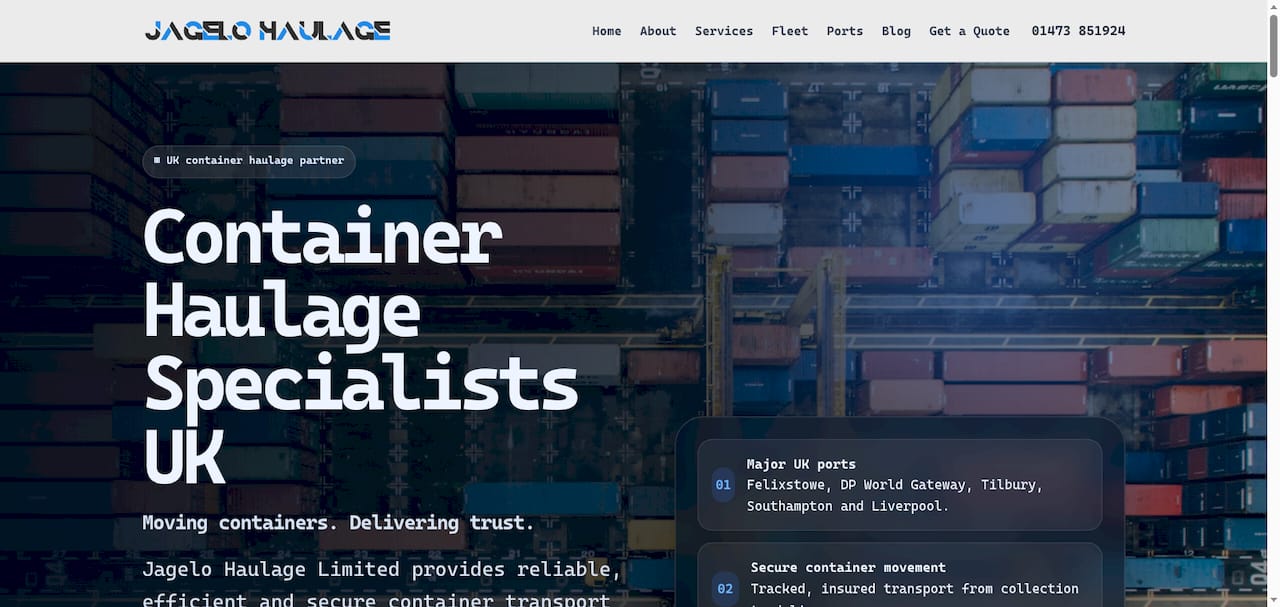
Jhaulage’s fleet of over 40 GPS-tracked trucks and trailers covers Felixstowe, Tilbury, Southampton, Liverpool and the wider UK port network. Every vehicle transmits live location data, so site coordinators receive accurate ETAs rather than estimated windows. TAS slots are managed directly through terminal portals, site access constraints are held in a maintained digital library, and lifting equipment is pre-booked as part of the delivery plan rather than arranged on the day.
For freight forwarders, importers and distribution centre operators who need a haulier that arrives prepared and completes deliveries first time, Jhaulage offers contracted port-to-door services with 24/7 operational support. To discuss your requirements or request a quote, visit Jhaulage’s container haulage page and contact the team directly.
Key takeaways
Effective container delivery scheduling requires a TAS-driven, rolling-horizon plan supported by verified site data, pre-booked equipment, and a disciplined communication protocol from booking through to offload.
| Point | Details |
|---|---|
| Use TAS with soft windows | Soft time windows reduce gate rejections and lower fleet operational costs versus hard-window or manual scheduling. |
| Build and maintain a site library | Digital records of turning radii, ground conditions and access constraints prevent abortive visits on repeat deliveries. |
| Pre-book lifting equipment early | Crane and Hiab availability drives the delivery plan; confirm SWL, lift radius and LOLER compliance before committing to a date. |
| Apply rolling-horizon reoptimisation | Rerun the schedule daily with real-time inputs; static weekly plans break against port congestion and variable unloading times. |
| Jhaulage for UK port haulage | Jhaulage’s GPS-tracked fleet, TAS coordination and maintained site library deliver the practices in this guide across Felixstowe, Tilbury, Southampton and Liverpool. |
The scheduling gap most operators ignore
The conventional wisdom in container logistics focuses heavily on technology: better TMS, smarter route optimisation, real-time GPS. Those tools matter, but the most persistent cause of failed deliveries and excess cost is not a technology gap. It is a data gap.
Operators invest in scheduling software and then feed it site records that were last updated two years ago, unloading time estimates copied from a spreadsheet that nobody owns, and TAS slot data that is manually re-entered from a terminal email. The software produces a plan that looks precise and fails in the field because the inputs were wrong.
The modest investment that removes most of this risk is a maintained site library and a clear owner for the data. Not a platform, not an AI tool — a person or a small team whose job is to keep the records current. Every abortive visit that results from an outdated gate width or an unrecorded overhead cable is a data failure, not a scheduling failure.
The trade-off between speed and cost is real, particularly for same-day operations where scheduling demands are significantly higher. Accepting a slightly longer lead time to secure a validated TAS slot and confirmed site access is almost always cheaper than the combination of an abortive visit charge, a re-delivery fee and the demurrage that accrues while the container waits. Flexibility has a cost; so does speed. The operators who manage this trade-off deliberately, rather than defaulting to urgency, consistently achieve better outcomes.
Useful sources
The following references support the guidance in this article and provide further reading for practitioners who wish to explore the underlying research.
- Optimization of external container delivery and pickup scheduling based on appointment mechanism (PLOS One) — peer-reviewed research on TAS design, soft time windows and penalty mechanisms; confirms the operational case for soft windows over hard-window systems.
- The dynamic stochastic container drayage problem with truck appointment scheduling (Springer) — academic modelling of stochastic variables in drayage scheduling; supports the use of buffers and rolling-horizon frameworks.
- MDPI article on rolling-horizon scheduling frameworks — industry and academic guidance on rolling-horizon planning and batching policies for container logistics.
- Algorithms for shipping container delivery scheduling (arXiv) — foundational research on batching and scheduling policies, including the decoupling of delivery timing from container assignment decisions.
- Inbound Logistics: how agentic AI is redefining route optimisation — practitioner perspective on data hygiene as the prerequisite for effective AI scheduling tools.
- Jhaulage container haulage services — Jhaulage’s service landing page covering UK port coverage, fleet capabilities and contact information for contracted haulage enquiries.
Recommended
- How to Organise Efficient Container Delivery Scheduling in 2026 | Jagelo Haulage
- Scheduled Container Deliveries: A Strategic Guide to UK Port Logistics in 2026 | Jagelo Haulage
- Ensuring On-Time Container Delivery: A Professional Checklist for 2026 | Jagelo Haulage
- Booking a Container Delivery Slot: A Professional Guide to UK Logistics | Jagelo Haulage