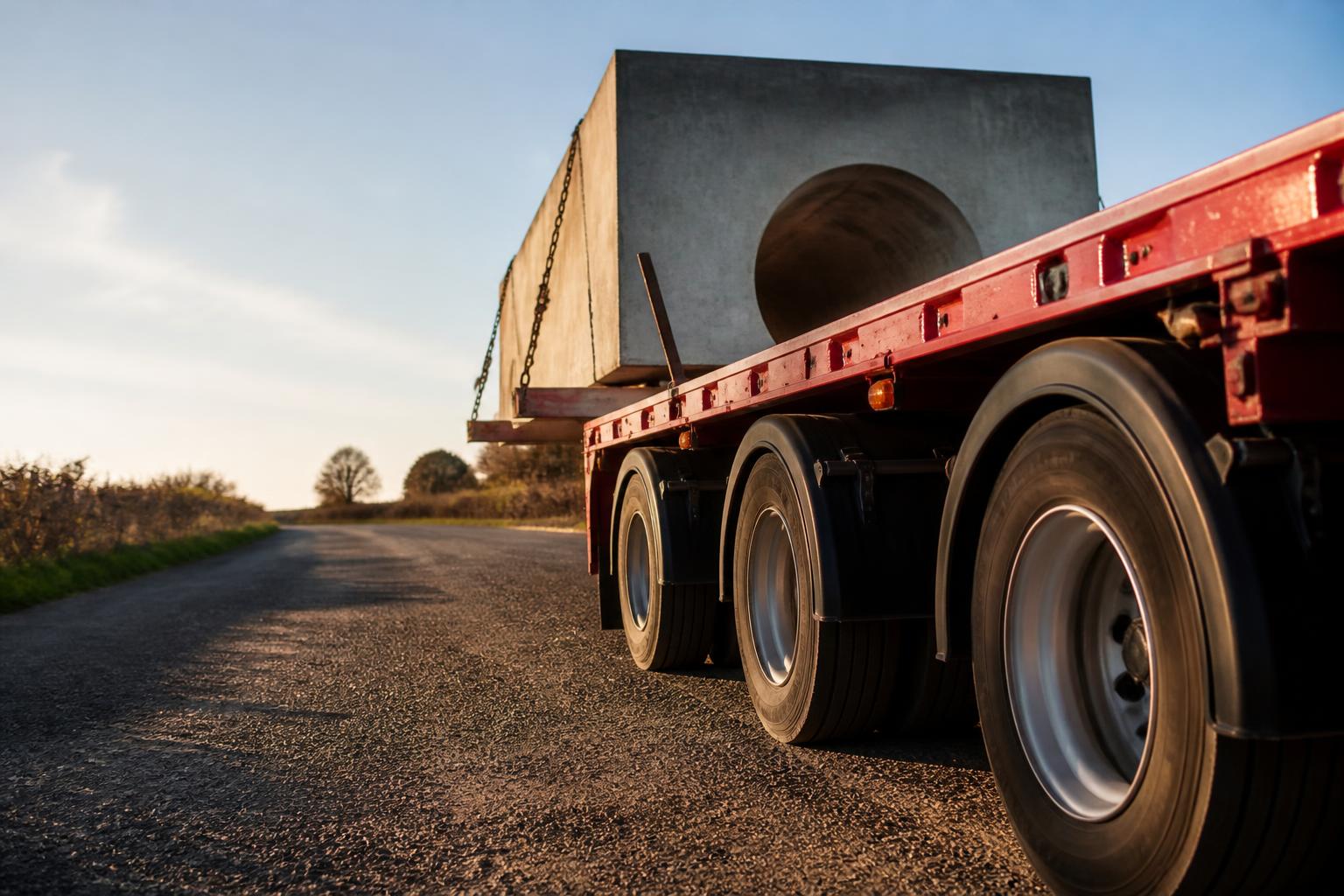
Most port collections are standard road haulage. A container is cleared, the release is in place, the slot is booked, and the box moves on a normal skeletal trailer within ordinary vehicle and load limits. A movement becomes different when the load itself, or the vehicle needed to carry it, goes beyond those limits. That is when we stop talking about routine container work and start talking about abnormal haulage.
For importers and forwarders, the important point is practical rather than academic. If a movement is abnormal, the job cannot just be added to the daily plan with a port booking and a delivery ETA. It may need route surveys, police or highway notices, bridge checks, movement timing restrictions, permits, escort arrangements, and different equipment. That changes lead time, cost, and what information we need from you at the quoting stage.
What abnormal haulage means in Great Britain
In Great Britain, abnormal haulage means moving a load by road when the vehicle, the load, or both exceed the normal limits allowed under the standard construction and use rules for ordinary goods vehicles. In day to day transport planning, that usually means one of three things.
First, the overall dimensions are too large for a standard movement. The load may be too wide, too long, or too high once loaded. Second, the gross weight or individual axle weights may be above what a normal articulated vehicle can lawfully carry on the road. Third, the load may require a specialist vehicle configuration that itself creates an abnormal movement.
That is different from a difficult job or a time critical job. A late release from Felixstowe, a tight warehouse booking, or a heavy but lawful 20ft ISO Container is still standard road haulage if it stays within normal legal limits and can move on ordinary equipment. It may need careful planning, but it is not an abnormal load movement just because it is awkward.
In Great Britain, this area is governed by domestic rules and procedures, not by a single EU wide system. That matters because some readers will deal with cross border traffic and may assume the same thresholds and notices apply everywhere. They do not. Once a load is moving on roads in England, Scotland or Wales, the British rules on dimensions, weights, notifications and road authority involvement are what count.
For us as a container haulier, this distinction matters because our core work is merchant haulage of ISO containers from Felixstowe, London Gateway, Tilbury, Purfleet, Southampton and Liverpool to delivery points across Great Britain. Most of that work is normal FCL collection and delivery on standard skeletal equipment. Even where the cargo inside a container is unusual, the road movement is often still standard because the external unit is a 20ft ISO Container, 40ft ISO Container, 45ft ISO Container or Refrigerated Container moving within normal road limits.
When a load becomes abnormal
The common triggers are width, length, height, gross weight and axle weight. In practice, width is often the first issue people recognise, but it is not the only one and not always the most restrictive.
A movement becomes abnormal on width when the overall width exceeds the normal legal maximum for an ordinary road vehicle and load combination. Length can trigger the same issue if the overall combination or the projecting load goes beyond standard limits. Height is slightly different because there is no single universal bridge clearance guarantee on the road network. A load may be lawful in width and weight but still need abnormal movement planning because the loaded height creates bridge and overhead line risk.
Weight is where many importers get caught out. A container can look ordinary and still create an abnormal movement if the cargo concentration pushes the gross combination weight or the axle loading beyond what a standard artic and trailer can lawfully carry. This is particularly relevant with dense commodities in a 20ft ISO Container. The box itself is standard. The road movement may not be.
Axle weight matters just as much as gross weight. A load can be under a headline gross figure and still be unlawful because too much of that weight sits over one axle or axle group. That is why we need accurate cargo weights and, where possible, loading distribution details. “About 26 tonnes” is not enough if the cargo is a single dense machine or stacked product with a strong front bias.
Height becomes critical where the load is not in a standard container format. For example, machinery on a flat or specialist trailer may be within weight but too tall for a safe unescorted route. Once route planning has to revolve around bridge strikes, utility crossings, tree cover, or local restrictions, the job moves out of ordinary planning.
Overhang and indivisibility also matter. Some loads are abnormal because they cannot be broken down into smaller legal loads without unreasonable effort, cost, or risk of damage. That is a classic feature of abnormal haulage, especially with plant, fabricated steel, transformers, tanks, and large construction components.
By contrast, standard container work is usually straightforward on dimensions. A 40ft ISO Container or 45ft ISO Container may need the right trailer and route awareness, but it is generally not abnormal simply because of its ISO size. If you are comparing equipment options for port work, our guide to choosing the right trailer for port container work explains where normal trailer selection ends and specialist movement planning begins.
What changes once a movement is abnormal
Once a movement falls into the abnormal category, the process changes from routine dispatch to controlled transport planning.
The first change is information quality. We need confirmed dimensions, confirmed weight, axle or point load data where relevant, collection and delivery constraints, and whether the load is divisible. If the movement is ex works, from a quay, or from a temporary site, we also need to know what lifting method is available and whether the loaded height can be reduced by changing orientation or equipment.
The second change is route planning. For ordinary container work, route planning is mainly about traffic, delivery access, port cut offs, and timing. For abnormal haulage, the route itself may need to be engineered around bridge capacities, road widths, street furniture, roundabout geometry, weak structures, low trees, utility apparatus, and local traffic orders. A sat nav route is not a transport plan.
The third change is notices and permits. Depending on the dimensions and weight, the movement may require notification to police forces, highway authorities, bridge owners or other bodies. Some movements require formal orders or permits before they can take place. The lead time can vary sharply depending on the route and the nature of the load. This is one reason why a same day or next day collection that is realistic for standard port work is often unrealistic once the movement is abnormal.
The fourth change is operating controls on the day. These can include restricted travel times, escort vehicles, specific route instructions, weather checks, communication protocols, and site marshals at collection or delivery. There may also be conditions attached to bridge crossings, convoy spacing, or stopping points.
The fifth change is equipment. Standard skeletal trailers are built for ISO containers. Abnormal movements may need step frames, low loaders, extendables, bolster trailers or other specialist combinations. The loading method and securing plan also change. Container twistlocks are one thing. A fabricated steel section, tracked plant item or oversized machine needs a proper restraint plan based on its own shape, centre of gravity and contact points.
This is also where lead time and risk management become much more important. In ordinary merchant haulage, we regularly book the port slot, collect within free time, and keep the importer or forwarder updated if customs, terminal congestion or release timing puts the collection at risk. We cover that process in how UK container haulage avoids port cost and delay. With abnormal movements, the same discipline applies, but there are more moving parts and far fewer shortcuts.
How abnormal haulage differs from container haulage
For port users, this is where confusion often starts. A lot of people hear “specialist haulage” and assume any non standard cargo from a port is abnormal. In reality, most container collections are not.
If the unit is a standard ISO container, correctly plated, within normal road weight limits, and moving on a normal container trailer, it is standard container haulage. That covers the majority of FCL moves from Felixstowe, London Gateway, Tilbury, Purfleet, Southampton and Liverpool. It also covers many LCL deliveries where a degrouped cargo is loaded into a normal curtain or box vehicle after devanning.
A standard port collection usually turns on operational points such as release status, customs clearance, VGM accuracy, quay location, terminal booking availability, and delivery slot timing. At Felixstowe, for example, booking discipline through CARGOES VBS is part of the normal process. Elsewhere, a terminal may use its own Container Booking System or CBS arrangements. Those systems affect when the box can be collected, but they do not make the movement abnormal.
Likewise, container type alone does not decide the issue. A Refrigerated Container can be standard road haulage. So can a 45ft ISO Container, provided the movement is within the applicable legal conditions. The same applies to hazardous or temperature controlled cargoes. They may require extra compliance steps, but they are not automatically abnormal loads.
Where the line is crossed is usually one of two ways. Either the cargo is not moving in a standard container format at all, in which case dimensions and weight may drive an abnormal movement, or the containerised cargo is so heavy that the road leg cannot be carried within normal gross and axle limits on ordinary equipment.
That distinction matters to importers and forwarders because the booking workflow is different. A normal box move can often be planned around release, terminal slot and delivery booking. An abnormal movement may not be capable of collection at all until notices are served, a route is approved, and specialist equipment is assigned.
What to confirm before you ask a haulier to quote
If you need a quote for abnormal haulage, the fastest way to get a sound answer is to send complete movement data at the start. The minimum we need is:
The exact collection point and delivery point, including postcode, site contact, and whether the load is quayside, in a warehouse, on a yard, or on a live construction site.
The load description in plain terms. “Machine parts” is not enough. “One CNC machine on skids” or “three steel beams, indivisible” is useful.
The exact dimensions of each item, loaded if known, including length, width, height and any projections.
The exact gross weight of each item and, if available, axle loads, point loads, centre of gravity, and lifting points.
Whether the load is divisible or must travel as one piece.
Photos, drawings, GA plans, packing lists, and method statements where available.
The proposed loading method and unloading method. Crane, forklift, side loader, HIAB, jacks and skates, or drive on and drive off all affect equipment choice and timing.
Any site restrictions at collection or delivery. Narrow gates, soft ground, overhead cables, one way systems, school time restrictions, banksman requirements, booking slots, PPE rules, and waiting time controls all matter.
Any route sensitivities you already know about, such as weak bridges near site, estate roads unsuitable for low trailers, or a delivery point that can only be approached from one direction.
The target date, and whether that date is fixed or flexible.
If the movement starts from a port but is still container related, say whether the load is moving as a complete container, out of gauge cargo, or cargo devanned from a container before onward transport. For standard container jobs, we also need the usual operational data such as shipping line, container number, release status, customs position, and terminal booking requirements. If you are moving a reefer through London Gateway, our note on getting a reefer box out of London Gateway without delay sets out the kind of information that helps avoid wasted time.
It also helps to be clear about what you want included in the quote. Do you need route survey costs included. Do you want escort provision included if required. Is crane hire by others or by us. Is permit lead time part of the programme already agreed with your customer, or are you still testing feasibility.
At Jagelo Haulage Limited, our day to day work is container haulage, not pretending every specialist move is the same as a port box collection. We operate 40 vehicles and 40 trailers on operator licence OF2023521, with vetted partner hauliers handling overflow on their own licences, and we plan around the real constraints of British port and road operations. That means saying early when a movement is routine, when it needs heavier planning, and when a load has crossed into abnormal haulage.
For standard container traffic, that early call helps protect free time, avoid storage and keep delivery bookings realistic. For abnormal movements, it does something even more important. It stops a load being treated like ordinary road haulage when it plainly is not.
If you are unsure which side of the line your movement sits on, send the dimensions, weight and site details first. We can then tell you whether it is a normal container job, a heavy but standard movement, or a true abnormal haulage operation that needs a different plan from the outset.
Is a shipping container classed as abnormal haulage?
Usually no. A standard 20ft ISO Container, 40ft ISO Container or 45ft ISO Container moved within normal road limits is standard haulage, not abnormal haulage.
Does abnormal haulage always mean STGO?
No. Some movements are abnormal because of dimensions, some because of weight, and the legal basis can differ. STGO is only one part of the picture.
Can a wide load travel on any route?
No. The route has to be checked against bridge limits, road width, street furniture, works, local restrictions and site access before the movement is planned.
What information does a haulier need first?
At minimum: exact dimensions, gross weight, axle weights if known, collection and delivery points, loading method, and any site restrictions at both ends.
Does Jagelo Haulage Limited offer abnormal haulage?
This article explains the subject generally. Jagelo Haulage Limited focuses on container haulage within Great Britain from Felixstowe, London Gateway, Tilbury, Purfleet, Southampton and Liverpool.