Punctuality in the UK logistics sector is rarely the result of good fortune; it is the direct outcome of disciplined operational protocols. With Drewry's World Container Index surging by 23 per cent in early June 2026, the margin for error in your supply chain has never been thinner. You likely understand the frustration of unpredictable port delays and the mounting costs of demurrage and detention charges that follow. Achieving consistent on-time container delivery requires a shift from reactive problem-solving to a rigorous, checklist-driven approach that anticipates disruptions before they occur.
This article provides a professional framework to help you master the essential steps required to guarantee punctual container transport across the UK. By following these established protocols, you can secure predictable delivery windows and eliminate the risk of avoidable port fines. We examine the critical impact of the final EU Emissions Trading System (ETS) phase and outline how a disciplined haulage partner maintains communication to protect your schedule. You will gain the technical insights needed to transform your logistics from a source of uncertainty into a pillar of corporate stability.
Key Takeaways
- Eliminate port collection delays by verifying release PINs and synchronising Vessel Booking System (VBS) slots before the driver reaches the terminal.
- Protect your bottom line from escalating demurrage and detention charges by prioritising consistent on-time container delivery through disciplined scheduling.
- Evaluate haulage partners based on functional reliability indicators, such as Euro 6 engine compliance and the use of real-time telematics for precise tracking.
- Streamline inland logistics by organising unloading areas and staff in advance to ensure immediate vehicle access and efficient container turnaround.
- Utilise professional expertise and modern fleet standards to transform container haulage into a strategic outcome that supports long-term supply chain stability.
Why Punctual Container Haulage is Critical for Supply Chain Stability
Punctuality in modern UK port operations is defined by the precise alignment of vessel arrivals, vehicle booking system (VBS) slots, and warehouse unloading windows. It isn't merely the absence of lateness; it's the execution of a disciplined schedule that protects the integrity of the entire supply chain. For UK manufacturing and retail sectors, the financial impact of "just-in-time" failures can be devastating. A single delayed container can halt a production line or leave retail shelves empty, leading to immediate revenue loss and long-term reputational damage.
Reliable on-time container delivery is the primary defence against escalating port storage and demurrage fees. When cargo sits idle at terminals like Felixstowe or Southampton beyond the agreed "free time," costs accumulate rapidly. These charges are designed to maintain fluid movement through the intermodal freight transport network, but for importers, they represent significant bottom-line erosion. Operational managers who partner with a disciplined logistics provider gain the psychological benefit of security, knowing their cargo is moving according to a structured plan rather than reacting to avoidable crises.
The Hidden Costs of Logistics Delays
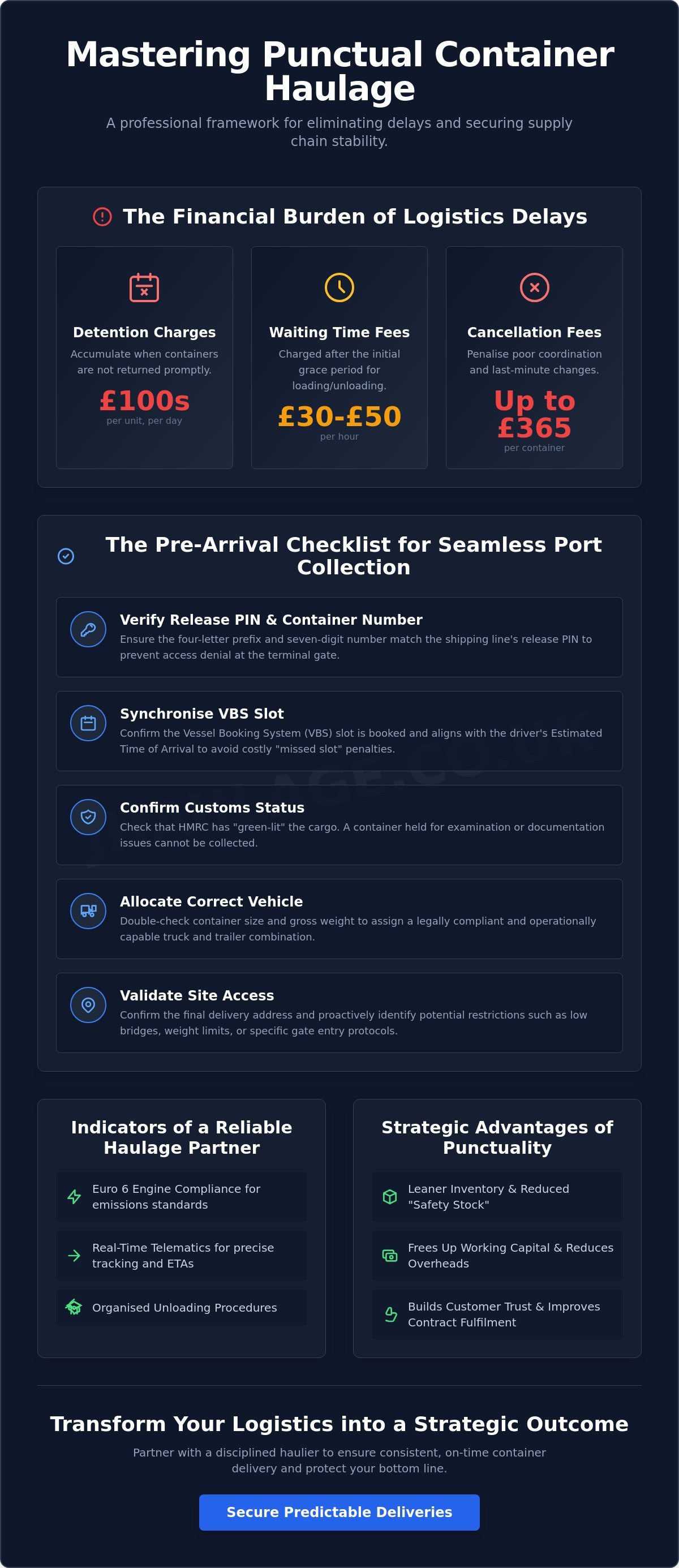
Logistics delays carry a heavy financial burden that extends far beyond the initial freight rate. Detention charges accumulate daily when containers aren't returned to the port within the specified window, often reaching hundreds of pounds per unit. In the UK market, waiting time fees typically range from £30 to £50 per hour after the initial grace period. These costs are compounded by warehouse labour scheduling; if a vehicle arrives outside its window, staff may remain idle whilst still drawing wages. Late cancellation fees, which some carriers set as high as £365 per container, further penalise poor coordination and lack of communication.
Reliability as a Competitive Advantage
Consistency in on-time container delivery allows businesses to adopt leaner inventory management strategies. When arrival windows are predictable, there's less need for expensive "safety stock" to cover potential shipping gaps. This efficiency frees up working capital and reduces warehouse overheads. By working with a professional partner like Jagelo Haulage, companies can build trust with their own end-customers through accurate delivery estimates. A disciplined haulage contractor doesn't just move goods; they act as a strategic partner that enables more precise corporate planning and improved contract fulfilment.
The Pre-Arrival Checklist: Essential Steps for Seamless Port Collection
Achieving consistent on-time container delivery is a process that begins long before a vehicle arrives at the port gates. Meticulous preparation is the only way to avoid the administrative friction that leads to terminal delays and missed windows. A professional haulage operation relies on a specific sequence of verifications to ensure that every collection is executed without disruption. Failure to validate even a single data point can result in a vehicle being turned away, triggering avoidable costs and supply chain bottlenecks.
The following checklist represents the minimum operational standard for preparing a port collection:
- Release PIN and Container Number: Verify that the four-letter prefix and seven-digit number match the release PIN provided by the shipping line.
- VBS Slot Alignment: Confirm the Vessel Booking System slot is booked and synchronised with the driver's arrival time to prevent "missed slot" penalties.
- Customs Status: Ensure HMRC has "green-lit" the cargo; a container held for examination or documentation issues cannot be collected.
- Vehicle Allocation: Double-check the container size and gross weight to ensure the assigned truck and trailer are legally compliant and operationally capable.
- Site Access Validation: Confirm the final delivery address and identify any restrictions, such as low bridges, weight limits, or specific gate requirements.
Document Readiness and Data Accuracy
Inaccurate data is a leading cause of logistics failure. Logistics managers must ensure all container prefixes and check digits are correct to prevent terminal system errors. Meticulous data management is a pillar of resilience, as highlighted in Supply Chain: The Insights You Need. For hazardous cargo, Dangerous Goods Notes (DGN) must be processed well in advance. Utilising scheduled container deliveries helps to prevent these administrative bottlenecks by creating a predictable rhythm for document submission.
Port Protocol and Collection Windows
Understanding terminal opening times and peak congestion periods is vital for maintaining a disciplined schedule. Collection windows are often tight, and merchant haulage requirements necessitate early booking to secure the most efficient VBS slots. Avoiding peak periods between 07:00 and 10:00 can significantly reduce turnaround times. By coordinating closely with your haulage partner, you can navigate these port protocols with quiet confidence. If you require a partner who understands these complexities, you can request a professional haulage consultation to secure your 2026 transport requirements.
Key Performance Indicators for Choosing a Reliable Haulage Partner
Selecting a haulage partner is a strategic decision that requires a move beyond simple rate comparisons toward a rigorous evaluation of operational KPIs. Reliability in the logistics sector is built on measurable standards and technical competence. Achieving consistent on-time container delivery depends entirely on the physical assets a provider maintains and the digital infrastructure they use to manage them.
Evaluating Fleet Capacity and Specialist Equipment
A modern fleet provides the necessary redundancy to absorb unexpected vehicle downtime or sudden surges in demand. Providers maintaining a fleet of over 40 trucks offer a level of operational security that smaller operators cannot match. This capacity must be paired with high equipment standards, specifically Euro 6 engine compliance, to ensure uninterrupted access to London's Ultra Low Emission Zone (ULEZ) and other UK Clean Air Zones. Specialist equipment, such as sliding skeletal trailers, is essential for handling varied container sizes from 20ft to 45ft without compromising safety or efficiency. For businesses requiring reliable container haulage across the UK, these technical specifications are non-negotiable requirements for long-term stability.
Communication Standards and Problem Resolution
Real-time telematics and tracking capabilities are foundational tools for modern supply chain visibility. These systems allow for the precise monitoring of vehicle location and driver behaviour, ensuring that schedules remain on track throughout the day. As noted in the World Bank report on shipping efficiency, operational optimisations at the port-to-inland transition are critical for reducing overall transit delays. You should always request historical performance data and "on-time" success rates to verify a partner's ability to maintain high standards under pressure.
The traffic office serves as the nerve centre of any professional haulage operation. A dedicated traffic manager provides a single point of professional contact, ensuring that communication is direct, factual, and timely. Proactive alerts regarding port congestion or VBS slot availability allow for immediate route adjustments, protecting the delivery window before a delay occurs. This level of responsiveness demonstrates the quiet confidence of a disciplined logistics provider who understands the high stakes of merchant haulage. Rather than offering excuses, a reliable partner provides solutions based on real-time data and established technical expertise to ensure on-time container delivery remains a constant reality.
Best Practices for Streamlining Inland Container Deliveries
Success in the final leg of the journey depends on the readiness of the destination site. Whilst a haulage partner manages the transit, the receiver must ensure the infrastructure is prepared for immediate vehicle entry. A disciplined approach to on-time container delivery requires synchronisation between the traffic office and the site manager. Delays at the point of unloading are a primary source of supply chain friction and avoidable detention costs. Efficiency here is a strategic outcome of site-side preparation.
The following protocols should be established to ensure a fluid transition from road to warehouse:
- Prepare the unloading area to ensure immediate vehicle access upon arrival.
- Organise staff and equipment, such as forklifts or cranes, to align with the scheduled arrival time.
- Communicate site-specific safety protocols clearly to the haulage contractor before the vehicle departs the port.
- Monitor real-time traffic alerts to anticipate local transit issues that may impact the final few miles.
- Implement a clear "drop and swap" or "wait and load" policy to manage vehicle turnaround times effectively.
Destination Management and Site Access
Site managers must conduct a rigorous assessment of physical access constraints before a delivery is scheduled. This includes checking for height restrictions, tight turning circles, and ensuring the ground surface is suitable for heavy container vehicles. A 44-tonne vehicle requires a stable, level surface to operate safely. Understanding these technical requirements is essential for maintaining a fluid operation. Detailed container delivery scheduling helps to optimise site throughput by preventing vehicle bunching and ensuring that every arrival is expected and managed.
Maximising Turnaround Efficiency
Vehicle detention at the delivery point carries significant cost implications, often charged by the hour after the initial grace period. Standardising the check-in process for visiting drivers reduces administrative delays and ensures that unloading begins immediately. For urgent supply chain gaps, utilising same day container delivery requires an even higher level of site readiness to protect the compressed timeline. Every minute saved during the turnaround process contributes to the overall reliability of the on-time container delivery cycle. If you require a logistics partner who prioritises operational discipline, you can request a professional haulage quote to secure your 2026 deliveries.
How Jagelo Haulage Maintains Consistent Delivery Standards
Jagelo Haulage operates with a clear understanding that logistics is the backbone of your corporate reputation. We leverage 15 years of expertise in UK port logistics to deliver a service rooted in functional reliability and technical competence. Our commitment to on-time container delivery is supported by a modern, Euro 6 compliant fleet and a team of disciplined drivers who follow terminal protocols strictly. We maintain a national reach with a focus on core maritime hub connectivity, ensuring your cargo moves efficiently from major ports to any inland destination with methodical precision.
Proactive management is the hallmark of our merchant haulage booking process. We don't wait for issues to arise; our transport office anticipates potential bottlenecks by monitoring port congestion and VBS availability in real time. This structured approach ensures that the administrative requirements discussed in earlier sections are handled with accuracy, protecting your supply chain from avoidable delays. We take pride in our ability to manage the complexities of the UK's intermodal network, providing a steady and predictable flow of goods for our corporate clients.
A Disciplined Approach to Logistics
Safety and security are the primary priorities of every operation we undertake. We don't view container transport as a mere physical task. Instead, we frame our service as a strategic outcome that enables your business to meet its broader operational goals. Our professionally managed transport office acts as a central hub for coordination, providing you with the quiet confidence that comes from working with a seasoned partner. We focus on the fundamentals of punctuality and communication. This ensures that every delivery is executed according to the established plan, allowing your site managers to focus on their core responsibilities without the distraction of logistical uncertainty.
Securing Your Supply Chain for 2026
The logistics sector is currently facing significant shifts, including the final implementation phase of the EU Emissions Trading System (ETS) for shipping. As of 2026, shipping companies must surrender allowances for 100 per cent of verified emissions, a factor that directly influences the cost and scheduling of the entire supply chain. Jagelo Haulage adapts to these changing port regulations and technological shifts by maintaining high equipment standards and operational flexibility. We understand that the margin for error in 2026 is minimal, and we align our protocols to meet these new challenges head-on.
A long-term partnership with a seasoned contractor provides the stability needed to navigate volatile market conditions. We understand the high stakes of your operations and offer a protected outcome for every container we move. By choosing a partner who prioritises performance over self-promotion, you secure a reliable foundation for your 2026 logistics strategy. You can contact Jagelo Haulage for a reliable transport solution that guarantees the safety and efficiency of your container movements.
Securing Your Supply Chain Stability for the Year Ahead
Maintaining a resilient supply chain in 2026 requires a transition from reactive logistics to a model of disciplined operational excellence. Achieving consistent on-time container delivery depends on the precise synchronisation of port protocols, administrative accuracy, and destination site readiness. By implementing a rigorous pre-arrival checklist and prioritising clear communication with your traffic office, you can effectively eliminate the hidden costs of terminal delays and vehicle detention.
Jagelo Haulage provides the technical expertise and physical capacity needed to protect your operations. With over 15 years of industry experience and a modern fleet of more than 40 trucks, we specialise in both merchant and shipping line haulage across the UK's major maritime hubs. Our methodical approach ensures that your cargo moves according to a structured plan, regardless of market volatility or regulatory shifts. We invite you to secure your on-time container delivery with Jagelo Haulage and experience the benefit of a partner who prioritises your strategic outcomes.
We look forward to supporting your logistical requirements with the quiet confidence and reliability your business demands.
Frequently Asked Questions
What is the most common cause of container delivery delays at UK ports?
Administrative inaccuracies and document errors are the primary causes of collection delays. Incorrect release PINs or container prefixes prevent terminal systems from releasing cargo to the driver. These issues lead to missed Vessel Booking System (VBS) slots and avoidable waiting time fees. Maintaining rigorous data standards is the most effective way to ensure on-time container delivery and prevent terminal friction.
How early should I book my container haulage to ensure on-time delivery?
You should aim to book your haulage requirements at least 48 to 72 hours before the vessel is due to dock. This lead time allows your logistics partner to secure optimal VBS slots and allocate the most suitable vehicle and trailer type. Early booking is particularly critical for merchant haulage to avoid peak congestion periods and ensure the driver arrives within the scheduled window.
What information do I need to provide for a merchant haulage booking?
A complete booking requires the container number, the four-digit release PIN, and the precise delivery address. You must also provide the gross weight of the cargo and any site-specific access restrictions, such as low bridges or weight limits. Providing this technical data upfront allows the traffic office to ensure the operation remains legally compliant and efficient from port to destination.
Can you provide same-day container delivery for urgent shipments?
Professional haulage providers prioritise urgent requirements, though success depends on vehicle availability and terminal VBS slot openings. Whilst same-day service is possible, it requires all customs clearances and release documentation to be green-lit immediately upon vessel arrival. Providing all necessary data in advance increases the likelihood of a successful rapid turnaround for time-critical supply chain gaps.
How do port demurrage charges work and how can I avoid them?
Demurrage charges are daily fees applied by shipping lines when a container stays at the port terminal beyond the agreed "free time" period. You can avoid these costs by coordinating a disciplined schedule for on-time container delivery before the vessel arrives. Verifying that the container is cleared for release ensures that the haulage contractor can collect the unit within the free window.
What is the difference between merchant haulage and shipping line haulage?
Merchant haulage allows the importer to choose their own independent contractor, providing greater control over the inland transit and direct communication with the driver. Shipping line haulage is organised by the carrier as part of a bundled rate. Many professional managers prefer merchant haulage because it offers more flexibility and a partner who prioritises their specific strategic outcomes.
How does vehicle telematics improve on-time delivery rates?
Telematics systems provide real-time visibility of a vehicle's location and transit performance. This technology allows traffic managers to monitor progress and provide accurate arrival estimates to the destination site. If local congestion occurs, the traffic office can proactively adjust the route or alert the receiver, ensuring that warehouse staff and equipment are ready exactly when the vehicle arrives.
What happens if my container is delayed due to port congestion?
A disciplined logistics partner will notify you immediately if terminal congestion impacts the collection schedule. This proactive communication allows you to reorganise warehouse labour and unloading equipment, minimising the secondary costs of the delay. Whilst port congestion is often outside of a carrier's direct control, professional management ensures the delay is handled with methodical precision to protect your broader operation.