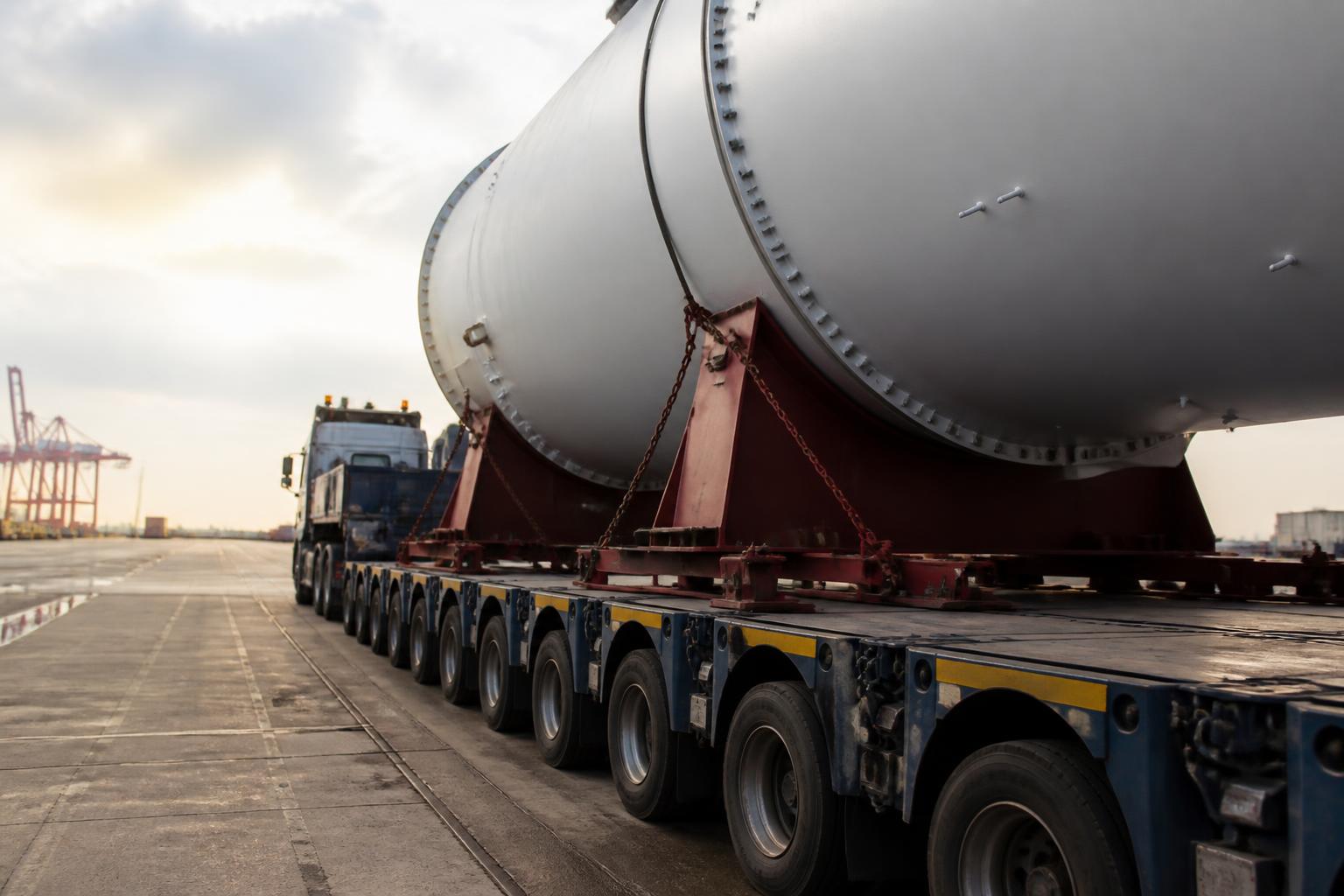
Most container work stays firmly inside standard road haulage rules. A loaded import box from Felixstowe or London Gateway can be heavy, awkward on timing, and expensive if it misses free time, but it is still usually moved on a normal artic at normal dimensions. A load stops being standard when its size or weight takes it outside those ordinary limits and the move has to be treated differently from a routine container collection and delivery.
In Great Britain, that usually means the vehicle, the trailer, the load, or the combination is too wide, too long, too heavy on gross weight, or too heavy on individual axles for normal use without special planning. At that point, abnormal load transport is no longer just a traffic office job of booking a slot, checking release, and sending a driver. It becomes a compliance and route-planning exercise first, and a transport movement second.
What abnormal load transport means in Great Britain
In practical UK terms, abnormal load transport means moving a load that cannot travel within the normal Construction and Use limits for ordinary goods vehicles. The key point is not that the cargo is unusual in a commercial sense. A machine, tank, steel section, modular unit, or plant item becomes abnormal because of how it sits on the road network, not because it is valuable or specialist.
That is different from ordinary road haulage. Standard road haulage covers the loads most importers and forwarders deal with every day, including palletised freight, machinery within normal dimensions, and loaded ISO containers on skeletal trailers. A 20ft ISO Container, 40ft ISO Container, 45ft ISO Container, or Refrigerated Container can still be standard road haulage if the vehicle combination remains within the legal limits for width, length, height, gross weight, and axle weights.
This is where people sometimes blur two separate issues. A container can be very heavy without being abnormal in the legal sense, provided it stays within the normal UK gross and axle limits for the tractor and trailer being used. Equally, a load can be relatively light but still abnormal because it is overwidth or overlength.
Great Britain has its own operating framework. The legal tests and notification rules used here are not simply the same as an EU-wide road move. If a client is used to mainland European practice, it is important to reset expectations. In Britain, police notifications, highway authority notices, bridge checks, and local restrictions often drive the plan. The route that works on paper by mileage may be unusable in practice.
For us as a container haulier, most work is still standard merchant haulage. We collect from Felixstowe, London Gateway, Tilbury, Purfleet, Southampton and Liverpool, book the relevant port systems such as CARGOES VBS or another Container Booking System, often referred to as CBS, and deliver within normal road haulage rules. Abnormal work sits outside that routine and needs a different level of preparation from the start.
When a load becomes abnormal
A load becomes abnormal when one or more legal triggers are exceeded. In Great Britain, the main ones are width, length, axle weight, and total weight.
Width is often the first trigger. Once a vehicle or its load goes over the normal width limit for standard use, the move stops being straightforward. Extra width affects lane position, opposing traffic, street furniture, roundabout use, bridge parapets, and the ability to pass parked vehicles or roadworks. Even where a move is legally possible, the route window can become much narrower.
Length is another common trigger, especially with indivisible items on extendable trailers. Overall length changes the turning circle and the swept path. A route that is simple for a standard artic can fail completely for a long combination that cannot clear a junction, mini-roundabout, or site entrance without crossing into opposing lanes or mounting the kerb.
Weight has two parts. Total gross weight matters, but axle weight matters just as much. A movement can be under an overall maximum and still be impossible because one axle group overloads a bridge, a weak road, or the legal axle limit for that vehicle configuration. This is why abnormal load planning cannot be done from cargo weight alone. You need the actual transport arrangement, including tractor unit, trailer type, axle layout, kingpin position, load position, and likely weight distribution.
In container terms, this is one reason a very heavy import does not automatically become an abnormal load. A loaded container may simply need the right tractor and trailer combination to stay legal. We deal with that distinction regularly in standard port work. If the issue is payload and axle distribution rather than abnormal dimensions, the answer may be equipment choice and weight planning, not abnormal load procedure. Our guide on how much a 44 tonne artic can legally carry explains why gross weight on its own never tells the full story.
The load itself also matters. If it is indivisible, meaning it cannot reasonably be split into smaller legal loads for road transport, that supports treatment as an abnormal movement. If it can be broken down into standard consignments, authorities and route planners will expect that option to be considered first.
Height is another issue in practice, even though abnormal load discussions often focus first on width and weight. A high load can introduce bridge strike risk, overhead cable checks, tree cover problems, and site entry issues. Height planning is route planning, not just a measurement on a job sheet.
What has to be planned before the vehicle moves
Before an abnormal movement starts, the paperwork and route checks need to be in place. This is where the job departs most clearly from ordinary port container haulage.
First, the load dimensions and weight have to be confirmed properly. That means overall width, overall length, travelling height, gross weight, axle weights, and the exact trailer and unit configuration. Estimates are not enough. If the dimensions change after loading, the route and notices may need to change with them.
Next comes the legal basis for the move. Depending on the size and weight, the movement may require notice to the police, highway authorities, and bridge or structure owners. In Great Britain this is a practical compliance step, not an optional courtesy. The notice periods and who must be notified depend on the nature of the load and the route. If a movement falls into Special Types General Order territory, the operating conditions become more specific again.
Bridge checks are often critical. A route may look suitable for width and turning space but fail on structure capacity. That means checking not only obvious major bridges but also smaller structures on local roads, estate roads, and access roads near the delivery point.
Route surveys are frequently needed. For some movements, desk planning is enough. For others, a physical route survey is the only safe way to confirm the move. That survey may need to check junction swing, overhanging trees, road camber, parked vehicle pressure points, pinch points through villages, refuge islands, temporary traffic lights, and whether the site entrance can physically accept the trailer and load.
Restrictions also need checking in advance. These include roadworks, bridge repairs, overnight closures, diversion routes, low bridges, environmental weight restrictions, time-of-day delivery limits, and local access controls. A route that was clear last week may not be clear on the planned movement date.
Escort requirements may also apply depending on the dimensions and route conditions. That can mean private escort vehicles and, in some cases, police involvement where required under the relevant notification framework. We have covered some of the practical thresholds and planning points in when an escort vehicle is needed for a UK load.
Then there is timing. Abnormal movements are often planned around traffic conditions, authority preferences, and local access windows. The shortest path is not always the route that can legally or safely be used at the required time.
That is a very different process from standard container work. In ordinary merchant haulage, we are usually managing release status, customs holds, line free time, VGM history where relevant, terminal slot availability, and delivery booking. We book CARGOES VBS at Felixstowe or the equivalent system elsewhere, collect, and deliver. The planning is still detailed, but it is detailed in a different way.
Why route choice matters more than distance
With abnormal loads, route choice matters more than mileage because road distance is rarely the real constraint. The route succeeds or fails on physical fit and legal fit.
Bridges are an obvious example. A shorter route with a weak structure is no route at all. The same applies to low bridges for tall loads, though height is usually checked separately from weight. One restricted structure can force a complete redesign of the journey.
Street furniture causes problems more often than non-specialists expect. Traffic islands, bollards, signs, pedestrian refuges, parked cars, and barrier systems can all remove the margin a wide or long load needs. A route that looks fine on a map can become impossible when the trailer has to swing through a junction and there is nowhere for the rear to track.
Roadworks are another common issue. Temporary lane narrowing, cones, barriers, shuttle working, and temporary signals can close a route to an abnormal movement even though standard HGVs are still passing through. That matters particularly on longer lead times, where a route checked at booking stage may have changed by movement day.
Turning space matters at both ends of the job. Collection and delivery access can be harder than the trunk road section. Industrial estates built for standard artic traffic may still be unsuitable for a long or overwidth movement. Site gates, internal road widths, overhead structures, and unloading position all need checking. There is no value in getting to the postcode if the last 200 metres do not work.
For this reason, abnormal load planning is often about avoiding risk concentration. A route with more miles but better geometry, stronger structures, and cleaner access is usually the better route. It gives the movement room to stay controlled.
This is also why communication with the delivery point has to be more detailed than a normal booking-in call. We need accurate site information, not just an address and a contact name. If the consignee assumes the vehicle will arrive like a normal container lorry, the problem may only become visible when the unit is already committed to the final approach.
How abnormal loads differ from container haulage
For importers and forwarders used to FCL and LCL movements, the main operational difference is that standard container haulage is built around port process, while abnormal work is built around route process.
In normal container transport, the key controls are release, customs status, terminal booking, free time, equipment availability, and delivery timing. If we are collecting a loaded 40ft ISO Container from Felixstowe, London Gateway, Tilbury, Purfleet, Southampton or Liverpool, the first questions are usually whether the box is released, whether there is a hold, whether the slot is booked, and whether the destination can receive. The work is often time-sensitive because of demurrage, storage, warehouse booking slots, and onward production needs.
The container itself is standardised. ISO containers are designed to fit established transport equipment and terminal systems. Whether the cargo inside is measured in pallets, tonnes, or CBM, and whether it moved as FCL or as devanned cargo after an LCL arrival, the road leg usually uses known dimensions and known handling assumptions.
Abnormal movements are different. The cargo often dictates the trailer, the route, the timing, the notices, and the access method. There may be no routine port slotting issue at all, but there will be much more attention on survey work, authority notifications, bridge assessments, and escort planning.
Another difference is flexibility. In container haulage, if one route is blocked, there is often another viable route that a standard artic can use with limited operational change. In abnormal work, one closure can remove the only practicable option. Replanning is slower because each alternative has to be checked against the same physical and legal constraints.
The commercial risk profile is different too. In container work, the cost exposure often comes from port storage, line detention, quay rent, missed slots, and warehouse delay. In abnormal work, the exposure is more likely to come from failed route assumptions, postponed movement windows, escort changes, and site access failure.
That is why businesses should not assume that a haulier doing routine container collections can automatically undertake abnormal work under the same operating model. The disciplines overlap, but they are not the same. Our core work at Jagelo Haulage Limited is container haulage, especially direct merchant haulage from the major UK ports to inland deliveries across Great Britain. That includes booking collections, managing timing against free time, and flagging risk early when a container is likely to miss plan. If your issue is a heavy container rather than an abnormal one, choosing the right operator and equipment matters far more than simply asking for a bigger lorry. Our article on choosing a bulk container transporter without added port cost is useful on that point.
We operate 40 vehicles and 40 trailers on operator licence OF2023521, with vetted partner hauliers adding capacity on their own licences where needed. Since 2019 we have moved more than 75,000 containers, mainly from Felixstowe and the other major container ports we cover. That experience matters because many loads that worry importers are not abnormal at all, they are simply loads that need the right legal weight planning, the right trailer, and a realistic collection and delivery plan.
The practical test is simple. If the movement can travel within normal dimensions and weights on a standard artic, it remains standard road haulage, even if the cargo is awkward, valuable, urgent, or heavy for its size. Once the load goes outside those limits, abnormal load transport starts, and the route, notices, and compliance steps become the job.
What is classed as an abnormal load in the UK?
A load is generally abnormal when it cannot be divided into smaller parts for road transport and it exceeds normal legal limits for weight, width, length or axle loading.
Is every oversized load an STGO movement?
No. Some movements are abnormal without falling under STGO rules. The exact category depends on the vehicle, axle weights, dimensions and how the load is carried.
Do abnormal loads always need police escort?
No. Escort requirements depend on the route, dimensions, local conditions and notices. Some movements need no escort, while others need private escort arrangements or specific controls.
Can a shipping container be an abnormal load?
Yes, but not in normal container work. Standard ISO containers moved on standard equipment are routine haulage. A container only becomes abnormal if the overall movement exceeds legal road limits.
Does Jagelo Haulage Limited carry abnormal loads?
This article explains the subject generally. Jagelo Haulage Limited focuses on container haulage within Great Britain from Felixstowe, London Gateway, Tilbury, Purfleet, Southampton and Liverpool.