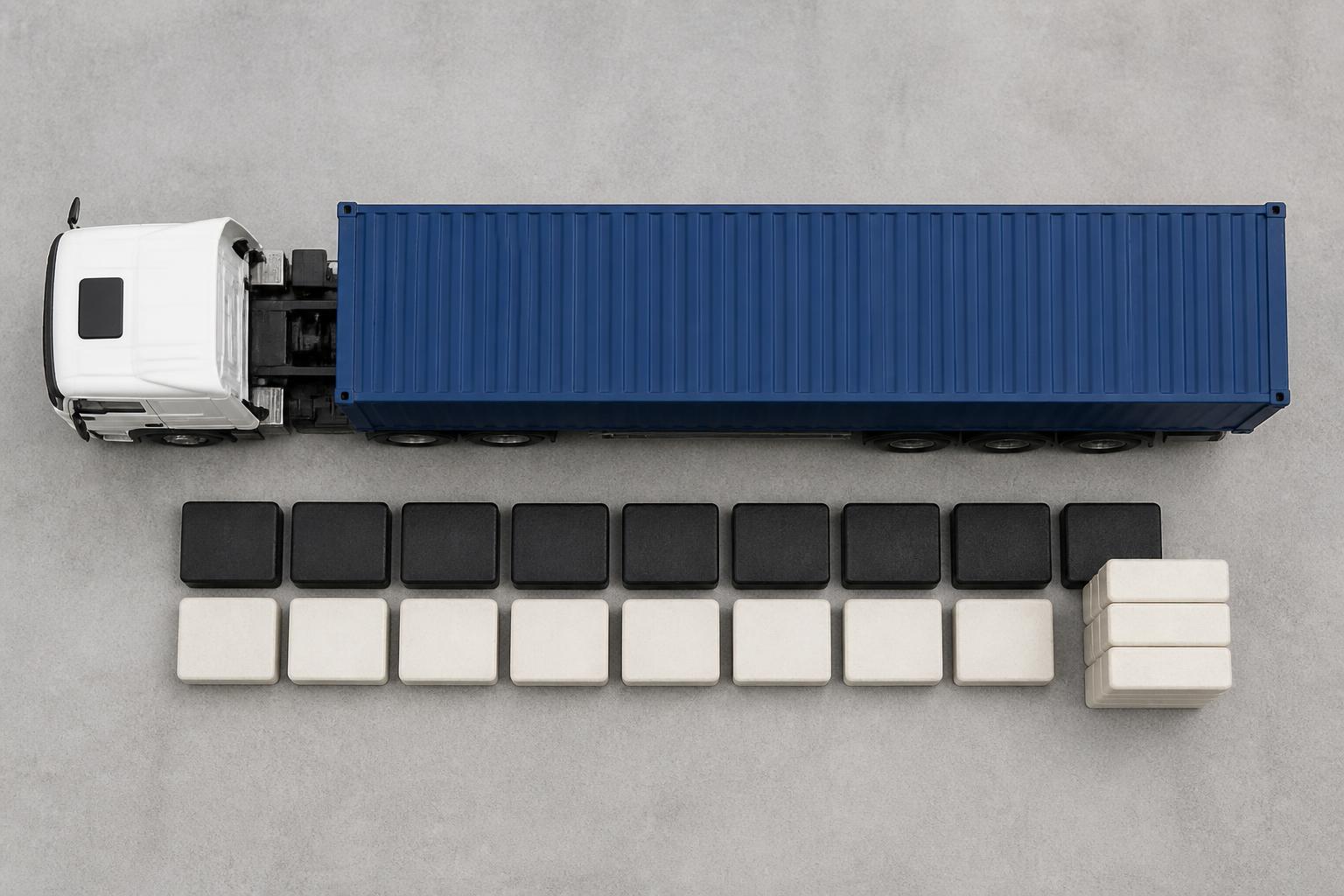
When people ask how much a 44 tonne artic can carry, they are usually not asking about the legal gross weight of the vehicle combination. They want to know the usable payload, in other words what weight of cargo can actually be loaded into the container and still move legally on UK roads.
In practice, the answer is rarely a clean single figure. A 44 tonne artic can be legal at 44,000 kg gross vehicle weight, but the cargo weight available to book depends on the tractor unit, the trailer, the container tare, and how that weight sits across the axles. For container work, the real answer to 44 tonne lorry load capacity is normally somewhere well below 44 tonnes of goods.
What 44 tonnes actually means in practice
In Great Britain, 44 tonnes refers to the maximum gross vehicle weight, or GVW, of the full articulated combination when the vehicle and trailer meet the legal conditions for running at that weight. That gross figure includes everything:
- tractor unit
- trailer
- container
- fuel
- driver
- cargo
- any additional equipment
So if a vehicle is plated to run at 44,000 kg, that does not mean it can carry 44,000 kg of freight. It means the whole outfit must not exceed 44,000 kg on the road.
What importers and forwarders usually mean by 44 tonne lorry load capacity is payload. That is the cargo weight left after deducting the tare weight of the tractor, trailer and container from the legal gross limit.
For container haulage, that distinction matters. A shipper may see that a container line allows a high maximum gross on the box itself, but the road leg still has to comply with UK road law. A container can be valid for sea carriage and still be too heavy for legal road delivery in Great Britain.
The UK position also needs separating from general EU assumptions. You will often see 40 tonnes quoted as the standard maximum for articulated road vehicles in Europe. In Great Britain, 44 tonnes is widely used for six axle artic combinations in domestic operations, including port container work, provided the vehicle configuration is compliant. That is why a box that moves by road in one country may need different planning in another.
For us, the starting point on any heavy booking is simple. We look at the declared cargo weight, the container type, and the likely all-up road weight before the box is collected. If the numbers look tight, we raise it before the port slot is booked, not after the driver has arrived.
How tare weight changes the payload you can book
The easiest mistake is to start from 44,000 kg and forget how much of that is already taken up by the equipment.
A typical container movement includes three separate tare elements:
- the tractor unit
- the skeletal trailer
- the shipping container itself
Even before cargo is loaded, that combination is carrying substantial dead weight. Exact tare varies by specification, fuel level, trailer type and container build, but the principle is always the same. Every extra kilogram in equipment reduces the legal payload by a kilogram.
For example, a heavier tractor with extra kit may be operationally useful, but it leaves less room for cargo. The same applies to trailers. A skelly set up for flexibility across different box sizes may not be the lightest option. Container tare also varies significantly between box types and manufacturers.
This is where a 20ft ISO Container often catches importers out. A 20ft box has relatively modest internal volume, so dense cargo reaches the road weight limit long before the box is full by cube. Stone, tiles, metal products, paper reels, bagged minerals, animal feed, liquids in flexitanks, and many palletised industrial products can all hit the legal road limit while there is still physical space left inside.
By contrast, a 40ft ISO Container or 45ft ISO Container is more often cube-limited before it is weight-limited, especially with lighter consumer goods. You may run out of pallet positions or CBM before you get anywhere near the gross road ceiling.
That is why we ask for cargo weight and container type at booking stage, not just collection reference and delivery postcode. If the declared weight is close to the practical road limit, we need to know whether it is a standard dry box, a heavy tare unit, or a Refrigerated Container, which often carries more tare than a dry van because of the machinery and insulated construction.
The same issue comes up on FCL and LCL work alike. With FCL, the shipper usually knows the cargo weight, but may not have translated that into legal UK road payload. With LCL devans, the receiving site may be focused on the goods weight only, without considering the heavier road equipment around it.
If you are moving particularly dense freight, it is worth checking the likely road payload before loading instructions are finalised. For some commodities, a small reduction in load weight at origin avoids a failed collection, a rework at the port, or a forced transhipment later. On heavy commodities, our team often has the same conversation as in importing granite headstones without avoidable port costs, because the sea leg and the road leg do not fail at the same point.
Why axle weights matter as much as gross weight
A container movement can be illegal even when the total gross weight is under 44,000 kg. That is because axle and axle group limits matter just as much as the overall gross figure.
In practical terms, the legal test is not just "what does the whole outfit weigh?" but also "how is that weight distributed?"
Three things usually drive the problem:
- load position inside the container
- container length and design
- trailer and tractor axle layout
A dense load hard up at one end of the box can overload a drive axle or trailer axle group even though the total gross is still legal. This is common with partially loaded heavy cargo, machinery, stone products, paper, metal stock and any freight where the centre of gravity is concentrated rather than evenly spread.
A 20ft ISO Container is especially sensitive because a very heavy, compact load can create a strong point loading effect. Depending on where the cargo sits and how the box is mounted on the trailer, the axle distribution can become the limiting factor before the gross vehicle weight does.
Container type matters too. A Refrigerated Container has different tare and weight distribution characteristics from a standard dry box. A 45ft ISO Container may present more of a volume issue than a weight issue, but its length and load pattern still affect axle distribution. Even where the cargo itself is not especially heavy, poor stowage can create avoidable axle issues.
This is one reason we prefer early visibility of cargo details. If a shipper says "28 tonnes in a 20ft" we do not treat that as enough information on its own. We need to know what the cargo is, whether it is floor loaded or palletised, and whether the weight is evenly spread. If the weight is all in the first few metres of the box, the move may not be road legal as presented.
At the port, a vehicle can be checked for gross and axle compliance. If the distribution is wrong, being under the top line figure does not solve the problem. The movement still cannot proceed lawfully until the load issue is corrected.
This is also why merchant haulage planning is not just a matter of booking a slot in CARGOES VBS, the Container Booking System, or CBS at other ports. The road leg has to be judged before the truck is sent. If the box is borderline on weight, we would rather challenge it at the desk than discover at collection that it cannot move as loaded.
Typical limits for 20ft, 40ft and 45ft boxes
The practical difference between common ISO containers is not just length. It is the balance between weight capacity, usable volume, pallet count and road legality.
20ft ISO Container
The 20ft ISO Container is the one most likely to become weight-limited before it is full.
In road haulage terms, this is the classic heavy box. It suits dense commodities because the box itself is compact and robust, but that same compactness means it can hit the practical limit quickly. Many 20ft imports are nowhere near full by CBM when they reach the maximum legal road weight.
As a rule, if the cargo is dense, the 20ft box needs proper checking before release from the port. This is where the phrase 44 tonne lorry load capacity matters most in day to day booking, because the customer often assumes "44 tonne truck" means there is ample room for a very heavy 20ft load. In practice, there may not be.
40ft ISO Container
The 40ft ISO Container is more often constrained by volume or pallet count than by pure weight, especially for retail, consumer, packaging and general manufactured imports.
A 40ft box gives much more internal space than a 20ft, so lighter cargoes usually cube out first. That makes it operationally easier in many cases. However, a heavy 40ft still needs checking. If the cargo is dense enough, or badly distributed, axle issues can still arise even where the box is not packed to the roof.
For many standard FCL imports, the 40ft is the most straightforward balance between payload and cube.
45ft ISO Container
The 45ft ISO Container is typically chosen for extra volume rather than extra weight. It is often the right answer where pallet count or CBM is the real constraint. For lighter, high-volume cargo, it can be very efficient.
But the longer box needs delivery site access checking. Not every consignee yard, industrial estate or unloading point is suitable for a 45ft delivery. Tight turns, parked cars, weak surfaces, restricted gates and limited shunt room can all turn a straightforward port move into a problem on arrival.
That is why we ask access questions early, particularly on first deliveries and especially outside major distribution sites. A box that is legal on the road still needs somewhere practical to put the vehicle.
If your cargo is temperature controlled, a Refrigerated Container adds another layer. Reefer tare, genset arrangements if applicable, delivery timing and site unloading readiness all need to be considered. We cover some of those operational points in choosing a reefer container haulier without extra port cost.
What importers should check before the box leaves the port
A good container move is usually decided before collection, not on the quay. Our pre-booking checklist is straightforward and it saves time.
1. Declared cargo weight
Check the actual cargo weight, not an estimate passed along from an early document. If the load is dense, ask whether the weight is net cargo only or includes pallets, dunnage and packing. On a borderline 20ft, those details matter.
If the box looks heavy for the equipment, tell us before we book the port slot. We can then assess whether the move is likely to be legal and practical.
2. Customs status and release
Confirm the box is customs cleared or that the release conditions for collection are met. A truck arriving for a container that is still on hold wastes a slot and can push the move into storage or detention risk.
We need the collection reference, release position and any relevant status updates in time to plan the job properly.
3. Shipping line free time
Know the last free day for quay rent, storage, demurrage or detention exposure, depending on the line and the terminal arrangements. We plan collections against free time and available slots so that at-risk boxes are surfaced early.
That is particularly important when collection windows are tight or when the port booking system is under pressure. If a container needs urgent uplift, we approach it differently from routine work. The same applies where a customer needs a same-day port collection in the UK.
4. Delivery site access
Check whether the receiving site can actually accept the vehicle and container length booked. We need to know about:
- narrow roads
- weight restrictions near site
- timed delivery windows
- forklift availability
- side clearance
- whether the box will be live unloaded or tipped and turned
- any ban on 45ft vehicles
- whether a loaded vehicle may need to stand on site
If there is any doubt, tell us before collection. A failed delivery creates cost very quickly.
5. Collection port
Tell us where the box is being collected from, because planning differs by port and terminal process. We collect from Felixstowe, London Gateway, Tilbury, Purfleet, Southampton and Liverpool, and each location has its own booking pattern, traffic pinch points and terminal workflow.
At Felixstowe, CARGOES VBS governs slot booking. Elsewhere, the Container Booking System may be referred to as CBS or by terminal-specific wording, but the operational point is the same. We need enough notice to secure the right slot and align it with customs release, free time and driver availability.
6. Cargo type and special status
Advise if the goods are waste, animal feed, Category 3 material, ADR, high value or otherwise non-standard. Jagelo Haulage Limited is an upper tier waste carrier and dealer, CBDU471791, and is registered with APHA to carry Category 3 animal by-products, animal feed in shipping containers, quay to premises, U1433815/TRANS. If the cargo needs a particular compliance route, we need that flagged up at booking stage.
7. Liability expectations
If the load is unusually high value, raise that before movement. Our standard freight liability is £6,500 per tonne under RHA 2024 conditions, including subcontracted loads, and up to £10,000 per tonne is available by arrangement. That conversation needs to happen before dispatch, not after an incident.
For importers and forwarders booking direct, that is part of choosing the right merchant haulage setup, particularly where a heavy container is also commercially sensitive. We cover the broader road leg in Full Container Load Haulage in the UK.
A 44 tonne artic does not give you 44 tonnes of cargo payload. In container work, legal carrying capacity is reduced by vehicle tare, trailer tare, container tare and axle distribution. That is why the real answer depends on the box and the cargo, not just the truck category.
At Jagelo Haulage Limited, we plan those checks before collection from Felixstowe, London Gateway, Tilbury, Purfleet, Southampton or Liverpool. With 40 vehicles and 40 trailers on operator licence OF2023521, plus vetted partner hauliers on their own operator licences for overflow, we handle the road leg the way it needs to be handled, by checking the weight, the release, the slot and the delivery point before the container starts generating avoidable cost.
What is the payload of a 44 tonne lorry?
There is no single payload figure. The legal payload depends on the tare weight of the tractor, trailer and container, plus axle distribution. Gross weight and usable payload are not the same.
Can a 20ft ISO Container be too heavy for road haulage?
Yes. A 20ft ISO Container can hit road weight limits well before it is full by volume. Dense cargo is the usual issue, especially where axle weights are tight.
Does a 40ft ISO Container always carry more than a 20ft box?
Not by weight. A 40ft ISO Container usually gives more space, but the legal road payload may be similar or lower once container tare and axle limits are considered.
Why can a load be under 44 tonnes but still not move legally?
Because axle weights can still be exceeded. If the cargo sits too far forward or too far back, one axle group may be overloaded even though the total gross weight is legal.
Who should confirm the weight before container collection?
The booking party should provide the cargo weight and container details, and the haulier should sense-check whether the move is likely to be legal. If in doubt, check before the port slot is booked.