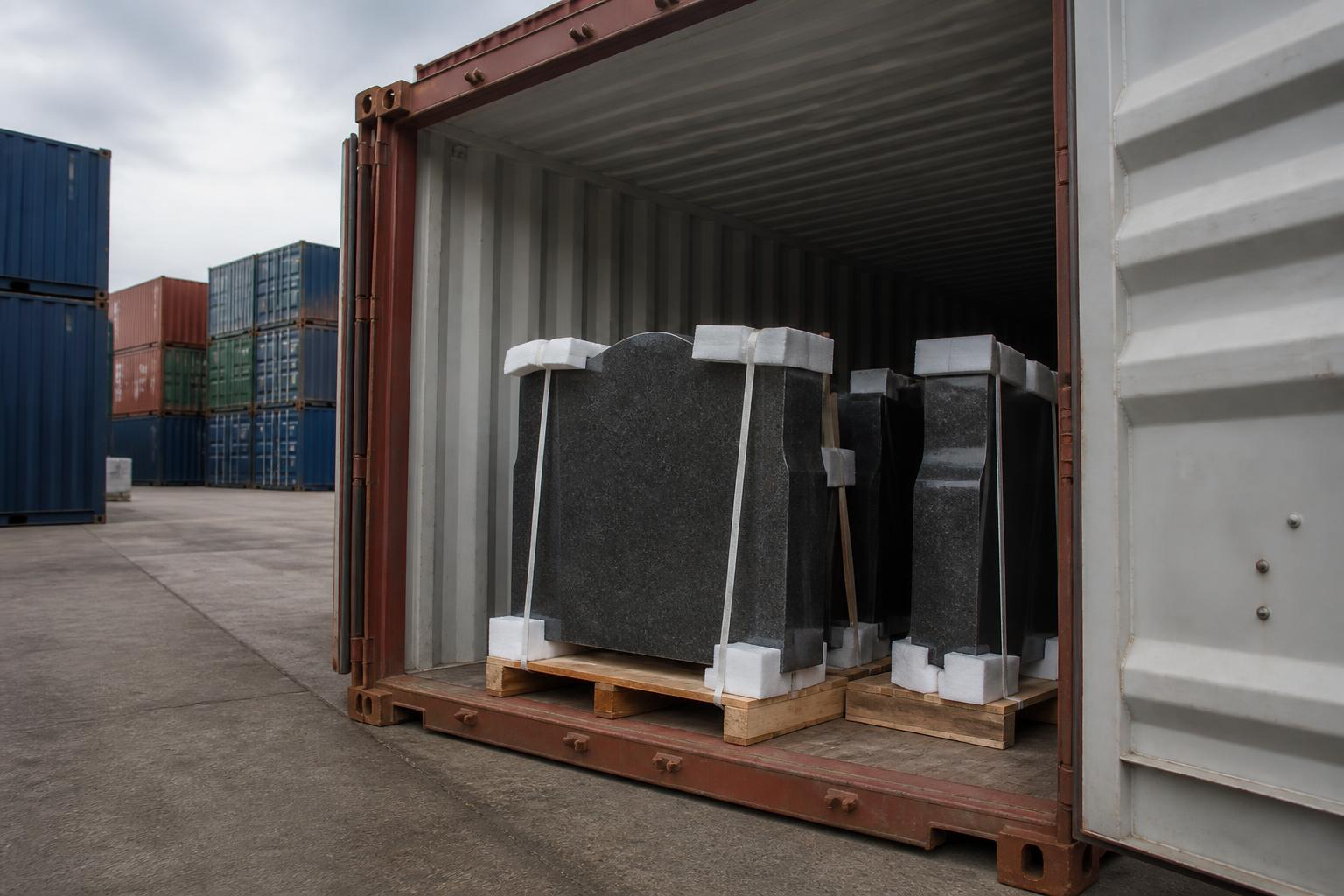
When we are importing granite headstones to the UK, most avoidable port costs come from the same few failures. The box is not fully released when it lands. Customs or line requirements are still outstanding. The container has been packed in a way that slows unloading or creates damage risk. Or the delivery site is not actually ready for a loaded unit that may be heavy, fragile and awkward to unload. Once free time starts running, those small gaps become demurrage, storage, wasted trips and rebooking charges.
Memorial stone is not a routine stone movement just because it travels in standard ISO containers. Headstones are finished items, often polished, shaped, engraved and matched to bases or accessories. A broken paving slab is a claim. A broken memorial is usually a remake, delay to an end customer and a much more difficult conversation. That is why the import work needs to be tighter before arrival, at the port and at the final delivery point.
What makes granite headstone imports different from other stone cargo
Granite headstones sit in a different risk category from rough block, standard slabs or many palletised building stone products. The first reason is finish. A memorial can be structurally sound and still be unsaleable because of edge chips, rubbing damage, face scratching, staining from wet timber, or movement that marks polished surfaces. The second is shape. Uprights, bases, cover slabs, vases and kerb sets do not always stack into a neat cube, so voids inside the container become a real load security issue.
Weight distribution also matters more than many importers expect. A container of memorial stone may not look extreme in volume terms, but it can become axle-sensitive very quickly. A dense load in a 20ft ISO Container can be legal in one layout and a problem in another, simply because too much mass has been pushed forward or concentrated in one section. That is one reason we always want accurate cargo details early, especially gross cargo weight, piece count and how the load has been built inside the unit. If a container is heavy, the planning issues are similar to other dense imports, and our guide to moving overweight containers without port delays covers the practical points.
There is also a delivery difference. Many stone imports go to yards with forklifts, crane capacity and teams used to unloading heavy packs every day. Memorial imports often go to stonemasons, memorial workshops or storage yards with tighter access, smaller lifting equipment and stricter handling requirements. A site may be perfectly capable of receiving the cargo, but only if the load is presented in a workable order and the right machine is on site when the vehicle arrives.
What to sort before the container lands in the UK
Before arrival, the importer should have the document set complete and the delivery instructions clear enough that collection can be booked as soon as the box is available. At minimum, that usually means the commercial invoice, packing list, bill of lading or sea waybill details, commodity code confirmation, customs entry status, shipping line release position and final delivery address with contact details.
For customs, the key point is not just whether an entry has been submitted, but whether it has been accepted and whether there is any hold to clear. In the UK, that means checking the position against HMRC and the port community systems in use for the specific movement, not assuming that a submitted file equals a collectable container. If the goods are selected for documentary or physical checks, we need to know early. A box that is technically on the quay but still under customs control is not a live collection.
Cargo details should be specific. “Granite memorials” is not enough for planning. We need to know the container type, whether it is a 20ft ISO Container, 40ft ISO Container or 45ft ISO Container, the gross weight, number of packs or crates, whether there are loose items, whether the cargo is floor-loaded or palletised, and whether any unloading sequence matters. FCL and LCL movements also need different handling expectations. With FCL, we are usually planning around a full unit direct to the receiver. With LCL, unpack may be at a depot first, which changes timing and responsibility.
The packing list should also tell the receiver what is actually inside, in a way that helps unloading. Piece count, dimensions, weights by crate or pack, and identification marks save time at the door. If the site has to hunt for the right base under three unrelated crates, unloading slows and vehicle standing time rises.
Release status with the shipping line is another common failure point. We need to know whether all charges have been settled, whether the line has issued release, whether any PIN or collection reference is required, and whether the container is under line haulage restrictions or available for merchant haulage. If that is not clear before discharge, free time can start disappearing while people are still asking who can collect the unit.
Finally, delivery information should be checked before the vessel arrives, not on the morning of collection. That means opening hours, booking rules, site access, vehicle restrictions, unloading equipment, whether a side unload is possible or needed, and how long the site expects to take. If timing is tight at Felixstowe, early planning matters, and we have covered that in more detail in fast container collection from Felixstowe when timing matters.
How headstones should be packed inside the container
The safest container movement starts with the pack at origin. Granite headstones should travel in strong timber crates, A-frames or other purpose-built supports suited to finished memorial stone, with the weight carried properly and polished faces protected from direct abrasion. Internal packing should stop stone-to-stone contact and prevent any face from taking point pressure during sea transit.
Inside the container, the load needs three things. It needs even weight distribution, restraint against movement in all directions, and an unloading layout that the UK receiving site can actually work with. Those are related but not identical.
Weight should be spread so the container is roadable and stable. Dense packs all pushed to the front wall create road transport problems. Dense packs all to one side create stability and handling issues. Heavy crates should sit square, on sound dunnage, with enough bearing area to avoid collapse or shift. Voids should be blocked. If there is empty space, the cargo can move under braking, cornering or vessel motion, even where each individual crate appears solid.
Restraint should be more than token lashing. Timber bracing, chocks, blocking and suitable lashings all have their place, depending on the crate design and the voids left in the box. What matters is that the load cannot creep, tip or surge. For memorial stone, that includes preventing rubbing between crate members and finished surfaces if the crate flexes.
Unloading should be considered before the doors are closed. If the first item needed at destination is buried behind unrelated packs, the site may have to strip and restack the container. That increases handling risk and time on vehicle. If a forklift needs fork gaps, the crate base needs to allow for that. If packs are too close to the doors or have shifted against them, opening the unit becomes a safety issue.
Where the importer controls packing instructions, it is worth issuing a written loading specification to the supplier. That should cover crate strength, face protection, maximum crate weights, dunnage requirements, blocking of voids, door-end safety and clear piece marking. It is much easier to prevent a bad pack at origin than to solve it on the quay in the UK.
Where UK port costs usually start to build up
Port costs usually start building before anyone sees an invoice for them. The first trigger is delay in release. If customs clearance, line release or terminal availability is incomplete, collection cannot proceed. Free time still moves. Once the free period ends, demurrage or storage exposure begins, depending on the line and terminal position.
The second trigger is booking failure. At ports such as Felixstowe, access depends on the relevant booking system, including CARGOES VBS. Other ports use their own Container Booking System or CBS arrangements. If the release is late in the day, if the box misses the workable collection window, or if there are no suitable slots left, the next available booking may already be into chargeable time. The same applies at London Gateway, Tilbury, Purfleet, Southampton and Liverpool, even though the systems and cut-offs differ.
The third trigger is customs or examination holds after discharge. A documentary check can stop a box that looked ready. A physical exam can take longer and may also affect delivery planning after release. If the importer, forwarder, customs agent and haulier are not all working from the same live status, time is lost in assumptions.
The fourth is failed delivery planning. A container is collected, reaches site, and cannot be unloaded because the forklift is too small, the yard is blocked, the booking was not made, or the receiver did not understand the weight and handling needs. That can create waiting time, aborted delivery, additional haulage and, if the box is not returned inside free time, demurrage as well.
Missed free time is often treated as a port problem when it is really a communication problem. The practical fix is to work backwards from the last free day, not forwards from vessel arrival. We need release confirmed, customs clear, booking secured, and delivery site ready early enough that any issue can still be recovered. Our article on avoiding extra port cost on Felixstowe container delivery explains how that planning approach reduces charge risk.
How to plan delivery from port to site without damage or delay
Before collection is booked, the haulier and receiving site need the same operational picture. The basic questions are simple. Can the loaded vehicle get in and out? Can the cargo be unloaded safely? Can it be done within the booked time?
Access comes first. We need to know road width, gate width, turning room, overhead restrictions, ground conditions and any vehicle limits. A loaded container vehicle is not a rigid on local drops. If the route includes weak surfaces, steep entries or tight internal turns, that must be raised before the job is planned.
Unloading equipment is next. The site should confirm what machine will unload the container, its safe working load, fork length or lifting arrangement, and whether it can reach the cargo as packed. A machine that can lift one crate in the yard may not be able to extract it from inside a 40ft ISO Container. Where the cargo includes long bases, tall uprights or mixed crate sizes, the site should review the packing list and crate dimensions in advance.
Weight matters at both container and piece level. The gross container weight tells us about road planning. The individual crate or pack weight tells the receiver whether unloading is realistic. This is where accurate CBM figures alone are not enough. Stone is a dense cargo. Two crates with the same footprint can be very different to handle.
Timing should also be agreed properly. If the site closes at 16:00 and takes two hours to unload, a late afternoon port collection may not be workable, even if the road time looks possible on paper. If the site needs notice to arrange labour or lifting equipment, that should be built into the plan before the container is dispatched from port.
For some sites, a container devanning warehouse is the safer answer. For others, direct delivery is fine if the pack is right and the equipment is ready. The right choice depends on the actual cargo and the actual unloading point, not on habit.
When merchant haulage is the better fit for this type of import
For granite headstones, merchant haulage is often the better fit because the importer or forwarder keeps direct control of the collection and delivery timing. That matters when free time is tight, customs status can change quickly, and the receiver has specific unloading constraints. If the box is at risk, we can say so early and act on it, rather than waiting for information to move through several layers.
With merchant haulage, we can work directly from the live release position, the port booking position and the delivery site requirements. If a slot needs to be moved, if a customs hold appears, or if the receiver cannot take the box on the planned day, decisions can be made fast enough to protect free time where possible. That is especially useful on awkward stone imports where one missed step can create both damage risk and port cost.
It also helps with container control. We collect from Felixstowe, London Gateway, Tilbury, Purfleet, Southampton and Liverpool, and we plan around the actual booking systems in use, whether that means CARGOES VBS or another Container Booking System. For importers and forwarders who want the haulier to book the slot, monitor the release and flag risk early, that direct control is usually more useful than a line-managed movement with less visibility.
At Jagelo Haulage Limited, we handle container collections within Great Britain as merchant haulage, using our own fleet on operator licence OF2023521 and vetted partner hauliers for additional volume when needed. We move FCL container traffic every day, including dense and handling-sensitive cargoes where timing and clear communication matter. Our freight liability is set at a higher level than the standard RHA limit, which is relevant when the cargo value per tonne is not routine.
When we are importing granite headstones to the UK, the cheapest container is not the one with the lowest base haulage rate. It is the one that is released on time, booked on time, delivered to a prepared site and returned inside free time, without damage on the way. That comes from getting the documents, packing, booking and delivery plan right before the vessel lands, not after the charges start.
Are granite headstones usually imported as FCL or LCL?
Both are used, but FCL is often simpler for heavy, damage-sensitive cargo. It reduces extra handling and makes packing, weight distribution and delivery planning easier to control.
What is the main risk once the container reaches the UK port?
The main operational risk is delay after arrival: missing release, customs holds, booking delays or site issues can use up free time and lead to demurrage and storage.
Do I need special unloading equipment for headstones?
Usually yes. The receiver should confirm what is arriving, how it is packed and what lifting equipment is available. A standard forklift may not be suitable for all crates or stone pieces.
Should the haulier know the cargo is memorial stone?
Yes. The haulier needs the cargo type, gross weight, packing format and delivery constraints so collection and delivery can be planned properly and risks flagged early.
Can a container be collected before every document is finalised?
Not normally. The container usually needs release and a clear customs position before collection can be booked and completed through the relevant port system.