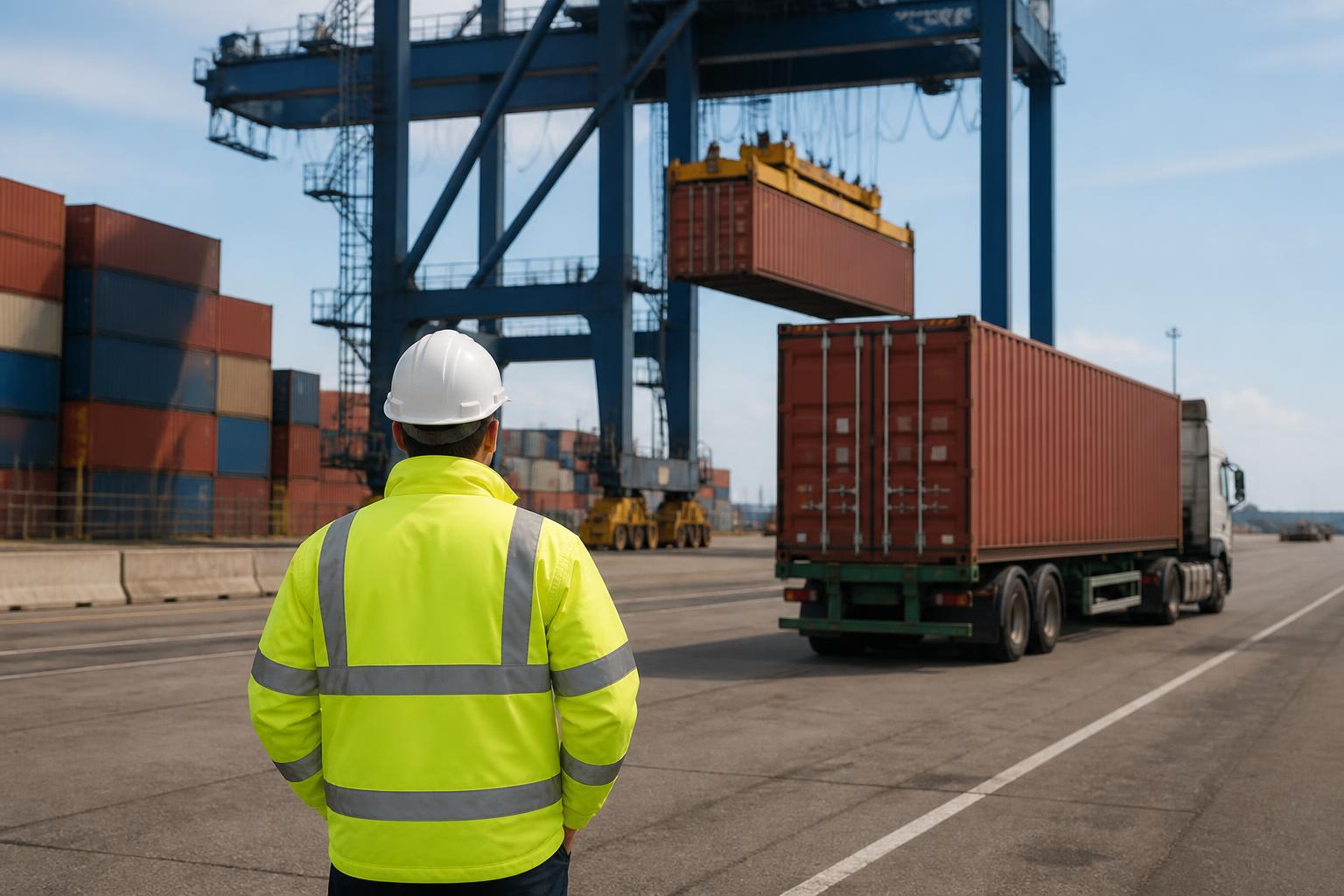
Getting a container off a UK port the same day is possible, but only when the release, customs position, booking slot, vehicle availability and delivery plan all line up early enough. In practice, most failed urgent moves are not caused by the drive itself. They fail because one key reference is missing, the line has not released the box, the port slot is gone, or the delivery site cannot actually receive the unit that day.
At Jagelo Haulage Limited, we handle same-day container collection from port UK work as merchant haulage every week from Felixstowe, London Gateway, Tilbury, Purfleet, Southampton and Liverpool. The quickest collections happen when we are asked early, given the full container and release details up front, and allowed to check the real constraints before anyone assumes the box can move.
What same-day collection actually depends on
A same-day collection is not just a transport question. It is an operational chain, and every link has to be ready.
First, the container must be physically available and released for haulage. That means the shipping line or carrier system must show the unit as cleared for collection, with any relevant line holds removed. If the box is still under line control, under customs hold, or not yet discharged in a collectable status, no haulier can solve that by turning up at the port.
Second, customs must be in order. For UK imports, that usually means the declaration has been accepted and any intervention, documentary query or hold has been dealt with. Where goods are moving under a transit procedure or to a temporary storage or customs-controlled destination, we need that routing agreed before we plan the movement. If the cargo is not customs-cleared for the intended move, a same-day collection is not realistic.
Third, the port booking must be available at the right time. Ports do not work on a simple first-come, first-served queue for road haulage. Access is controlled through booking systems, and the slot has to match the release timing, driver hours, road time and delivery window. If the release comes through late in the day, the port may still be open, but the workable booking slots may already be gone.
Fourth, the delivery point must be ready to receive. We need to know whether the site can accept a laden container, what the cut-off time is, whether there are booking requirements, whether a 40ft ISO Container or 45ft ISO Container can access safely, and whether the consignee can unload on arrival. A same-day port collection is no use if the box then sits on our trailer because the delivery point closes before we can tip it.
Fifth, the container itself must be suitable for the planned equipment and route. ISO containers are not all operationally identical. A 20ft ISO Container can be straightforward, but if it is heavy, axle weights become the issue. A 40ft ISO Container or 45ft ISO Container may be light enough on gross weight but still unsuitable for a restricted site. A Refrigerated Container may need genset planning if the movement or waiting time requires continuous power.
The final condition is vehicle availability with the right operator controls behind it. For urgent merchant haulage, the haulier needs a compliant vehicle, an available driver within hours rules, suitable trailer equipment, and the ability to react if the first plan changes. That is why same-day work is easier to secure with a haulier that books directly into the port systems and runs regular port traffic, rather than trying to arrange ad hoc cover once the release arrives.
The information a haulier needs before booking
To assess and book a same-day move without avoidable delay, we need the job details in one complete instruction, not spread across multiple emails over several hours.
Start with the shipment identifiers. We need the container number, size and type, the port, the shipping line, and the relevant release or collection reference. If there is more than one unit, send all unit numbers together. For FCL, that is usually straightforward. For LCL, we need to know whether the move is the full import container under merchant haulage, or a devanned collection from another point, because the planning is different.
We also need the cargo details that affect legality and routing. That includes gross weight, commodity, whether the cargo is palletised or floor-loaded, and whether anything makes the load unusual. If the container is heavy, tell us the verified gross weight and, where possible, the likely cargo distribution. A legal gross vehicle weight does not always mean legal axle weights, especially on a 20ft ISO Container. If you are moving dense cargo, our guide on moving overweight containers without port delays covers the practical issues that should be checked before the booking is made.
Release status matters as much as the container number. We need to know whether the line has released the box, whether any PIN or collection code applies, whether all charges due to the line have been settled, and whether customs are fully cleared for the intended move. If there is still a chance of a hold, we would rather know that before we book than after the driver is at the gate.
For delivery, we need the exact postcode, site name, contact details, opening hours and latest acceptable arrival time. We also need any booking reference required by the receiving warehouse, any site restrictions, whether a side-loader is needed later, and whether the site can take a full-length artic with a laden container. Many same-day failures happen because the port side is ready but the delivery point has not confirmed receipt.
If the cargo has specialist status, send that early as well. We are registered as an upper tier waste carrier and dealer, CBDU471791, and with APHA to carry Category 3 animal by-products, animal feed in shipping containers, quay to premises, U1433815/TRANS. If the load falls into one of those categories, we can plan it properly from the start rather than revising the move after booking.
For urgent jobs, one message with all key data is best. As a minimum, that message should include:
- Container number
- Port of collection
- Shipping line
- Size and type, such as 20ft ISO Container, 40ft ISO Container, 45ft ISO Container, or Refrigerated Container
- Gross weight
- Customs status
- Line release status and reference
- Delivery address and contact
- Delivery cut-off time
- Any site restrictions
- Any special cargo status
That is what lets us say quickly whether a same-day collection is genuinely achievable.
How port booking and release timing affect the plan
The biggest misconception in urgent imports is that once the vessel has arrived, the container can simply be collected. In reality, release timing drives the whole plan.
If the line release arrives early enough, we can assess transport, secure the port booking and line up the delivery. If the release appears late morning or early afternoon, the move may still be possible, but only if the port slot, truck capacity and delivery window all remain workable. If release comes through near the end of the day, there may be no practical route to collect and deliver the box that same day, even if the distance itself is manageable.
Free time also matters. If the container is already close to the end of line free time or terminal free time, the question changes from convenience to risk control. In that situation, we prioritise whether the box can be legally and practically extracted before storage or demurrage exposure worsens. That is often where a fast decision saves money, even if the delivery itself has to be staged carefully.
At Felixstowe, booking discipline is particularly important. The port uses the Container Booking System, commonly referred to as CBS. In day-to-day operations, many people also refer to Felixstowe CBS or the Container Booking System interchangeably. Whatever term is used, the point is the same, the collection depends on a valid booking slot, and the slot has to fit the release and the road plan. If the release is delayed, the original booking may no longer work. If the booking window has limited availability, we may need to act immediately once the box is released.
That is why same-day work from Felixstowe is often decided by timing rather than mileage. Being about 35 miles by road from the port helps us react quickly, but proximity alone does not override the booking system. Our job is to line up the release, the CBS slot, the driver and the delivery point so the collection is not wasted. We covered that in more detail in our article on fast container collection from Felixstowe when timing matters.
Other ports have their own slot controls and operating patterns. London Gateway, Tilbury, Purfleet, Southampton and Liverpool all require the same basic discipline, check release status, secure the right booking, and match it to a realistic delivery plan. If you are moving inland from Essex, our piece on moving containers from London Gateway to the Midlands explains the planning points that often decide whether the move can happen on the intended day.
Where delays usually happen and how to reduce them
Most delayed or failed collections come from a short list of recurring issues.
The first is customs holds. A declaration may have been submitted, but if customs have not released the goods, the container is not ready. We always recommend checking the actual status before asking for a same-day booking, especially where an examination, document query or routing instruction is still possible.
The second is missing or incorrect references. A wrong container number, an outdated release number, a missing PIN, or a mismatch between the line system and the booking instruction can stop a collection immediately. The fix is simple, send the exact references from the release notice and keep them together in one instruction.
The third is line issues. Sometimes charges remain outstanding, the line has not updated the release, or a change in consignee or agent has created a document mismatch. These problems are common on urgent jobs because everyone assumes someone else has already dealt with them. We would rather check early than have a driver lose the slot at the port.
The fourth is delivery site restrictions. A receiving point may close earlier than expected, refuse late arrivals, require advance booking, or be unsuitable for a full-length articulated vehicle. A 45ft ISO Container may be the right shipping equipment but the wrong unit for a narrow yard entrance. The earlier we know the site conditions, the less likely the port collection is to fail.
The fifth is weight and equipment mismatch. Dense cargo in a 20ft ISO Container can be legal in the box but difficult on UK roads because of axle loading. This is a UK-specific operational issue that often differs from what parties expect from EU road planning generally. A gross weight that looks acceptable on paper can still require a different trailer plan or, in some cases, make the move unsuitable as a standard road collection.
The sixth is poor timing on booking systems. By the time all parties confirm the box is ready, the best slot has gone. This is common where the instruction reaches the haulier only after customs clearance has already been sitting with the forwarder or importer for some time.
To reduce delays, we recommend a straightforward process:
- Confirm customs status before requesting collection
- Send complete release details in one instruction
- State the real delivery cut-off time
- Flag heavy cargo at the start
- Tell us about site restrictions before booking
- Ask for the collection as soon as release is likely, not after everyone assumes it is urgent
For Felixstowe and Essex port work, our articles on urgent container haulage from Felixstowe without delays and same-day planning from Tilbury cover the same pattern in practical terms.
Choosing a haulier for urgent merchant haulage
For urgent merchant haulage, the right question is not just whether a haulier says yes. It is whether they can actually complete the move compliantly, book the port slot themselves, and manage the exceptions when the plan changes.
Start with coverage. If your imports land at Felixstowe, London Gateway, Tilbury, Purfleet, Southampton and Liverpool, you need a haulier that works those ports routinely and can deliver across Great Britain. Same-day work depends on familiarity with the systems, the terminals and the traffic patterns. It is not enough to have a truck somewhere in the country.
Check the fleet and equipment position. We run 40 vehicles and 40 trailers of our own under operator licence OF2023521, with vetted partner hauliers on their own operator licences handling overflow volume where needed. That matters because urgent work needs actual operational depth, not just a booking desk.
Operator compliance should be verified, not assumed, and you can monitor your requirements using the Operator Compliance platform. If you are placing time-critical import work, ask for the operator licence number and make sure the haulier is carrying the work on a proper basis. The licence reference for our own fleet is OF2023521.
Then check freight liability. Standard RHA terms often provide a lower recovery level than cargo owners expect. Our freight liability cover is £6,500 per tonne under RHA 2024 conditions, five times the RHA standard of £1,300, and the same limit applies on subcontracted loads. For higher-value cargo, up to £10,000 per tonne is available by arrangement. If you are moving sensitive or high-value imports, that point should be checked before the urgent movement, not after a claim issue arises.
Also ask how the haulier handles specialist traffic. If the load is waste-related, animal feed, or Category 3 material, the registrations need to be in place. If the move involves a Refrigerated Container, there should be a clear plan for the unit type and any temperature-related handling requirement.
Finally, look for a haulier that will tell you early when the plan is at risk. Same-day port work is not helped by optimistic silence. It is helped by a clear answer on whether the box is released, whether the booking is secured, whether the delivery can still be made, and what fallback is available if one part slips.
We founded Jagelo Haulage Limited in 2019, and the team running the operation has worked in container haulage since 2015. Since 2019 we have moved more than 75,000 containers, around 13,000 a year, across regular and urgent port collections. For importers, forwarders and customs agents booking direct merchant haulage, that experience matters most when the job has to move today, not tomorrow.
If you need a same-day container collection from a UK port, the fastest way to make it happen is to treat it as an operational release-and-booking exercise, not just a transport request. Give us the full release, customs and delivery details early, and we can tell you quickly whether the collection is achievable, what slot is realistic, and where the real risks sit before costs build up.
Can any released container be collected on the same day?
No. Release is only one part of it. The container also needs cleared customs status where required, a bookable slot, available haulage capacity and a delivery plan that can actually be run that day.
Which UK ports does Jagelo Haulage Limited collect from?
Jagelo Haulage Limited collects from Felixstowe, London Gateway, Tilbury, Purfleet, Southampton and Liverpool. Where relevant, the article should link to the matching port page on jhaulage.co.uk.
What details should I send for a same-day collection request?
Send the container number, port, shipping line, release status, customs status, size such as 20ft ISO Container or 40ft ISO Container, delivery postcode, weight and any site restrictions.
Does Felixstowe still use VBS for container collections?
No. At Felixstowe, collections are booked on the Container Booking System (CBS), which replaced the Vehicle Booking System in January 2025.
What cover applies if the load is damaged in transit?
Jagelo Haulage Limited carries freight liability of £6,500 per tonne under RHA 2024 conditions, including subcontracted loads. Up to £10,000 per tonne is available by arrangement.