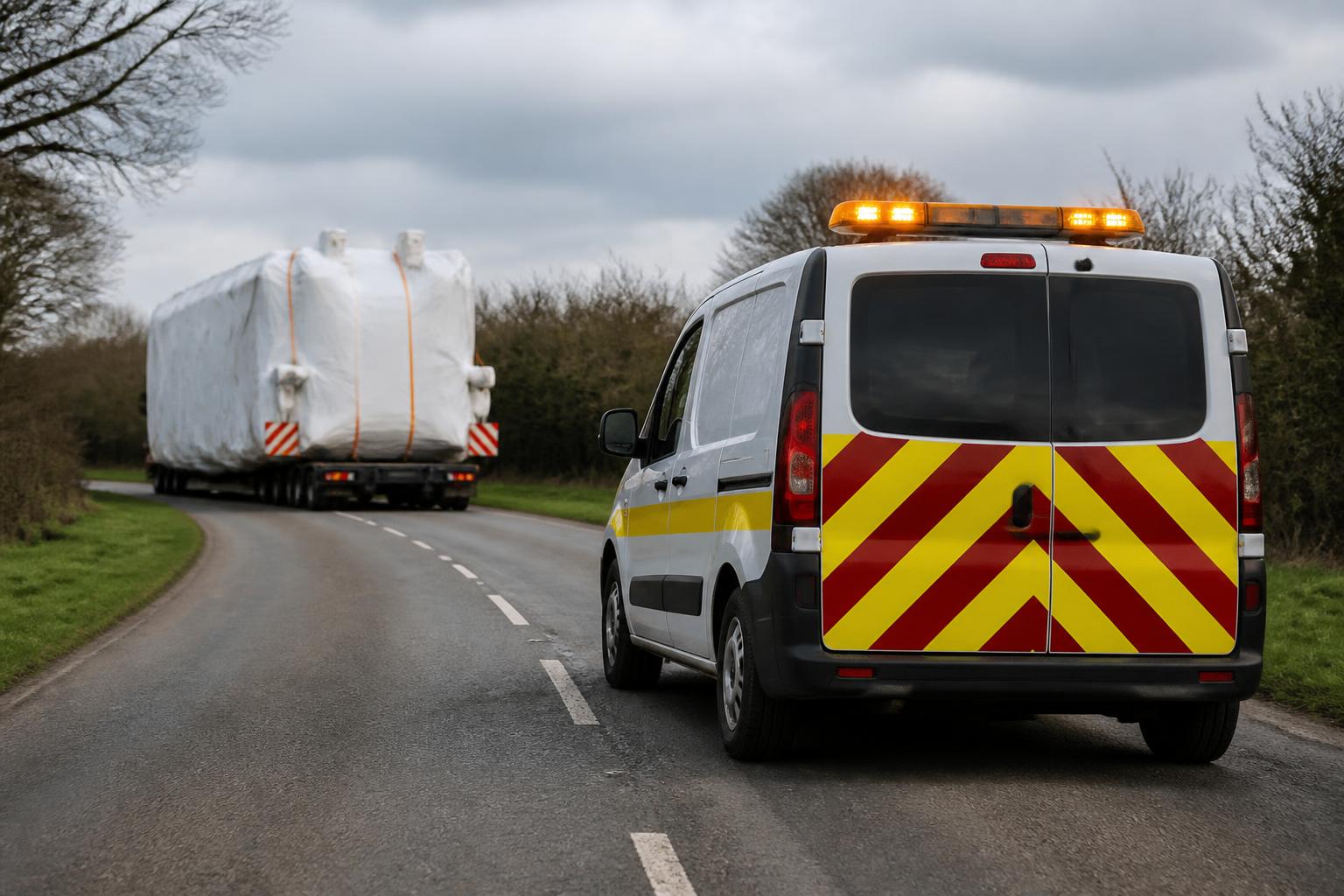
Moving an abnormal load on UK roads is not just a matter of booking a tractor unit and setting a delivery slot. In some cases, an escort vehicle is needed to support the movement, protect other road users, and help the journey go ahead without avoidable delay. Whether that escort is required by the route, by the size of the load, or by site conditions, it needs to be planned properly before the vehicle leaves the port or depot.
For operators moving containers and specialist units through Felixstowe, DP World Gateway, Tilbury, Southampton and Liverpool, the question usually comes up when the load falls outside normal dimensions, involves difficult access, or needs a tightly controlled route. At Jagelo Haulage Limited, we deal with these decisions as part of practical haulage planning, especially where port collections, urgent onward movement and specialist container work overlap.
What an escort vehicle does in UK haulage
An escort vehicle supports the safe movement of a load that presents unusual risk on public roads. In UK haulage, that usually means a load that is over-width, over-length, unusually heavy, difficult to manoeuvre, or moving on a route with known pinch points.
The escort vehicle is there to reduce operational risk in real terms. It can warn approaching traffic, help manage passing points, assist the driver through restricted sections, and provide advance notice of hazards such as parked vehicles, roadworks, sharp bends, low trees, narrow bridges or awkward junction geometry. On some jobs, the escort runs ahead to assess live road conditions. On others, it follows behind to protect the rear of the movement and improve visibility for traffic approaching from behind.
For abnormal loads, the issue is often not only legal dimensions but how the vehicle behaves on the route. A movement may technically fit within one road lane on paper, but still need support because roundabouts are tight, industrial estate access is obstructed, or the trailer swing creates a hazard at turns. An escort vehicle helps the movement stay controlled from collection point to delivery point.
In practice, the escort also supports communication. The escort driver can stay in direct contact with the HGV driver, relay route changes, flag unexpected obstructions, and coordinate with site staff on arrival. That matters where a port collection has to connect with a booked delivery window, a crane offload, or a restricted site opening time.
This is particularly relevant to container-related work because not every container movement is straightforward. Standard FCL port haulage involving a 20ft ISO Container or 40ft ISO Container may not need any special road support if gross weight, route and access are routine. But once the movement involves oversized plant in a flat-rack equivalent arrangement, a specialist unit, a 45ft ISO Container on a constrained route, or a Refrigerated Container going into a difficult urban site, the need for support can change quickly.
When a load may need an escort
There is no single rule that says every abnormal movement must have an escort vehicle. The practical answer depends on the load, the route and the delivery conditions.
A load may need an escort where width is the main issue. Over-width movements are one of the most common reasons for escort planning because they affect lane use, passing clearance and junction negotiation. The wider the load, the more likely it is that traffic management support will be needed, especially on A roads, rural routes with limited verge, or town approaches with street furniture and parked vehicles.
Length can also trigger the need. Long combinations may have difficulty clearing roundabouts, turning into narrow entrances, or crossing junctions without using opposing carriageway space. In those cases, an escort vehicle can help control the movement through the hazard point.
Weight matters too, although heavy loads are often more about route engineering than traffic visibility. If the movement is unusually heavy, bridge capacities, road classifications and local restrictions become central. An escort may be advisable where the route includes sections that require very controlled progress, reduced speed, or close monitoring through sensitive points.
Some loads need an escort because of shape rather than headline dimensions. An awkward load with overhang, restricted rear visibility, or unusual securing arrangements can justify extra support even where the gross dimensions do not immediately suggest it. The same applies to specialist machinery moves connected with port traffic.
Container work can create these situations more often than some shippers expect. A standard 20ft ISO Container, 40ft ISO Container or 45ft ISO Container is not automatically abnormal, but the loaded height, weight distribution, and delivery route may still make the movement non-standard. The same is true where ISO containers are modified, carried on specialist trailers, or delivered into sites with poor access.
Escort planning may also be sensible where the route is difficult even if the load is only marginally outside normal parameters. Examples include:
- narrow village roads with no practical passing place
- urban deliveries with tight turns and street parking
- industrial sites with steep approaches or blind exits
- port to site runs involving temporary diversions
- timed deliveries where waiting on the public highway is not acceptable
- movements entering construction sites, energy sites or secure compounds
For hazardous loads, the analysis becomes more operational. A movement involving a container subject to a Hazardous Goods Requirement may not need an escort simply because it is hazardous, but the route, stopping arrangements, emergency planning and site controls may make an escort advisable. The decision has to be taken against the full risk profile, not one label on the paperwork.
How escort requirements are decided
In the UK, escort requirements are decided through a combination of legal compliance, route assessment and instructions or conditions imposed by relevant authorities. It is not simply a matter of operator preference.
The starting point is the load itself. We need accurate dimensions, axle weights, gross weight, trailer type, load configuration and any overhang details. Without that, no one can make a proper decision. If the movement qualifies as an abnormal indivisible load, the notification and routing process will usually determine what support is needed.
Police are no longer routinely used to escort abnormal loads in the way many operators once assumed. In most cases, private escort vehicles are used where support is required. Police involvement tends to be limited to particular circumstances, and local police guidance may influence how the movement is handled rather than providing the escort directly.
Local authorities can affect the decision where the route passes through roads under their control, especially if there are restrictions, temporary works, bridge concerns, traffic sensitivity or timing conditions. National Highways may also be relevant for motorway and trunk road sections. If a route survey identifies a hazard point, the authority position on that section may shape whether an escort is needed and how the movement is timed.
The route survey is often the real deciding factor. On paper, a load may appear manageable. On the ground, the route may include lane narrowing, weak verges, temporary traffic lights, low structures, overhanging vegetation or turning circles that make unsupported movement impractical. A proper survey turns assumptions into usable instructions.
Site constraints matter just as much. We regularly see movements where the public road section is manageable, but the final mile is the problem. A delivery point may have a narrow gate, internal one-way circulation, overhead services, or no waiting area for a loaded artic. In that case, an escort vehicle may be needed to control the approach, hold the vehicle clear until unloading is ready, or guide reversing and positioning.
This is one area where UK practice should be treated as UK-specific. Operators should not assume that a general EU approach applies. Road authority structures, abnormal load notifications, bridge restrictions and police involvement differ by country. For UK movements, the decision has to follow UK roads, UK authorities and UK operating conditions.
What operators need to plan before the vehicle moves
Before any movement that may need an escort vehicle, the planning work has to be done in full. Leaving decisions to the day of collection is how loads get delayed at the port gate or stopped on route.
First, confirm the actual load data. That means:
- loaded dimensions, including overall height from road level
- gross vehicle weight and axle weights
- trailer type and deck height
- front, side and rear overhang
- whether the unit is sealed, modified or specialist
- whether the consignment is FCL or LCL, if that affects handling or onward site process
For port traffic, we also need to know exactly what is being collected. A booking described loosely as a container job may in practice involve ISO containers with non-standard loading, a Refrigerated Container with site power requirements, or a specialist movement that cannot be treated like a routine port pull. If the consignment details include CBM data only, that is not enough for road movement planning. We need road dimensions and weights, not just shipping volume.
Route checks come next. These should include bridge heights, bridge weight limits, width restrictions, known roadworks, diversion risks, and delivery access. If the movement is borderline or clearly abnormal, a route survey is often necessary. For heavier jobs, bridge assessment and approved routing become critical.
Timing matters more than many customers expect. A movement that is technically possible at midday may be completely unsuitable in peak traffic, at school run times, or during local access restrictions. Some routes are manageable only in early morning windows or outside urban peak periods. Port collection timing has to line up with that reality.
Permits and notifications must be dealt with before departure. Depending on the movement, that can include abnormal load notifications, local authority coordination, route approvals or site permits. Ports and terminals may have their own booking requirements as well. At Felixstowe, booking and collection flow can be affected by systems such as CARGOES VBS, so road planning and terminal timing have to be aligned rather than handled separately.
Delivery access is often where the final decision is made. We need to know:
- whether the site can accept the vehicle size
- whether unloading equipment is in place
- whether there is room to turn or reverse
- whether banksman support is available on arrival
- whether waiting on the road is prohibited
- whether the site has restricted booking windows
If the load is urgent, the pressure to move quickly cannot override these checks. We handle urgent work regularly, but the movement still has to be planned properly. Where timing is tight, what helps most is responsive coordination, not skipped process. That is one reason many customers use our urgent container haulage support from Felixstowe when a booking needs to move quickly without losing control of the detail.
Vehicle readiness also matters. Escort planning is pointless if the haulage unit or trailer is not prepared for the actual route and load. Maintenance, tyre condition, lighting, communications equipment and load security all need to be right before dispatch, especially on specialist or time-critical work, which is why we rely on the HGV247 platform to ensure fleet readiness. Our approach to fleet maintenance for dependable container movements sits directly behind that.
Escort vehicles and container transport through UK ports
Escort planning is not limited to classic abnormal plant loads. It can apply to port-related container work where the unit, route or delivery point creates unusual road risk.
Through Felixstowe, DP World Gateway, Tilbury, Southampton and Liverpool, most standard container collections move as normal road haulage. A routine FCL move with a 20ft ISO Container or 40ft ISO Container, within legal limits and going to a suitable delivery site, will not usually require an escort vehicle.
But there are several port-related cases where escort planning becomes relevant.
One is the movement of oversized units connected with container traffic. That may include out-of-gauge cargo associated with ISO containers, specialist equipment on non-standard trailers, or modified container units going to infrastructure, defence, utilities or construction sites. In these cases, the port collection is only the first stage. The real challenge is often the onward road route.
Another is a 45ft ISO Container where the route or site access is unusually tight. The container itself may be familiar, but the turning space, gate layout or urban approach can make support advisable. The same applies to a Refrigerated Container being delivered into a site with limited standing room, narrow service yards or strict timed access.
Port work involving hazardous cargo can also increase planning complexity. A container subject to a Hazardous Goods Requirement needs the correct documentation, handling process and route discipline. Whether an escort is needed depends on the whole movement, but the decision should be made early, not after the unit is released from the terminal.
Terminal systems and collection windows matter too. If the box is being collected under a booked slot, including through CARGOES VBS where relevant, the escort plan has to fit the terminal timing. There is no value in arranging route support for a movement that then misses its release or arrives outside the workable road window.
For operators moving through these ports, the practical point is simple. Treat escort planning as part of the transport job, not as an extra added later. The moment a movement looks oversized, unusually heavy, difficult to route, or awkward to deliver, the route, permissions and support need to be reviewed together.
That is especially important when port collections are urgent or when the booking has already been delayed by shipping, customs release, quay congestion or delivery pressure. In those cases, clear communication and realistic planning matter more than optimistic promises. If you are arranging collections and want to avoid preventable hold-ups, our guidance on choosing a Felixstowe container haulier without delays covers the operational points that make the difference.
At Jagelo Haulage Limited, we plan container and specialist port movements around the actual load, the actual route and the actual delivery conditions. When an escort vehicle is needed, it should be identified early, coordinated properly, and built into the movement from the start. That is how abnormal and difficult loads move safely through UK roads without creating avoidable risk or delay.
Is an escort vehicle the same as a police escort?
No. An escort vehicle is usually a private support vehicle used to help manage the movement of a load. Police involvement depends on the load, route and any specific authority requirements.
Do all abnormal loads need an escort vehicle?
No. Some abnormal loads can move without one, while others need an escort because of width, length, route hazards, traffic conditions or instructions from the relevant authorities.
Can a container movement need an escort vehicle?
Yes. Most standard container work will not, but an oversized unit, specialist equipment move or difficult access route may mean an escort vehicle is needed.
When should escort planning start?
As early as possible. Operators should confirm load dimensions, route suitability, restrictions and delivery access before the movement is booked in final form.
What information is needed to assess escort requirements?
The key details are load dimensions, gross weight, collection and delivery points, route constraints, timing, and any special handling issues such as a Hazardous Goods Requirement.