Avoid Failed Container Drops in the UK with a Haulier Access Checklist
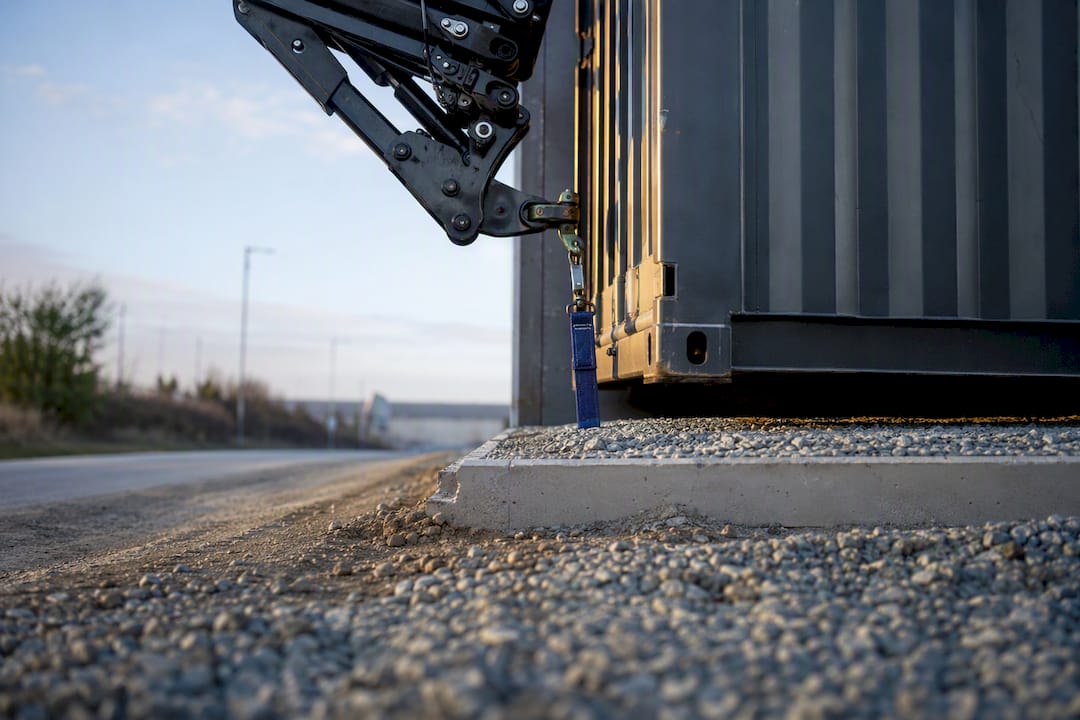
Most UK sites can accept a container delivery without drama, provided access, ground conditions and overhead clearance meet a few straightforward checks. The default method is a HIAB lorry-mounted crane, with an extended-reach artic HIAB or a flatbed as alternatives depending on distance and site layout. Three things stop deliveries: not enough room for the vehicle to get in and turn, ground too soft to bear the load, and overhead obstructions blocking the lift. Before booking, measure your clear widths and gate height, walk the route from road to siting point, and photograph the whole path so a haulier can confirm access properly.
TL;DR:
- Most UK container deliveries using a HIAB require a minimum clear width of 3 to 4 meters, with larger units needing more space for manoeuvres.
- Overhead obstructions like power lines or overhanging branches often cause failures even when ground access appears adequate.
- Ground conditions must be firm and level, such as concrete or tarmac, to prevent sinking or tilting during lift operations.
- Precise measurements and photographs of route and siting points before booking significantly reduce the risk of delayed or failed delivery.
- Urban deliveries into London or restricted areas often need early permits, off-peak scheduling, and careful coordination to avoid delays.
Table of Contents
- How containers are delivered in the UK: HIAB, sidelifter, flatbed and collection
- What access and clearance does container delivery in the UK need?
- Preparing the site: bases, load bearing and door swing
- Vehicle footprints, crane reach and stabiliser space
- Delivery-day checklist and the mistakes that cause delays
- Lead times, pricing factors and getting an accurate quote
- What to check before delivering into London or restricted urban areas
- Jagelo Haulage’s approach to access checks and delivery support
- Why an access check is the cheapest insurance in the whole process
- Get your container delivered without the guesswork
- Sources
- FAQ
How containers are delivered in the UK: HIAB, sidelifter, flatbed and collection
A HIAB is a lorry fitted with its own hydraulic crane and it is the method most UK container deliveries rely on because the driver can lift and position the box precisely without booking a separate crane. The vehicle calls ahead, arrives, lifts the container off the bed, and swings it into place. That’s it. No forklift, no ground crew, no extra plant hire.
Longer or heavier placements, particularly 40ft units or sites where the crane needs extra centre-to-centre reach, call for an extended-reach or artic HIAB. These vehicles trade manoeuvrability for lift capacity, so they need more room to work.
Flatbed or skeletal trailer deliveries are the exception: the container simply sits on the bed and rolls off the back or gets lifted by whatever offload equipment the customer supplies. That means:
- A forklift, telehandler, or ground-based mobile crane must be arranged on-site in advance
- The site itself must be firm and level enough to support that equipment, not just the container
Some businesses collect the container themselves from the port or depot on a hired flatbed, which shifts every access and offload responsibility onto the customer.
What access and clearance does container delivery in the UK need?
Container delivery access in the UK comes down to three measurements: width, length, and height. Get these wrong and the lorry either can’t reach the site or can’t safely position the load once it’s there.
A typical HIAB needs a minimum clear width of around 3 to 4 metres to pass through a gateway or along a driveway; larger artic units need more, so narrow or gated entrances are worth checking twice. Linear access matters just as much as width. A 20ft container needs less manoeuvring room than a 40ft unit, and tight turns or dead-end approaches often force the driver to reverse in, which eats into the space needed for the crane’s stabiliser legs.
Overhead clearance catches people out more than any other factor. Power lines, overhanging branches, and low archways can all block a lift even when the ground-level access looks perfectly fine.
Before contacting a haulier, run through this:
- Measure the narrowest gate or gap along the route, in metres
- Check gateway height against the vehicle and crane’s working height
- Measure the linear distance from the road to the intended siting point
- Note any obstacles (trees, cables, walls) and the surface type underfoot
Pro Tip: Take photos from the road looking toward the siting point, and a couple from the siting point looking back. A haulier can often confirm access from images alone, which saves a wasted site visit.
Preparing the site: bases, load bearing and door swing
Ground condition decides whether a delivery succeeds or gets aborted halfway through. A loaded shipping container weighs several tonnes, and soft or uneven ground risks the box sinking, tilting, or damaging the crane’s stabilisers mid-lift.
Acceptable surfaces include:
- Concrete
- Tarmac
- Well-compacted hardcore
Soft lawns, loose gravel, or waterlogged ground are the most common reasons a delivery gets delayed or refused on arrival.
For permanent placements, a proper concrete pad gives the most reliable long-term base and avoids gradual sinking. For temporary or lower-load situations, compacted hardcore laid to a consistent depth is often enough, provided it’s levelled properly before delivery day.
Door swing is the detail people forget until the container’s already down. Suppliers generally recommend leaving around 10ft (roughly 3 metres) of clear space beyond the container’s footprint so the doors can open fully and there’s room to manoeuvre goods in and out. Skip this and you may end up with a container you technically own but can barely use.
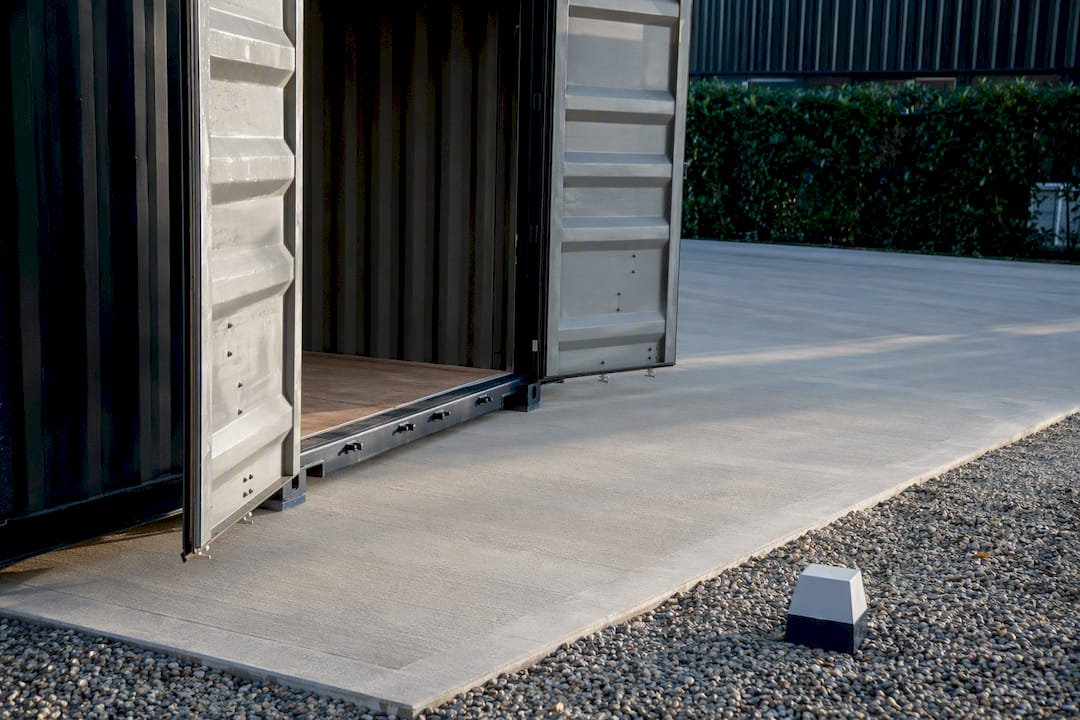
Drainage and levelling deserve equal attention. A container sat on a sloped or poorly drained base will tilt over time, and standing water against the base rails accelerates corrosion.
Vehicle footprints, crane reach and stabiliser space
Rigid HIAB lorries are generally easier to manoeuvre onto tighter sites than artic units, which need considerably more length and turning space to position correctly. A compact HIAB typically offers a working reach of around 10 to 12 metres, while an extended-reach HIAB can stretch to somewhere in the 20 to 40 metre range centre to centre, useful for gardens or plots set well back from the road.
Whichever vehicle is used, the crane’s stabiliser legs need firm, level ground either side of the lorry to deploy safely, so a wide but obstructed strip of tarmac can still fail an access check.
When booking, expect a haulier to ask for:
- Route notes covering any tight corners or narrow lanes
- Known weight restrictions on the approach road
- Height restrictions such as low bridges or overhanging structures
Delivery-day checklist and the mistakes that cause delays
The driver will call ahead, usually 30 to 60 minutes before arrival, so have a named site contact with a working mobile number on hand from the moment the delivery window opens. Follow this order on the day:
- Clear the drop zone of parked cars, bins, or loose materials
- Mark the exact placement point clearly, with paint, pegs, or tape
- Confirm the site contact is reachable and physically present
- Flag any restricted access, low bridges, or local traffic orders to the supplier before the vehicle is booked, not on the day
The most frequent cause of a failed or delayed drop is assuming access is fine without measuring it, only to discover on the day that a gatepost is six inches too narrow. A close second is leaving the site unattended, which stalls the driver and often pushes the job to the back of the queue. Failed deliveries caused by site readiness commonly attract additional charges, so the ten minutes spent measuring beforehand is cheap insurance.
Pro Tip: Don’t forget space for the stabiliser legs either side of the lorry, not just the container itself. A clear driveway with no room either side still counts as restricted access.
Lead times, pricing factors and getting an accurate quote
Mainland UK deliveries using stock vehicles typically run to a 3 to 5 working day lead time once access is confirmed; remote areas, tight urban sites, or anything needing an extended-reach crane usually add extra days for planning and vehicle allocation.
Cost is driven by several variables working together:
- Distance from depot or port to the final siting point
- Vehicle type required (standard HIAB versus extended-reach or artic)
- Whether a paid site survey is needed before booking
- Timed delivery windows, particularly in restricted urban areas
- Failed-delivery or aborted-lift charges if access turns out to be unsuitable
Port container release status also affects scheduling, since a haulier can’t commit a firm delivery slot until the box has actually cleared the terminal, which is why coordinating closely with your freight forwarder matters. For the fastest, most accurate quote, send clear measurements, photographs of the route and siting area, and your final placement instructions upfront. Sharp measurement photos and a short route video remove most of the back-and-forth that otherwise delays a quote.
What to check before delivering into London or restricted urban areas
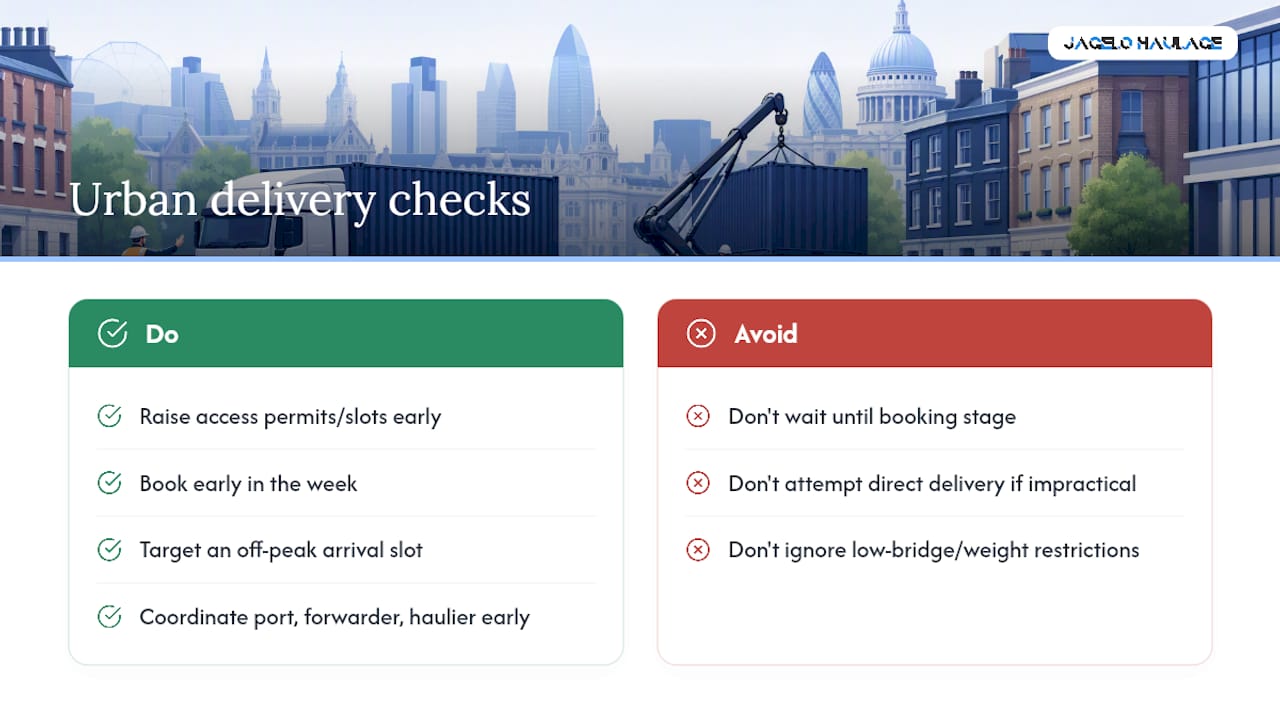
Urban and central London sites carry an extra layer of planning that rural or suburban deliveries rarely face. Congestion charging zones, timed delivery windows, and low-bridge or weight restrictions can all block or delay a straightforward HIAB drop.
Some routes require permits or scheduled access slots, so raise this with your haulier as early as possible rather than at the point of booking. Where direct delivery genuinely isn’t practical, options include interim consolidation at a depot, deliberately scheduling an off-peak arrival, or arranging a last-mile transfer onto a smaller vehicle.
Booking early in the week and targeting an off-peak arrival slot noticeably cuts the risk of local restrictions holding up the lorry. Coordinating early between port, forwarder, and haulier avoids wasted moves, which matter more in dense urban settings where a failed attempt can mean a multi-day rebooking delay. Readers moving containers onto active construction sites may also find our guide to construction site container delivery useful for staging and timing.
Jagelo Haulage’s approach to access checks and delivery support
A modern fleet of trucks and trailers fitted with GPS tracking provides real-time visibility over container movements across major UK ports including Felixstowe, Tilbury, Southampton, and Liverpool, backed by 24/7 support.
The standard access-check workflow is simple:
- Send route and siting photographs along with your measured widths and gate height
- Confirm the preferred delivery window and any known restrictions
- A site survey gets scheduled where the access details raise questions before booking is confirmed
Responsibility on delivery day splits cleanly: the customer clears the drop zone, marks the siting point, and keeps a contact reachable; Jagelo Haulage matches the right vehicle to the job and handles the lift itself. For sites with unusual weight constraints on the approach, our container weight limits guide is worth a read before booking.
Why an access check is the cheapest insurance in the whole process
Send clear photographs and honest measurements before you book, not after. That single step catches most of the problems that abort a lift on the day, whether that’s a gate six inches too narrow or a low branch nobody thought to mention. An aborted delivery costs more in rebooking and lost time than the ten minutes it takes to measure properly, and it’s avoidable in nearly every case. For readers with genuinely tight sites, our tight access delivery guide covers the harder edge cases in more detail.
— Vytautas
Get your container delivered without the guesswork
Tracked container haulage services are available from major UK ports including Felixstowe, Tilbury, Southampton, and Liverpool, matching HIAB, extended-reach, or flatbed vehicles to your site instead of leaving you to work out equipment yourself.
Getting a quote is straightforward: send us your measured widths and gate height, photographs of the route and siting point, and your preferred delivery dates. We’ll confirm the vehicle needed and flag anything that needs a site survey before the job is booked, keeping the process honest from the first message. A well-maintained fleet also matters here. Well-serviced vehicles handle stabiliser deployment on uneven ground far more reliably, which is worth understanding via this fleet maintenance checklist if you’re curious what a haulier should be checking. Head to Jagelo Haulage to request your access check and quote today.
Sources
- Container Delivery UK | HIAB & Flatbed Options | Bosh Boxes
- UK-Wide HIAB Container Delivery — Nationwide from Phil’s UK Depot Network
- What Access Do You Need for a Shipping Container Delivery, A Practical Guide
- How To Plan Container Delivery Into London
FAQ
How much does it cost to deliver a 20ft container in the UK?
Cost depends on distance, vehicle type, and whether a site survey or timed delivery window is needed, so figures vary widely between jobs. Sending accurate measurements and photographs upfront is the fastest way to get a firm, comparable quote from a haulier.
Do I need planning permission for a shipping container in the UK?
It depends on how the container will be used, how long it stays, and its position relative to boundaries, since permanent structures and certain locations trigger planning rules that a simple storage box on a driveway typically wouldn’t. Check with your local planning authority before committing to a permanent siting.
Can I live in a shipping container in the UK?
Using a container as permanent residential accommodation generally requires planning permission and compliance with building regulations, since it counts as a change of use rather than simple storage. This is a matter for your local planning authority, not something a haulier can advise on.
How much does a 40ft shipping container cost in the UK?
Container purchase price sits outside what a haulier quotes, since haulage covers transport and delivery, not the unit itself. What does scale with a 40ft unit is the delivery side: it typically needs more linear access and a longer-reach vehicle than a 20ft container, which affects the haulage cost specifically.
What causes a container delivery to fail on the day?
The most common causes are insufficient vehicle access or turning space, ground too soft to bear the load, and overhead obstructions blocking the crane’s lift path. Measuring access and sending photographs before booking catches nearly all of these in advance.