Tight access deliveries: how to plan a UK container drop
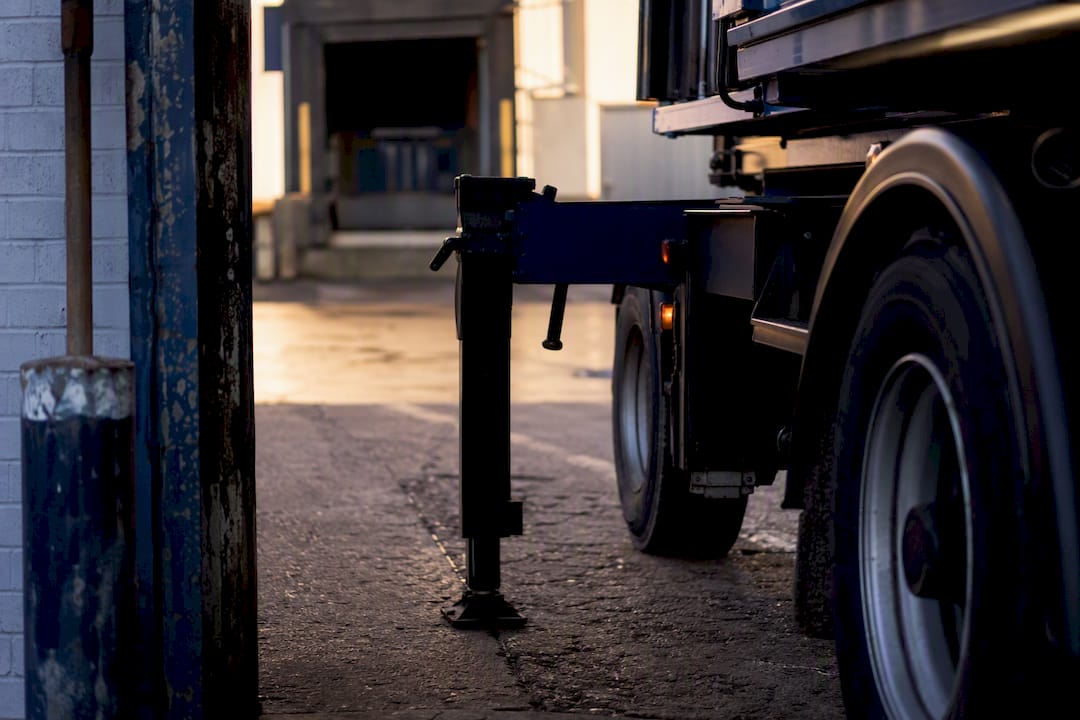
Tight access deliveries are container movements into sites where narrow gates, low overhead clearance, tight turning circles or soft ground rule out a standard rigid trailer drop. The immediate action is straightforward: book a specialist HIAB or sidelifter haulier, arrange a pre-delivery site survey, and send accurate measurements and photographs before the vehicle is booked, not after.
Two things matter before you go further:
- Measure your gate width, approach route and vertical clearance, and photograph any pinch points.
- Confirm port release status and share both with your haulier at the same time you request the slot.
Get those two right and most access failures never happen.
Key Takeaways
Tight access deliveries succeed when accurate site measurements, the right lift method and clear documentation are agreed with the haulier before a vehicle is booked.
| Point | Details |
|---|---|
| Measure before you book | Confirm gate width, vertical clearance and approach route, not just the drop point. |
| Know the clearance minimums | Plan around roughly 3.1 metres width, 4.5 metres vertical clearance and 1.8 metres of stabiliser space per side. |
| Match vehicle to site | Use a sidelifter for parallel access on firm ground, a HIAB where the drop point sits behind an obstacle. |
| Ground prep prevents refusal | Confirm bearing capacity and lay trackway or bearers where ground is soft. |
| Choose a specialist haulier | Jhaulage runs HIAB and sidelifter equipment with GPS-tracked fleet coverage across major UK ports for constrained-site placements. |
Table of Contents
- What are the minimum clearances for tight access deliveries?
- What vehicle should you use for restricted sites?
- Who is liable if a driver refuses to offload?
- How should freight forwarders plan a tight access booking?
- What experience actually looks like on a difficult drop
- Book a specialist haulier before the gate becomes a problem
- Sources
What are the minimum clearances for tight access deliveries?
Every constrained site has a hard floor of clearances beneath which a specialist vehicle simply cannot operate safely, and knowing these numbers before you call a haulier saves a wasted trip.
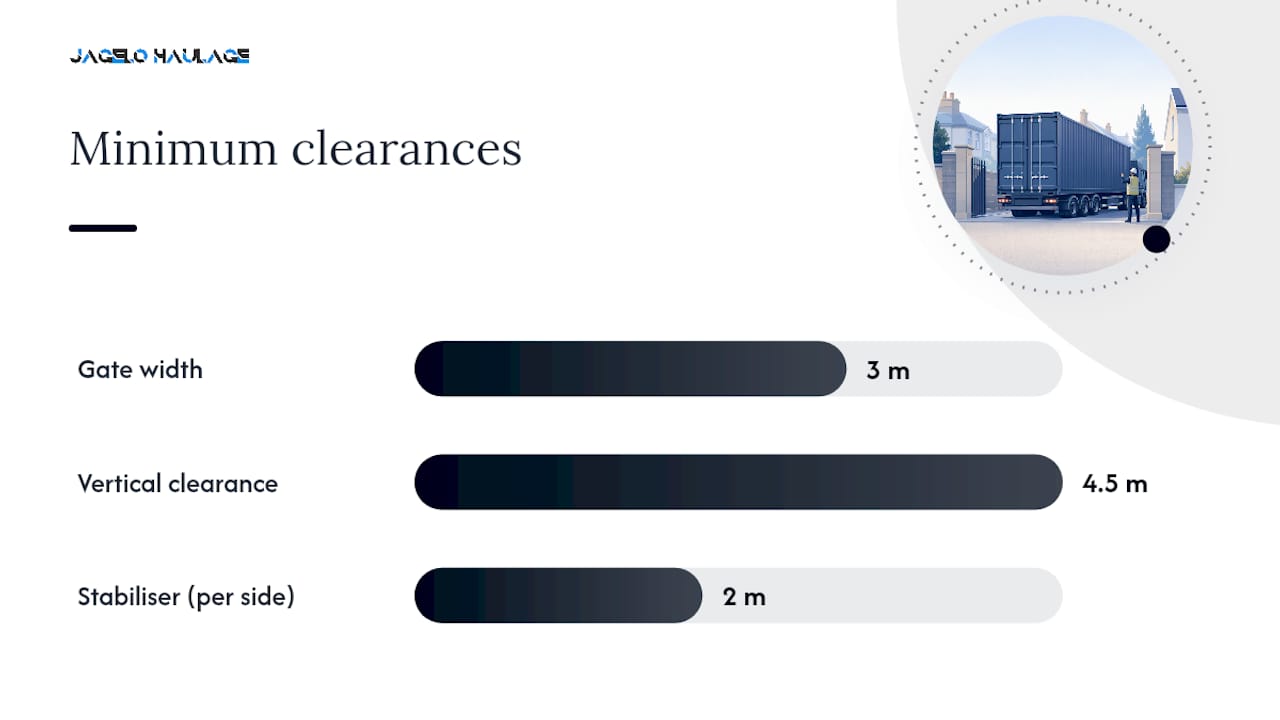
As a working guide, trucks need roughly three metres of width to pass through a gate or gap without contact, and around four and a half metres of vertical clearance for the vehicle and any raised container to clear overhead obstructions. A HIAB offload adds a further requirement: the outriggers typically need nearly two metres of stabiliser clearance on each side of the vehicle to deploy safely, which is easy to overlook on a site where the gate itself is wide enough but the yard beyond it is not.
Turning circle is the other figure that catches planners out. It is not enough to confirm the vehicle can enter the site. You need to check it can also reverse, swing, or exit without a three-point manoeuvre that a loaded articulated unit simply cannot perform. Distinguish the approach route from the drop point itself: a site can have a generous concrete pad for placement and still fail because the lane leading to it has a blind bend or a parked skip.
Before booking, measure and photograph:
- Gate width and height, taken at the narrowest point, not the widest.
- The full approach route, including any bends, overhanging trees or scaffolding.
- The proposed drop point surface (concrete, hardcore, grass, tarmac).
- Any overhead cables, signage gantries or building overhangs along the route.
Ground condition deserves equal weight to width. A hardstanding rated for occasional van traffic will not necessarily support a loaded 20ft or 40ft container plus the outriggers of a HIAB lorry, and this is one of the most common reasons deliveries are aborted on arrival, according to S Jones Containers’ delivery guide.
What vehicle should you use for restricted sites?
The vehicle choice usually comes down to three questions: can it get parallel to the drop point, does the ground support outriggers, and how far does the container need to travel from kerb to final position.
- HIAB lorry. Choose a HIAB when the drop point sits behind a wall, fence or other obstacle the vehicle cannot reach directly, since the crane’s lateral reach lets the container be lifted over an intervening barrier. It needs firm, level ground for the outriggers and the stabiliser clearance mentioned above.
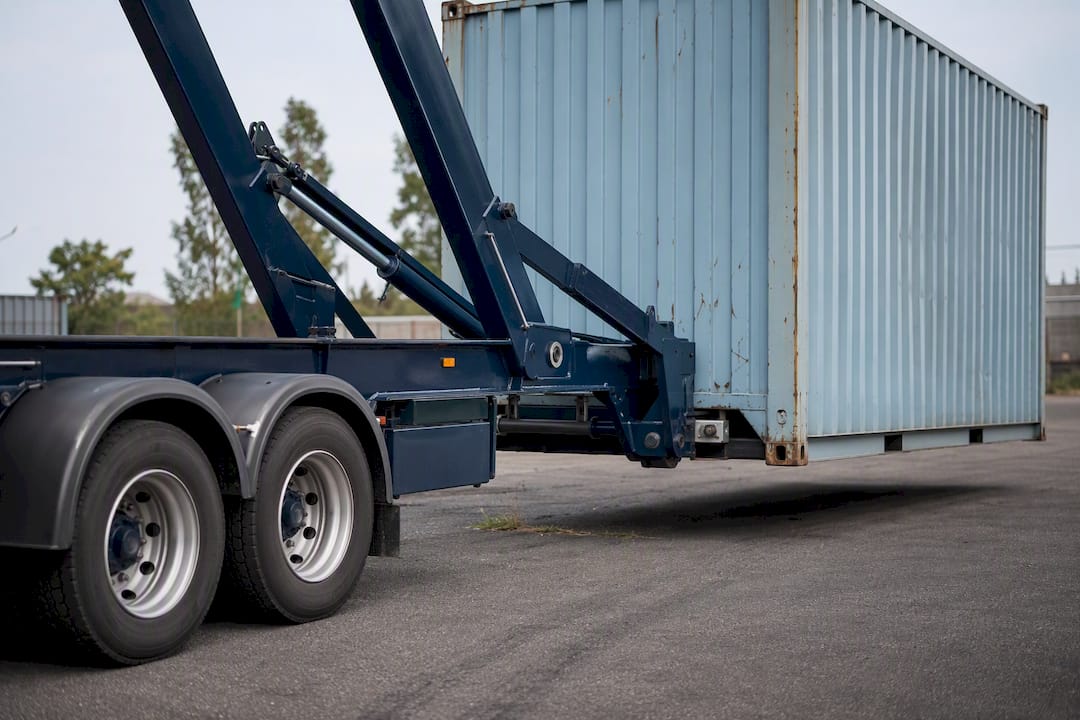
- Sidelifter (self-loading vehicle). A sidelifter is the more efficient choice when the vehicle can park parallel to the placement spot and the ground is suitable, because it lifts common container sizes, 20ft, 40ft and 45ft, and lowers them straight onto the ground without a separate crane, according to Containerlift’s port-to-site guide. That cuts mobilisation cost and removes a layer of choreography that can go wrong.
- Rigid or wagon and drag. Suited to sites with reasonable access but tighter turning circles than a full articulated trailer can manage, often used where the final few metres still need a HIAB or sidelifter to finish the placement.
- Container movers and skates. For the last few metres inside a yard or warehouse where no vehicle can turn, specialist container movers or skate systems reposition the box without further crane lifts.
Container length and gross weight decide the route as much as the drop point. A 40ft unit at maximum weight forces a wider turning check and often a different approach road than a lighter 20ft box, which is why weight and dimensions belong in the initial booking conversation rather than being confirmed on the day.
Pro Tip: If your site allows parallel parking but has a firm, level surface, ask specifically for a sidelifter quote before defaulting to a HIAB. It is often the simpler and more cost-effective option where the ground supports it.
Who is liable if a driver refuses to offload?
Drivers have the final say on whether a delivery is safe to complete, and refusal is not negotiable once genuine hazards are present.
The most common refusal grounds are soft or unverified ground, unexpected overhead obstructions discovered on arrival, and proximity to live power lines, all recognised operational limits rather than driver discretion, according to goBig Site Services. Some hauliers apply an exclusion distance of up to 20 metres from live overhead cables before a HIAB crane will operate, and this should be checked against local distribution network operator guidance well before the delivery window is booked, not discovered on the day.
Ground-bearing capacity is a site-owner responsibility. If you cannot state with confidence that the surface will hold a laden vehicle and its outriggers, commission a check or lay temporary trackway, concrete or timber bearers first.
- Confirm bearing capacity in writing before the slot is booked.
- Share RAMS (risk assessment and method statement) documentation with the haulier in advance.
- Flag any overhead lines, gantries or low bridges on the approach, not just at the drop point.
Pro Tip: An aborted delivery due to unsuitable ground or undisclosed hazards typically carries a redelivery charge. Sending accurate site information upfront costs nothing and avoids that bill entirely.
How should freight forwarders plan a tight access booking?
A clean booking comes down to giving the haulier and terminal everything they need in one pass, rather than in a chain of follow-up calls once the vehicle is already committed to a slot.
- Site deliverables. Send annotated photographs of the gate, approach route and drop point, gate width in metres, and a simple mark-up showing exactly where the container should sit and which way the doors should face.
- Slot and contact details. Confirm the booked arrival window, a named on-site contact who can meet the driver, and a fallback number in case the route is blocked on the day.
- Contingency planning. Where the site sits in a congested urban area, allow for stricter slot systems and weight-restricted routes; London deliveries in particular demand tighter time-window discipline because missing an arrival slot can mean immediate rejection by site security.
For sites where container weight interacts with local road restrictions, it is worth reviewing UK road weight limits before confirming the vehicle type, since axle loading can rule out certain approach routes entirely.
What experience actually looks like on a difficult drop
Vytautas, who writes on technical haulage planning for Jhaulage, has seen the same pattern repeat across dozens of constrained sites: the delivery that fails is almost never the one with an obviously impossible gate. It is the one where nobody measured the approach lane properly.
Jagelo Haulage runs a fleet of over 40 trucks and trailers with GPS tracking across major UK ports, including Felixstowe, Tilbury, Southampton and Liverpool, and that port coverage means access problems get flagged during booking rather than discovered on arrival. On one recent job, a 40ft unit destined for a rear yard behind a low archway was quietly rebooked onto a sidelifter after survey photos showed the arch height, avoiding an abortive call-out entirely.
— Vytautas
Book a specialist haulier before the gate becomes a problem
Jhaulage runs HIAB and sidelifter equipment as standard, not as a specialist add-on, which means a constrained site does not turn into a second phone call and a second quote, similar to how a dedicated same-day courier integrates vehicle services for seamless delivery. The fleet’s GPS tracking gives you live visibility on a delivery once it leaves port, and port coverage across Felixstowe, Tilbury, Southampton and Liverpool means the same haulier can handle collection and the awkward final mile without handing the job to a subcontractor halfway through.
To get an accurate quote first time, send Jhaulage the container number, gross weight, terminal and release reference alongside photographs of the gate, approach route and proposed drop point. That single package lets the team confirm whether a HIAB or sidelifter suits the job before a vehicle is dispatched, rather than after. If the site sits somewhere genuinely tight, London, a rural lane, a fenced yard with a single narrow entrance, mention it upfront and a survey can be arranged ahead of the slot. Get in touch through Jagelo Haulage’s booking page to request a quote or reserve a delivery window.