More on refrigerated containers from Jagelo Haulage
Reefer temperature monitoring: the real-time telematics standard
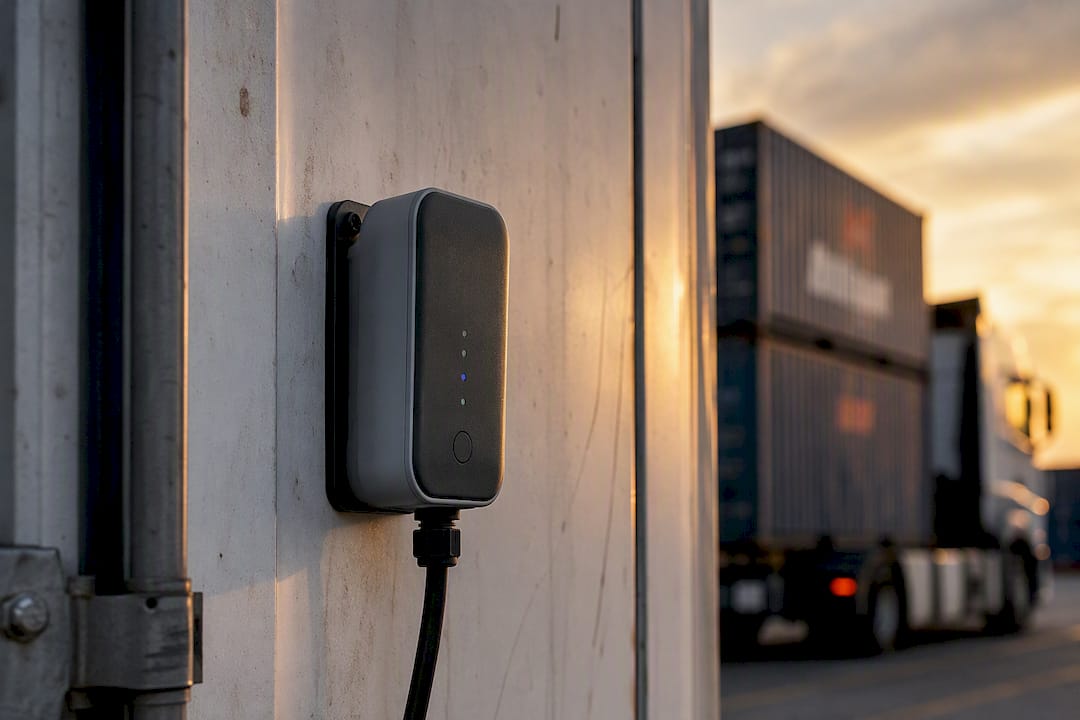
Reefer temperature monitoring today means continuous, timestamped telematics plus independent calibrated sensors, not clipboard checks at the depot gate. The recommended standard combines active telemetry with a sensor package that isn’t dependent solely on the reefer unit’s own controller readings. This pairing catches problems the reefer’s internal thermostat can miss, because continuous cloud-based telemetry flags threshold breaches the moment they happen rather than hours later at delivery.
Get this right and the payoff is immediate: fewer spoilage write-offs, audit-ready records for every trip, and corrective action that happens in minutes rather than after a customer complaint.
A production-grade system should give you:
- Real-time alerts pushed to dispatch and drivers, not just stored logs
- Geofenced arrival and departure timestamps for proof of delivery
- Offline logging that keeps recording when a trailer is unhooked or out of signal range
- Door-open and humidity data alongside core temperature readings
TL;DR:
- Using real-time telematics with calibrated sensors improves detection of temperature breaches by flagging threshold breaches instantly rather than hours later.
- Independent sensors with at least 0.1°C resolution are essential for high-value cargo, as reefer controllers measure air near the evaporator, not the entire load.
- Proper probe placement in cargo zones, not airflow paths, significantly reduces false alarms caused by sensor misplacement or physical damage.
- Establishing clearly defined alert ownership and response protocols before deployment ensures rapid action and minimizes spoilage or liability.
- Continuous monitoring across port-to-door moves, combined with geofencing and timestamped logs, closes critical cold chain gaps during handoff points.
Table of Contents
- What is reefer temperature monitoring and how does it work?
- Which monitoring features actually protect cold chain integrity?
- How should you evaluate a monitoring solution for your fleet?
- How do you implement reefer monitoring without generating false alarms?
- What does the monitoring workflow look like day to day?
- Why do reefer alarms fire when nothing is actually wrong?
- How does Jagelo Haulage apply monitoring across port-to-door moves?
- Key Takeaways
- What logistics teams get wrong about reefer monitoring
- Sources
What is reefer temperature monitoring and how does it work?
A monitoring system has four working parts: sensors inside the trailer, a gateway that transmits the readings, a cloud platform that stores and analyses them, and a reporting layer that turns raw data into something an auditor or customer can read. Sampling frequency matters more than most buyers realise. A five-minute interval catches a compressor fault long before a thirty-minute interval would, and transmission typically runs over cellular networks with satellite as a backup for dead zones on long-haul routes.
Three broad system types exist:
- Manual checks — periodic readings logged by hand, still common but offering no continuous record and no alerting.
- Data loggers — devices ranging from single-use NFC recorders to reusable units that capture readings but often require manual download at journey’s end.
- Real-time telematics — continuous transmission with live alerts, the standard for regulated cargo and multi-stop routes.
Most fleets moving food or pharmaceutical freight have already moved past loggers into the third category, largely because regulated supply chains now expect continuous, timestamped records rather than a spot-check history.
Which monitoring features actually protect cold chain integrity?
Procurement teams often default to whatever the reefer manufacturer bundles in. That’s a mistake for higher-risk cargo. Set a clear specification before you talk to any supplier.
- Sensor accuracy and resolution. Manufacturers recommend independent calibrated sensors with resolution of at least 0.1°C for high-value or sensitive freight, because a reefer’s built-in controller measures return air near the evaporator, not conditions at the back of a fully loaded trailer.
- Alert configuration. Thresholds need to trigger a notification chain, not just a dashboard flag. Dispatch, the driver, and a duty manager should all receive an alert within minutes of a breach.
- Door and humidity monitoring. A door left open for ninety seconds at a delivery stop can undo an hour of careful temperature control on chilled produce; humidity sensors matter for controlled-atmosphere loads like bananas or leafy greens.
- Geofencing and event logs. Automated, timestamped arrival and departure records remove the argument over when a trailer actually reached a site.
Unit manufacturers back strong claims on accuracy: Thermo King documents refrigeration unit precision as tight as ±0.25°C in chilled mode and ±1°C in frozen mode on its advanced units, though that figure describes the unit’s own control loop, not necessarily what an independent probe reads three metres further back.
How should you evaluate a monitoring solution for your fleet?
Match the specification to what you actually haul. A fleet running frozen seafood needs a different probe count and alert sensitivity than one moving ambient-tolerant pharmaceuticals with a wide excursion window. Start by mapping cargo risk, then work outward to the technical requirements.
- Sensor count and placement should reflect load density; a fully packed trailer needs probes in more than one zone to catch hot spots away from the airflow path.
- Integration with your existing telematics, GPS tracking platform, TMS and ELD stack avoids a second dashboard nobody checks. Platforms like Carrier’s TripLINK also offer two-way control, letting fleet managers adjust setpoints remotely rather than waiting for the next stop.
- Durability matters more than spec sheets suggest: confirm the IP rating for washdown environments, battery life on unhooked trailers, and whether the gateway survives a cold-store forklift knock.
- Reporting format should output audit-ready CSV or PDF records without a manual export step.
Pro Tip: Ask any supplier for a sample report before you sign anything. If it takes their support team more than a day to generate one, your drivers will struggle with it in the field.
Total cost of ownership includes far more than hardware price. Factor in data plan fees, calibration servicing, and the support contract’s response time for a failed sensor mid-route.
How do you implement reefer monitoring without generating false alarms?
Poor probe placement is the single biggest cause of nuisance alerts. Fix the fundamentals before blaming the hardware.
- Place probes in cargo zones, not airflow paths. A sensor mounted directly in the discharge air will read colder than the actual product temperature.
- Set sampling intervals to match trip risk. Five-minute intervals suit short chilled runs; longer frozen hauls can tolerate ten to fifteen minutes without losing meaningful detection.
- Plan for power on unhooked trailers. Solar-assisted gateways and long-life batteries keep offline logging running during yard dwell or ferry crossings; AC standby covers extended depot storage.
- Validate pre-cool remotely before dispatch. Confirm the trailer has reached setpoint from the dashboard, not from a driver’s word at the gate.
Pro Tip: For high-value loads, deploy two independent probes in separate cargo zones. A single sensor near the door tells you nothing about what’s happening at the nose of the trailer.
What does the monitoring workflow look like day to day?
Good hardware means little without a defined response process. Build the workflow before the alert ever fires.
- An alert reaching only a dashboard, with no named owner, is functionally the same as no alert.
- Geofencing should automate arrival and departure logging so nobody has to phone in a timestamp.
- Every delivery should generate a timestamped verification report, packaged for the customer or auditor without manual formatting.
- When a breach occurs mid-route, the monitoring record becomes the evidence base for any liability discussion or insurance claim, so retention and export speed both matter.
A documented cold chain process that ties monitoring data directly to your compliance checklist saves hours when a customer disputes a delivery temperature weeks after the fact.
Why do reefer alarms fire when nothing is actually wrong?
Most false alarms trace back to maintenance gaps rather than genuine equipment failure.
- Calibration drift creeps in gradually; schedule sensor checks on a fixed interval rather than waiting for a complaint.
- Physical damage to cabling or housings is common in washdown environments, so confirm IP rating and cable routing during installation, not after a fault.
- Mode confusion causes needless panic: a unit cycling into null mode during defrost is normal behaviour, not a failure, and manufacturer controller documentation explains exactly how cool, heat and null modes should read on a dashboard.
- Loading errors — blocked airflow channels, cargo stacked against the bulkhead, or a poor door seal — generate more nuisance alerts than any sensor fault.
How does Jagelo Haulage apply monitoring across port-to-door moves?
Reefer monitoring only earns its keep when it’s built into the handoffs that actually happen on a container move, not treated as a bolt-on after the trailer leaves the port. Jhaulage runs a fleet of more than 40 trucks and trailers, each fitted with GPS tracking, across major UK ports including Felixstowe, Tilbury, Southampton and Liverpool.
- Continuous telemetry travels with the container from quay to final delivery, so a temperature record exists across every leg, not just the road portion.
- Port coverage across four major gateways means monitoring continuity survives the handover points where cargo integrity is most often lost.
- GPS and temperature data combine to give geofenced timestamps for refrigerated container haulage, matching arrival records to temperature logs automatically.
Continuous telemetry across the port handoff, not just the road leg, is what actually closes the gap where most cold chain failures happen.
Fleet operators evaluating a pilot programme are welcome to request sample performance data on tracked container moves.
Businesses that need dedicated container haulage with monitoring built into every leg can get in touch through Jhaulage’s container haulage services to discuss port coverage, fleet capacity and pilot terms for refrigerated freight.
Key Takeaways
Reliable reefer temperature monitoring depends on real-time telematics paired with independently calibrated sensors, correct probe placement, and a defined alert response process.
| Point | Details |
|---|---|
| Choose telematics over loggers | Real-time alerts and timestamped logs beat manual checks or download-only data loggers for regulated freight. |
| Specify independent sensors | Require calibrated probes with at least 0.1°C resolution rather than relying solely on the reefer’s own controller. |
| Place probes by cargo zone | Position multiple probes away from airflow paths to avoid false readings on dense or high-value loads. |
| Build the alert workflow first | Define who owns each alert and the expected response time before deploying any hardware. |
| Plan for unhooked power | Use solar gateways or long-life batteries so logging continues during yard dwell or ferry legs. |
What logistics teams get wrong about reefer monitoring
Most fleets treat reefer monitoring as a hardware decision. It isn’t. The sensor and gateway matter, but the article’s own evidence points somewhere else: the gap between a good system and a wasted one is almost always the workflow around it, not the equipment inside the trailer.
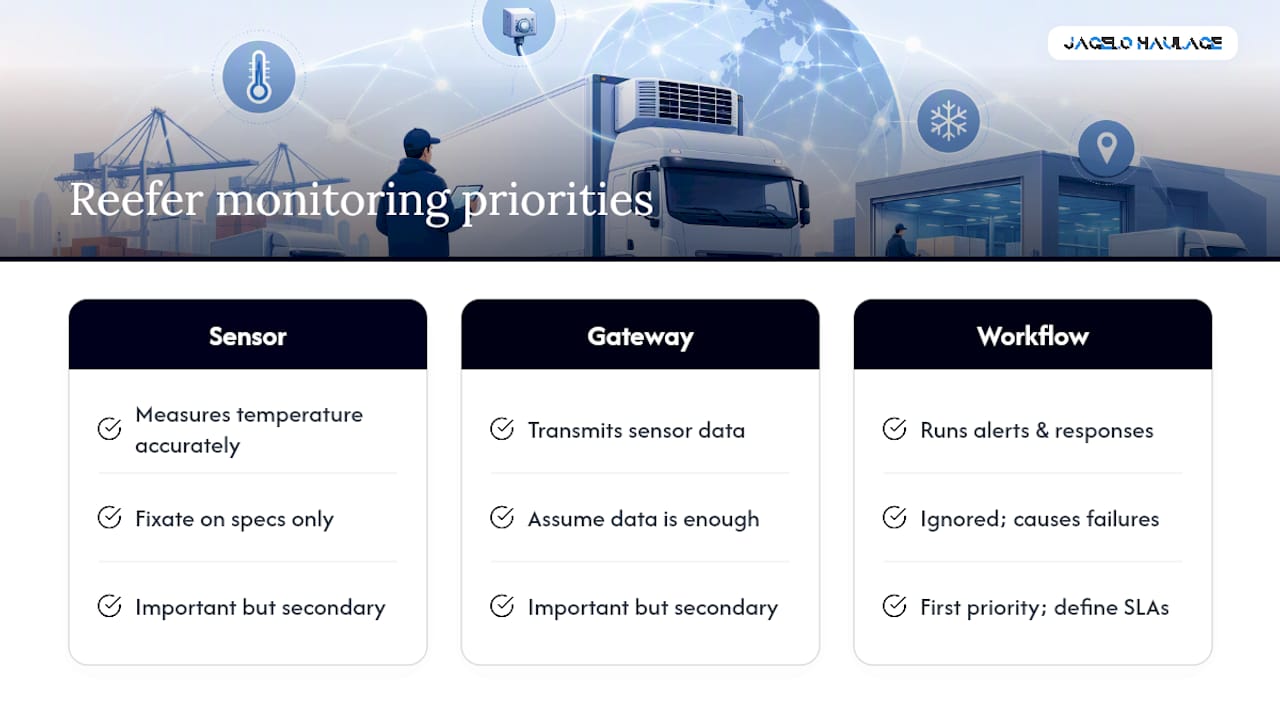
Conventional advice tends to fixate on accuracy specifications, and manufacturer figures like ±0.25°C sound impressive on a data sheet. But a beautifully accurate sensor reading straight into a dashboard nobody checks at 2am delivers nothing. The pilot programmes that actually succeed define alert ownership and response SLAs before a single trailer rolls, then validate the technology against those operational KPIs, not the other way round.
If you’re prioritising one thing first, prioritise the escalation path. Get that wrong and even the best telemetry on the market just produces a very precise record of a problem nobody caught in time.
— Vytautas
Sources
- Reefer trailer temperature monitoring: How it works and benefits | Geotab
- Thermo King launches new container fresh & frozen (CFF)
- Temperature monitoring sensors | Rees Scientific