What is cold chain logistics: a professional guide

Cold chain logistics is the end-to-end management system for storing and transporting temperature-sensitive goods within controlled environments, maintaining product integrity from origin to final delivery. Pharmaceuticals, vaccines, fresh produce, and certain industrial chemicals all depend on this unbroken chain of refrigeration, spanning production, cold storage, transport, and distribution. A single failure at any link, whether a loading dock delay or a malfunctioning reefer unit, can compromise product safety and regulatory compliance. For supply chain managers, understanding the mechanics of cold chain management is not optional. It is the foundation of safe, compliant, and commercially sound temperature-controlled logistics.
What is cold chain logistics and how does it work?
Cold chain logistics is defined as the continuous, temperature-controlled supply chain designed to preserve perishable and temperature-sensitive goods from the point of manufacture through to the end consumer. The system encompasses refrigerated warehousing, specialised transport vehicles, monitoring equipment, and the documentation frameworks that prove compliance at every stage. Unlike standard freight, cold chain cargo requires active environmental control throughout transit, not just at storage points.
The operational sequence follows a clear pattern. Goods leave a temperature-controlled production or storage facility, are loaded into a pre-conditioned vehicle or container, transported under continuous monitoring, and received into a compliant storage environment at the destination. Each handoff point, including port terminals, distribution centres, and last-mile delivery, represents a potential vulnerability. The end goal of cold chain is environmental condition control across every stage while product passes through multiple parties.
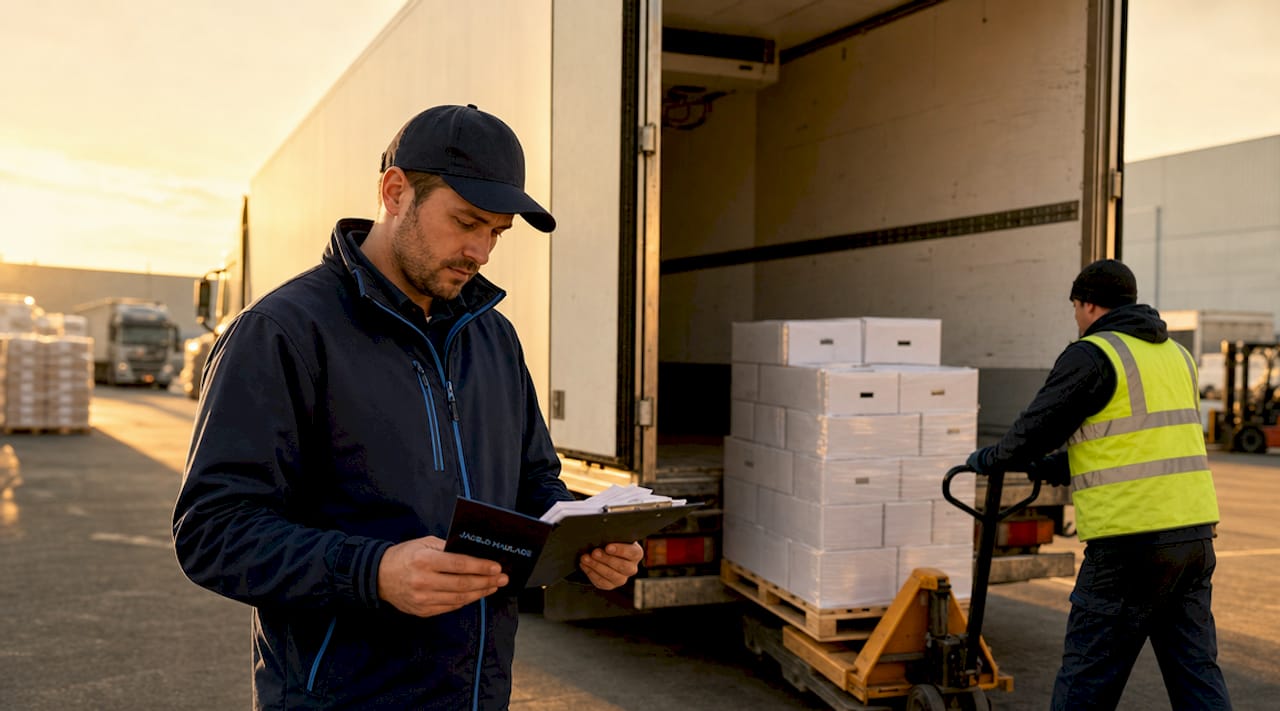
A common misconception among logistics professionals is that booking a refrigerated truck constitutes a complete cold chain solution. True cold chain requires a continuous, unbroken sequence of temperature control from production through delivery. A reefer vehicle is one component of that system, not the system itself.
What temperature ranges and product types define cold chain?
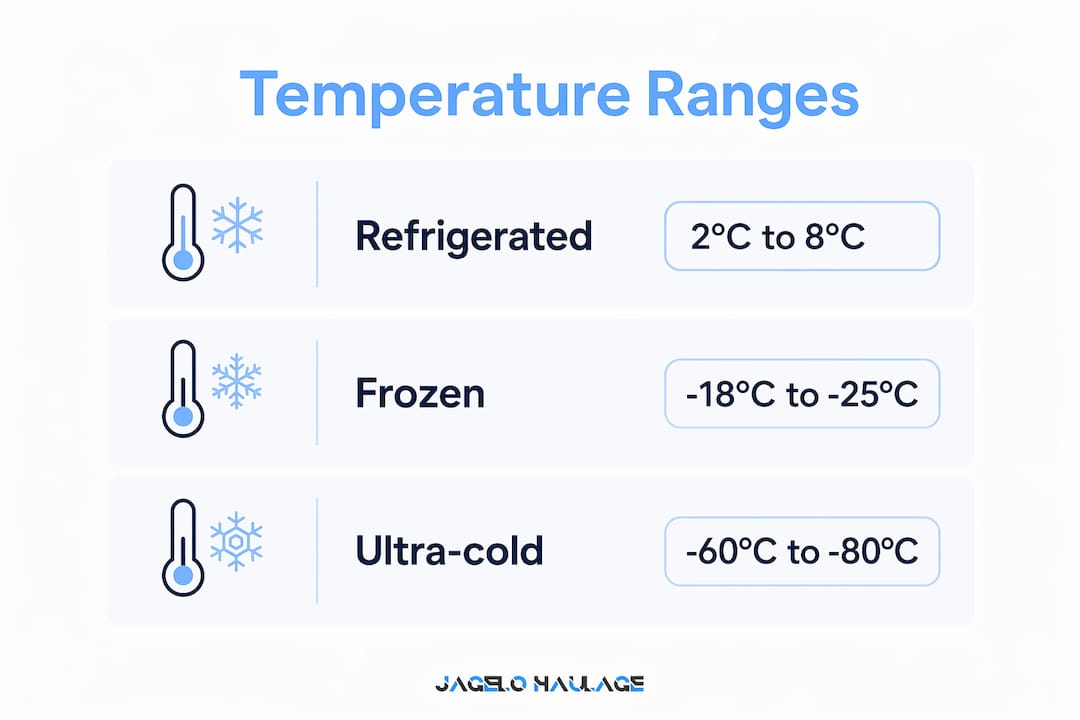
Temperature-controlled logistics operates across three primary bands, each corresponding to specific product categories and regulatory requirements. Understanding these distinctions is fundamental to specifying the correct equipment and documentation for any given shipment.
| Temperature band | Range | Typical products |
|---|---|---|
| Refrigerated / chilled | +2°C to +8°C | Vaccines, dairy, fresh produce, certain biologics |
| Frozen | -18°C to 0°C | Frozen food, some pharmaceuticals, ice cream |
| Ultra-cold | Below -60°C | mRNA vaccines, certain biotech compounds |
These temperature bands by product type are not interchangeable. Storing a vaccine at -5°C when it requires +2°C to +8°C renders it non-compliant and potentially unsafe, regardless of how well the rest of the chain was managed. Ultra-cold requirements, which became widely discussed during the distribution of mRNA vaccines, demand specialised dry-ice packaging or cryogenic containers that most standard reefer fleets cannot accommodate.
The distinction between cold chain and broader temperature-controlled logistics is worth clarifying. Temperature-controlled logistics is the wider category, covering any shipment where environmental conditions are managed. Cold chain is the specific, documented, and validated subset where an unbroken record of compliance must accompany the goods. Not every temperature-sensitive shipment requires full cold chain protocols, but pharmaceuticals, biologics, and regulated food products almost always do.
Key product categories requiring cold chain management include:
- Pharmaceuticals and biologics: insulin, vaccines, blood products, and monoclonal antibodies
- Fresh and processed food: meat, fish, dairy, ready meals, and fresh fruit
- Industrial chemicals: certain reagents and laboratory samples with strict stability requirements
- Cosmetics and personal care: some formulations degrade above +25°C
How does technology support cold chain monitoring and compliance?
Continuous temperature monitoring is the technical backbone of any compliant cold chain operation. Data loggers produce a shipment thermal record from pickup to delivery, providing the audit trail required under Good Distribution Practice (GDP) and supporting dispute resolution when excursions occur. Without this record, even a shipment that remained within range throughout transit cannot be proven compliant.
Modern cold chain systems extend well beyond basic data loggers. Advanced fleet telematics now provide two-way microprocessor interfacing, delivering real-time data on vehicle location, refrigeration unit operating modes, temperature readings, and door sensor events. This means a transport manager can identify a door-open event at a loading bay in real time, rather than discovering the excursion on a post-delivery report. For real-time shipment tracking, this level of visibility is now considered standard practice in professional cold chain operations.
The monitoring technology stack for a compliant cold chain operation typically includes:
- Calibrated data loggers: positioned at multiple points within the load, not just at the refrigeration unit sensor
- Fleet telematics systems: integrating GPS, refrigeration unit interface, and door sensors into a single dashboard
- Cloud-based data platforms: enabling remote access to thermal records and automated excursion alerts
- Pre-trip temperature mapping: validating that the vehicle or container achieves and maintains the required range before loading
GDP compliance requires not just devices but the associated documentation trail. A temperature record with gaps, uncalibrated sensors, or missing chain-of-custody documentation can cause a shipment to fail regulatory review even if the actual temperatures were acceptable throughout.
Pro Tip: Position data loggers at the warmest point within the load, typically near the doors or at the top of the stack, not adjacent to the refrigeration unit. This gives you the most conservative and defensible thermal record.
What are the critical regulatory and best practice standards in cold chain management?
Regulatory frameworks for cold chain management vary by jurisdiction and product type, but GDP provides the most widely applied international standard for pharmaceutical cold chains. GDP requires documented evidence of temperature control, validated equipment, trained personnel, and defined procedures for managing excursions. Compliance is not a one-time certification but an ongoing operational discipline.
The vaccine cold chain offers one of the most precisely defined regulatory examples. Under Victoria, Australia’s ‘Strive for 5’ standard, vaccines must be maintained between +2°C and +8°C, with short fluctuations up to +12°C permitted for under 15 minutes. All breaches must be reported to the relevant health authority. This level of specificity illustrates the direction of travel for regulated cold chains globally: measurable thresholds, mandatory reporting, and no room for subjective judgement.
Best practice cold chain management follows a structured compliance hierarchy:
- Define breach thresholds explicitly: specify the temperature range, the maximum permitted excursion duration, and the reporting trigger for each product type
- Align SOPs with jurisdictional rules: breach reporting workflows must reflect product-label requirements and local regulations, not generic industry defaults
- Document every handoff: each transfer of custody, from manufacturer to freight forwarder to haulier to consignee, must be recorded with a corresponding temperature snapshot
- Train all personnel on excursion response: drivers, warehouse operatives, and logistics coordinators must know the escalation procedure before an incident occurs
“Explicit breach definitions and reporting protocols focus teams on objective thresholds, improving cold chain management outcomes by avoiding subjective judgements.” — health.vic.gov.au
The practical implication for supply chain managers is that SOPs must be product-specific and jurisdiction-aware. A generic cold chain procedure that does not account for the difference between a short fluctuation allowance and a full breach will create compliance risk at precisely the moment it matters most.
What operational challenges and common pitfalls affect cold chain logistics?
The most persistent operational challenge in cold chain logistics is the gap between nominal setpoints and actual temperature profiles. Thermal mapping and validation are critical because a refrigeration unit set to +4°C does not guarantee that every point within the load experiences +4°C. Door-open events, uneven loading patterns, and delays at port terminals all create localised excursions that the unit’s own sensor will not detect.
The loading and unloading stages represent the highest-risk points in the cold chain. A pre-conditioned reefer vehicle can absorb significant heat gain during a prolonged loading dock wait, particularly in summer conditions at busy UK ports such as Felixstowe or Tilbury. Cold chain continuity is only as strong as the weakest link, and that link is frequently not the transport leg but the transition points before and after it.
Common operational pitfalls that supply chain managers should address proactively include:
- Trusting setpoints over measured data: always validate actual load temperatures against the refrigeration unit’s nominal setting before departure
- Inadequate pre-conditioning: loading warm product into a cold vehicle, or loading into a vehicle that has not reached the target temperature, creates an excursion from the first minute of transit
- Poor route planning: extended dwell times at ports or customs hold points can exceed excursion tolerances, particularly for chilled products with narrow temperature bands
- Insufficient driver training: driver behaviour at delivery points, including door management and handoff procedures, directly affects cold chain integrity
Pro Tip: Build a container transport checklist that includes a pre-departure temperature verification step, requiring the driver to record the actual load temperature, not just the unit setpoint, before leaving the collection point.
Scheduling discipline also plays a significant role. Efficient container delivery scheduling reduces dwell time at handoff points and minimises the window during which the cold chain is most exposed. For pharmaceutical and vaccine shipments, pre-agreed delivery windows with receiving facilities are not a courtesy. They are a compliance requirement.
Key takeaways
Effective cold chain logistics requires an unbroken sequence of temperature control, validated monitoring, and complete documentation at every stage from production to final delivery.
| Point | Details |
|---|---|
| Definition and scope | Cold chain logistics covers refrigerated production, storage, transport, and delivery within validated temperature bands. |
| Temperature bands matter | Refrigerated (+2°C to +8°C), frozen (-18°C to 0°C), and ultra-cold (below -60°C) each require distinct equipment and protocols. |
| Technology is non-negotiable | Data loggers, fleet telematics, and cloud platforms provide the thermal records required for GDP compliance and dispute resolution. |
| Regulatory specificity | SOPs must align with product-label requirements and jurisdictional rules, not generic cold chain defaults. |
| Weakest link principle | Loading docks, handoff points, and last-mile delivery are higher-risk than the transport leg itself. |
Cold chain logistics: what I have learned from the ground up
Having worked closely with container haulage operations across UK ports for a number of years, the observation that stands out most clearly is this: the majority of cold chain failures are documentation failures, not temperature failures. The product often stayed within range. The record did not prove it.
Supply chain managers frequently invest heavily in refrigeration equipment and then underinvest in the monitoring and documentation infrastructure that makes that equipment’s performance provable. GDP does not ask whether your reefer unit is capable. It asks whether you can demonstrate, with a calibrated and continuous record, that the required conditions were maintained. Those are different questions with different answers.
The other misconception I encounter regularly is the conflation of refrigerated haulage with full cold chain management. Booking a refrigerated container haulage service is a necessary step. It is not a sufficient one. The haulier controls the transport leg. The shipper, freight forwarder, and consignee are jointly responsible for the integrity of every other stage. Assigning cold chain responsibility entirely to the carrier is a governance gap that regulators and insurers will both identify.
My practical recommendation is to treat cold chain management as two parallel workstreams: physical temperature control and documentary compliance. Both must be planned, resourced, and audited independently. When they are managed as a single process, the documentation element almost always receives less attention, and that is where regulatory exposure accumulates.
— Vytautas
How Jhaulage supports cold chain logistics in the UK
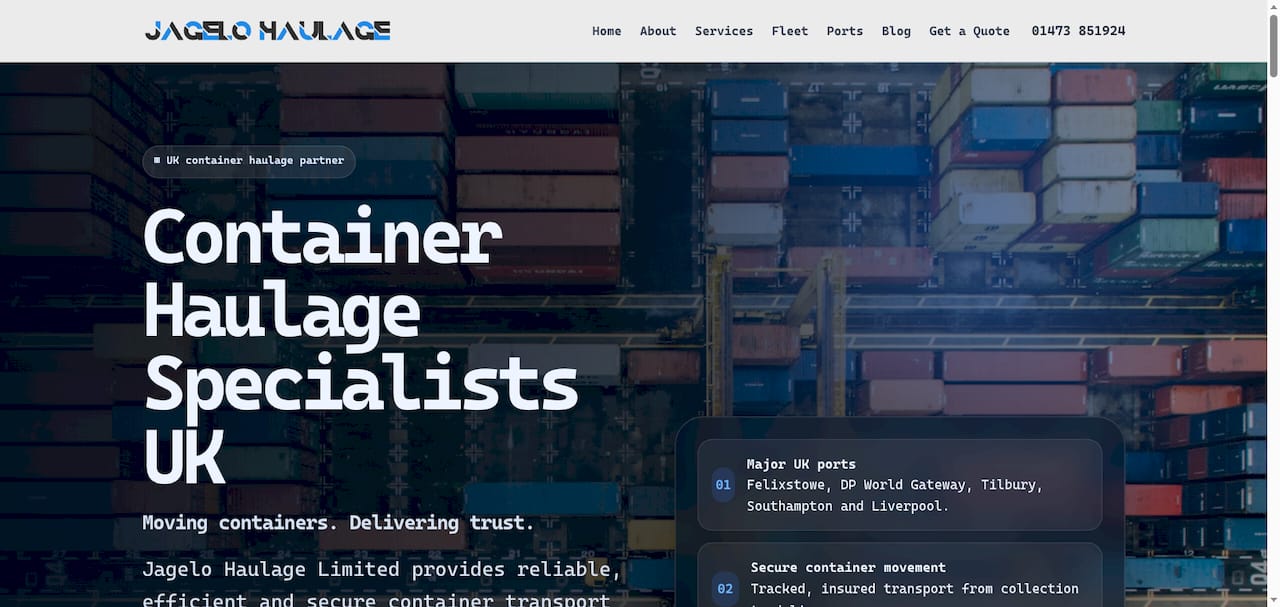
Jhaulage operates as a specialist container haulage provider across major UK ports including Felixstowe, Tilbury, Southampton, and Liverpool, with a fleet of over 40 GPS-tracked vehicles equipped for temperature-sensitive freight movements. For logistics managers handling refrigerated or frozen container shipments, Jhaulage provides the port-to-door transport capability, real-time tracking visibility, and 24/7 operational support that cold chain compliance demands. If your supply chain includes temperature-controlled container movements through UK ports, contact Jhaulage to discuss how our haulage services can be integrated into your cold chain solution.
FAQ
What is cold chain logistics in simple terms?
Cold chain logistics is the system for transporting and storing temperature-sensitive goods, such as vaccines, food, and pharmaceuticals, within a controlled temperature range from origin to delivery. The chain must remain unbroken at every stage to preserve product safety and regulatory compliance.
What temperature ranges are used in cold chain logistics?
The three standard bands are refrigerated (+2°C to +8°C), frozen (-18°C to 0°C), and ultra-cold (below -60°C), each corresponding to specific product types and regulatory requirements.
What is the difference between cold chain and temperature-controlled logistics?
Temperature-controlled logistics is the broader category covering any shipment where environmental conditions are managed. Cold chain is the validated, documented subset where an unbroken compliance record must accompany the goods throughout every stage of the supply chain.
How does GDP apply to cold chain management?
Good Distribution Practice requires continuous temperature monitoring, calibrated equipment, trained personnel, and a complete audit-ready documentation trail. A shipment can fail GDP review even if temperatures were maintained, if the supporting records are incomplete or uncalibrated.
What causes most cold chain failures in practice?
The most common causes are temperature excursions at loading and unloading points, inadequate pre-conditioning of vehicles, poor route planning that extends dwell times, and insufficient documentation rather than outright refrigeration failure during transit.