What is logistics outsourcing? A 2026 guide
Logistics outsourcing is defined as the practice of delegating logistics functions, including transportation, warehousing, inventory management, and order fulfilment, to specialised third-party providers (3PLs) in order to reduce costs and improve operational efficiency. According to a GXO industry survey, 88% of companies already outsource some part of their logistics operations, with 73% outsourcing transportation and 61% outsourcing warehousing. This level of adoption reflects a fundamental shift: logistics outsourcing is no longer a fringe cost-cutting measure but a core supply chain strategy for businesses of every scale. For UK supply chain managers and business owners, understanding how outsourcing works, what it covers, and how to govern it effectively is the difference between a supply chain that performs and one that costs you money.
What is logistics outsourcing and what services does it include?
Logistics outsourcing, also referred to in industry practice as third-party logistics (3PL) management or supply chain outsourcing, covers a broad spectrum of services that external providers deliver on a client’s behalf. The scope varies considerably depending on business size, sector, and supply chain complexity, but the core service categories are consistent across most engagements.
Common logistics outsourcing services include:
- Transportation management: Road, rail, sea, and air freight coordination, including carrier selection, route optimisation, and freight audit.
- Warehousing and distribution: Storage, pick-and-pack operations, cross-docking, and last-mile delivery management.
- Inventory management: Stock replenishment, demand forecasting, and cycle counting to maintain accuracy.
- Customs clearance and compliance: Import/export documentation, duty management, and regulatory adherence at ports such as Felixstowe, Tilbury, and Southampton.
- Value-added services: Kitting, labelling, returns processing, and product configuration prior to distribution.
Technology is central to how modern 3PLs deliver these services. Providers deploy Warehouse Management Systems (WMS), Transport Management Systems (TMS), and real-time cargo tracking platforms to give clients operational visibility tools that most individual businesses could not afford to build independently. This technology layer also enables demand forecasting, workforce scheduling, and compliance reporting, all of which reduce the administrative burden on your internal team.
Scalability is one of the most practical advantages of this model. A 3PL can absorb volume surges during peak trading periods, such as Q4 retail demand or post-port-congestion backlogs, without requiring you to hire permanent staff or lease additional warehouse space. The provider’s existing infrastructure and workforce absorb the fluctuation, and your cost base adjusts accordingly.

Pro Tip: When scoping logistics outsourcing services, map your current logistics cost per unit across each function before approaching providers. This baseline gives you a precise benchmark for evaluating proposals and prevents you from accepting a contract that looks cheaper on paper but underperforms on service levels.
What are the main benefits and challenges of logistics outsourcing?
The benefits of logistics outsourcing are well-documented and quantifiable. A GXO survey from July 2025 found that 43% of logistics outsourcing users cite improved efficiency and productivity as the primary benefit, while 41% identify cost reduction as the key driver. These two outcomes are not independent: efficiency gains directly reduce cost per order, cost per shipment, and cost per unit stored.
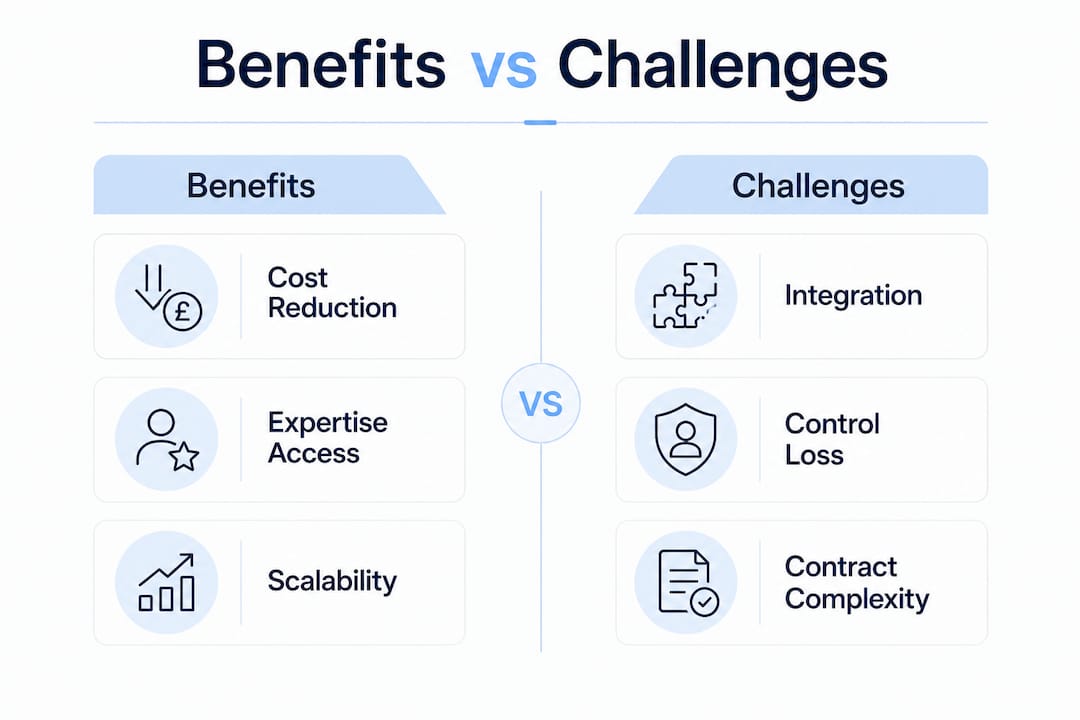
Beyond cost and efficiency, outsourcing delivers access to specialist expertise and technology that would take years and significant capital to develop in-house. 3PLs invest continuously in automation, data analytics, and compliance infrastructure because logistics is their core business. For a manufacturer or retailer, replicating that capability internally is rarely justifiable.
However, logistics outsourcing carries genuine challenges that must be managed with discipline.
| Factor | Benefit | Challenge |
|---|---|---|
| Cost structure | Converts fixed logistics costs to variable, reducing overhead | Contract pricing complexity can obscure true total cost |
| Technology access | Immediate access to WMS, TMS, and tracking platforms | Integration with existing ERP or order management systems requires careful planning |
| Scalability | Provider absorbs volume peaks without capital investment | Over-reliance on one provider creates single-point-of-failure risk |
| Expertise | Access to specialist knowledge in customs, compliance, and carrier management | Cultural and operational misalignment between client and provider can erode service quality |
| Focus | Internal teams freed to concentrate on core business activities | Loss of direct control over logistics execution and customer experience |
The integration challenge deserves particular attention. Connecting a 3PL’s systems to your own ERP, e-commerce platform, or order management system is rarely plug-and-play. Data feeds, API connections, and compliance workflows all require structured setup time. Poorly managed integration is the most common reason outsourcing engagements underperform in their first year.
Pro Tip: Address common misconceptions about outsourced logistics early in your evaluation process. Reviewing resources that dispel outsourcing myths for UK logistics managers can prevent misaligned expectations before you sign a contract.
How do logistics outsourcing contracts and governance work?
Contract structure is where logistics outsourcing either succeeds or fails in practice. Most professional outsourcing engagements use a multi-year base contract with option years, giving both parties stability while preserving the client’s ability to renegotiate or exit at defined intervals. A well-structured contract defines not just price, but service scope, performance standards, escalation procedures, and transition obligations.
The US Department of Defense USTRANSCOM contract model illustrates a disciplined approach: a 45-day phase-in period is built into the contract start to allow systems integration, staffing, and compliance workflows to be established before full operational handover. This phased implementation model is directly applicable to commercial logistics contracts and significantly reduces the risk of service disruption during transition.
The table below outlines the key governance elements that should appear in any logistics outsourcing contract:
| Contract element | Purpose |
|---|---|
| Phase-in period (typically 30 to 60 days) | Allows systems integration, data feed setup, and staff onboarding before live operations begin |
| Key Performance Indicators (KPIs) | Defines measurable targets for order accuracy, cycle times, on-time delivery, and inventory accuracy |
| Service Level Agreements (SLAs) | Sets minimum acceptable performance thresholds with defined remedies for non-compliance |
| Escalation and dispute resolution | Establishes a structured process for resolving performance failures without contract termination |
| Exit and transition obligations | Specifies data handover, asset return, and knowledge transfer requirements at contract end |
At scale, the importance of this governance framework becomes even more apparent. ONGC’s decision to outsource $600 million in western offshore supply chain operations under a 3 to 5 year contract demonstrates that even the most complex, high-value logistics engagements rely on the same foundational governance principles: defined scope, measurable KPIs, and structured transition periods.
KPI selection is a discipline in itself. Cycle time, order accuracy rate, inventory shrinkage, and demurrage avoidance are the metrics that most directly reflect logistics performance. Tracking these consistently through a shared reporting platform, rather than relying on periodic provider reports, gives you the operational visibility needed to manage the relationship proactively.
How to approach logistics outsourcing strategically
Treating logistics outsourcing as a purely transactional cost-reduction exercise is the single most common strategic error businesses make. Argon & Co’s 2025 strategic guide positions outsourcing as a capability partnership encompassing digital transformation, not simply a mechanism for reducing headcount or warehouse spend. This reframing changes how you select providers, structure contracts, and measure success.
A structured approach to logistics outsourcing follows these steps:
- Conduct a logistics audit. Map your current logistics costs, service performance, and technology gaps across every function. Identify which activities are genuinely non-core and which require specialist capability you do not currently possess.
- Define your operating model. Determine whether you need a single integrated 3PL partner or a multi-provider model with separate specialists for transportation, warehousing, and customs. Multi-provider models offer resilience but require more governance overhead.
- Align procurement and operations. Successful outsourcing requires alignment between your procurement team, who negotiate the contract, and your operations team, who will live with the service delivery. Disconnects between these two functions produce contracts that look good commercially but fail operationally.
- Evaluate providers on capability, not just price. Assess technology infrastructure, sector experience, port coverage, and financial stability. For UK container movements, a provider’s access to ports such as Felixstowe, Tilbury, and Liverpool is a practical differentiator. Guidance on selecting a reliable haulier provides a useful framework for this evaluation.
- Plan the integration in detail. Define data exchange requirements, API connections, and reporting structures before contract signature. Build the phase-in period into your project plan and assign internal ownership for integration delivery.
- Establish ongoing performance governance. Schedule regular operational reviews, agree on a shared KPI dashboard, and define the escalation path for service failures. Performance management is not a contract clause; it is an ongoing operational discipline.
Supply chain resilience and digital integration are the two factors that will define outsourcing success in 2026 and beyond. Providers who offer real-time cargo tracking, predictive analytics, and multi-modal flexibility give you the operational agility to respond to port disruptions, demand shifts, and regulatory changes without rebuilding your logistics model from scratch. Reviewing fleet management best practices alongside your outsourcing strategy helps ensure the operational standards you expect from providers align with current industry benchmarks.
Pro Tip: Request a technology demonstration from any shortlisted 3PL before contract signature. Ask specifically how their WMS and TMS integrate with your existing systems, and request a sample of the KPI reporting you will receive. The quality of that demonstration tells you more about operational capability than any sales presentation.
Key takeaways
Logistics outsourcing delivers measurable cost and efficiency gains only when governed through structured contracts, defined KPIs, and disciplined systems integration from day one.
| Point | Details |
|---|---|
| Outsourcing adoption is widespread | 88% of companies outsource some logistics function, making it a standard supply chain practice. |
| Services span the full supply chain | 3PLs cover transportation, warehousing, customs clearance, inventory, and value-added services. |
| Benefits are quantifiable | 43% of users cite efficiency gains and 41% cite cost reduction as primary outcomes. |
| Contract governance is non-negotiable | Phase-in periods, KPIs, and SLAs determine whether an outsourcing engagement succeeds or fails. |
| Strategic alignment drives results | Aligning procurement and operations around an integrated operating model is the critical success factor. |
Why logistics outsourcing is more than a cost lever
From my experience working closely with supply chain managers across the UK freight sector, the businesses that extract the most value from logistics outsourcing are those that treat it as a long-term capability investment rather than a short-term cost exercise. The companies that struggle are almost always those who selected a provider on price alone, skipped the integration planning, and then spent the first six months of the contract managing service failures instead of capturing efficiency gains.
The technology dimension is where I see the sharpest divergence between high-performing and underperforming outsourcing relationships. Providers who offer genuine real-time visibility, predictive demand tools, and structured compliance reporting create a compounding advantage over time. Those who rely on manual reporting and reactive communication erode trust quickly, regardless of how competitive their initial pricing was.
One area that receives insufficient attention in most outsourcing evaluations is cultural and operational fit. A 3PL that excels in fast-moving consumer goods may lack the precision and port-side discipline required for container haulage or industrial supply chains. The operational rhythms, communication cadences, and performance expectations differ significantly across sectors. Investing time in reference checks with existing clients in your specific sector is not due diligence theatre; it is the most reliable predictor of relationship quality.
Looking ahead, sustainability reporting and carbon accounting are becoming contractual requirements in major outsourcing tenders, particularly in the public sector and among large retailers. 3PLs who cannot provide verified emissions data per shipment or per pallet will face growing commercial disadvantage. If your business has sustainability commitments, this criterion belongs in your provider evaluation now, not at the next contract renewal.
— Vytautas
How Jhaulage supports your logistics outsourcing strategy
For businesses managing container movements through UK ports, partnering with a specialist provider is the most direct route to reducing demurrage exposure, improving port-to-door cycle times, and gaining the operational visibility your supply chain requires.
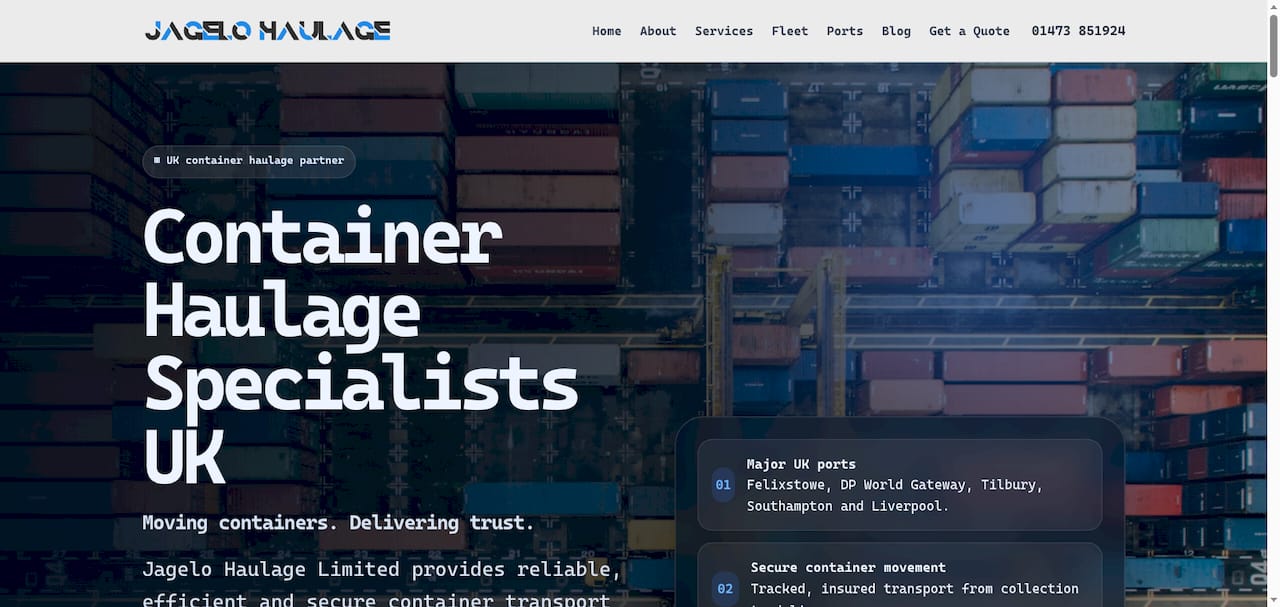
Jhaulage operates a modern fleet of over 40 GPS-tracked trucks and trailers, providing dedicated container haulage services across Felixstowe, Tilbury, Southampton, and Liverpool. With 24/7 support and full container load capability, Jhaulage delivers the precision and reliability that outsourced logistics partnerships demand. Explore container haulage services from Jhaulage to find out how a specialist UK haulier can reduce your logistics costs and improve supply chain performance.
FAQ
What is the logistics outsourcing definition?
Logistics outsourcing is the practice of contracting third-party providers to manage logistics functions such as transportation, warehousing, inventory management, and customs clearance on behalf of a business. It is also referred to as third-party logistics (3PL) management or supply chain outsourcing.
What are the main benefits of logistics outsourcing?
The primary benefits are improved efficiency and cost reduction. A GXO industry survey found that 43% of users cite efficiency and productivity gains as the top benefit, while 41% identify cost reduction, with additional advantages including access to specialist technology and scalable capacity.
How does a logistics outsourcing contract typically work?
Most contracts use a multi-year base structure with option years, defined KPIs, SLAs, and a phase-in period of 30 to 60 days to allow systems integration and operational setup before full service handover begins.
What types of logistics outsourcing are most common?
Transportation outsourcing is the most prevalent, used by 73% of companies, followed by warehousing at 61%, according to GXO survey data. Other common types include inventory management outsourcing, customs clearance, and value-added services such as kitting and returns processing.
Why use logistics outsourcing rather than managing logistics in-house?
Outsourcing converts fixed logistics costs to variable expenditure, provides immediate access to specialist technology and expertise, and allows internal teams to concentrate on core business activities. For businesses without the scale to justify dedicated logistics infrastructure, a 3PL partnership delivers capability that would otherwise be unaffordable.
Recommended
- Logistics fleet management best practices: 2026 guide | Jagelo Haulage
- Outsourced Container Haulage: Dispelling Myths for UK Logistics Managers | Jagelo Haulage
- How to Organise Efficient Container Delivery Scheduling in 2026 | Jagelo Haulage
- Port Logistics Management: A Strategic Framework for UK Container Haulage | Jagelo Haulage